

Human Rights and Responsibilities in Ireland examines how rights are legally defined, protected, and debated on the island of Ireland. This topic covers the core characteristics of human rights, constitutional protections and international treaties regarding education, the statutory equality framework, patterns of diversity across both jurisdictions, state watchdog institutions, and ideological disputes over state intervention and redistribution. It also evaluates the contributions and historical contexts of five prescribed thinkers: John Locke, Robert Nozick, Paulo Freire, Martha Nussbaum, and Kathleen Lynch.
Core Characteristics and Classifications of Human Rights
Human rights are fundamental moral and legal entitlements that belong to every person simply by virtue of being human. Under international human rights law and political philosophy, rights rest on three defining characteristics:
- Universal: Rights belong equally to all human beings everywhere, without distinction based on nationality, gender, ethnicity, religion, or social status.
- Inalienable: Rights belong naturally to every person and cannot be voluntarily surrendered, sold, or taken away. A state can restrict the exercise of a person's liberty through due process following a lawful criminal conviction, but this legal punishment does not destroy their underlying human dignity or fundamental rights.
- Indivisible: All human rights—civil, political, economic, social, and cultural—form an interconnected system of equal importance. No right can be fully enjoyed in isolation. For instance, the democratic right to vote has little practical value if a person is denied basic schooling and cannot read a ballot paper.
Civil and Political versus Economic, Social, and Cultural Rights
Rights are conventionally grouped into two broad streams:
- Civil and Political Rights: Often called first-generation rights, these safeguard individual liberty against arbitrary state overreach and guarantee participation in democratic life. They include the right to life, freedom of expression, freedom of assembly, religious liberty, and the right to a fair trial. While often described as negative rights because they restrain government intrusion, many require positive state action and public funding. For example, a fair trial requires well-funded court systems and legal aid, and the right to vote requires the state to organise nationwide elections.
- Economic, Social, and Cultural Rights: Often called second-generation rights, these focus on social security, material wellbeing, and human flourishing. They include rights to adequate housing, healthcare, fair working conditions, and education. These rights generally require proactive state spending, institutional planning, and public provision.
Operational Levels of Legal Protection
Human rights treaties and domestic legal codes classify rights into three operational tiers based on whether and when authorities may restrict them:
| Tier | Legal Meaning | Named Example |
|---|---|---|
| Absolute Rights | Cannot be restricted, suspended, or balanced against any competing interest under any circumstances, even during a public emergency or war. | Freedom from torture and inhuman or degrading treatment (Article 3, European Convention on Human Rights). |
| Limited Rights | Can be restricted only under specific, narrow circumstances set out explicitly in the law itself. | The right to liberty (Article 5, European Convention on Human Rights), which permits detention following lawful arrest or a judicial sentence. |
| Qualified Rights | Can be balanced against the rights of other citizens or wider public interests such as public health, public safety, or national security. Any restriction must be lawful, necessary, and proportionate. | Freedom of expression and freedom of assembly, which can be restricted by defamation laws or public health regulations. |
Negative Rights, Positive Rights, and State Obligations
The distinction between negative and positive rights outlines the duties placed on governments and public bodies.
- Negative Rights ('freedom from'): These rights require outside actors, particularly the state, to refrain from interfering with individual action. Freedom of conscience, for instance, requires the state to avoid dictating personal religious beliefs. John Locke argued that individuals hold natural rights to life, liberty, and estate that governments exist to protect rather than restrict.
- Positive Rights ('right to'): These rights demand active public intervention, institutional resources, and state expenditure. The right to primary education or medical care cannot exist through government inaction. The state must levy taxes, build infrastructure, and employ qualified professionals.
Rights Holders and Duty Bearers
Every human right creates an enforceable relationship between two distinct entities:
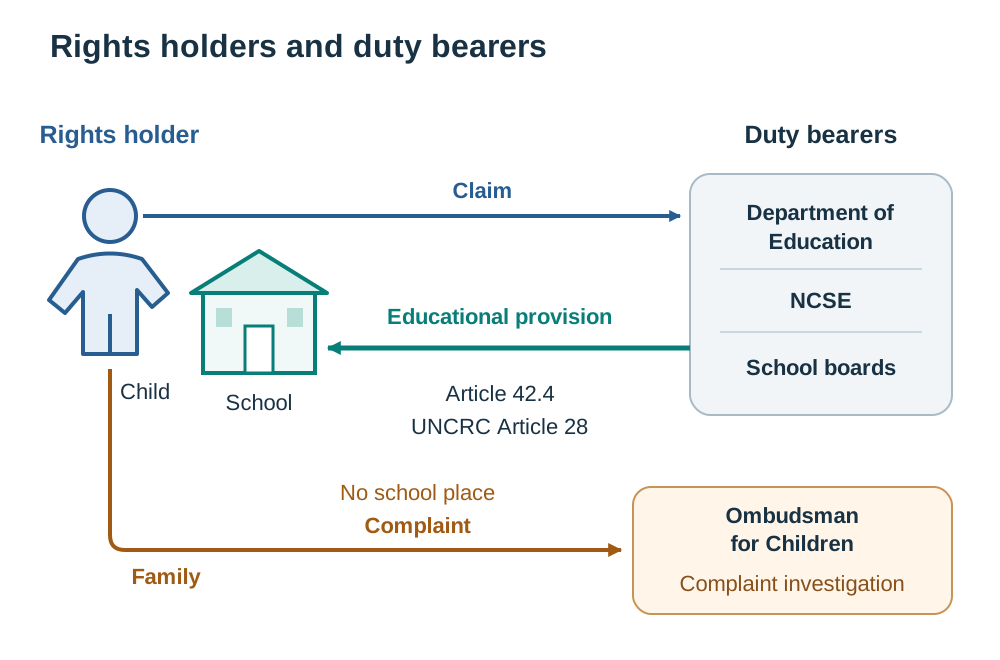
- Rights Holder: The individual or group entitled to claim and exercise the protection (for example, a child residing in Ireland).
- Duty Bearer: The institution or person legally or morally bound to respect, protect, and fulfil that right (primarily the state and its agencies, alongside parents and school boards of management).
Consider an applied scenario: A child with special educational needs in Dublin has no appropriate school place in September. The child is the rights holder. The primary duty bearers are the Department of Education, the National Council for Special Education (NCSE), and local school boards. The rights engaged are free primary education under Bunreacht na hÉireann Article 42.4 and access to education under Article 28 of the UN Convention on the Rights of the Child. If the duty bearers fail to provide a place, the family can lodge an official complaint with the Ombudsman for Children's Office.
Immediate Obligations versus Progressive Realisation
Because states differ in economic resources, international treaties recognise two operational standards of delivery:
- Immediate Obligations: Legal duties that governments must implement straight away without delay, regardless of budgetary constraints. These include non-discrimination in state services and the provision of basic primary schooling.
- Progressive Realisation: Applies to resource-dependent economic, social, and cultural rights. States agree to take continuous, targeted steps to the maximum extent of their available resources to achieve the full enjoyment of these rights over time. Progressive realisation is not a legal loophole for postponement, and deliberate backward steps (retrogression) are not allowed unless the state can fully justify them.
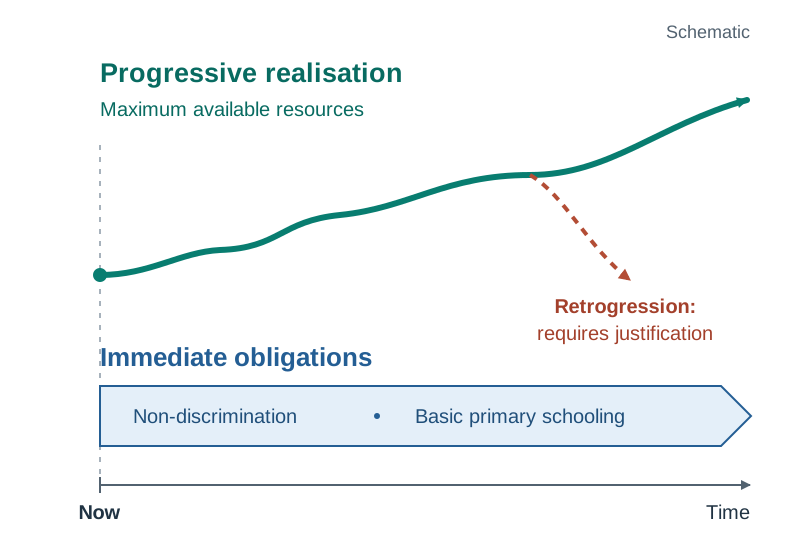
In Ireland, progressive realisation is illustrated by current incremental policy expansions: free primary schoolbooks were introduced in 2023 and extended to junior cycle in 2024, while free GP care was phased in for children under 6 in 2015 and extended to children under 8 in 2023. By contrast, Budget 2012 provided an example of retrogression when the government removed the separate ('ex-quota') allocation for guidance counsellors in second-level schools, disproportionately harming disadvantaged pupils during austerity. While the 1967 introduction of free second-level education by Minister Donogh O'Malley expanded educational access, it predated Ireland's ratification of international human rights covenants and serves as a historical precursor rather than the formal execution of a treaty obligation.
The Right to Education: Bunreacht na hÉireann and International Treaties
Educational entitlements in Ireland are defined by the domestic constitution alongside binding international agreements.
Bunreacht na hÉireann (Articles 42 and 42A)
Bunreacht na hÉireann sets out the rights and duties of parents and the State in education:
- Article 42.1: Acknowledges the Family as the primary and natural educator of the child.
- Article 42.2: Guarantees parental freedom to provide education in homes, private institutions, or state-recognised schools.
- Article 42.3.1°: Prohibits the State from forcing parents to send their children to state-established schools.
- Article 42.3.2°: Mandates that the State, as guardian of the common good, require children to receive a certain minimum education.
- Article 42.4: Places an immediate constitutional obligation on the State to provide for free primary education. This creates an individually enforceable personal right.
- Article 42A (Children): Inserted following the 2012 Children's Referendum and enacted in 2015. It affirms the natural and imprescriptible rights of all children and requires the best interests of the child to be the paramount consideration in child protection, custody, and adoption proceedings, alongside hearing the views of the child.
Key judicial interpretations shape educational rights in Ireland. In O'Donoghue v Minister for Health (1996), the High Court ruled that a child with severe disabilities had a constitutional right to free primary education tailored to his developmental needs. In Sinnott v Minister for Education (2001), the Supreme Court ruled that the constitutional right to free primary education ends at age 18, leaving adults with severe disabilities without a constitutional entitlement to continuing educational provision.
The UN Convention on the Rights of the Child (UNCRC)
The UNCRC (1989) sets out detailed international standards through four overarching guiding principles: non-discrimination (Article 2), the best interests of the child (Article 3), the right to life, survival and development (Article 6), and the right of the child to be heard (Article 12). Its educational articles establish that:
- Article 28 (Access to Education): Free primary education must be compulsory for all. Secondary schooling must be encouraged and accessible, and higher education made accessible based on individual capacity. School discipline must uphold human dignity.
- Article 29 (Aims of Education): Schooling must develop the child's personality, talents, and abilities to their fullest potential. It must prepare young people for responsible life in a free society guided by understanding, peace, tolerance, and human rights.
Relationship Between the UNCRC and the UDHR
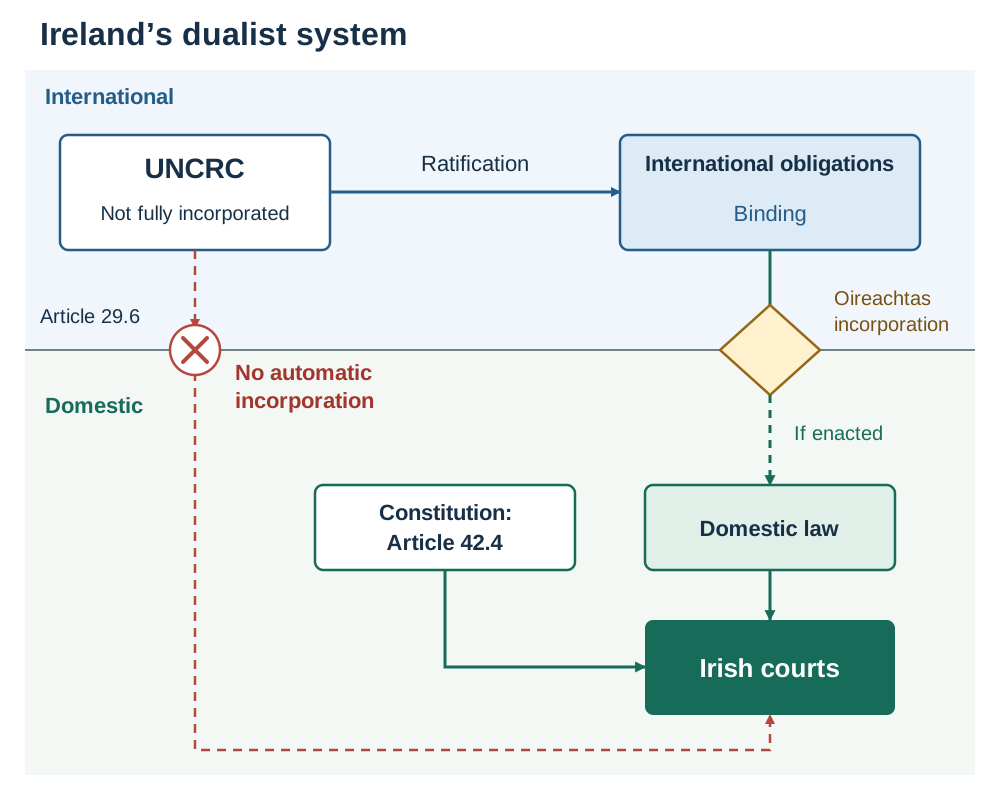
The Universal Declaration of Human Rights (UDHR, 1948) is a non-binding declaration adopted by the UN General Assembly establishing universal standards, including education (Article 26) and special care for childhood (Article 25(2)). Its principles were later codified into two binding 1966 covenants: the ICCPR and the ICESCR. The UNCRC builds directly on this architecture. Unlike the UDHR, the UNCRC is a legally binding convention on states that ratify it. Ireland ratified the UNCRC in 1992 and reports regularly to the UN Committee on the Rights of the Child, which issues evaluative concluding observations.
However, Ireland operates a dualist constitutional system under Article 29.6 of Bunreacht na hÉireann: international treaties signed by the government do not become domestic law unless formally enacted by the Oireachtas. Because the UNCRC has not been fully transposed into domestic statute, an individual cannot directly sue the State in an Irish court relying solely on the text of the UNCRC.
Equality, Non-Discrimination, and Patterns of Diversity on the Island
Human rights require equal standing without discrimination based on birth, status, or identity.
The Irish Statutory Equality Framework
Discrimination is prohibited under two complementary sets of legislation:
- Employment Equality Acts 1998–2021: Outlaw discrimination in the workplace, covering recruitment, equal pay, working conditions, and promotion across nine grounds:
- Gender
- Marital status (the specification's term; Irish law now uses 'civil status' after the Civil Partnership Act 2010)
- Family status
- Sexual orientation
- Religion
- Age
- Disability
- Race (including colour, nationality, or ethnic origin)
- Membership of the Traveller community
- Equal Status Acts 2000–2018: Outlaw discrimination outside employment across the same nine grounds, covering goods, services, accommodation, and educational bodies. In 2016, a housing assistance ground was added, making it unlawful for landlords to refuse accommodation because a tenant receives the Housing Assistance Payment (HAP) or rent supplement. Claims under both Acts are adjudicated by the Workplace Relations Commission (WRC).
Direct versus Indirect Discrimination
- Direct discrimination: Treating a person less favourably than another person is, has been, or would be treated in a comparable situation on any protected ground (for example, refusing service to an individual because they are an Irish Traveller).
- Indirect discrimination: An apparently neutral rule, policy, or practice that puts people who belong to a protected category at a particular disadvantage compared with others, where that practice cannot be objectively justified by a legitimate aim. For example, a secondary school admissions policy giving absolute preference to the children and grandchildren of past pupils appears neutral, but indirectly disadvantages immigrant families, members of the Traveller community, and families without multi-generational ties to the local area.
Patterns of Diversity on the Island of Ireland
Both jurisdictions on the island show marked diversity across demographic measures:
- Republic of Ireland (Census 2022):
- Religion: Shows increasing secularisation. Catholic identification fell to roughly 69%, while individuals reporting 'no religion' rose to 14% (over 736,000 people).
- Ethnicity: 32,949 individuals identified as Irish Travellers, with Travellers formally recognised as an indigenous ethnic minority by the State in 2017. Approximately 16,000 people identified as Roma.
- Nationality and Language: 12% of the resident population held non-Irish citizenship, with Polish nationals forming the largest minority group. Over 750,000 people spoke a language other than English or Irish at home, led by Polish, Romanian, and French.
- Disability: 22% of the population (1.1 million people) reported a long-lasting condition or difficulty to some extent, highlighting the need for inclusive infrastructure.
- Sexual Orientation: Not captured in the census, but social diversification is evidenced by the 2015 Marriage Equality referendum (carried by 62.1% Yes). Gender identity is formally recognised under the Gender Recognition Act 2015, which allows legal self-determination of gender.
- Northern Ireland (Census 2021):
- Community Background: For the first time, people from a Catholic background (45.7%) outnumbered those from a Protestant or other Christian background (43.5%); 1.5% had another religious background and 9.3% had no religious background.
- Language: The Identity and Language (Northern Ireland) Act 2022 granted official status to the Irish language and established statutory commissioner roles for both Irish and Ulster Scots.
Competing Political Arguments About Rights (LO 5.4)
Human rights are contested political ideas. Ideological traditions interpret the legitimacy, funding, and scope of rights differently. The five arguments outlined in the syllabus reflect these debates:
- Rights provide a framework that protects us all from powerful groups in society: Classified as either. This argument can lean right or left depending on who holds power. Classical liberals use it to restrict overreaching state power over individuals, while left-wing trade unionists use it to protect vulnerable workers from exploitation by corporate employers.
- Rights provide a basis for ensuring equality in society: Classified as either. While egalitarians argue universal rights guarantee equal moral worth, this position often leans left because guaranteeing equality in reality requires interventionist state legislation and judicial protection against discrimination.
- Positive rights are unfair as they make some people pay to implement the rights of other people: Classified as right-wing. This position is grounded in libertarian thought. Thinkers like Robert Nozick argue that redistributive taxation to fund public welfare forces taxpayers to work for the benefit of others, infringing on property rights and self-ownership.
- Sometimes the rights of the individual have to be set aside to protect the rights of the majority: Classified as either. Both communitarian and social democratic models accept that individual liberties can be limited during crises. For example, during the COVID-19 pandemic, governments temporarily restricted freedom of assembly and movement to preserve public health.
- Rights don't go far enough because they only provide equality of access and opportunity, not equality of outcome: Classified as left-wing. Critical theorists argue that neutral legal rights establish a formal starting line on paper without removing structural inequalities. An impoverished student and a wealthy student both have the legal right to sit an examination, but vastly different material conditions determine their real outcomes.
Context and Concepts of the Five Prescribed Thinkers
The specification requires students to understand the ideas and historical contexts of five thinkers:
- John Locke (1632–1704):
- Context: Wrote Two Treatises of Government (1689) in England around the time of the Glorious Revolution of 1688, arguing against the absolute divine right of kings.
- Key ideas: Argued that human beings possess natural negative rights to life, liberty, and estate (property) prior to any political authority. Legitimate government is created through a social contract solely to protect these rights. If a ruler breaches this trust through tyrannical rule, citizens hold a moral right to overthrow the government.
- Robert Nozick (1938–2002):
- Context: A Harvard philosopher who published Anarchy, State, and Utopia (1974) as a critique of John Rawls's redistributive A Theory of Justice (1971). His work became a philosophical foundation for free-market and libertarian policies in the late twentieth century.
- Key ideas: Defended self-ownership, arguing that individuals possess absolute ownership over their own bodies, talents, and justly acquired property. For Nozick, rights function as moral side-constraints that prevent the state from treating people as mere means to an end. Nozick famously argued that "taxation of earnings from labour is on a par with forced labour", advocating a strictly minimal 'night-watchman state' limited to defence, policing, and enforcing contracts.
- Paulo Freire (1921–1997):
- Context: A Brazilian educator who developed adult literacy initiatives for impoverished rural labourers in north-east Brazil. Following the 1964 military coup, he was imprisoned and exiled, writing Pedagogy of the Oppressed (1970) while living in Chile.
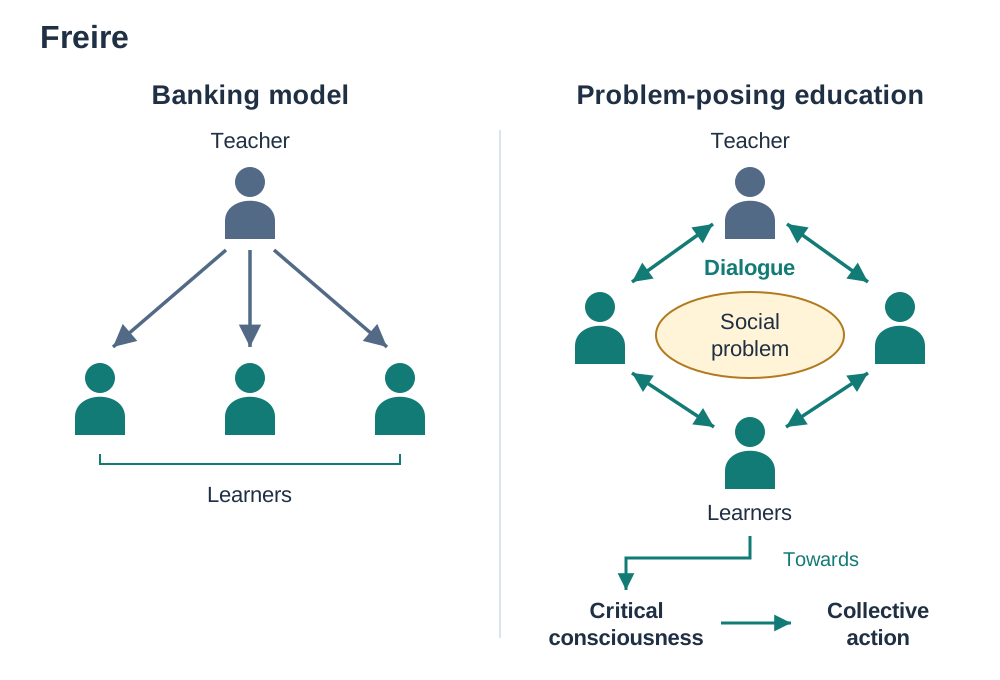
- Key ideas: Condemned traditional authoritarian schooling as the banking model of education, where teachers treat learners as empty containers to be filled with state-sanctioned knowledge. He proposed critical pedagogy: a problem-posing dialogue that fosters critical consciousness (conscientização), allowing marginalised people to understand social oppression and take collective action to liberate themselves.
- Martha Nussbaum (1947–present):
- Context: An American philosopher who developed her own version of the capabilities approach pioneered by economist Amartya Sen. Sen’s work helped shape the human-development approach used by Mahbub ul Haq and the UNDP. She drew on fieldwork examining the material realities of women in India, publishing Women and Human Development (2000) and Creating Capabilities (2011).
- Key ideas: Argued that constitutional justice should not be judged by economic output (GDP) or rights on paper, but by what people are actually able to do and to be. She identified ten central capabilities essential for human dignity. Education is a fertile capability: securing it helps realise other central freedoms, including employment, health, and political participation. Deprivation in education causes corrosive disadvantage, spreading inequality into other domains of life.
- Kathleen Lynch (Contemporary Irish Sociologist):
- Context: Emeritus Professor of Equality Studies at University College Dublin, where she helped establish the UCD Equality Studies Centre. She co-authored Equality: From Theory to Action (2004) and Affective Equality (2009), analysing social class, Traveller marginalisation, and the Points System in Ireland.
- Key ideas: Argues that mainstream liberal frameworks focus narrowly on legal and economic rights while ignoring affective equality (equality in giving and receiving love, care and solidarity; Lynch points out that care work is unequally shared and done mainly by women). Lynch critiques the competitive Points System for treating education as a private market commodity. She argues that formal equality of opportunity creates an unfair competition and advocates for equality of condition, demanding that state policy eliminate disparities in wealth, power, and living conditions.
State Watchdogs and Research Evidence on Educational Equity
Human rights require independent monitoring bodies and empirical research to assess real compliance.
State Human Rights Bodies on the Island of Ireland
Both jurisdictions operate independent statutory institutions:
- Republic of Ireland:
- Irish Human Rights and Equality Commission (IHREC): Established in 2014 by merging the Irish Human Rights Commission and the Equality Authority. Functions include providing legal assistance to victims of discrimination, conducting inquiries, appearing as amicus curiae ('friend of the court') in significant human rights trials, reporting to UN treaty bodies, and promoting and monitoring the Public Sector Equality and Human Rights Duty, which requires public bodies to have regard to the need to eliminate discrimination, promote equality and protect human rights in their work.
- Ombudsman for Children's Office (OCO): Set up under the Ombudsman for Children Act 2002 (operational 2004) to investigate individual complaints against public bodies and schools, promote children's rights under the UNCRC, and advise government on policy affecting young people.
- Northern Ireland:
- Northern Ireland Human Rights Commission (NIHRC): Established under the Northern Ireland Act 1998 following the Good Friday Agreement to review legislation, advise government, and protect human rights.
- Equality Commission for Northern Ireland (ECNI): Enforces anti-discrimination legislation across employment and public services.
- Northern Ireland Commissioner for Children and Young People (NICCY): Investigates complaints and safeguards the rights of children in Northern Ireland.
- The Joint Committee: Provided for under the Good Friday Agreement, bringing IHREC and the NIHRC together to monitor all-island human rights issues.
Research Evidence on the Right to Education in Ireland
Empirical research highlights clear disparities in how the right to education is experienced:
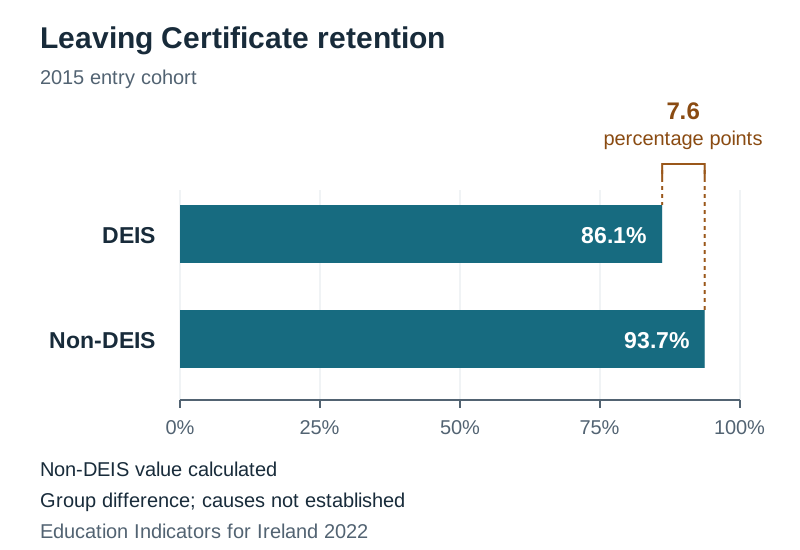
- Socio-Economic Stratification (DEIS): The Delivering Equality of Opportunity in Schools (DEIS) programme provides supplementary funding, lower pupil-teacher ratios, and literacy initiatives to disadvantaged schools. For a named example, the Department of Education’s Education Indicators for Ireland 2022 reported Leaving Certificate retention of 86.1% in DEIS schools for the 2015 entry cohort, with a 7.6 percentage-point gap between DEIS and non-DEIS schools. This measures retention to the Leaving Certificate, not entry to higher education; it shows a group difference without establishing its causes.
- Traveller Community: According to official data from the Central Statistics Office and Department of Education, Leaving Certificate completion rates for Irish Travellers remain significantly below national averages. Factors include historical exclusion, anti-Traveller prejudice, and inadequate culturally inclusive teaching.
- School Admissions: The Education (Admission to Schools) Act 2018 dismantled the 'baptism barrier'. The Act's ban on using religion as an admission criterion applies only to state-funded primary schools (the Act covers admissions more widely), with an exception for minority-faith schools to protect their ethos.
- Hidden Costs of Schooling: Annual school-cost surveys from the Society of St Vincent de Paul (SVP) show that mandatory digital devices, voluntary contributions, and uniform costs impose substantial burdens on low-income families, showing how material inequalities undermine formal constitutional guarantees.
Key terms
- Universal
- The principle that human rights belong equally to all people everywhere, without distinction based on nationality, gender, or social status.
- Inalienable
- Rights cannot be given up or taken away; due process can lawfully restrict how a right is exercised (e.g. imprisonment limits liberty).
- Indivisible
- The principle that all human rights are equal in importance, interconnected, and cannot be enjoyed fully without each other.
- Negative Rights
- Rights that require non-interference and restraint from others, particularly the state (e.g. freedom of speech or religious conscience).
- Positive Rights
- Rights that require active state funding, intervention, and resource provision to be realised (e.g. healthcare or primary schooling).
- Rights Holder
- An individual or social group legally entitled to claim, exercise, and enjoy human rights protections.
- Duty Bearer
- An institution or individual (primarily the state and its organs) legally or morally bound to respect, protect, and fulfil human rights.
- Immediate Obligation
- A legal duty under human rights law that a government must satisfy straight away, regardless of national economic resources.
- Progressive Realisation
- The obligation on states to take targeted, continuous steps to the maximum extent of available resources to achieve socio-economic rights over time.
- Retrogression
- Any backwards policy or budgetary measure by a state that reduces or weakens the existing level of realisation of socio-economic rights.
- Absolute Right
- A right that can never be restricted, suspended, or balanced against any competing public interest under any circumstances (e.g. freedom from torture).
- Limited Right
- A right that can be restricted only in specific, narrow circumstances clearly set out in law (e.g. personal liberty through lawful arrest).
- Qualified Right
- A right that the state can lawfully restrict when necessary and proportionate to protect public order, public health, or the rights of others.
- Direct Discrimination
- Treating a person less favourably than another person is, has been, or would be treated in a comparable situation on any protected ground.
- Indirect Discrimination
- When an apparently neutral rule puts a protected group at a particular disadvantage without an objective, legitimate justification.
- Dualist State
- A constitutional system (as under Article 29.6 of Bunreacht na hÉireann) where international treaties do not become domestic law unless incorporated by parliament.
- Capabilities Approach
- Martha Nussbaum's theory that justice requires states to provide the material conditions for people to achieve ten central human capabilities.
- Fertile Capability
- A capability, such as education, whose achievement supports and unlocks multiple other fundamental human capabilities.
- Corrosive Disadvantage
- A structural deprivation, such as educational exclusion, that spreads disadvantage into other domains of life.
- Affective Equality
- Equality in giving and receiving love, care and solidarity; Lynch points out that care work is unequally shared and done mainly by women.
- Equality of Condition
- An egalitarian goal advocated by Kathleen Lynch that seeks to equalise living conditions, wealth, and power, rather than settling for equal opportunity.
- Banking Model of Education
- Paulo Freire's critique of traditional education where teachers deposit static information into passive students, reinforcing social oppression.
Check yourself
What are the four guiding principles of the UN Convention on the Rights of the Child (UNCRC)?
Non-discrimination (Article 2), the best interests of the child (Article 3), the right to life, survival and development (Article 6), and the right of the child to be heard (Article 12).
Give one Irish example of progressive realisation and one of retrogression in education policy.
Progressive realisation: the phased rollout of free primary schoolbooks in 2023 and junior cycle books in 2024. Retrogression: the removal of the separate ('ex-quota') allocation for guidance counsellors in second-level schools in Budget 2012.
Name one statutory human rights body in each jurisdiction on the island and identify one of its core functions.
Republic of Ireland: The Irish Human Rights and Equality Commission (IHREC), which provides legal assistance and acts as amicus curiae in court cases. Northern Ireland: The Northern Ireland Human Rights Commission (NIHRC), which monitors compliance with the European Convention on Human Rights and advises the UK government.
What is the legal significance of Ireland being a 'dualist' state under Bunreacht na hÉireann Article 29.6?
International treaties ratified by the Irish government, such as the UNCRC, do not become part of domestic law unless the Oireachtas passes legislation incorporating them, meaning citizens cannot sue directly in Irish courts on the basis of the treaty alone.
How do Martha Nussbaum's terms 'fertile capability' and 'corrosive disadvantage' apply to education?
Education is a fertile capability because acquiring it helps secure other central freedoms like good health, political participation, and employment. Lacking education creates corrosive disadvantage, because this single deprivation spreads into multiple areas of life.