

Power and decision-making in the school explores how authority, rules, and governance operate in the environment students experience every day. Rather than treating school rules as neutral facts of life, this topic applies social and political science to answer three fundamental questions: Why do we need rules? Who makes them and who holds the most influence? And who benefits from how schools are run? By examining school governance under the Education Act 1998, evaluating the four dimensions of power, and applying named thinkers such as Thomas Hobbes, John Locke, Robert Nozick, Karl Marx, Kathleen Lynch, and Sylvia Walby, students learn to test whether school decision-making reflects genuine democratic participation or adult control.
Governance and Rule-Making in Irish Schools
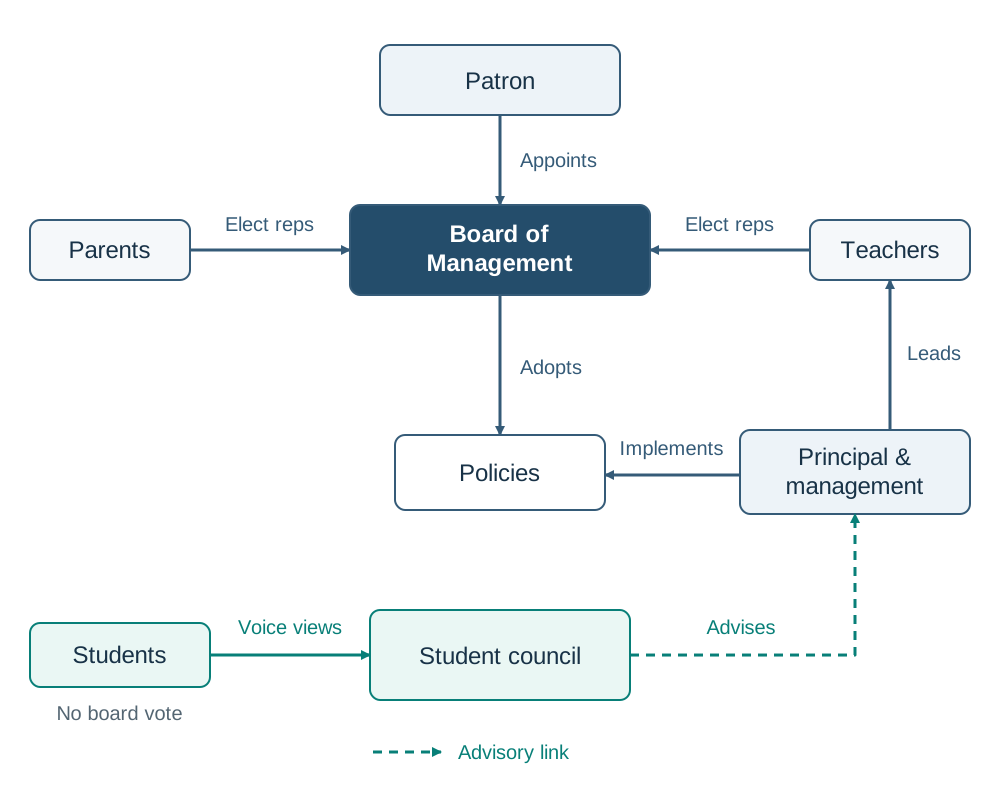
Every Irish primary and post-primary school operates inside a legal framework anchored by the Education Act 1998. School governance divides authority across distinct tiers:
- The Patron: Appoints the board of management and protects the school's characteristic religious or philosophical ethos. Patrons include Catholic or Church of Ireland dioceses, Education and Training Boards (ETBs), and Educate Together.
- The Board of Management: The legal body that runs the school and adopts its policies under Section 14 of the Education Act 1998. The board's exact composition depends on the sector. A typical voluntary secondary school board comprises eight adult members: patron nominees, elected teacher representatives, and elected parent representatives, with the principal acting as non-voting secretary. Students are not among the groups represented on the board. This means the largest stakeholder group in the school has no vote on the body that adopts school policy.
- The Principal and In-School Management: Manage daily administration, enforce behavioural policies, and lead the teaching staff.
- Teachers: Enforce daily discipline and policies, and elect representatives to the board.
- Parents: Exercise collective voice through a parents' association formed under Section 26 of the Education Act 1998 and elect board representatives.
- Student Councils: Established under Section 27 of the Education Act 1998, which requires boards to encourage and facilitate a student council. However, councils have purely advisory functions. They hold no veto power, cannot amend school rules independently, and depend on school management for recognition and facilities.
Safety Rules Versus Non-Safety Rules
When evaluating school rules, the specification draws a sharp distinction between two categories:
- Safety-related rules (e.g., child safeguarding, anti-bullying procedures, substance misuse): Authority here is largely dictated outside the individual school. The Department of Education, statutory bodies such as Tusla (the Child and Family Agency), and child protection laws (such as the Children First Act 2015) set mandatory national procedures. School authorities must enforce these rules strictly under their legal duty of care and the doctrine of *in loco parentis* (acting in the place of a parent). Adults maintain decisive control because the board carries legal liability for student safety.
- Non-safety rules (e.g., uniforms, hairstyles, jewellery, locker access): These rules are determined locally by individual boards and school leaders. Although students and parents feel the daily impact and direct financial cost of these policies, they often have the least say in designing or reforming them. While recent Department of Education guidance has directed schools to keep uniform costs down and advised on mobile phone restrictions, final decisions on daily dress codes remain local.
Who Has the Most and Least Influence over School Rules?
Under Learning Outcome 1.1, students must evaluate the decision-making process and reach a clear conclusion on which groups have the most and least influence over school rules.
The Hierarchy of Influence
- Most Influence:
- The Government and Statutory Bodies (Department of Education, Tusla): They issue binding circulars, curriculum mandates, and national anti-bullying procedures that every school must enforce.
- The Board of Management: It is the legal entity that formally adopts, amends, and ratifies all official school policies.
- The Principal: The principal drafts policies, directs the staff, manages the daily disciplinary system, and directly influences the board.
- Moderate Influence:
- The Patron: Appoints board members and ensures policies respect the school's founding ethos.
- Teachers: Enforce rules daily in the classroom and have elected colleagues on the board.
- Parents: Represented on the board and through parents' associations. Under Section 23 of the Education (Welfare) Act 2000, the board must consult parents, the principal, teachers, and the educational welfare service when preparing the school's code of behaviour.
- Least Influence:
- Students and the Student Council: Noticeably, Section 23 of the Education (Welfare) Act 2000 does not include students among the mandatory statutory groups that must be consulted when drafting the code of behaviour. Student councils operate under Section 27 of the Education Act 1998 as purely advisory bodies, leaving students with the least structural influence in the school community.
Worked Comparison: Two Policy Examples
- Safety rule (anti-bullying policy): National anti-bullying procedures are drawn up by the Department of Education. The principal drafts the school's local version, which the board of management formally ratifies. Students may be invited to complete an anti-bullying survey. Conclusion: The Department and the board hold decisive power; student influence is marginal.
- Non-safety rule (school uniform policy): The board of management decides whether to require a crested jumper or specific shoes, often responding to traditions set by school leadership. While a student council might request a change to comfortable tracksuits, the board has the final say and can reject the request without appeal. Conclusion: Even on an issue that directly affects students' comfort and their families' pockets, adult authorities hold decisive power.
Six Arguments Concerning the Need for Rules
The specification outlines six distinct arguments regarding why rules exist, who should make them, and how they should be enforced. Learning Outcome 1.2 requires students to evaluate these arguments against evidence and classify each as left-wing, right-wing, or either.
- Argument 1: Rules protect weaker members from stronger members and provide a framework for orderly learning.
- Classification: Right-wing or Either. It is often associated with conservative thought (such as Thomas Hobbes) because it prioritises social order, strong authority, and stability. However, the left also values protecting vulnerable individuals from harm.
- Evidence test: Strongly supported by evidence. Anti-bullying policies and safeguarding rules exist because real abuse occurs; disorderly classrooms damage everyone's education.
- Argument 2: Those who have the most knowledge and wisdom should play the strongest role in making rules.
- Classification: Right-wing. This reflects an epistocracy (rule by those with expert knowledge) and defers to traditional hierarchical authority (resembling Plato's ideal of wise rulers).
- Evidence test: Moderately supported in schools. Teachers and principals possess professional training, legal knowledge, and child development expertise that students do not yet have.
- Argument 3: There should be very few rules and then only concerned with keeping people safe; any more than that is an infringement on people's freedom.
- Classification: Right-wing (Libertarian). Grounded in Robert Nozick's minimal state philosophy, which argues that state or institutional rules beyond basic security violate individual liberty.
- Evidence test: Hard to sustain fully in a school. While it effectively challenges petty dress codes, compulsory attendance and the school's legal duty of care require broader organisational rules (such as attendance tracking and class schedules) to function.
- Argument 4: Those who have the most power or influence can make rules that suit their own interests and not the interests of everyone in the community.
- Classification: Left-wing. Rooted in Karl Marx's critique of dominant class interests and conflict theory.
- Evidence test: Supported by examples such as compulsory crested uniforms from a single supplier, which raise costs for low-income families.
- Argument 5: There is a danger of those with power enforcing rules arbitrarily.
- Classification: Either. Left-wing thinkers highlight how arbitrary authority targets marginalised groups, while liberal and right-wing thinkers defend the rule of law and due process against tyranny (John Locke).
- Evidence test: Strongly supported. Inconsistent enforcement of rules by individual teachers creates resentment, and disciplinary codes without clear appeals procedures risk unfair treatment.
- Argument 6: It is compliance to norms and values, not enforcement of rules, that maintains a sense of order.
- Classification: Either. Conservatives argue that traditional cultural norms hold communities together, while left-wing educators favour restorative practice over punitive sanctions.
- Evidence test: Supported by schools' growing use of restorative practice, though students should check the evidence behind claims that it produces calmer schools.
On balance, Arguments 1 and 5 are most supportable. Rules are needed to protect students and allow learning, but they must be applied clearly and consistently. Argument 3 is hardest to sustain in a school with compulsory attendance, while Arguments 4 and 6 are strongest for non-safety rules such as uniforms.
Four Dimensions of Power in School
Learning Outcome 1.3 outlines four distinct dimensions of power. The political theorist Steven Lukes (Power: A Radical View, 1974) developed a well-known three-dimensional model that matches the first three. The fourth dimension, power exercised by those who appear institutionally powerless, is the specification's own addition.
The Dimensions Compared
| Specification Dimension (Lukes equivalent) | Core Mechanism | School Application | Wider Society Application |
|---|---|---|---|
| 1. Getting people to act in ways they would not otherwise act (Lukes: Decision-Making / Visible Power) | Open authority and direct sanctions compel compliance when preferences clash. | A year head gives detention to a student who broke a rule; the student attends to avoid suspension. | An Garda Síochána issues a speeding fine; the driver pays it to avoid being taken to court. |
| 2. Setting rules or practices that benefit some groups over others (Lukes: Agenda-Setting / Hidden Power) | Power-holders control the agenda, quietly keeping uncomfortable issues out of discussions, or designing rules that favour specific interests. | Management excludes a motion on uniform costs or gender-neutral options from the student council agenda; crested uniform rules benefit suppliers over parents. | A government uses parliamentary procedures to block an opposition bill from being debated on the Dáil floor. |
| 3. Shaping ideas so people think a particular way of doing things is the best or only way (Lukes: Ideological Power / Invisible Power) | Authority shapes people's desires and beliefs through ideology, so they accept existing hierarchies as natural or common sense. | Students accept that high-stakes, terminal written exams are the only fair way to assess intelligence, never imagining alternatives. | Citizens accept extreme wealth inequality as a natural and inevitable outcome of free markets. |
| 4. Power exercised by people or groups who appear institutionally 'powerless' (Specification addition) | Grassroots collective action, peer culture, or non-cooperation disrupts authority from the bottom up. | Students organise a petition or collective boycott that forces management to permit sports tracksuits on cold days. | Grassroots movements, such as civil rights campaigns or student climate strikes, putting pressure on governments to act. |
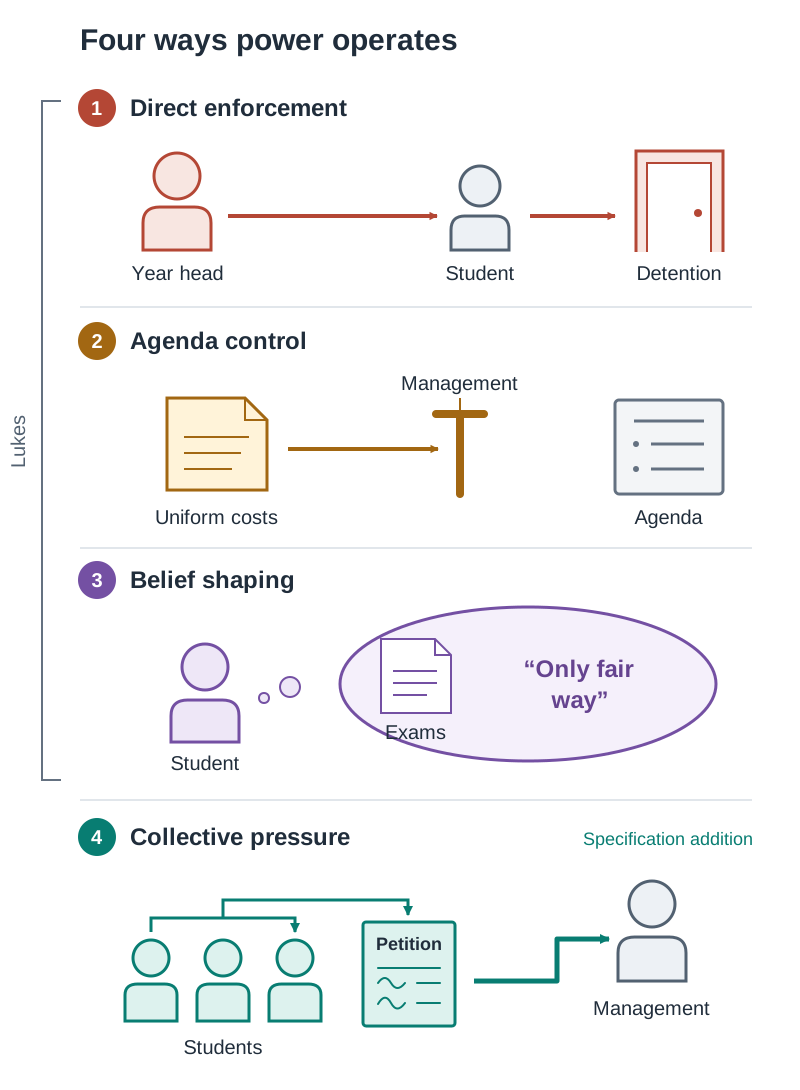
The third dimension is the most subtle and effective form of power: when authorities successfully shape ideology, people obey voluntarily without the need for visible threats or closed-door agenda manipulation.
Research Evidence and Models of Student Voice
To judge whether student representation in Ireland is genuine or merely tokenism, students must test school practices against empirical research and theoretical models.
Named Research Evidence
- Keogh and Whyte (2005): In their national study of Irish second-level student councils, Keogh and Whyte found that while most post-primary schools had established a council, their actual remit was confined to low-stakes topics like canteen snacks, lockers, and charity non-uniform days. Councils were systematically excluded from core educational policy, such as curriculum planning, teaching methods, and codes of behaviour.
- Kathleen Lynch and Anne Lodge (Equality and Power in Schools, 2002):* In this comprehensive study of Irish second-level schools, Lynch and Lodge found that students identified unequal power relations between adults and young people as a major equality issue. Students felt their opinions were largely ignored by school management. Lynch and Lodge argued that schools maintain a 'hidden curriculum' of hierarchical authority, quietly socialising students to accept having little real voice in the institutions that shape their daily lives.
How to Critique Social Research
In the written examination (especially Section 2 data-based questions), top-band marks require critiquing the quality of research rather than simply accepting its findings. Apply five tests:
- Sample size and selection: Is the sample representative? Did the study include DEIS schools, fee-paying schools, Gaelcholáistí, single-sex schools, and special classes, or was it skewed toward one demographic?
- Data type: Quantitative surveys provide broad statistical trends but lack personal depth. Qualitative interviews and focus groups capture lived experiences but are difficult to generalise across the entire country.
- Respondent bias: Who answered the survey? Principals often give a far more positive assessment of student voice than students do.
- Timeliness: Keogh and Whyte gathered their data in 2005. Since then, Ireland introduced the National Strategy on Children and Young People's Participation in Decision-Making (2015–2020) and updated Department wellbeing guidelines. Findings from twenty years ago must be checked against current practice.
- Sound conclusions: Do the conclusions follow logically from the data, or has the researcher mistaken correlation for cause?
Diagnostic Models of Participation
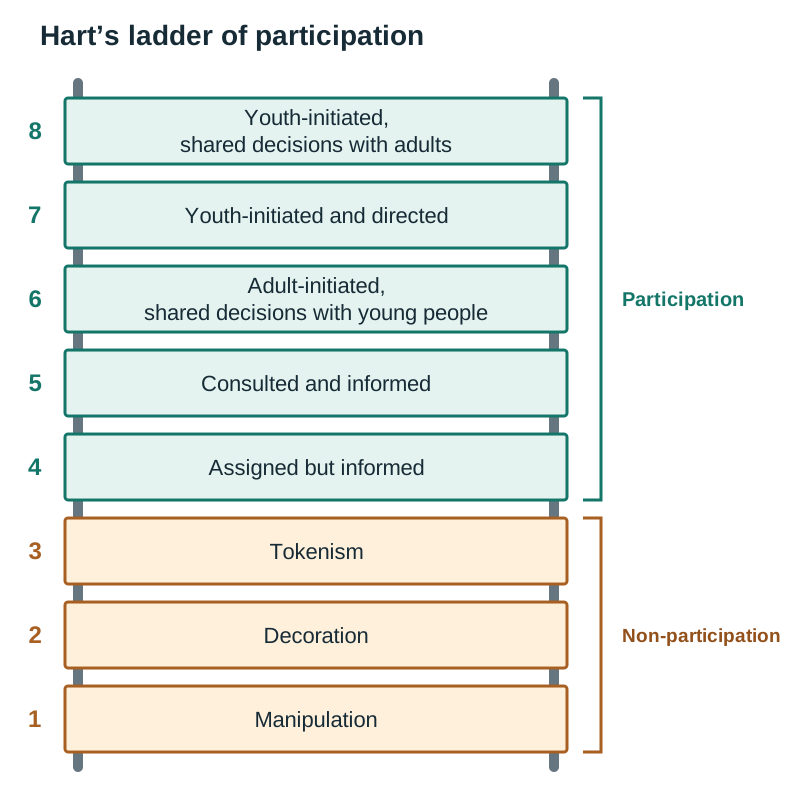
- Roger Hart's Ladder of Children's Participation (1992):
- Rungs 1 to 3 (Non-Participation): Manipulation, Decoration, and Tokenism. Young people are used as window dressing for school open nights or promotional brochures without understanding the issues or holding any power.
- Rungs 4 and 5 (Early Participation): Assigned but Informed, and Consulted and Informed. Adults design the projects, but young people understand them and their feedback is collected. Using Keogh and Whyte's evidence, it can be argued that many Irish student councils sit at Rungs 4 and 5.
- Rungs 6 to 8 (Genuine Participation): Shared decisions with adults (Rung 6 and Rung 8) or youth-initiated and directed decisions (Rung 7). Young people hold real decision-making power, either shared with adults or led by themselves.
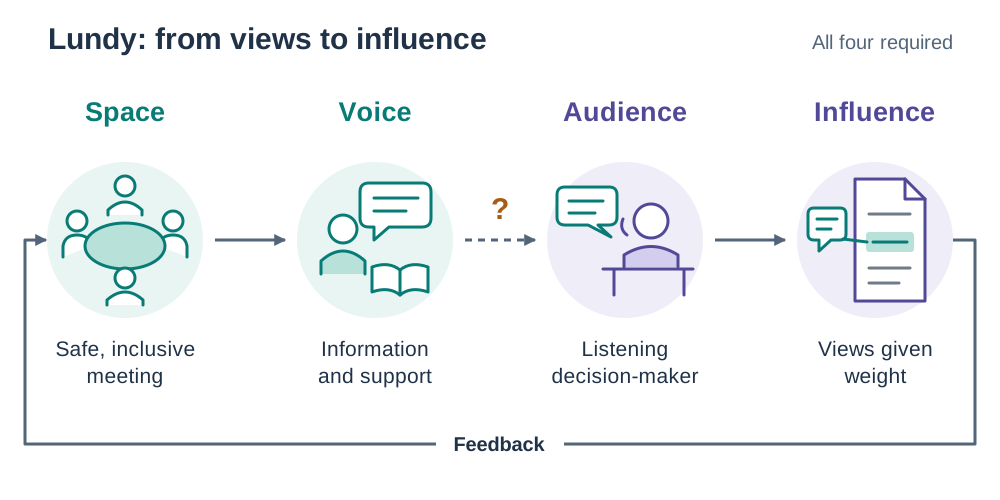
- Laura Lundy's Model of Child Participation (2007):
Designed to implement Article 12 of the United Nations Convention on the Rights of the Child (UNCRC), the Lundy model is official Irish policy, having been adopted in the National Strategy on Children and Young People's Participation in Decision-Making (2015–2020). It requires four non-negotiable elements:
- Space: Safe, inclusive opportunities to express views.
- Voice: Information and support so students can articulate real opinions.
- Audience: The view must be listened to by someone with real decision-making power (the board of management, not just a liaison teacher).
- Influence: The view must be taken seriously and given genuine weight in the final outcome, with clear feedback explaining the decision.
Irish post-primary schools frequently provide Space and Voice through council meetings, but stall at Audience and Influence because boards of management have no legal duty to act on student proposals.
Course Thinkers in Context
Learning Outcome 2.7 requires students to understand the contributions of named thinkers and the historical contexts in which they wrote:
Thomas Hobbes (1588–1679): Order Needs Strong Authority
- Context: Hobbes wrote Leviathan (1651) during the English Civil War, having witnessed political collapse, violent anarchy, and civil war.
- Core Idea: Without government, human life in the state of nature would be a terrifying "war of all against all", making life "solitary, poor, nasty, brutish, and short". To secure peace, people agree to a social contract, surrendering freedoms to a strong sovereign authority who enforces order.
- School Application: Hobbes provides the strongest defence of Argument 1 and strict adult authority: clear rules, enforced by school leaders, protect vulnerable students from bullying and maintain the order necessary for education.
John Locke (1632–1704): Consent of the Governed
- Context: Locke wrote Two Treatises of Government (1689) around the Glorious Revolution in England, justifying limits on royal power and defending parliamentary checks.
- Core Idea: Legitimate political authority rests only on the consent of the governed. Governments exist solely to protect natural rights: life, liberty, and property. If authority becomes tyrannical, it loses its legitimacy.
- School Application: While Locke himself argued that young children remain under parental authority until reaching the age of reason, senior-cycle students aged 16 to 18 are approaching or have reached adulthood (some can vote at 18). Applying Locke's consent principle suggests that subjecting young adults to rules without any vote or direct representation on the board of management undermines democratic legitimacy.
Robert Nozick (1938–2002): The Minimal State
- Context: An American philosopher, Nozick published Anarchy, State, and Utopia (1974) as a libertarian rebuttal to John Rawls's defence of the redistributive welfare state.
- Core Idea: Only a minimal state (a "night-watchman state") is morally justified. Its functions must be strictly limited to protection against force, theft, and fraud, and the enforcement of contracts. Any further state interference infringes on personal liberty.
- School Application: Nozick directly underpins Argument 3. A school is justified in banning violence, theft, and weapons, but mandatory dress codes, grooming rules, and jewellery bans represent unjustified paternalism over students' personal freedom.
Karl Marx (1818–1883): Class Interests and Ideology
- Context: Marx analysed nineteenth-century industrial capitalism in Britain and Germany, observing deep worker exploitation and urban poverty.
- Core Idea: The legal and educational systems form a 'superstructure' that protects the economic interests of the ruling capitalist class. As Marx wrote in The German Ideology, "the ideas of the ruling class are in every epoch the ruling ideas". Later Marxist sociologists Samuel Bowles and Herbert Gintis (Schooling in Capitalist America, 1976) developed this into the correspondence principle, arguing that school discipline conditions working-class children to accept hierarchy, punctuality, and obedience in capitalist workplaces.
- School Application: Rules mandating expensive branded uniforms, strict timetables, and uncritical obedience serve institutional order and commercial suppliers while penalising working-class families.
Sylvia Walby: Gender and Patriarchal Structures
- Context: A British sociologist who published Theorizing Patriarchy (1990) during the development of second-wave and third-wave feminist sociology.
- Core Idea: Walby defines patriarchy as a system of social structures in which men dominate, oppress, and exploit women. She identifies six key structures: paid work, household production, culture, sexuality, male violence, and the state. She also tracks a historical shift from private patriarchy (women controlled inside the home) to public patriarchy (women enter the public sphere but remain segregated into lower-paid, less powerful roles).
- School Application: In post-primary schools, teaching staff are predominantly female, yet historically, top leadership roles (principalships) were disproportionately occupied by men. Furthermore, dress codes frequently reflect patriarchal control over "culture" and "sexuality": female students often face far heavier scrutiny and surveillance regarding skirt length and modesty than male students face regarding their clothes.
Kathleen Lynch: Affective Equality and Educational Inequality
- Context: Professor of Equality Studies at University College Dublin, writing on equality, care, and social class in contemporary Irish education.
- Core Idea: Lynch critiques market-driven managerialism in education, arguing that treating schooling purely as an economic competition damages affective equality—the vital human need for love, care, solidarity, and relational respect.
- School Application: In Equality and Power in Schools (2002), Lynch and Anne Lodge demonstrated how authoritarian school structures deny students respect and partnership, treating them as passive subordinates rather than active citizens.
Noam Chomsky: Manufactured Consent
- Context: An American linguist and political critic writing from the Vietnam War era to the present.
- Core Idea: In Manufacturing Consent (1988, co-written with Edward Herman), Chomsky argued that elite media institutions filter news to engineer public support for corporate and state policies through a "propaganda model".
- School Application: By analogy, school management can use advisory student councils to manufacture consent: by offering students a visible forum to debate minor issues like locker keys or vending machines, management creates the illusion of democracy while keeping major structural policies firmly under adult control.
Key terms
- Board of Management
- The legal body that runs the school and adopts its policies under Section 14 of the Education Act 1998, appointed by the patron and composed of adult representatives, leaving students without a vote.
- Student Council
- A consultative representative body established under Section 27 of the Education Act 1998 to voice student opinions to school management without holding executive or veto powers.
- Code of Behaviour
- The formal school discipline policy required under Section 23 of the Education (Welfare) Act 2000, which legally mandates consultation with teachers, parents, and Tusla, but not students.
- In loco parentis
- A legal principle meaning 'in the place of a parent', placing a common law duty of care on school leaders and teachers to protect student safety and wellbeing.
- First Dimension of Power
- Getting people to act in ways they would not otherwise act through visible decision-making, direct authority, and disciplinary sanctions.
- Second Dimension of Power
- Setting rules or practices that bring benefit to some groups over others, including hidden agenda-setting that keeps controversial grievances off the official discussion table.
- Third Dimension of Power
- Shaping ideas through ideology so people view existing institutional arrangements and hierarchies as natural, inevitable, or the only right way.
- Power of the 'Powerless'
- The fourth dimension of power recognised in the specification, where groups lacking formal institutional office organise collective action or bottom-up pressure to alter rules and culture.
- State of Nature
- Thomas Hobbes' philosophical concept of human life without government authority, characterised by lawless chaos, violence, and insecurity.
- Social Contract
- An agreement where individuals surrender certain liberties to a sovereign authority in exchange for the protection of order, rights, and physical safety.
- Consent of the Governed
- John Locke's core philosophical principle stating that institutional authority possesses moral legitimacy only when the people subject to that authority have agreed to it.
- Minimal State
- Robert Nozick's libertarian model of government, restricted strictly to protecting individuals against force, theft, and fraud, rejecting broader rules that regulate personal lifestyle.
- Tokenism
- Giving a superficial appearance of including marginalised voices (such as students on Rungs 1 to 3 of Hart's Ladder) without granting them genuine decision-making power.
- Lundy Model of Child Participation
- Laura Lundy's four-part rights framework implementing UNCRC Article 12 through four sequential requirements: Space, Voice, Audience, and Influence.
- Patriarchy
- Sylvia Walby's concept of an interlocking system of social structures through which men dominate, oppress, and exploit women across both private and public spheres.
- Affective Equality
- Kathleen Lynch's concept emphasising that justice requires valuing care, love, solidarity, and relational respect, rather than reducing education solely to economic and academic competition.
Check yourself
Which legal body formally adopts school policies under the Education Act 1998, and why does its composition raise democratic concerns?
The Board of Management adopts policies under Section 14. Its composition raises democratic concerns because students are not among the represented groups, giving the largest school group no vote on the rules governing them.
Is the argument that 'there should be very few rules, only for safety' left-wing, right-wing, or either? Explain why.
It is right-wing. It aligns with Robert Nozick's libertarian philosophy of the minimal ('night-watchman') state, which defends individual freedom against institutional interference.
A school principal refuses to allow a motion on replacing branded school jumpers with plain alternatives onto the student council agenda. Which dimension of power is being exercised?
The second dimension of power (agenda-setting / hidden power), because an authority figure is deciding which issues are kept off the official table.
Name the four sequential components of Laura Lundy's Model of Child Participation.
Space, Voice, Audience, and Influence.
Name one methodological weakness of using Keogh and Whyte (2005) as evidence about Irish school democracy today.
The data is over twenty years old and predates the Lundy model, the National Participation Strategy (2015), and recent Department student-voice initiatives.
How did Kathleen Lynch and Anne Lodge describe students' experience of power relations in their 2002 study 'Equality and Power in Schools'?
They found that students viewed unequal power relations with adults as a major equality issue, and that schools maintain a hidden curriculum teaching students to accept having little real voice.