

In Leaving Certificate Politics and Society, key thinkers are your essential analytical tools. Across all four strands—Power and Decision-Making, Active Citizenship, Human Rights and Responsibilities, and Globalisation and Localisation—the syllabus expects you to evaluate modern political issues by contrasting different theories. On the Higher Level written paper, discursive essays carry 40% of the total subject marks (half the marks of the written examination), while short-answer and case-study questions regularly name individual theorists. You score top marks by explaining each thinker's core concepts in clear language, grounding them in their historical context, and applying them directly to Irish data, political institutions, and international events.
Thinkers at a Glance
This reference table maps every prescribed thinker (and key optional thinkers) across the four strands to help you rapidly select theorists for Section 1 short questions and Section 3 discursive essays.
| Thinker | Core Idea in Plain English | Key Term to Use | Key Work & Context | Strand & Learning Outcome | Exam Application |
|---|---|---|---|---|---|
| Thomas Hobbes | Without a strong ruler, life is violent chaos; order must come before freedom. | State of nature, Leviathan, social contract | Leviathan (1651); written during the English Civil War. | Strand 1 (LO 2.7) | State security, policing budgets, emergency powers. |
| John Locke | Government is a trust created to protect natural rights; tyrants can be overthrown. | Natural rights, limited government, Law of Nature | Two Treatises of Government (1689); Glorious Revolution (1688). | Strands 1 & 3 (LO 2.7, 5.7) | Civil liberties, property rights, right to protest. |
| Jean-Jacques Rousseau (Optional) | Society corrupts natural innocence; legitimate law must reflect the shared common good. | General will, popular sovereignty | The Social Contract (1762); pre-revolutionary France. | Strand 1 (Supplementary) | Direct democracy, civic equality, common good. |
| Robert Nozick | The state should only protect against violence and fraud; redistributive taxes violate rights. | Minimal state, entitlement theory, self-ownership | Anarchy, State, and Utopia (1974); reply to John Rawls. | Strands 1 & 3 (LO 2.7, 5.7) | Right-wing critiques of welfare, negative rights. |
| Karl Marx | Capitalism divides society into owners and workers, using state power to exploit labour. | Bourgeoisie, proletariat, economic base | The Communist Manifesto (1848); European industrial factory conditions. | Strand 1 (LO 2.7) | Wealth inequality, class power, systemic exploitation. |
| Sylvia Walby | Male dominance is built into six distinct social structures across private and public life. | Patriarchy, six structures, public patriarchy | Theorizing Patriarchy (1990); British women entering paid work. | Strand 1 (LO 2.3, 2.7) | Gender pay gap, unpaid domestic care, political representation. |
| Kathleen Lynch | Schools reproduce class divisions, and society ignores the vital labour of care. | Affective equality, equality of condition | Equality and Power in Schools (2002); UCD Equality Studies Centre. | Strands 1 & 3 (LO 2.7, 5.6, 5.7) | Educational disadvantage (DEIS, grinds), carers' rights. |
| Noam Chomsky | Corporate-owned media filters news to protect elite wealth without overt censorship. | Propaganda model, manufacturing consent | Manufacturing Consent (1988); critique of US foreign policy. | Strand 1 (LO 2.6, 2.7) | Media bias, corporate ownership, political agenda-setting. |
| Mahatma Gandhi | Open, non-violent refusal to obey unjust laws wins moral authority against oppressors. | Satyagraha, civil disobedience | 1930 Salt March; Indian independence struggle against British rule. | Strand 2 (LO 3.1) | Non-violent community action, peaceful resistance. |
| Nelson Mandela | Armed struggle can become a justified last resort when peaceful protest is violently crushed. | Armed resistance against undemocratic rule | Formation of Umkhonto we Sizwe (1961); South African apartheid. | Strand 2 (LO 3.1) | Limits of non-violence, legitimacy of political revolt. |
| Paulo Freire | Traditional schools train poor people into passive silence; critical dialogue brings liberation. | Banking education, problem-posing, conscientização, praxis | Pedagogy of the Oppressed (1970); literacy work with Brazilian workers. | Strand 3 (LO 5.7) | Educational reform, community empowerment, critical citizenship. |
| Martha Nussbaum | Judge development by what real individuals can do and be, not by national GDP figures. | Capabilities approach, human dignity | Women and Human Development (2000); building on Amartya Sen. | Strand 3 (LO 5.7) | Measuring human rights, disability access, global development. |
| Benedict Anderson | A nation is an imagined political community united across vast distances by shared media. | Imagined community, print capitalism | Imagined Communities (1983); Southeast Asian anti-colonial movements. | Strand 4 (LO 7.4, 7.7) | National identity, media rituals, borders and citizenship. |
| Kwame Anthony Appiah | People can love their home country while respecting all humans; cultures constantly borrow and mix. | Cosmopolitan patriotism, contamination | Cosmopolitanism (2006); growing up between Ghana and Britain. | Strand 4 (LO 7.5, 7.7) | Interculturalism, hybrid identity, limits of tolerance. |
| Thomas Hylland Eriksen | Identity is formed by drawing borders against 'them'; rapid globalisation sparks local anxiety. | Relational ethnicity, overheating, clashing scales | Ethnicity and Nationalism (1993); Overheating (2016); Norway. | Strand 4 (LO 7.4, 7.7) | Ethnic conflict, anti-globalisation backlash, EU disconnect. |
| Edward Said | Western culture painted non-Western societies as backward and irrational to justify imperial rule. | Orientalism, binary construction | Orientalism (1978); Palestinian-American literary academic. | Strand 4 (LO 7.5, 7.7) | Media portrayals of the Global South and Muslims. |
| Samuel Huntington | Post-Cold War conflicts happen along cultural and religious boundaries between civilisations. | Clash of civilisations, fault lines | The Clash of Civilizations (1996); post-Cold War US foreign policy. | Strand 4 (LO 7.5, 7.7) | Geopolitical tensions, cultural friction, security policy. |
| André Gunder Frank | Rich nations deliberately keep poor nations underdeveloped to extract cheap resources and labour. | Dependency theory, metropolis-satellite | The Development of Underdevelopment (1966); Latin America. | Strand 4 (LO 8.2, 8.3) | Global trade inequality, neo-colonialism, foreign aid limits. |
| Vandana Shiva | Industrial agriculture exploits nature and robs women of their traditional role as seed stewards. | Maldevelopment, biopiracy, Earth Democracy | Staying Alive (1988); Chipko movement in northern India. | Strand 4 (LO 8.2, 8.3) | Sustainable farming, corporate patents on seeds, ecofeminism. |
| Seán McDonagh | Unchecked capitalism destroys the environment, and the world's poorest people suffer first and worst. | Eco-theology, planetary limits | To Care for the Earth (1986); missionary in the Philippines. | Strand 4 (LO 8.2, 8.3) | Climate justice, biodiversity loss, Laudato si' influence. |
State Legitimacy and the Social Contract: Hobbes, Locke, Rousseau, and Nozick
Social contract theory asks a fundamental question: why should citizens obey the state, and when does political power become illegitimate?
Thomas Hobbes (1588–1679)
Hobbes argues that without a powerful government, human beings tear each other apart in constant competition. Writing during the chaos of the English Civil War, he described a hypothetical state of nature where laws do not exist. Driven by fear, pride, and scarce resources, people live in a state of war where life is 'solitary, poor, nasty, brutish, and short'. Rational people realise this danger and agree to a social contract: they surrender their individual freedoms to an undivided, absolute sovereign (the Leviathan) in return for physical protection and order. For Hobbes, the state's main duty is security; rebellion is never justified because any government is better than anarchy. You can apply Hobbes to modern debates about anti-terror laws, mandatory emergency powers during pandemics, or prioritising police funding over social programmes.
John Locke (1632–1704)
Locke takes a far more optimistic view: humans are naturally rational and moral, bound by a divine Law of Nature not to harm others in their life, health, liberty, or possessions. His book Two Treatises of Government was published after England's Glorious Revolution (1688), defending limited parliamentary rule against royal tyranny. Locke argues that people enter a social contract to secure impartial judges and protect the natural rights they already had: life, liberty, and property. He developed the labour theory of property: mixing physical labour with natural resources creates legitimate ownership, provided enough and as good is left for others. Legitimate government is limited, not absolute. People consent to it and trust it to protect their rights. If a ruler abuses power and breaks that trust through tyranny or unconsented taxes, the contract is broken and citizens have the right to revolt.
Jean-Jacques Rousseau (1712–1778) (Supplementary Thinker)
Rousseau argued that humans were peaceful and uncorrupted until private property sparked greed and inequality ('Man is born free, and everywhere he is in chains'). In The Social Contract (1762), he maintained that legitimate law must express the general will—the shared common good of all citizens—rather than the private interests of factions. Government is only the servant of the sovereign people; if it acts against the general will, it is illegitimate and the people may replace it. Rousseau is not on the specification's named list, but examiners accept him as an additional comparative thinker.
Robert Nozick (1938–2002)
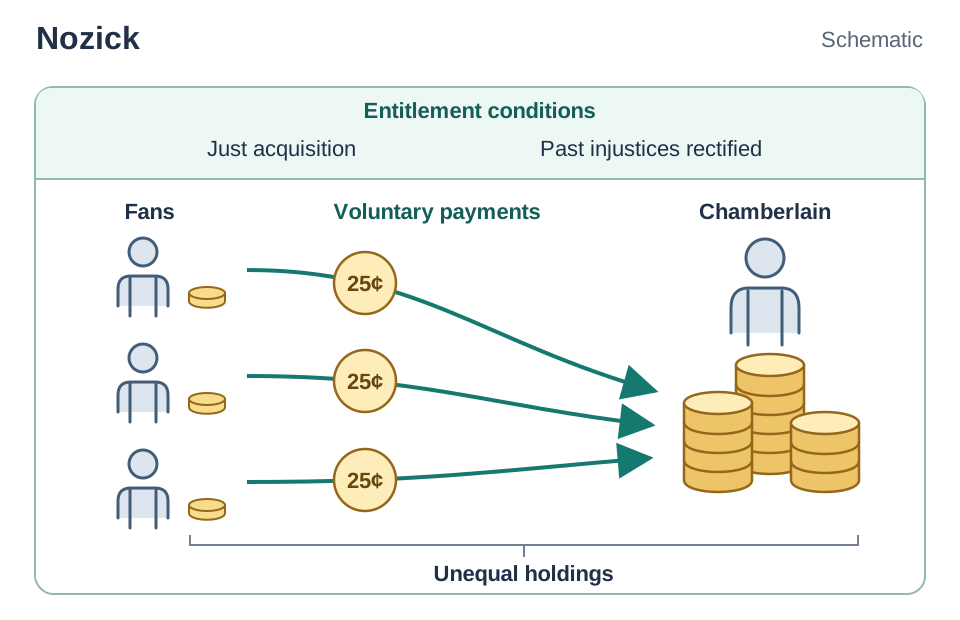
Nozick updated classical liberalism into modern libertarianism in Anarchy, State, and Utopia (1974), written as a direct reply to John Rawls's arguments for economic redistribution. Nozick begins with self-ownership: you own your body, your talents, and the labour you produce. He defends the minimal state ('night-watchman state'), restricted strictly to protecting people against violence, theft, and fraud, and enforcing contracts. Nozick formulated the entitlement theory of justice, which states that any distribution of wealth is just if it meets three conditions:
- Justice in acquisition: the property was originally acquired without harming or stealing from anyone.
- Justice in transfer: the property was bought, sold, or gifted through free and voluntary exchange.
- Rectification: past injustices, such as theft, have been corrected.
If these rules are followed, the outcome is just, no matter how unequal it looks. Nozick used the famous example of basketball star Wilt Chamberlain: if hundreds of thousands of fans freely pay an extra 25 cents each to watch him play, Chamberlain becomes extremely wealthy. Nozick asks: who was wronged? No one. Therefore, the state has no right to seize part of his income through redistributive taxes to pay for public services. For Nozick, redistributive taxation is morally equivalent to forced labour because the state takes hours of your labour without your consent. Any state larger than the minimal state violates rights and is unjust.
| Thinker | View of Human Nature | Core Purpose of the State | Redistribution and Property | Can Citizens Revolt? |
|---|---|---|---|---|
| Hobbes | Self-interested, fearful, competitive | Maintain absolute order and prevent civil war | Sovereign controls property to preserve stability | No; rebellion triggers anarchy and civil war |
| Locke | Rational, moral, cooperative | Protect natural rights: life, liberty, and estate | Pre-existing natural right; taxes require consent | Yes; if government breaks trust or acts tyrannically |
| Rousseau | Naturally compassionate, corrupted by property | Enforce the general will and civic equality | Regulate property to prevent extreme inequality | Government is a servant; people can replace it |
| Nozick | Self-owning, autonomous individuals | Minimal protection against force, theft, and fraud | Opposes redistributive taxes (taxation = forced labour) | Argues for shrinking the state, not violent revolution |
Power, Inequality, and Care: Marx, Walby, and Lynch
These theorists show how formal legal equality often masks deep underlying inequalities in social class, gender, and care.
Karl Marx (1818–1883)
Marx argues that economic power drives everything else in society. Writing during the rise of European factory capitalism, he saw that society splits into two opposing classes: the bourgeoisie (who own the means of production, such as factories, technology, and land) and the proletariat (wage workers who own nothing but their ability to work). The economic base shapes the superstructure—laws, media, religion, and government. For Marx, the state is not a neutral referee; it functions as an executive committee managing the interests of the capitalist class. Wealthy elites extract surplus value from workers' labour. Today, you can see this dynamic in the vast gap between corporate executive salaries and average worker pay, or in how corporate lobbying influences housing and tax legislation.
Sylvia Walby (1953– )
Sylvia Walby, a British sociologist, gives us the primary framework on the course for analysing whether modern society is a patriarchy (Topic 2, LO 2.3). Writing in Theorizing Patriarchy (1990) as women entered the workforce in large numbers, she defined patriarchy as a system of social structures and practices in which men dominate, oppress, and exploit women. Walby identified six interdependent patriarchal structures:
- Household production: Women perform most unpaid domestic work, childcare, and eldercare, subsidising the wider economy while reducing their own earnings.
- Paid work: Women face systemic barriers in the workplace, including the gender pay gap, segregation into low-paid caring roles, and the glass ceiling blocking top management.
- The state: Parliaments and public policy have historically been dominated by men, frequently failing to prioritise issues like affordable childcare or domestic safety.
- Male violence: Intimidation and violence by men reinforce women's insecurity in both private homes and public spaces.
- Sexuality: Society pressures people towards heterosexuality ('compulsory heterosexuality') and judges women's sexual behaviour far more harshly than men's (the sexual double standard).
- Culture: Media, education, and religion produce representations that normalise traditional gender roles and female subservience.
Walby tracked an important historical shift from private patriarchy (individual men controlling women inside the home) to public patriarchy (women freely enter public life and work, but remain collectively subordinated in lower-paid, male-dominated institutions). In Ireland, Central Statistics Office (CSO) data reveals this clearly: women still do the majority of domestic chores and caring, while men dominate senior commercial and political roles.
Kathleen Lynch (1951– )
Kathleen Lynch, an Irish sociologist at University College Dublin who founded its Equality Studies Centre, shows how schools and institutions entrench social class divisions while neglecting the human reality of care.
- Education and Social Inequality (LO 5.6): Lynch argues that the Irish education system presents itself as a fair meritocracy where rewards go to talent and hard work, but in reality it reproduces class privilege. Wealthy families purchase advantages through private fee-paying schools, expensive grinds, voluntary school contributions, and the social know-how required to navigate the CAO points race. Working-class students are disproportionately concentrated in underfunded schools, placed in lower academic tracks, and under-represented in prestigious university courses like medicine or law. Lynch also criticises the market model of education, where schools and universities compete like businesses, treating learning as an economic commodity rather than a fundamental human right.
- Equality of Condition (LO 5.4): Lynch distinguishes between basic equality (equal human worth), liberal equality of opportunity (everyone enters a 'fair race', but unequal outcomes are accepted), and equality of condition. She argues that equality of opportunity is deeply flawed: if people start from radically unequal living conditions, a fair race still guarantees that privileged students win. Society must instead equalise living conditions across resources, respect, power, and care.
- Affective Equality (LO 2.7, 5.7): Lynch's most original concept is affective equality—the principle that equal access to love, care, and emotional solidarity is a vital matter of justice. Liberal theory treats people as independent, self-sufficient economic actors. Lynch reminds us that human beings are fundamentally vulnerable, dependent, and interdependent. Care labour involves taxing physical, mental, and emotional work. Because care work is heavily gendered, poorly paid, or unpaid, carers suffer systemic economic penalties. In Ireland, rigid means-testing for the Carer's Allowance and the high cost of private childcare reflect this structural neglect.
| Lynch's Dimension of Inequality | Core Focus | Irish Real-World Example |
|---|---|---|
| Economic | Income, wealth, and material resources | School voluntary contributions, private grinds, the CAO points race |
| Power | Influence over political and workplace decisions | Working-class and female under-representation in the Dáil |
| Cultural / Status | Social respect, stigma, and recognition | Discrimination against Travellers under the Equal Status Acts |
| Affective | Burdens of care; access to love and solidarity | Carer's Allowance thresholds; lack of state support for family carers |
Media Control, Resistance, and Critical Pedagogy: Chomsky, Gandhi, Mandela, and Freire
This section covers how political power shapes minds, and how active citizens use education and direct action to challenge unjust authority.
Noam Chomsky (1928– )
Chomsky argues that in modern democracies, the media does not need open government censorship to support the powerful; the way media is owned and funded already filters what the public hears. In Manufacturing Consent (1988), written with Edward Herman, he showed how corporate-owned news channels defend elite interests through the propaganda model. Rather than relying on state intimidation, the press filters stories through five structural constraints:
- Ownership: Major media outlets are large corporations whose primary goal is profit.
- Advertising: Media companies do not sell news to citizens; they sell audiences to corporate advertisers, creating a reluctance to challenge corporate power.
- Sourcing: Journalists depend on official government and corporate press officers for quick, cheap information, giving authorities agenda-setting power.
- Flak: Wealthy lobby groups and corporations produce legal threats and public complaints to discipline critical journalists.
- Dominant ideology / Common enemy: Media outlets unite the public around shared external or internal enemies (historically communism, today terrorism or immigration scares).
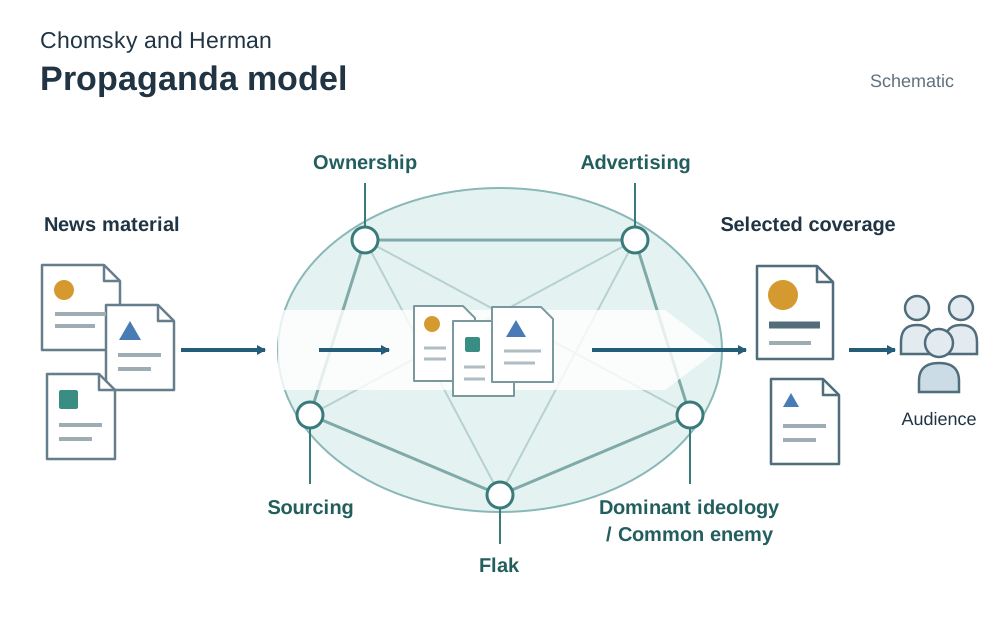
In Ireland, concerns over concentrated media ownership and news outlets relying on commercial advertisers reflect Chomsky's propaganda model.
Mahatma Gandhi (1869–1948) (LO 3.1)
Gandhi led the Indian independence movement against British colonial rule using satyagraha ('truth-force')—disciplined, non-violent resistance and civil disobedience. Civil disobedience means openly and deliberately breaking an unjust law, without violence, and accepting the legal punishment to expose the moral bankruptcy of the oppressor. His most famous action was the 1930 Salt March, walking 385 kilometres to the sea to make salt in defiance of the British colonial monopoly and tax. A key strength of civil disobedience is that it wins global moral authority and mobilises masses of ordinary people. Its major limitation is that it requires an opponent sensitive to public opinion; against ruthless regimes, non-violent protesters risk total slaughter.
Nelson Mandela (1918–2013) (LO 3.1)
Mandela was a central leader of the African National Congress (ANC) fighting against South African apartheid. For years, the ANC used non-violent boycotts and strikes. Following the 1960 Sharpeville massacre—where police shot 69 peaceful protesters—and the total banning of the ANC, Mandela concluded that non-violence had reached its limit. In 1961, he co-founded the armed wing Umkhonto we Sizwe ('Spear of the Nation'). Mandela argued that when an undemocratic state meets peaceful demands with violent repression and shuts down every legal path to reform, armed struggle becomes a legitimate last resort. After 27 years in prison, Mandela negotiated the end of apartheid and became president in 1994, showing how armed resistance can eventually bring an undemocratic regime to the negotiating table.
Paulo Freire (1921–1997)
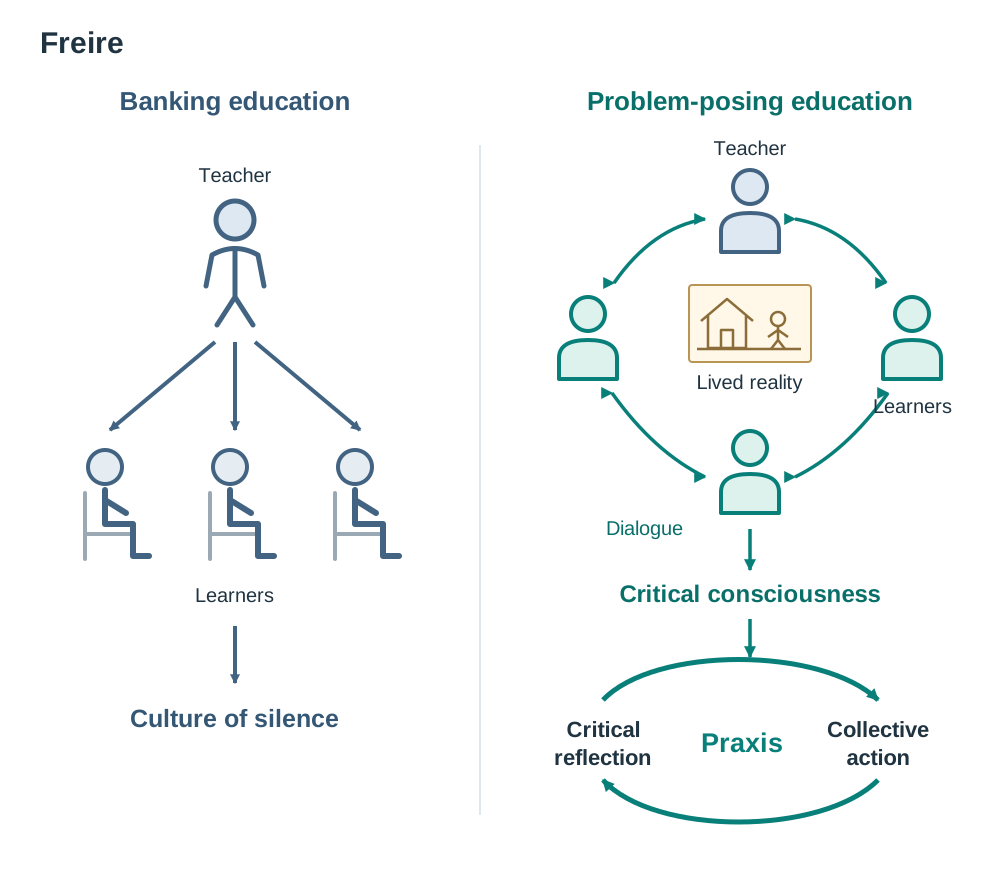
Paulo Freire was a Brazilian educator who taught adult literacy to poor rural farm workers in north-east Brazil. After the 1964 military coup, he was jailed and exiled because his literacy programmes empowered poor workers to vote and demand land rights. In Pedagogy of the Oppressed (1970), Freire insisted that education is never neutral: it either acts as a tool of conformity or becomes the practice of freedom.
He strongly attacked traditional schooling as the banking concept of education. Teachers act as depositors of official knowledge, while students are treated as passive, empty bank accounts to be filled with facts. This creates a culture of silence, conditioning working-class students to accept their poverty without question. As an alternative, Freire introduced problem-posing education in democratic culture circles where teachers and learners investigate reality together ('teacher-student with students-teachers'). Using codifications (photographs or drawings showing local hardships, such as low wages or landlord eviction), learners reflect on their real lives, develop critical consciousness (conscientização), and engage in praxis—the dynamic cycle of critical reflection and collective political action to transform society.
Human Rights and Human Capabilities: Nussbaum, Nozick, and Lynch on Justice
Topic 5 and Topic 6 examine whether rights should be negative or positive, and how real human wellbeing should be measured.
Martha Nussbaum (1947– )
Building on the work of economist Amartya Sen, Nussbaum developed her own distinct version of the capabilities approach (Women and Human Development, 2000). She attacks conventional economic measures like Gross Domestic Product (GDP) per capita. GDP measures total national economic activity, telling us nothing about who holds wealth, whether women have basic freedoms, or whether the sick receive care. A country can have soaring GDP while millions of citizens live in destitution.
Instead of asking 'how rich is this country?', Nussbaum asks: 'What is each person actually able to do and to be?'
Nussbaum established a concrete list of ten central human capabilities that every government must constitutionally guarantee to ensure a life of human dignity:
- Life (living a normal lifespan without premature death).
- Bodily health (good health, shelter, and nourishing food).
- Bodily integrity (freedom of movement, safety from assault, and reproductive choice).
- Senses, imagination, and thought (using reason and imagination, supported by education and artistic freedom).
- Emotions (loving, grieving, and forming emotional attachments without fear).
- Practical reason (forming one's own plan of life and religious or ethical beliefs).
- Affiliation (living with others, showing empathy, and being treated with dignity and non-discrimination).
- Other species (living with respect for animals, plants, and the natural world).
- Play (laughing, playing, and enjoying recreation).
- Control over one's environment (political participation, free speech, holding property, and equal workplace rights).
For Leaving Certificate students, Nussbaum turns human rights into tangible requirements: governments cannot just sign treaties; they must resource the actual opportunities people need to flourish.
Connecting Thinkers to the Human Rights Arguments (LO 5.2, 5.4):
- Negative Rights vs Positive Rights: Negative rights require others to leave you alone (freedom from state interference, speech, fair trials). Positive rights require the state to provide tangible services (education, healthcare, shelter).
- The Right-Wing Argument against Positive Rights: Robert Nozick represents the view that positive rights are fundamentally unfair because they force taxpayers to pay for services for other people, violating self-ownership. This is an examinable right-wing position in LO 5.4.
- The Left-Wing Argument for Equality of Condition: Kathleen Lynch represents the left-wing view that formal liberal human rights do not go far enough. Protecting basic access and opportunity simply allows the privileged to dominate. Justice demands positive rights and equality of condition.
Globalisation, Culture, and Identity: Anderson, Appiah, Eriksen, Said, and Huntington
Topic 7 explores how global media, migration, and trade transform who we are, and whether national identity is fading.
Benedict Anderson (1936–2015)
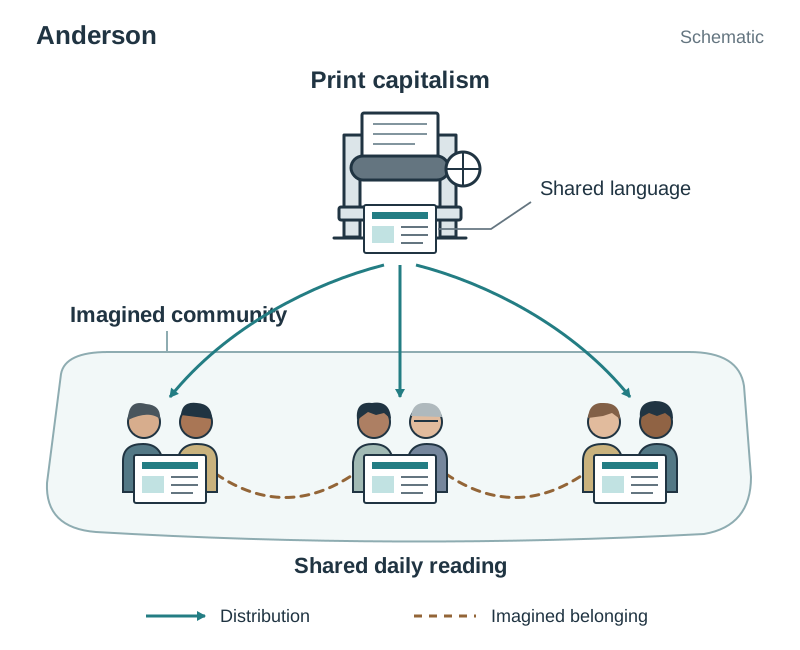
Anderson wrote Imagined Communities (1983) to explain how modern nationalism works. He showed that nations are not ancient, biological realities; they are modern cultural creations. He defined a nation as 'an imagined political community—and imagined as both inherently limited and sovereign':
- Imagined: Citizens will never meet, hear of, or know most of their fellow members, yet in the minds of each lives the image of their shared communion.
- Limited: Every nation has finite boundaries on a map. No nationalist dreams of a nation covering the entire globe.
- Sovereign: Nations were born during the Enlightenment and the American and French Revolutions, replacing the rule of divinely appointed kings with the sovereignty of the people.
- Community: Regardless of actual inequality and exploitation, the nation is imagined as a deep, horizontal fraternity.
Anderson showed that print capitalism—mass printing of daily newspapers and novels in national languages—created this shared national identity. When millions of people read the same morning news in the same language, they know thousands of their compatriots are doing the same thing simultaneously. Today, national sports, elections, and national broadcasters continue this shared daily imagination.
Kwame Anthony Appiah (1954– )
Appiah grew up in Ghana with an English mother and a Ghanaian father, giving him personal experience of mixed cultural heritage. In Cosmopolitanism: Ethics in a World of Strangers (2006), he presents two core strands of cosmopolitanism:
- Universal concern: We have ethical duties to all human beings, not just our fellow citizens.
- Respect for legitimate difference: We must respect individual choices and the different cultural communities that give lives meaning.
Appiah champions cosmopolitan patriotism: there is no contradiction between having a deep affection for your local community or country while caring for universal human rights. In response to the LO 7.2 syllabus point, Appiah introduces the idea of contamination. He points out that no culture has ever been 'pure' or static. Throughout human history, cultures have borrowed, adapted, and mixed—such as Ghanaian kente cloth absorbing European fabrics. Globalisation is not destroying authentic cultures; it is continuing this ancient process of mixing.
Appiah stresses conversation across difference. Diverse groups do not need to agree on every value to live peacefully together; they simply need to get used to each other through dialogue. However, he establishes clear limits of tolerance: practices that violate fundamental human dignity (such as female genital mutilation or slavery) cannot be tolerated. He strongly rejects 'counter-cosmopolitans' (such as religious fundamentalists) who demand that everyone live by their single absolute truth.
Thomas Hylland Eriksen (1962– )
Thomas Hylland Eriksen, a Norwegian social anthropologist, explains how identity works on the ground and why globalisation creates political backlashes.
- Ethnicity as Relational (LO 7.4): In Ethnicity and Nationalism (1993), Eriksen showed that ethnicity is relational. It does not exist in isolation; it is created along the borderlines where groups meet. A group only becomes conscious of being 'us' by comparing itself to 'them'. Ethnicity is also situational: individuals stress different identities depending on where they are (a student might feel 'from Mayo' in Dublin, 'Irish' in London, and 'European' in Asia). A secure sense of identity provides community and belonging. But an insecure, threatened identity often produces toxic stereotyping, discrimination, and conflict.
- Overheating and Clashing Scales (LO 7.7): In Overheating (2016), Eriksen argued that accelerated global change creates severe unintended friction. When international bodies or global markets impose top-down regulations, they trigger clashing scales—a direct collision between distant, large-scale decision-makers and the lived reality of small-scale local communities. Feeling alienated and powerless, local citizens often reassert national and local identities. This explains why rapid globalisation has fueled nationalist political parties and anti-immigration movements across Europe.
Edward Said (1935–2003)
In Orientalism (1978), Said showed that the West historically maintained colonial power by constructing an artificial cultural binary. European scholars, writers, and politicians portrayed the West ('us') as rational, civilised, democratic, and moral, while depicting the Orient ('them') as irrational, backward, superstitious, and dangerous. Said demonstrated that academic culture was intimately linked to imperial domination: framing non-Western people as childlike justified Western colonial conquest. In modern politics, Said's framework explains how media coverage often stereotypes Muslims, Arab communities, or asylum seekers as dangerous outsiders.
Samuel Huntington (1927–2008)
In The Clash of Civilizations (1996), Huntington argued that post-Cold War conflicts would be cultural rather than ideological or economic. He divided the world into major distinct civilisations (such as Western, Islamic, Sinic/Chinese, and Hindu), claiming their basic values are incompatible. Huntington argued that future global wars would occur along the geographic fault lines where these civilisations touch, insisting that Western nations must protect their culture and borders. Said strongly attacked Huntington's thesis in his essay The Clash of Ignorance (2001), arguing that Huntington treated cultures as closed, monolithic boxes while ignoring the internal diversity and centuries of mixing within all civilisations.
Global Underdevelopment and Ecological Stewardship: Frank, Shiva, and McDonagh
Topic 8 investigates why extreme poverty persists in the Global South, and how our economic system impacts planetary survival.
André Gunder Frank (1929–2005)
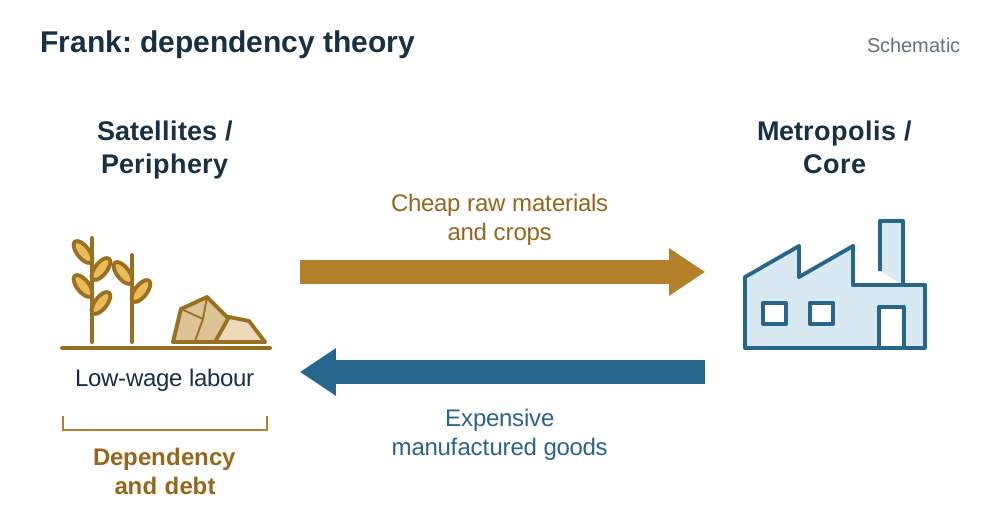
Frank rejected modernisation theory (associated with Walt Rostow), which claimed that low-income countries are poor simply because they lack Western technology, industrial know-how, and modern markets. In dependency theory, Frank showed that underdevelopment is not a primitive, original state. It was actively created by historical colonialism and an unequal capitalist system—a reality he called the development of underdevelopment.
Using his metropolis-satellite model, Frank explained that rich Western nations (the metropolis or core) deliberately keep developing nations (the satellites or periphery) in a state of dependency. The core extracts cheap raw materials, agricultural crops, and low-wage labour from the periphery, then sells expensive manufactured goods back to them, trapping poor nations in debt. Frank pointed to three historical patterns in Latin America:
- Wealthy core nations were never satellites to anyone else; they built their wealth by exploiting colonies.
- Developing satellites experienced their strongest industrial growth when ties to the core were interrupted (such as during the two World Wars and the 1930s Great Depression).
- The regions that are most impoverished today (such as sugar regions in the Caribbean or silver-mining zones in Bolivia) were historically the most closely tied to colonial powers, who abandoned them once their resources were stripped.
Vandana Shiva (1952– )
Shiva is an Indian physicist and ecofeminist scholar who was heavily influenced by the Chipko movement in northern India, where rural women hugged forest trees to block commercial loggers. In Staying Alive (1988), Shiva introduced the term maldevelopment—Western-style economic growth that measures progress purely through industrial extraction, while destroying nature and marginalising women.
Shiva argues that peasant women have historically served as the world's primary environmental stewards, saving seeds and protecting local biodiversity. She campaigns against biopiracy: Western multinational corporations patenting indigenous plant varieties (such as neem and basmati rice) to force local farmers to buy commercial seeds and chemical fertilisers. Shiva founded the Navdanya seed-saving network, championing food sovereignty and ecological farming under the vision of Earth Democracy.
Seán McDonagh (1944– )
Seán McDonagh is an Irish Columban priest and eco-theologian. While working as a missionary with the indigenous T'boli people in the Philippines, he saw commercial logging wipe out ancestral rainforests, driving local communities into destitution. This inspired his books To Care for the Earth (1986) and The Greening of the Church (1990), directly shaping Pope Francis's 2015 environmental encyclical Laudato si'.
McDonagh argues that modern global capitalism operates on a suicidal delusion: treating planet Earth as an infinite quarry for resource extraction and an infinite dumping ground for toxic waste. He stresses climate justice, showing that the poorest communities worldwide—who contributed least to greenhouse gas emissions—suffer first and worst from global warming, soil loss, and ecological collapse.
Matching Thinkers to the Development Arguments (LO 8.2):
- Lack of technology and modern industry causes poverty: Modernisation theory (Rostow). Usually classed as a right-wing / liberal view.
- Unfair global trade and Western exploitation cause poverty: André Gunder Frank and dependency theory. Classed as a left-wing view.
- Underdevelopment is caused by corrupt local elites in less-developed countries: This can be associated with either the left or the right. Free-market thinkers blame poor governance, while dependency thinkers note that elites often collaborate with Western interests.
- Industrialisation has disempowered women and ruined nature: Vandana Shiva and ecofeminism. Classed as a left-wing / environmentalist view.
- Free-market competition and technology will fix the environment: Free-market capitalism. Classed as a right-wing view.
- Development must focus on small-scale, self-reliant, sustainable communities: Vandana Shiva and Seán McDonagh. Classed as a left-wing / green view.
Key terms
- State of Nature
- A philosophical thought experiment examining how human beings would act without government, formal laws, or established authority.
- Social Contract
- An agreement where individuals surrender certain natural freedoms to a governing authority in return for peace, order, and the protection of their rights.
- Minimal State
- Robert Nozick's right-libertarian model of government, restricted strictly to protecting individuals against violence, theft, and fraud, and enforcing contracts.
- Patriarchy
- Sylvia Walby's definition of a system of social structures and practices in which men dominate, oppress, and exploit women across six key domains.
- Affective Equality
- Kathleen Lynch's concept that equal access to love, care, and emotional solidarity is a core requirement of justice alongside economic, power, and cultural equality.
- Equality of Condition
- Kathleen Lynch's argument that real equality requires equalising living conditions, resources, and status, rather than just offering equal opportunity to compete.
- Propaganda Model
- Noam Chomsky and Edward Herman's framework showing how five corporate and political filters shape news reporting to manufacture consent for elite policies.
- Banking Education
- Paulo Freire's critique of schooling where teachers treat students as passive, empty containers to be filled with deposits of official knowledge.
- Conscientização
- Paulo Freire's term for critical consciousness—the capacity to critically perceive social, political, and economic oppression and take action against it.
- Capabilities Approach
- Martha Nussbaum's theory of justice evaluating societies by what each person is actually able to do and to be across ten central human capabilities.
- Imagined Community
- Benedict Anderson's definition of a nation as a socially constructed political community, imagined as both inherently limited and sovereign.
- Print Capitalism
- The mass printing of newspapers and novels in national languages that enabled dispersed populations to experience shared daily news and imagine a unified nation.
- Cosmopolitanism
- Kwame Anthony Appiah's philosophy combining universal moral duties to all humanity with genuine respect for local and cultural differences.
- Contamination
- Kwame Anthony Appiah's concept that cultures have never been pure, but have always borrowed, adapted, and mixed through historical contact.
- Overheating
- Thomas Hylland Eriksen's term for the unintended crises in identity, economy, and ecology caused by accelerated global growth and connectivity.
- Clashing Scales
- Thomas Hylland Eriksen's concept describing the structural disconnect between distant large-scale decision-makers and the lived realities of local communities.
- Orientalism
- Edward Said's concept describing how Western culture constructed non-Western societies as backward and irrational to justify imperial domination.
- Dependency Theory
- The theory (associated with André Gunder Frank) that poor periphery countries are kept underdeveloped because rich core countries exploit their resources and labour.
- Development of Underdevelopment
- André Gunder Frank's argument that poverty in developing nations is not a natural starting point, but an active condition manufactured by global capitalism.
- Maldevelopment
- Vandana Shiva's term for Western-style economic development that destroys the environment and marginalises women while measuring success solely by GDP.
Check yourself
How did Thomas Hobbes and John Locke differ in their views of the state of nature?
Hobbes viewed the state of nature as an amoral, violent war of all against all requiring an absolute sovereign for security. Locke saw it as a moral condition governed by the Law of Nature where people hold natural rights to life, liberty, and property.
Which thinker argued that redistributive taxation is morally equivalent to forced labour, and what political philosophy is this?
Robert Nozick, representing right-libertarianism.
Give Benedict Anderson's definition of a nation and explain its four key elements.
'An imagined political community, imagined as both inherently limited and sovereign.' - Imagined: we never meet most fellow citizens but still feel connected. - Limited: every nation has borders beyond which lie other nations. - Sovereign: the people, not a king, hold power. - Community: a deep horizontal comradeship despite inequality.
Name Sylvia Walby's six structures of patriarchy.
Household production, paid work, the state, male violence, sexuality, and culture.
What is Kathleen Lynch's core critique of 'liberal equality of opportunity' in Irish schools?
Equality of opportunity is not enough because people start from radically unequal conditions; without equality of condition, wealthier families buy advantages (such as private grinds) so that a 'fair race' still reproduces inequality.
Which thinker is associated with the quote: 'Washing one's hands of the conflict between the powerful and the powerless means to side with the powerful, not to be neutral'?
Paulo Freire, criticising the idea that education or teachers can ever be politically neutral.
What is the difference between André Gunder Frank's 'metropolis' and 'satellite'?
The metropolis (core) is the wealthy industrial power that extracts resources, while the satellite (periphery) is the exploited developing nation kept dependent on the core.