

Power and Decision-Making at National and European Level explores how political authority is distributed, contested, and legitimised across modern democracies and authoritarian regimes. The topic investigates the executive branches of the Republic of Ireland, Northern Ireland, the European Union, and China, examining how political leaders are chosen and held to account. It tracks how national policy develops from an initial problem into enforceable legislation through nine distinct actors, and evaluates how effectively democratic institutions represent citizens across divisions of social class and gender. It also examines the democratic roles and power dynamics of traditional and digital media. Throughout, discussions are anchored in the work of seven prescribed thinkers: Thomas Hobbes, John Locke, Karl Marx, Robert Nozick, Sylvia Walby, Kathleen Lynch, and Noam Chomsky.
The Machinery of Executive Power: Comparative Selection Models
Government authority in modern democracies is divided across three branches: the legislature makes laws, the executive directs state policy and administers departments, and the judiciary interprets the law independently. Article 6 of Bunreacht na hÉireann establishes a separation of powers between these branches. In Ireland, the judiciary is strictly independent (Article 35), but the executive and legislative branches overlap: the Taoiseach and Cabinet sit directly within the Houses of the Oireachtas and depend on majority support in Dáil Éireann. This structural overlap is known as a partial fusion of powers.
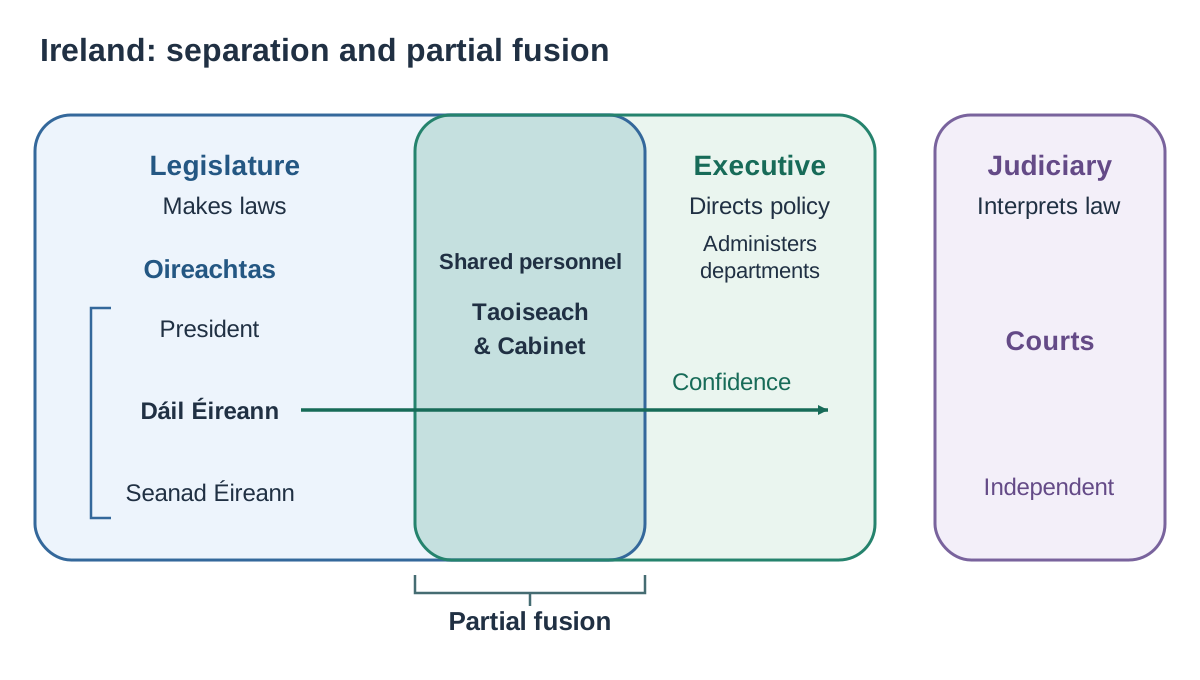
1. The Republic of Ireland
Ireland's parliament, the Oireachtas, consists of the President, Dáil Éireann, and Seanad Éireann.
- Dáil Éireann: Elected across multi-seat constituencies (3 to 5 seats) using Proportional Representation by Single Transferable Vote (PR-STV). At the 2024 general election, there were 43 constituencies returning 174 TDs. The franchise is strictly defined by law:
| Election | Who Can Vote |
|---|---|
| Dáil Éireann | Irish and British citizens aged 18+, ordinarily resident and registered |
| Presidential Elections and Constitutional Referendums | Irish citizens aged 18+ only |
| European Parliament | Irish and other EU citizens resident in Ireland |
| Local Elections | All residents aged 18+ regardless of nationality |
Franchise limitations: Most Irish emigrants cannot vote by postal ballot, non-Irish and non-British residents cannot vote in general elections, and the voting age remains 18.
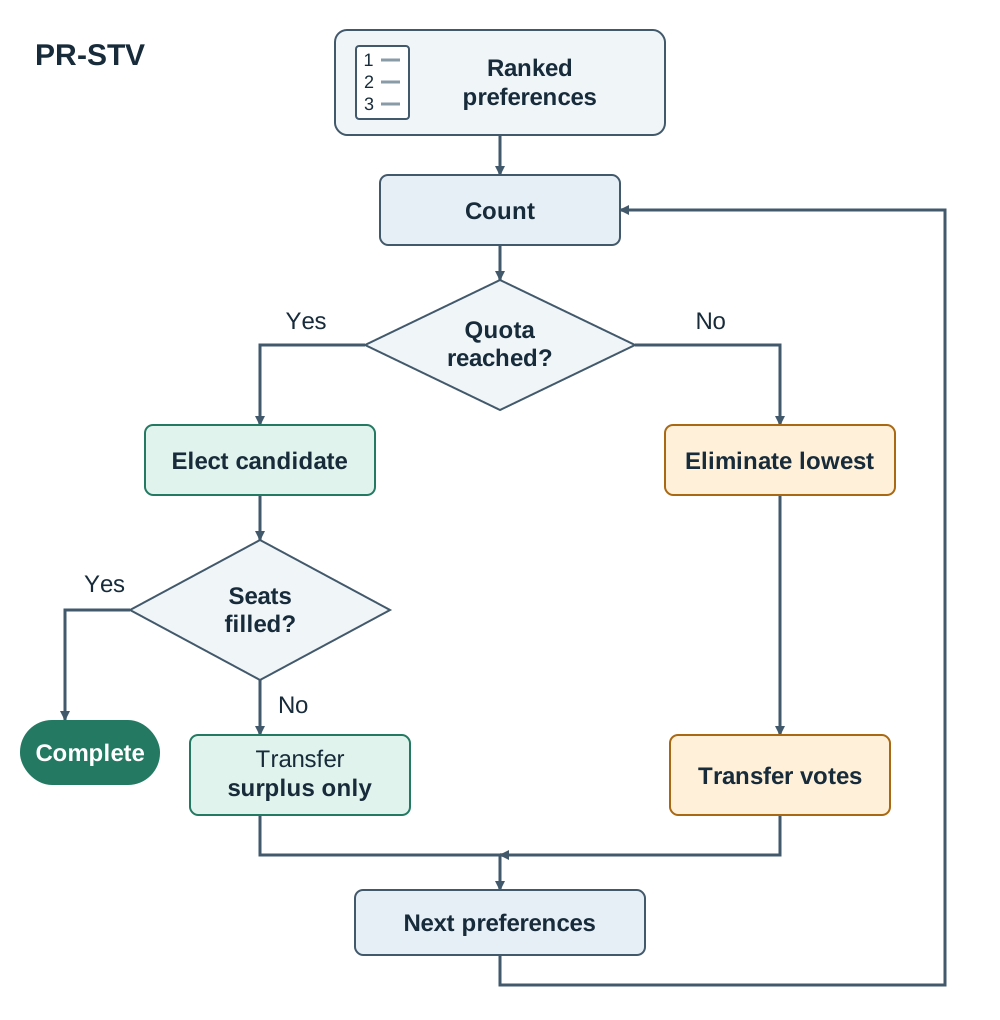
- How PR-STV Works: Voters rank candidates in numerical order (1, 2, 3, etc.). Seats are allocated using the Droop quota:
Any candidate reaching the quota is elected immediately. Their surplus votes (those above the quota) are transferred to next preferences. If no candidate reaches the quota, the lowest candidate is eliminated and their votes are redistributed. Counting continues until all seats are filled.
- Seanad Éireann: Composed of 60 senators: 11 nominated directly by the Taoiseach, 6 elected by graduates of the National University of Ireland (3) and the University of Dublin / Trinity College (3), and 43 elected from five vocational panels by an electorate of TDs, outgoing senators, and local authority councillors. Most citizens have no direct Seanad vote.
- Government Selection: Following an election, the Dáil nominates the Taoiseach, who is formally appointed by the President. The Taoiseach selects Cabinet ministers (mostly TDs, though up to two may come from the Seanad), who must be approved by a Dáil vote. Under Cabinet solidarity (collective responsibility, Article 28), all ministers must publicly support Cabinet decisions or resign.
- Coalition Government: Because PR-STV rarely gives one party an overall majority of seats, Irish governments are almost always coalitions. Parties negotiate a joint Programme for Government and vote together to elect a Taoiseach (e.g. the Fianna Fáil, Fine Gael, and Green Party coalition in 2020 with a rotating Taoiseach, and the Fianna Fáil and Fine Gael administration formed in January 2025). Coalition strengths include broader electoral representation and consensus-based policy. Weaknesses include slow decision-making, compromise that waters down party manifestos, and the risk of government collapse over inter-party disagreements.
- Checks and Balances: The Dáil checks the executive through parliamentary questions, committee inquiries (such as the Public Accounts Committee), and votes of no confidence. Under Article 26, the President can refer a bill to the Supreme Court before signing it to verify its constitutionality. Under Article 34, the High Court (and on appeal the Court of Appeal and Supreme Court) can strike down enacted laws that breach constitutional rights. The news media also acts as an external democratic watchdog.
- System Weakness: Its main weakness is executive dominance. Enforced by the party whip, government TDs almost always vote with their ministers, limiting backbench scrutiny of Cabinet decisions.
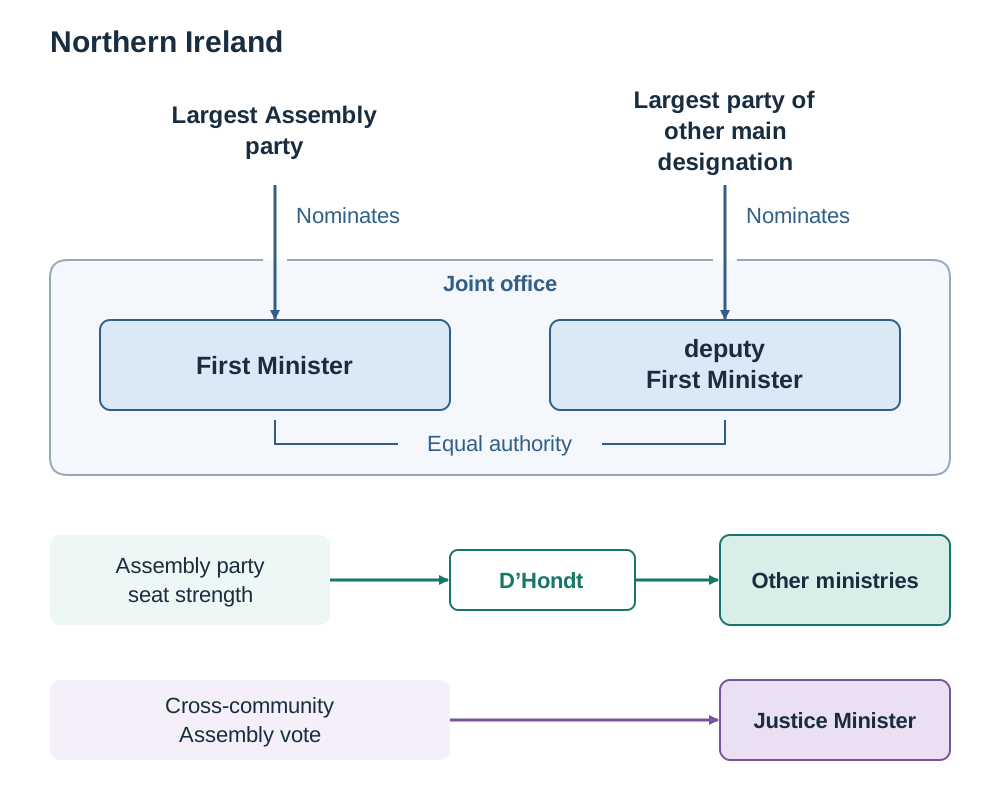
2. Northern Ireland's Consociational Executive
Established under the 1998 Good Friday Agreement, Northern Ireland operates a mandatory power-sharing executive designed for a divided society (consociationalism).
- Designations: Members of the Legislative Assembly (MLAs) register as 'Nationalist', 'Unionist', or 'Other'.
- First Minister and deputy First Minister: These two posts form a single, joint office with co-equal executive authority. The First Minister is nominated by the largest party in the Assembly. The deputy First Minister is nominated by the largest party of the other main designation (unionist or nationalist). In 2024 these were Sinn Féin (nationalist) and the DUP (unionist).
- Ministerial Portfolios: Other departments are allocated mathematically using the D'Hondt system, which distributes portfolios based on each party's seat share in the Assembly.
- Justice Minister Exception: The Minister for Justice is not allocated through D'Hondt. To maintain cross-community confidence in policing, this minister is elected through a cross-community Assembly vote.
- Safeguards and Weaknesses: The petition of concern allows 30 MLAs to demand that a measure secure a cross-community majority (requiring support from both a majority of designated unionists and a majority of designated nationalists) rather than a simple majority. While this protects minority interests, mutual vetoes have caused repeated government collapses and prolonged suspensions of devolved power (e.g. 2017–2020 over the Renewable Heat Incentive and Irish language legislation, and 2022–2024 over post-Brexit trade arrangements).
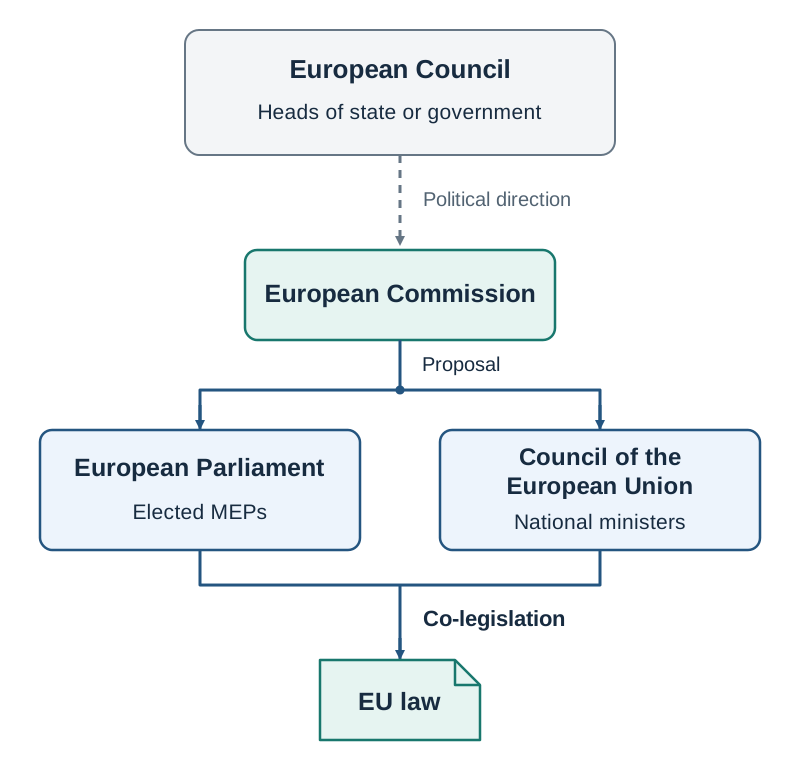
3. The European Union
The EU distributes executive and legislative responsibilities across three key bodies:
- European Commission: The EU's executive. It holds the sole formal right to propose new EU laws (right of initiative), manages the EU budget, implements policy, and acts as 'guardian of the treaties' by taking non-compliant member states to court. The European Council proposes a Commission President by qualified majority, taking into account the European Parliament election results. The Parliament must then elect the nominee by an absolute majority. Each member state nominates one Commissioner. Nominees undergo parliamentary committee hearings, and the full College of Commissioners must be approved in a vote by the European Parliament before formal appointment.
- European Parliament: 720 Members of the European Parliament (MEPs) directly elected every five years by EU citizens (last held in June 2024; Ireland elects 14 MEPs via PR-STV across three constituencies). The Parliament co-legislates and approves the EU budget alongside the Council of the European Union. It scrutinises the Commission and has the power to dismiss the entire Commission through a two-thirds motion of censure.
- Council of the European Union (Council of Ministers): Composed of one government minister from each member state, varying according to the policy area under discussion (e.g. national health ministers meeting for health policy). It co-legislates with the European Parliament, coordinates member states' policies, and concludes international agreements. Most decisions pass by qualified majority voting (55% of member states representing at least 65% of the total EU population), though sensitive matters like taxation and foreign policy require unanimity.
- European Council: Composed of national heads of state or government (Ireland is represented by the Taoiseach) alongside its own permanent President and the Commission President. It sets the EU's overall political direction and priorities but does not pass legislation.
- Court of Justice of the European Union (CJEU): Based in Luxembourg, it ensures EU law is interpreted and applied uniformly across all member states, upholds the supremacy of EU law over national law, and settles disputes involving institutions, states, or individuals.
- Democratic Deficit: Critics argue that the Commission exercises substantial agenda-setting and executive authority without direct electoral accountability to citizens, while key negotiations in the Council of Ministers occur in intergovernmental meetings away from public view.
4. Non-Democratic Executive: China
In the People's Republic of China, executive authority is controlled entirely by the Chinese Communist Party (CCP).
- Power Structure: Supreme executive power rests with the General Secretary of the CCP, a post held by Xi Jinping since 2012. Xi also serves as President of the PRC and Chairman of the Central Military Commission.
- Selection: The National People's Congress (about 3,000 delegates chosen through party-controlled indirect elections) formally elects the President and confirms the Premier on the President's nomination. In practice, all leadership appointments are decided in advance by the CCP Politburo Standing Committee. In 2018, the NPC abolished the constitutional two-term limit on the presidency, enabling Xi to secure a third term in 2023.
- Evaluation: Centralised command allows swift, long-term policy execution and large-scale infrastructure development. However, the system operates without competitive elections, tolerates no political opposition, suppresses independent trade unions and civil liberties, lacks judicial independence, and provides no lawful mechanism for citizens to replace their leaders.
Comparative Overview of Executive Selection
| System | Executive Selection Method | Accountability to Citizens | Removal Mechanism | Main Strength | Main Weakness |
|---|---|---|---|---|---|
| Ireland | Taoiseach nominated by Dáil majority following PR-STV elections; Cabinet approved by Dáil | Direct at elections; regular scrutiny by Dáil TDs and media | Dáil vote of no confidence or general election defeat | High democratic legitimacy; responsive local TDs | Executive dominance over parliament via the party whip |
| Northern Ireland | FM and dFM nominated by largest party and largest party of other main designation; D'Hondt for others | Indirect through Assembly elections; cross-community representation | Resignation of either the FM or dFM ends both posts, collapsing the executive | Prevents single-community dominance in divided society | Institutional fragility; party vetoes cause chronic collapse |
| European Union | Commission President proposed by European Council and elected by EP; Commissioners approved by EP | European Parliament elections every 5 years; indirect via national ministers | European Parliament motion of censure (two-thirds majority) | Balances multinational interests and collective European action | Democratic deficit; executive is geographically distant from voters |
| China | Handpicked by CCP Politburo Standing Committee; rubber-stamped by National People's Congress | None; no open, competitive multi-party elections | Internal party power shifts only; no legal citizen mechanism | Rapid long-term strategic decision-making and execution | Complete absence of civil liberties, checks, and popular accountability |
The Making of National Policy: Actors, Institutions, and Youth Case Study
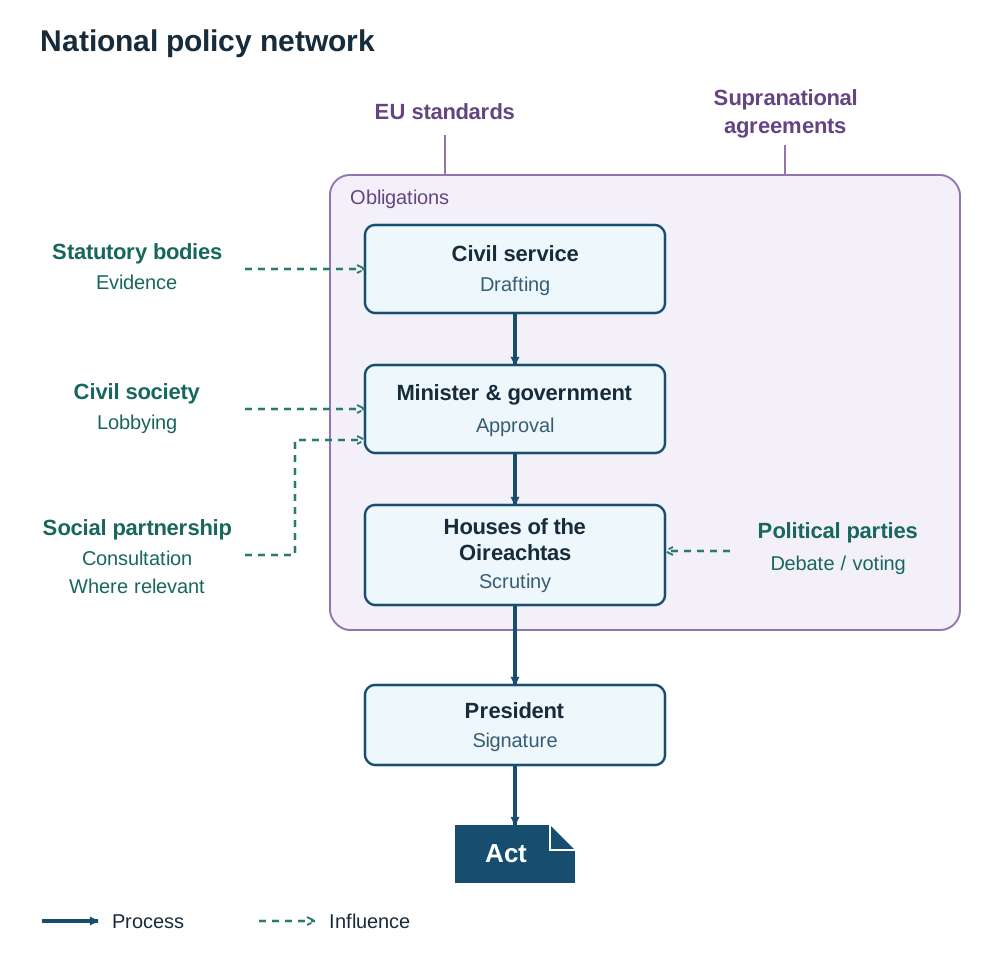
National policy is the formal process through which problems are identified, legislation is drafted, and public programmes are implemented. Learning Outcome 2.1 requires understanding how policy is made at national level in relation to a policy impacting young people, examining nine specific actors.
The Nine Core Actors in National Policy
- Civil Society Bodies: Non-governmental organisations, trade unions, student unions, and advocacy charities that mobilise public campaigns, gather grassroots evidence, and lobby politicians.
- Statutory Bodies: Independent state agencies established by law (e.g. the Health Service Executive, Tusla, or the Road Safety Authority) that provide technical research, administrative data, and enforcement services.
- The Civil Service: Permanent, non-partisan officials within government departments who analyse legal feasibility, assess financial costs, draft the general scheme (heads of a bill), and consult the Office of the Parliamentary Counsel to produce legal text.
- Social Partnership: A framework of national, multi-year agreements between the government, employers (IBEC), trade unions (ICTU), farming bodies, and community organisations that determined pay, taxation, and welfare from 1987 to 2009. While centralised economy-wide agreements ended after the 2008 financial crisis, regular structured consultation continues today through bodies like the Labour Employer Economic Forum (LEEF) and targeted public-sector pay negotiations.
- The Relevant Minister and the Government: The minister sponsors the bill and brings it to Cabinet. Under Cabinet solidarity, once Cabinet agrees to the proposal, the full government commits its parliamentary majority to passing it.
- Political Parties: Government parties enforce the party whip to secure voting majorities, while opposition parties table amendments, debate bill sections, and offer alternative policies.
- The Houses of the Oireachtas: The bill must pass through five formal stages in both Dáil Éireann and Seanad Éireann:
- First Stage: Formal introduction and publication.
- Second Stage: General debate on the principles of the bill.
- Third Stage (Committee Stage): Line-by-line examination and amendment by a parliamentary committee.
- Fourth Stage (Report Stage): Consideration of amendments made at Committee Stage.
- Fifth Stage: Final vote on the completed text, before submission to the President to sign into law.
- The European Union: EU directives and regulations establish binding legal standards that domestic legislation must respect. Where EU directives apply, member states must transpose them into national law; states can also introduce higher national protections provided they comply with EU single-market rules.
- Supranational Agreements: International treaties ratified by Ireland, such as the United Nations Convention on the Rights of the Child (UNCRC), create binding obligations to protect children's safety, health, and right to be heard.
Applied Case Study: Public Health (Tobacco and Nicotine Inhaling Products) Act 2023
This legislation banned the sale of nicotine-inhaling products (e-cigarettes/vapes) to persons under 18 years of age, prohibited vape vending machines, and banned advertising targeted at children.
- Civil Society: Health organisations (Irish Heart Foundation, Irish Cancer Society) collected survey data showing surging vaping rates among teenagers and lobbied TDs for an immediate ban on sales to minors. Retail bodies raised operational concerns regarding enforcement.
- Statutory Bodies: The HSE, through its Tobacco Free Ireland programme and the Health Research Board, provided medical evidence on nicotine addiction and adolescent lung health.
- Civil Service: Officials in the Department of Health reviewed international public-health evidence, drafted the general scheme, and prepared the detailed statutory language with state legal drafters.
- The Minister and the Government: Minister for Health Stephen Donnelly brought the proposal to Cabinet, securing formal approval to introduce the bill as government-backed legislation.
- Political Parties: Cross-party consensus supported the age limit. Opposition TDs used parliamentary debates to push for wider bans on vape flavours and bright packaging.
- Houses of the Oireachtas: The bill completed all five stages in the Dáil and Seanad, facing detailed committee scrutiny on penalty structures before being signed by the President in December 2023.
- European Union: The Act had to align with the EU Tobacco Products Directive (2014/40/EU), which regulates e-cigarette liquid capacity and nicotine concentrations. Ireland notified the European Commission under single-market transparency rules before enacting the sales ban.
- Supranational Agreements: Article 24 of the UNCRC guarantees every child the right to the highest attainable standard of health. This international treaty gave the state a clear human-rights justification to restrict commercial sales to minors.
- Social Partnership: Played no direct role in this legislation, as modern social dialogue focuses primarily on workplace pay and employment terms via LEEF rather than public-health statutes.
Earlier Comparison (2004 Workplace Smoking Ban): Introduced under the Public Health (Tobacco) Act 2002 (as amended in 2004) and taking effect on 29 March 2004, this historic ban made Ireland the first country in the world to ban smoking in all enclosed workplaces, including pubs. Health charities and trade unions demanded worker protection from second-hand smoke, overcoming resistance from the hospitality lobby through strong executive leadership by then Minister for Health Micheál Martin.
Evaluating Representation: Social Class, Patriarchy, and Care
Representative democracy claims to reflect the entire electorate, but parliaments frequently exhibit severe imbalances in descriptive representation (the degree to which an elected assembly mirrors the social, gender, and economic composition of the public).
Social Class and Economic Power in Capitalism
In Marxist theory, social class is defined by a person's relationship to the means of production. The bourgeoisie owns capital, land, and businesses, while the proletariat owns only its labour power, which it sells for wages.
- Evidence Supporting the Class View: Candidates for national office require flexible professional time, financial savings, and professional networks. TDs in Dáil Éireann are drawn heavily from the professional and commercial classes (lawyers, doctors, business directors, secondary school teachers, and political dynasties). Wealthier cohorts vote at higher rates than lower-income communities. Well-resourced corporate lobbies possess access to decision-makers that tenant organisations and welfare campaigners rarely match. Consequently, issues such as wealth taxation, capital gains exemptions, and private landlord rights often receive sustained parliamentary priority over public housing programmes.
- Critical Evaluation (Limits of the Class View): Free secondary schooling (since 1967) and expanded higher education have widened social mobility. Organised trade unions and left-wing parties give working-class citizens collective bargaining power. Furthermore, class alone cannot explain modern power: power is also divided by gender, race, disability, and age. Modern employment has blurred class lines through salaried professionals, self-employed contractors, and workers holding pension investments. While class remains a key source of political inequality, it does not explain power on its own.
Patriarchy and Gender Representation
Patriarchy is a social system in which men hold primary power and predominate in roles of political leadership, moral authority, social privilege, and control of property. British sociologist Sylvia Walby (Theorising Patriarchy, 1990) identifies six distinct structures of patriarchy:
- Paid work (employment segregation and the pay gap)
- Household production (unpaid domestic labour)
- The state (laws and institutions reflecting male priorities)
- Male violence (coercion and physical intimidation)
- Sexuality (double standards and regulation of female autonomy)
- Cultural institutions (media, education, and religion reinforcing gender roles)
Walby distinguishes between private patriarchy (where women are excluded from public life and controlled within the domestic sphere) and public patriarchy (where women enter the public sphere and the labour market, but remain segregated into lower-paid roles, under-represented in senior offices, and burdened with domestic labour).
- Evidence that Modern Ireland is a Patriarchy: Following the November 2024 general election, women held 44 of the 174 Dáil seats (about 25%). No woman has ever served as Taoiseach. Men hold most senior corporate, legal, and media directorships. Large employers continue to report an average gender pay gap under the Gender Pay Gap Information Act 2021. Women perform the vast majority of unpaid domestic care, and domestic and gender-based violence rates remain high. Furthermore, Article 41.2 of the Constitution (referencing a woman's 'life within the home') remains in place following the defeat of the March 2024 care referendum.
- Evidence that Modern Ireland is Not a Patriarchy: Ireland has elected two female Presidents (Mary Robinson in 1990 and Mary McAleese in 1997). Formal legal barriers to female employment and political candidacy have been abolished. Candidate gender quotas under the Electoral (Amendment) (Political Funding) Act 2012 forced political parties to run at least 30% female candidates in 2016 and 2020, rising to 40% for the 2024 general election or lose half of their state funding. Women outnumber men among university graduates, and historic referendums (Marriage Equality in 2015 and Repeal of the Eighth Amendment in 2018) demonstrated public rejections of conservative social restrictions.
- Conclusion: Evaluating the evidence through Walby's framework indicates that Ireland has largely shifted from private to public patriarchy. While explicit legal barriers have been dismantled, deep structural obstacles continue to hinder women in politics, senior management, and care responsibilities.
Kathleen Lynch: Affective Equality and Political Exclusion
Irish sociologist Kathleen Lynch (Affective Equality, 2009) argues that liberal political science ignores the reality that human beings are deeply interdependent care-givers and care-recipients. Society relies upon constant unpaid and low-paid caring work, which is carried out disproportionately by women. Lynch contends that equal political representation cannot be achieved until caring work is valued and shared fairly across society. Because primary carers carry heavy emotional and time demands, they lack the resources and flexibility to survive the late-night, Dublin-centred demands of Leinster House.
PR-STV: Proportionality vs Clientelism
While PR-STV produces a proportional parliament and enables independents and small parties to win election, multi-seat constituencies force candidates from the same party to run directly against one another. This internal competition fuels clientelism (parish-pump politics). TDs frequently prioritise personal constituent casework (e.g. following up medical cards, hospital appointments, and local planning letters) to defend their local personal vote, sometimes at the expense of national policy scrutiny and executive oversight.
Connecting Strand 1 Foundations to the National Arena
Learning Outcome 2.4 requires examining how the core arguments about rules (from LO 1.2) and the dimensions of power (from LO 1.3) apply at national and European levels.
Applying Topic 1 Arguments about Rules to National Governance
| Topic 1 Argument about Rules | National Policy Example | Political Spectrum Alignment |
|---|---|---|
| Rules protect the weak from the strong and ensure order | Minimum wage legislation, workplace safety laws, child protection statutes, and age limits on tobacco/vapes | Can be supported by both Left and Right (Locke's social contract) |
| Those with wisdom and knowledge should make the rules | Deferring public health policy to NPHET/HSE medical experts, or economic strategy to the Central Bank and civil service | Technocratic; accepted by both Left and Right |
| Very few rules, limited strictly to safety; anything more infringes liberty | Opposition to progressive wealth taxes, housing market regulations, and state commercial restrictions (e.g. Robert Nozick's minimal state) | Right-wing (Libertarian/Neoliberal) |
| The powerful make rules to suit their own class interests | Commercial lobbying by banking federations or property developers; tax exemptions for corporate capital (Karl Marx) | Left-wing (Socialist/Marxist critique) |
| Danger of rules being enforced arbitrarily | State surveillance powers, public order arrests, or Garda oversight mechanisms (investigated by the Garda Síochána Ombudsman Commission / Fiosrú) | Civil libertarian; supported by both Left and Right |
| Order is maintained through shared norms and values, not enforcement | Widespread civic compliance with the 2004 workplace smoking ban, which required almost no police enforcement | Sociological/Communitarian; non-aligned |
The Three Dimensions of Power at National Level
- First Dimension (Direct Coercion): Getting people to act in ways they would not otherwise act through statutory laws, court orders, fines, and imprisonment (e.g. collecting income taxes or enforcing age-restricted vape sales).
- Second Dimension (Agenda Setting): Being able to set rules and procedures that benefit some groups while keeping awkward issues off the national agenda (e.g. corporate lobbies preventing aggressive windfall taxes, or institutional party rules excluding non-traditional candidates).
- Third Dimension (Shaping Ideas / Ideology): Shaping public desires and beliefs so that citizens accept existing arrangements as natural, unavoidable, or 'common sense' (e.g. political arguments that public spending must always be constrained by corporate tax competitiveness).
Power by the 'Powerless': Power is not held solely by formal institutions. Institutionally powerless groups can build power through civic coalitions, trade union strikes, student boycotts, and mass social movements (e.g. the 2018 Repeal of the Eighth Amendment campaign, which forced national parties to reform reproductive healthcare).
Evaluating Research on Representation: The Data-Based Case Study
Section 2 of the Leaving Certificate Higher Level paper is an unseen data-based case study worth 30% of the total marks. Learning Outcome 2.5 requires students to summarise evidence on Irish electoral representation and critically evaluate unseen qualitative or quantitative research.
Evidence on the Effectiveness of Irish Representation
- Proportionality: PR-STV generates an assembly that broadly matches total national party votes, avoiding the extreme distortions of first-past-the-post systems.
- Electoral Turnout: Turnout in the November 2024 general election was approximately 60% (down from 63% in 2020). Turnout is uneven: it is typically much lower in disadvantaged urban areas and among young voters than in wealthier areas and among older voters. As a result, election outcomes disproportionately reflect the priorities of older, property-owning voters.
- Diversity Gaps: Despite candidate quotas raising female Dáil representation to ~25% in 2024, significant descriptive representation gaps remain. Working-class workers, ethnic minorities, Travellers, and people with disabilities remain severely under-represented in the Oireachtas (Senator Eileen Flynn, nominated in 2020, became the first Traveller member of the Oireachtas).
- Institutional Oversight: In 2023, Ireland established An Coimisiún Toghcháin (the Electoral Commission), an independent statutory body responsible for reviewing Dáil constituency boundaries, running voter education campaigns, overseeing the electoral register (which local authorities maintain), and overseeing referendum information.
- Deliberative Alternatives: To supplement parliamentary elections, Ireland has used deliberative bodies: the Convention on the Constitution (which recommended marriage equality) and Citizens' Assemblies (e.g. on the Eighth Amendment, biodiversity loss and drugs use). These assemblies bring together randomly selected, demographically representative citizens to review expert evidence and deliberate on contentious issues, demonstrating a model of participatory democracy.
The 'SAMPLE' Method for Critiquing Unseen Research
When asked to evaluate an unseen data extract, table, or research report, apply this six-step checklist:
- S – Source: Who funded and conducted the study? Is the author an independent academic body (e.g. ESRI), a government department, or a commercial advocacy group with a vested interest?
- A – Amount: What is the sample size ()? A survey of 1,000 voters carries statistical weight; a focus group of 20 people cannot support broad national conclusions.
- M – Method: How was the data gathered? Quantitative tools (structured surveys, national census data) produce statistical generalisability; qualitative tools (semi-structured interviews, focus groups) reveal deep personal motivations but cannot establish statistical prevalence.
- P – Population: Was the sample selected using stratified random sampling, or was it a self-selected online poll? Does the sample accurately reflect demographic variables (age, gender, social class, geography)?
- L – Limits: What are the temporal and contextual boundaries? When was the study completed? Is correlation being mistaken for causation?
- E – Extent: Do the authors' conclusions overreach what the data actually proves? Are qualitative personal quotes being presented as universal national truths?
Exam Technique: In the exam, always state at least one methodological strength, at least one methodological limitation, and provide an overall judgement on the reliability of the research.
Media Power and Democratic Discourse: Traditional vs New Media
A functioning democracy requires an informed public. The media links citizens to political institutions, ideally operating through three core democratic concepts:
- Freedom of the Press: The legal right of news organisations and journalists to investigate, report, and critique government policies without state censorship, arrest, or arbitrary interference. In Ireland, press freedom is protected under Article 40.6.1 of Bunreacht na hÉireann, subject to public order and morality.
- Social Responsibility of the Press: The ethical obligation of journalists to report facts accurately, verify sources, provide balanced analysis, respect personal privacy, and avoid publishing sensationalist claims that incite hatred or panic.
- Accountability of the Press: The mechanisms through which media outlets answer for inaccuracies, bias, or defamatory reporting. In Ireland, print and online news publishers answer to the independent Press Council and Press Ombudsman (formally recognised under the Defamation Act 2009); broadcasters and online video platforms are regulated by the statutory body Coimisiún na Meán; and all media can be sued for defamation in the civil courts.
Traditional Media vs New Media
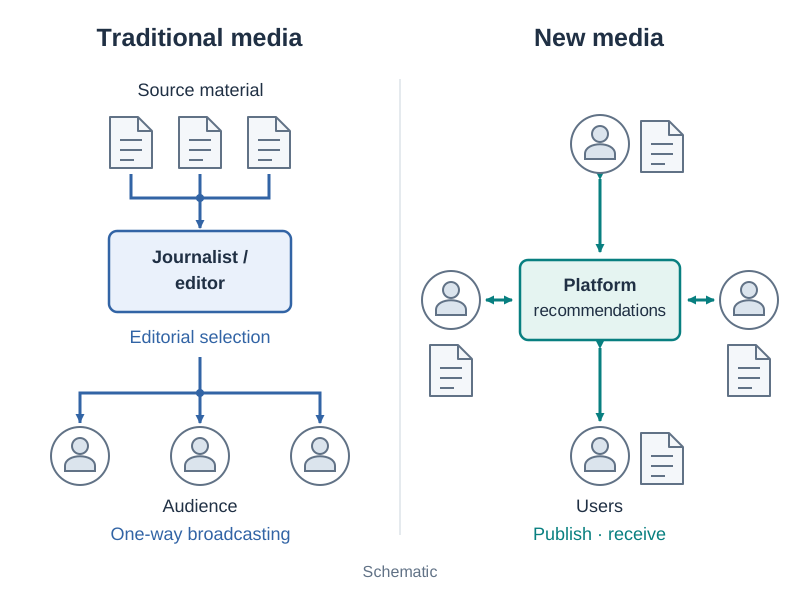
- Traditional Media: Includes newspapers, terrestrial radio, and broadcast television. Characterised by centralised ownership, one-way communication to a mass audience, and professional journalists serving as editorial gatekeepers who verify evidence before publication.
- New Media: Encompasses social media networks, video-sharing platforms, blogs, and podcasts. Characterised by decentralisation, immediate global publication, and interactive, two-way user-generated content.
Misinformation vs Disinformation
- Misinformation: False or inaccurate information that is created or shared without deliberate intent to deceive (e.g. an individual sharing an unverified health rumour believing it to be true).
- Disinformation: False information created, manipulated, and spread deliberately to deceive, manipulate public opinion, or undermine democratic institutions (e.g. coordinated bot farms distributing fabricated claims during an election campaign).
Challenges for Media Regulators
Regulating digital media presents serious difficulties for regulatory bodies like Coimisiún na Meán:
- Cross-Border Jurisdiction: Major multinational technology corporations (such as Meta, Google, and TikTok) operate globally. Because many maintain their European headquarters in Dublin, Ireland carries primary enforcement responsibility under the EU Digital Services Act.
- Volume and Velocity: The scale and speed of daily user uploads make human pre-broadcast editorial verification impossible.
- Anonymous Accounts: Perpetrators of online abuse, hate speech, and disinformation can hide behind pseudonyms across jurisdictions.
- Algorithmic Engagement: Commercial social media platforms use recommendation algorithms designed to maximise user attention. Sensational, polarising, and extreme content receives higher engagement, creating filter bubbles and echo chambers.
- Balancing Rights: Regulators must continually balance combating illegal hate speech and harassment against protecting freedom of speech under human-rights law.
Six Dimensions of Media Power
- Ownership and Control: Media conglomerates can shape editorial lines to reflect commercial or political alliances (e.g. Mediahuis owning both the Irish Independent and Sunday Independent).
- Role of Advertising: Commercial newsrooms depend on corporate advertising revenue, creating commercial pressure to produce soft reporting on corporate backers (e.g. RTÉ depending on a hybrid funding model of the television licence fee alongside commercial advertising).
- Power of Media Workers: Editors, news presenters, and producers decide which stories lead the news bulletin, framing the boundaries of public debate (demonstrated by public scrutiny during the 2023 RTÉ financial payments controversy).
- Targeting Strategies: Digital platforms use personal user data to deliver algorithmic, micro-targeted political advertisements that avoid public scrutiny.
- Origination of Content: Downsized newsrooms rely heavily on pre-packaged public relations copy, corporate press releases, and ministerial announcements rather than funded investigative journalism.
- Global Reach: Digital platforms operate across state borders instantly, allowing human-rights movements to spread while making it difficult for national regulators to police foreign election interference.
Connection to 1.3 Power Dimensions: Media ownership exerts direct agenda-setting power (Second Dimension), while corporate filtering shapes public common sense and ideological assumptions (Third Dimension).
Prescribed Thinkers on Power, Governance, and Media
Learning Outcome 2.7 requires students to understand the contributions of seven named thinkers, including the historical and political contexts in which they wrote:
| Thinker | Historical and Political Context | Core Concept | Leaving Certificate Exam Application |
|---|---|---|---|
| Thomas Hobbes (1588–1679) | Wrote Leviathan (1651) during the chaos and bloodshed of the English Civil War, concluding that humans without authority fall into destructive conflict. | In a state of nature, human life is 'solitary, poor, nasty, brutish, and short'. Rational individuals surrender their freedom to an absolute sovereign in exchange for basic physical safety. | Justifies centralised executive authority (e.g. China's authoritarian rule or emergency public health lockdowns) where social order is prioritised over civil liberties. |
| John Locke (1632–1704) | Wrote Two Treatises of Government (1689) in the context of the Glorious Revolution of 1688, justifying limits on royal monarchy. | Government derives legitimate authority solely from the consent of the governed to protect natural rights: life, liberty, and property. If rulers violate this trust, citizens may alter or remove them. | Underpins parliamentary democracy, regular general elections, and public health legislation (such as vape age limits) to protect citizen welfare. |
| Karl Marx (1818–1883) | Wrote The Communist Manifesto (1848, with Friedrich Engels) and Capital in 19th-century industrial Britain, observing severe factory exploitation and working-class poverty. | Under capitalism, the state functions as an instrument of the ruling class (bourgeoisie) to suppress and exploit the working class (proletariat). Economic power dictates political power. | Explains the class bias in parliamentary representation, the predominance of wealthy TDs, and corporate lobbying influence over housing and tax policy. |
| Robert Nozick (1938–2002) | Wrote Anarchy, State, and Utopia (1974) as a libertarian philosophical rebuttal to John Rawls's case for state redistribution of wealth. | Defends the minimal state ('night-watchman state') restricted strictly to protection against force, theft, and breach of contract. Redistributive taxation violates individual self-ownership. | Provides a libertarian critique of state intervention, high income taxes, commercial regulations, and paternalistic public health bans. |
| Sylvia Walby (1953–present) | British feminist sociologist; published Theorising Patriarchy (1990) during debates on structural barriers facing women in modern Britain. | Defines patriarchy as a system of social structures in which men dominate, oppress, and exploit women across six structures. Tracks the shift from private to public patriarchy. | Provides the theoretical framework for evaluating whether modern Ireland is a patriarchy and justifies candidate gender quotas to overcome institutional state bias. |
| Kathleen Lynch (Contemporary) | Irish sociologist and Professor of Equality Studies at UCD; published Affective Equality (2009) amid Irish economic expansion and social inequality. | Theorises affective equality: humans are interdependent beings who give and receive care. Ignoring unpaid care labour creates deep political and social injustice. | Explains how unequal burdens of domestic care work exclude women and working-class carers from contesting demanding political careers in Dáil Éireann. |
| Noam Chomsky (1928–present) | American linguist and political activist; wrote Manufacturing Consent (1988, with Edward Herman) analysing US news coverage of Cold War foreign interventions. | Mass commercial media operates through five institutional filters (ownership, advertising, sourcing, flak, and ideology) to manufacture consent for elite economic and state agendas. | Critiques commercial media bias, corporate news ownership, and explains how major news outlets construct public consent for government policies. |
Key terms
- Executive Branch
- The branch of government responsible for executing laws, directing national policy, and administering state departments (in Ireland, the Taoiseach and Cabinet).
- Separation of Powers
- The constitutional doctrine dividing authority between legislature, executive, and judiciary to prevent arbitrary power, established in Article 6 of Bunreacht na hÉireann.
- Cabinet Solidarity
- The constitutional requirement (Article 28) that the Government is collectively responsible for state departments; by convention, a minister who cannot publicly support a Cabinet decision must resign.
- Consociationalism
- A power-sharing governance model used in divided societies (such as Northern Ireland) requiring cross-community executive representation to prevent majority domination.
- D'Hondt System
- A mathematical formula used in the Northern Ireland Assembly to allocate ministerial departments proportionally based on each party's seat total.
- Democratic Deficit
- The criticism that decisions in international organisations like the EU are made by bodies that lack direct electoral accountability to ordinary citizens.
- Descriptive Representation
- The extent to which an elected parliament mirrors the actual demographic, gender, class, and ethnic composition of the society it represents.
- Social Class
- The hierarchical grouping of people in society based on shared economic status, wealth, income, and occupational position.
- Patriarchy
- A social system characterised by structural power imbalances where men hold primary leadership, decision-making authority, and systemic privilege over women.
- Affective Equality
- A concept developed by Kathleen Lynch asserting that justice requires the fair distribution of love, care, and solidarity work, recognising how unequal care burdens block political participation.
- Clientelism
- A political practice where elected representatives focus on personal constituent favours and local issues to secure re-election rather than national policy-making.
- Minimal State
- Robert Nozick's libertarian model of government, restricted strictly to protecting citizens against force, theft, fraud, and breach of contract.
- Misinformation
- False or inaccurate information created or shared without deliberate intent to deceive or manipulate.
- Disinformation
- False or manipulated information created and spread deliberately to deceive the public, skew debate, or undermine democratic institutions.
- Qualified Majority Voting
- The voting rule used in the Council of the EU requiring approval by 55% of member states representing at least 65% of the total EU population.
- Motion of Censure
- A formal vote in the European Parliament that, if passed by a two-thirds majority of votes cast, forces the entire European Commission to resign.
Check yourself
A 3-seat Dáil constituency has 40,000 total valid votes. Calculate the Droop quota required for a candidate to be elected.
Formula: (Total Valid Poll ÷ (Seats + 1)) + 1. Calculation: (40,000 ÷ 4) + 1 = 10,000 + 1 = 10,001 votes.
What is the key difference between how Northern Ireland's First Minister is appointed and how remaining ministers are selected?
The First Minister is nominated by the largest party in the Assembly overall (holding joint office with the deputy First Minister from the largest party of the other main designation), whereas other ministerial portfolios are allocated mathematically among qualifying parties using the D'Hondt system.
Define 'social class' in Marxist terms.
In Marxist theory, social class is defined by an individual's relationship to the means of production: the bourgeoisie owns capital, land, and firms, while the proletariat owns only its labour power, sold for wages.
Explain the difference between misinformation and disinformation.
Misinformation is false information shared without intent to deceive (e.g. sharing an inaccurate health tip believing it is real), while disinformation is false information created and spread deliberately to deceive or manipulate (e.g. coordinated fake accounts during elections).
State two methodological weaknesses of an online survey of 50 people from one county claiming to show national attitudes towards public transport.
1. Sample size: 50 respondents is far too small to support national generalizations. 2. Sampling bias: surveying people from only one county in an online self-selected poll fails to provide a representative, randomized national cross-section.
Why would Robert Nozick object to government legislation banning the sale of vapes to under-18s?
Nozick advocated a minimal state ('night-watchman state') restricted strictly to protection against force and theft; he argued that commercial regulations and paternalistic lifestyle bans infringe upon individual freedom, private property rights, and commercial liberty.