

Strand 4 explores how global interconnectedness reshapes local belonging, cultural practices, and political power. Topic 7 focuses on Globalisation and Identity. It examines the channels through which national identities are presented to young people in Ireland, North and South, and how migration and digital media drive cultural change. The topic also examines ethnic, linguistic, and religious diversity across the European Union, evaluates four major arguments on interactions between Western and non-Western cultures, and weighs whether sovereign decision-making is shifting from national governments to international bodies.
Representations of National Identity Made Available to Young People (7.1)
Young people are not born with a ready-made national identity. Instead, they encounter representations of national belonging through institutions, media, and cultural practices from an early age.
Channels of Representation
- Schooling and curriculum: History syllabi, national literature, and language instruction transmit shared narratives. In the Republic, national commemorations, such as the Decade of Centenaries (2012–2023), actively promoted historical reflection. In Northern Ireland, schooling remains largely separate: only around 7% to 8% of pupils attend formally integrated schools, meaning most children experience curricula shaped by either a Catholic/nationalist or Protestant/unionist ethos.
- Sport: Athletic organisations provide emotional and visual rituals of identity. The Gaelic Athletic Association (GAA) reinforces local parish and county ties linked to a distinct Irish cultural identity, while international soccer and rugby teams rally cross-community or pan-island support.
- Broadcasting and digital media: Public service broadcasters like RTÉ and TG4 provide cultural programming, while social media algorithms expose young people to global youth culture alongside local political content.
- Public symbols and streetscapes: Flags, anthems, parades, and street murals visually signal communal identity. This visual culture is especially prominent in Northern Ireland, where unionist and nationalist murals and parading traditions assert community boundaries.
Generational Change and Research Evidence
In the Republic, the Central Statistics Office (CSO) Census 2022 recorded that approximately 12% of the resident population holds non-Irish citizenship. Some argue that more diverse classrooms encourage young people to see Irishness in civic terms (taking part in society and sharing its rights) rather than by ancestry or religion.
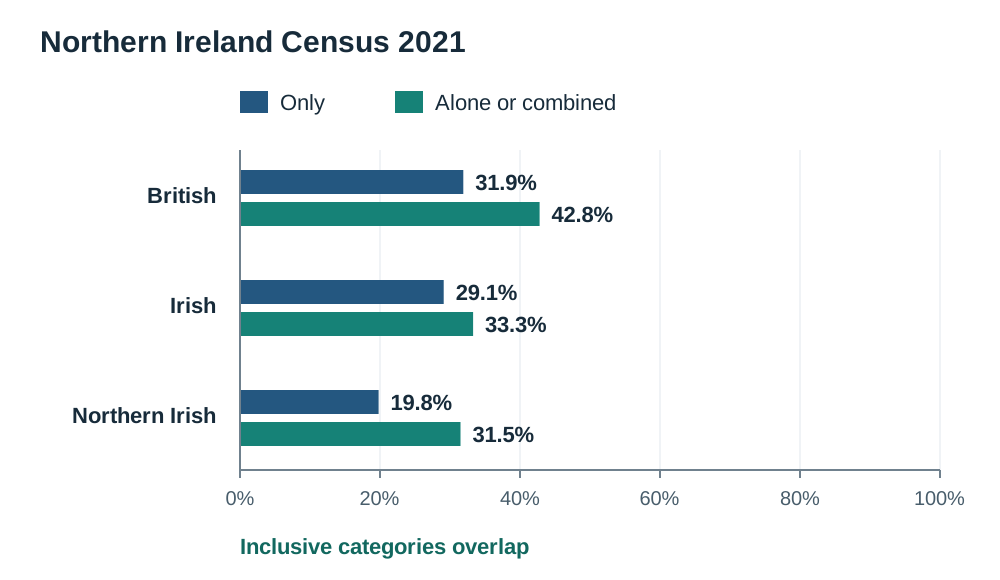
In Northern Ireland, the annual Young Life and Times (YLT) survey carried out by ARK (Queen's University Belfast and Ulster University) among 16-year-olds consistently shows that young people are more inclined than older generations to select Northern Irish as their label or to reject traditional sectarian categories altogether. The 2021 Northern Ireland Census shows that identity is now plural: 31.9% of respondents identified as British only, 29.1% as Irish only, and 19.8% as Northern Irish only. When multiple identities were counted, 42.8% included British, 33.3% included Irish, and 31.5% included Northern Irish, demonstrating that many people hold more than one national identity rather than choosing only one.
Understanding Identity: Common Culture versus Imagined Communities (7.4)
Political sociologists offer two contrasting explanations for how national and ethnic groups are constituted.
Argument 1: The Shared-Culture Argument
This perspective argues that a national or ethnic group is held together by genuine objective commonalities: shared values, beliefs, daily customs ('ways of doing things'), and often a common history and language.
- Supporting evidence: People living within a society share concrete cultural practices, such as sporting codes, holiday rituals, legal norms, and shared historical memories of events like emigration or national struggles.
- Limitations: Modern nations contain deep internal divisions. People living in the same state hold radically different moral, political, and religious views. Furthermore, culture is never static; treating it as fixed ignores how customs adapt over time.
Argument 2: Nations as Imagined Communities
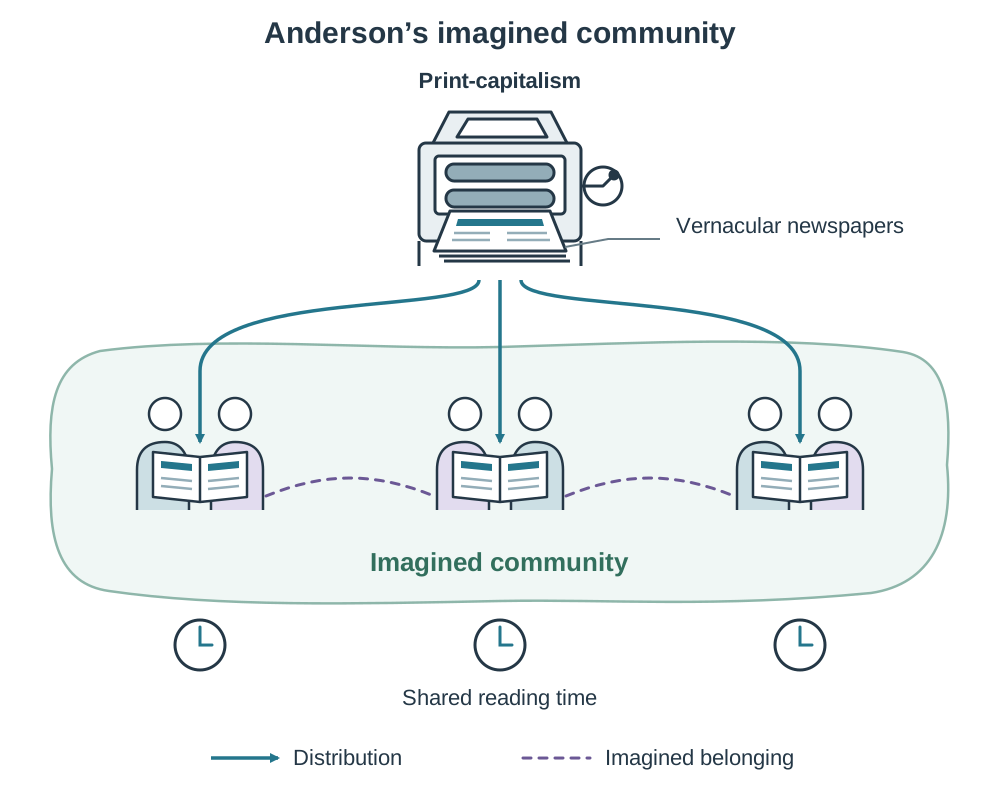
Benedict Anderson argued that the nation is a socially constructed imagined community. It is imagined because members of even the smallest nation will never meet, hear, or know most of their fellow members, yet in the minds of each lives the image of their communion. He identified key characteristics of this community:
- It is imagined as limited, with finite, elastic boundaries beyond which lie other nations.
- It is imagined as sovereign, born during the Enlightenment when divinely ordained dynastic hierarchies lost legitimacy.
- It is imagined as a community, conceived as a deep, horizontal comradeship.
Anderson showed that print-capitalism (mass-produced daily newspapers and novels printed in vernacular languages) enabled geographically scattered people to consume the same information simultaneously, imagining themselves as a single national body moving together through time. Today, shared television broadcasts or All-Ireland finals operate with the same logic.
Evaluating the Two Arguments
The imagined community model provides a more robust explanation of modern politics. It explains why people are willing to die for strangers, why national identity survives major cultural changes, and why two communities sharing similar material lives (such as nationalists and unionists in Northern Ireland) can imagine themselves into distinct national groups. However, shared culture remains the raw material people draw upon when imagining that community.
Dynamics of Ethnic Identity
Anthropologist Thomas Hylland Eriksen argues that ethnicity is relational and situational: it exists only in contact between groups, sharpening during political or economic competition and softening during cooperative interactions.
- Benefits of a secure ethnic identity: Provides psychological resilience, social solidarity, and the ability to mobilise for legal recognition, as seen in the civil rights campaigns of minority groups.
- Risks of an insecure ethnic identity: Can trigger defensive xenophobia, fear of cultural dilution, and radical exclusionary nationalism targeting minority populations.
In March 2017, the Taoiseach formally recognised Irish Travellers as a distinct ethnic group in a statement to Dáil Éireann. This recognition was symbolic rather than legislative and created no new statutory rights, yet it officially broadened Ireland's imagined community to acknowledge Travellers' distinct history and cultural traditions.
Diversity and Cultural Change: Adaptation, Mixing, and the EU (7.2, 7.3)
Cultures do not remain static across time. They are the product of continuous mixing, adaptation, and contact with other groups. Globalisation accelerates this process through migration, travel, and information and communication technology (ICT).
The Mechanics of Cultural Change
- Migration and travel: Direct contact brings new cultural practices into host communities. In Ireland, inward migration has introduced diverse community festivals, places of worship, languages, and foods, while the global Irish diaspora of an estimated 70 million people spreads Irish customs abroad.
- Information and communication technology (ICT): Digital platforms accelerate cultural exchange. Young people absorb international music, fashion, and social movements instantly. At the same time, ICT provides tools for cultural preservation: apps like Duolingo, TG4's global streaming service, and viral social media content allow minority and regional languages like Irish to engage youth and diaspora audiences.
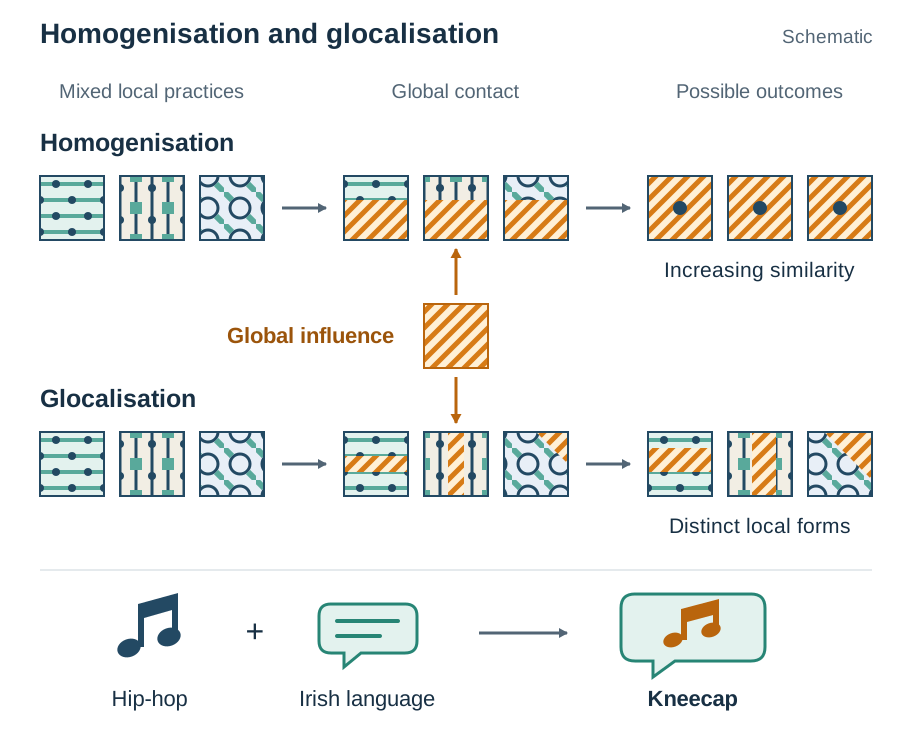
- Glocalisation: Rather than submitting to simple cultural homogenisation (where Western commercial brands flatten local customs), societies adapt global phenomena to local contexts. For example, the Belfast hip-hop group Kneecap uses a contemporary global music genre to express youth experiences through the Irish language.
Diversity in the European Union
The European Union operates under the motto 'In varietate concordia' (United in Diversity), balancing three main forms of pluralism:
- Ethnic diversity: Historical indigenous minorities (such as 10 to 12 million Roma spread across Europe and the Sámi in Scandinavia) coexist with established communities resulting from post-colonial migration (such as North African populations in France) and intra-EU movement under freedom of movement provisions.
- Linguistic diversity: The EU has 24 official working languages, including Irish, which achieved full status in 2022. This linguistic parity ensures citizens can read legislation directly binding them in their native language. In addition, over 60 regional or minority languages (such as Catalan, Basque, Breton, and Frisian) are spoken across member states and protected by the Council of Europe's European Charter for Regional or Minority Languages.
- Religious diversity: Significant secularisation in Western and Northern Europe coexists with major Christian denominations, historical Jewish communities, and growing Muslim, Hindu, and Buddhist populations.
Western and Non-Western Cultural Interactions: Four Competing Arguments (7.5)
Learning Outcome 7.5 requires students to evaluate four distinct arguments regarding the relationship between Western and non-Western cultures:
1. Orientalism and the Construction of 'The Other'
In Orientalism (1978), Palestinian-American scholar Edward Said argued that the West historically constructed its own identity ('us') in opposition to the non-Western world ('them'). Through colonial scholarship, literature, and imperial governance, the West imagined itself to be rational, civilised, and mature, while depicting the Orient as irrational, depraved, and childlike. Said showed that this imaginative division was an instrument of power used to legitimise imperial rule.
- Evaluation: Said's analysis remains highly persuasive for unpacking contemporary media bias and stereotyping, though globalisation and the rise of non-Western media platforms (such as Nollywood, Al Jazeera, and East Asian cinema) increasingly challenge Western cultural hegemony.
2. Cosmopolitan Culture and Cultural Hybridity
This perspective argues that travel, commerce, and digital communication are breaking down rigid national barriers, generating a global cosmopolitan culture and shared identities. Global civil society mobilisations around climate action and human rights demonstrate that citizens can unite across continents.
- Evaluation: While cultural mixing is widespread, this argument overstates the decline of the nation-state. As Eriksen notes, globalisation often triggers defensive local reactions, causing people to re-embed themselves in traditional, national, or religious identities rather than adopting a purely borderless mindset.
3. The Clash of Civilisations
In The Clash of Civilizations and the Remaking of World Order (1996), Samuel Huntington argued that post-Cold War conflicts are rooted in cultural and religious divisions rather than political ideologies. He divided the world into major civilisational blocs (such as Western, Islamic, Sinic, and Hindu) and argued that modernisation does not equal Westernisation. Non-Western societies adopt modern technology while reasserting their traditional cultural and religious identities.
- Evaluation: Huntington's thesis is widely criticised for treating civilisations as uniform blocs, ignoring deep internal divisions (such as Sunni-Shia conflicts), and downplaying diplomatic and trade cooperation across cultural boundaries. Said directly challenged Huntington in 'The Clash of Ignorance' (2001), arguing that civilisations are internally diverse and constantly exchanging ideas.
4. The Defence of Western Liberal Values
This argument asserts that Western traditions of rational inquiry, secular democracy, free expression, and universal human rights are exceptional achievements that must be actively defended from competing civilisational values, or risk being extinguished.
- Evaluation: This perspective wrongly frames human rights as an exclusively Western possession. The Universal Declaration of Human Rights reflects contributions from non-Western thinkers, and human rights principles are embraced globally. Furthermore, critics note that major threats to democratic norms—such as authoritarian populism and disinformation—often originate within Western democracies themselves.
Participants in the Debate: Thinkers and Their Contexts (7.7)
The specification names five central thinkers whose ideas explain identity, culture, and power:
- Benedict Anderson (1936–2015): A political scientist at Cornell University who specialised in Southeast Asian history (especially Indonesia). Writing in the shadow of conflicts between post-colonial communist regimes in Southeast Asia, his landmark book Imagined Communities (1983) explained how modern nations emerged not as ancient bloodlines, but as social constructs enabled by print-capitalism.
- Edward Said (1935–2003): A Palestinian-American literary theorist and cultural critic at Columbia University. Raised under British rule in Jerusalem and Cairo, his experience of displacement informed Orientalism (1978). Said founded post-colonial studies, revealing how imperial powers deployed cultural representations to control and subjugate non-Western peoples. In 'The Clash of Ignorance' (2001), he attacked civilisational essentialism.
- Samuel Huntington (1927–2008): An American political scientist and government advisor at Harvard University. Following the collapse of the Soviet Union, he published his 1993 article and 1996 book The Clash of Civilizations to reject the liberal optimism that Western democracy had permanently triumphed, warning that future conflicts would fall along cultural and religious fault lines.
- Kwame Anthony Appiah (born 1954): A British-Ghanaian philosopher who grew up in Kumasi, Ghana, and England, and currently teaches at New York University. In Cosmopolitanism: Ethics in a World of Strangers (2006), Appiah formulated rooted cosmopolitanism, which balances universal obligations to humanity with legitimate respect for local cultural differences. He praises cultural mixing ('contamination') as the natural state of human societies. This contrasts with political figures like John Hume, whose defence of diversity focused on practical peace-building in Northern Ireland, whereas Appiah develops a global ethical framework that also identifies clear moral limits to tolerance.
- Thomas Hylland Eriksen (1962–2024): A Norwegian social anthropologist at the University of Oslo who conducted fieldwork in multi-ethnic societies like Mauritius and Trinidad. In Ethnicity and Nationalism (1993) and Globalization: The Key Concepts (2007), Eriksen showed that ethnicity is relational, situational, and dynamic. He noted that while globalisation 'disembeds' people from traditional routines, it also provokes 're-embedding'—a return to local roots, heritage, and national identity politics.
Globalisation and Political Power: National Sovereignty versus Global Bodies (7.6)
A core debate in modern politics is whether decision-making power has decisively shifted from national parliaments to international institutions.
Institutional Types: Intergovernmental versus Supranational
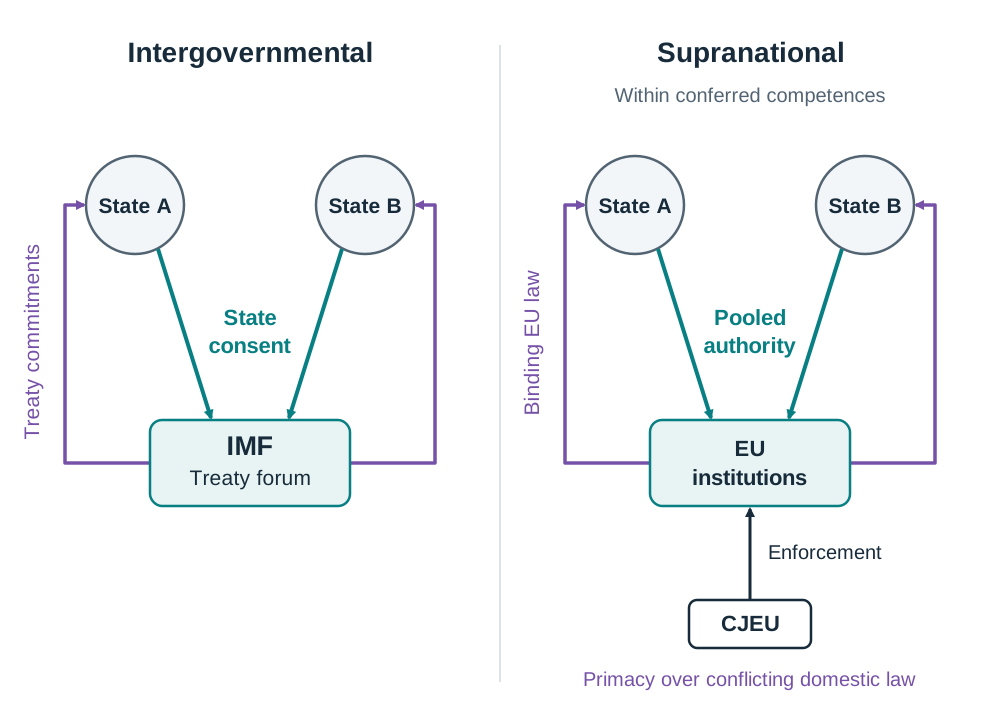
- Intergovernmental organisations (IGOs): Bodies where authority rests on voluntary treaties and state consent. Member states make decisions through consensus or weighted voting formulas, and decisions do not automatically override national legislation. Examples include the International Monetary Fund (IMF), World Bank, World Trade Organisation (WTO), and United Nations Development Programme (UNDP).
- Supranational organisations: Entities where member states pool sovereignty, granting independent institutions the legal power to pass binding laws that take precedence over domestic law. The European Union is the primary example: through the primacy of EU law, European directives and regulations override conflicting domestic statutes, enforced by the Court of Justice of the European Union (CJEU).
Case Study: Decision-Making and Youth Policy in the 2010–2013 EU/IMF Bailout
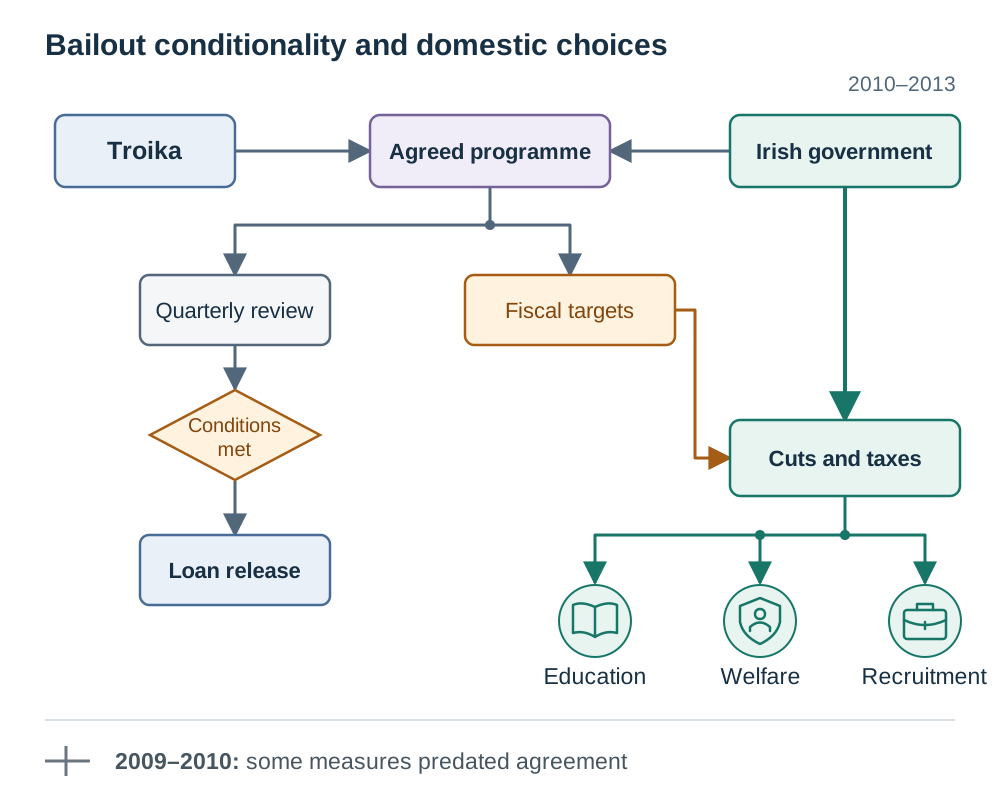
In November 2010, Ireland entered an €85 billion economic adjustment programme with the Troika (European Commission, European Central Bank, and IMF). Financial support was tied to strict conditionality detailed in a Memorandum of Understanding, requiring quarterly reviews before loan tranches were disbursed.
- Impact on young people: The required fiscal targets entrenched deep domestic spending cuts, leading to a public sector recruitment freeze, higher third-level student contribution fees, reduced Jobseeker's Allowance rates for claimants under 25, youth unemployment exceeding 30% in 2012, and widespread graduate emigration.
- Analysis of power dynamics: While external bodies set the macroeconomic deficit targets, the domestic Irish government decided the specific allocations of cuts and taxes. In fact, measures like the public sector recruitment moratorium (2009) and the initial tiered youth welfare cuts (Budget 2010) were initiated by the Irish government before the formal Troika agreement. Power was negotiated and shared rather than totally removed.
Evaluating Power Transfer: Has Sovereignty Moved?
- Arguments that power has shifted away from national governments:
- EU legal supremacy: In September 2024, the CJEU upheld a European Commission state aid ruling requiring Ireland to recover approximately €13 billion in back taxes from Apple, directly overriding the policy preference of the Irish government.
- Enforced compliance: In 2020, the CJEU ruled that Poland, Hungary, and the Czech Republic breached EU law by refusing to comply with mandatory refugee relocation quotas.
- Global regulatory standards: Ireland agreed to the OECD's 15% global minimum corporate tax framework (effective 2024), yielding ground on its long-defended 12.5% rate.
- Arguments that national governments retain sovereign power:
- Veto powers: EU tax laws need unanimous agreement of national ministers in the Council of the EU, and treaty changes must be agreed and ratified by every member state, so Ireland can block them.
- Democratic legitimacy: Transfers of constitutional power require domestic consent. Ireland held referendums to ratify EU treaties like the Lisbon Treaty (2008 and 2009).
- Domestic policy control: National parliaments retain authority over criminal law, policing, healthcare organization, and basic welfare systems.
- Reversibility: Brexit proved that sovereign member states retain the ultimate legal power to trigger Article 50 and leave supranational institutions.
State power is best described as pooled and reconfigured rather than simply lost. Governments choose to share sovereign authority in international institutions to achieve greater economic influence, regulatory control, and market access.
Key terms
- Globalisation
- The widening, deepening, and speeding up of worldwide interconnectedness across economic, social, cultural, and political dimensions.
- Imagined community
- Benedict Anderson's concept that a nation is socially constructed by members who will never meet face-to-face, yet carry in their minds a deep image of horizontal communion.
- Print-capitalism
- The mass production of books and daily newspapers in local vernacular languages, which Anderson argued allowed dispersed populations to imagine themselves as a single national group.
- Shared-culture argument
- The view that a national or ethnic group is held together by objective commonalities, including shared values, beliefs, customs, history, and language.
- Civic identity
- A concept of national belonging based on shared political allegiance, democratic participation, residency, and equality before the law, rather than ancestral descent.
- Ethnic identity
- A concept of belonging based on perceived shared ancestry, language, cultural heritage, and historical continuity.
- Hybrid identity
- A dynamic sense of self that blends traditions, values, and practices from multiple distinct cultural backgrounds.
- Cultural homogenisation
- The process by which local, regional, and indigenous cultures are eroded and replaced by a standardized, dominant global culture (often commercial and Anglo-American).
- Glocalisation
- The adaptation of global products, ideas, and media forms to fit local traditions, languages, and community contexts.
- Cosmopolitanism
- An ethical framework, articulated by Kwame Anthony Appiah as rooted cosmopolitanism, combining universal obligations to all human beings with respect for legitimate local cultural differences.
- Orientalism
- Edward Said's concept describing how Western discourse historically depicted Eastern societies as irrational, exotic, and backward to justify imperial and colonial domination.
- Clash of Civilisations
- Samuel Huntington's thesis that post-Cold War global conflicts occur along cultural and religious boundaries separating major civilisational blocs.
- Intergovernmental organisation
- An international alliance where sovereign states cooperate voluntarily through treaties, retaining their domestic sovereignty and reaching decisions by consensus or weighted voting.
- Supranational organisation
- An international body where member states pool sovereignty, granting independent institutions legal power to pass legislation that directly overrides domestic national law.
- Primacy of EU law
- The legal principle established by the Court of Justice of the European Union that EU law takes precedence over conflicting national legislation of member states.
- Conditionality
- The mandatory structural, budgetary, and fiscal reforms imposed by international lenders (such as the IMF) as conditions for releasing rescue loans.
- Pooled sovereignty
- The sharing of decision-making authority by sovereign nation-states within joint international bodies to achieve collective influence.
Check yourself
What technological innovation did Benedict Anderson identify as enabling modern national consciousness?
Print-capitalism: the mass production of daily newspapers and novels in vernacular languages, which allowed dispersed populations to experience shared events simultaneously.
What is Kwame Anthony Appiah's concept of 'rooted cosmopolitanism'?
An ethical position holding that people have universal obligations to humanity as global citizens, while legitimately maintaining pride and loyalty toward their local and national cultures.
Provide one piece of empirical evidence supporting the imagined community model over the shared-culture model.
Nationalists and unionists in Northern Ireland share much of the same everyday material culture, language, and geography, yet imagine themselves into entirely distinct national communities.
What is Edward Said's central critique in Orientalism?
That Western scholarship, art, and media historically constructed the non-Western world as irrational, backward, and exotic in order to justify colonial domination and frame the West as rational and superior.
How does legal authority differ between an intergovernmental body (like the IMF) and a supranational body (like the EU)?
Intergovernmental bodies rely on voluntary state treaties and consensus or weighted voting without overriding domestic law, whereas supranational bodies can pass binding laws that take primacy over national legislation.
What does Thomas Hylland Eriksen mean when he states that ethnicity is 'relational and situational'?
Ethnicity is not an intrinsic biological essence; it only exists when groups interact, and cultural boundaries sharpen or soften depending on social, economic, and political contexts.