

Topic 3 explores how individuals and groups contribute effectively to communities across local, national, and global contexts. Set within Strand 2 (Active Citizenship) and reflecting the key skill of being personally effective, the topic examines pathways of civic action, the skills required to plan and execute projects, and personal qualities like initiative, flexibility, reliability, and perseverance. It also provides a practical five-stage framework to evaluate community actions and reflect on personal learning, which directly supports the terminal written examination and the Citizenship Project Report.
Pathways to Social Impact: Strategies and Critical Evaluation
Active citizens shape their communities in very different ways. For Leaving Certificate Politics and Society, you need to describe six distinct pathways to social change and evaluate how well each one actually works. When you evaluate an approach, weigh the immediate practical relief it offers against its capacity to bring about long-term structural change.
1. Charity, Voluntary, and Community Work
This pathway delivers direct practical help to vulnerable people through community associations, shelters, or voluntary bodies.
- Irish example: Brother Kevin Crowley established the Capuchin Day Centre in Dublin to give hot meals, food parcels, and primary medical care to people experiencing homelessness.
- International example: Henri Dunant founded the International Committee of the Red Cross to deliver neutral humanitarian aid to wounded soldiers and civilians during armed conflicts.
- Evaluation: Voluntary work brings essential frontline relief and upholds human dignity right away. However, it treats the symptoms of disadvantage rather than dismantling the state policies or economic dynamics that generate poverty in the first place.
2. Running for Political Office
Seeking election gives a citizen a democratic mandate to propose laws, debate policy, and allocate state funding.
- Irish example: Mary Robinson used her election as President of Ireland (1990–1997) to liberalise social discourse and champion human rights, later serving as UN High Commissioner for Human Rights.
- International example: Barack Obama used the presidency to steer the Affordable Care Act (2010) through Congress, extending health insurance coverage to millions of previously uninsured Americans.
- Evaluation: Winning office gives politicians direct statutory power to enact nationwide reform. On the other hand, progress is often slowed down by election cycles, legislative bargaining, and party discipline.
3. Choosing a Career in Public Service
This route means dedicating one's daily professional labour to the public good within state-funded institutions like schools, hospitals, or social services.
- Irish example: A teacher in a DEIS (Delivering Equality of Opportunity in Schools) school or a social worker with Tusla (the Child and Family Agency) works directly within state-funded public services to support vulnerable young people, counter educational disadvantage, and provide safeguarding care to families.
- International example: Florence Nightingale served as a nurse during the Crimean War (1854–1856), collecting statistical mortality data to overhaul hospital sanitation and lay the foundations of professional modern nursing.
- Evaluation: Public servants transform individual lives every day and build deep frontline expertise. Even so, they must operate within budgets and rules set by government departments, which restricts their power to change the wider system unless they also engage in outside advocacy.
4. Using the Law
Legal advocacy involves taking test cases through national courts or international bodies to strike down unfair laws and establish enforceable rights.
- Irish example: David Norris challenged Ireland's criminalisation of male homosexuality in the High Court and Supreme Court. After losing domestically, he won Norris v. Ireland (1988) at the European Court of Human Rights, compelling the Oireachtas to decriminalise homosexuality in 1993.
- International example: Ruth Bader Ginsburg directed the ACLU Women's Rights Project during the 1970s, arguing landmark test cases such as Frontiero v. Richardson (1973) before the US Supreme Court to establish that statutory discrimination based on sex violates equal protection.
- Evaluation: Landmark court decisions set binding legal precedents that shield minorities against majoritarian prejudice. The drawbacks are substantial: court cases take years, demand huge legal expenses, and remain strictly limited by the wording of existing constitutional or statutory texts.
5. Civil Disobedience
Civil disobedience is the open, non-violent refusal to obey an unjust law or state decree. Those who use it accept fines or imprisonment willingly to expose the moral bankruptcy of the law to the broader public.
- Irish example (distinction: non-violent direct action and boycott): The Dunnes Stores anti-apartheid strike (1984–1987) was an example of non-violent direct action and a workplace boycott rather than civil disobedience, as the workers refused an employer's instruction rather than breaking a state law. Mary Manning and fellow IDATU cashiers refused to handle South African grapefruit, were suspended and went on strike, picketing for nearly three years until the Irish government banned South African agricultural imports.
- International example: Mahatma Gandhi led the 1930 Salt March across India, defying the British colonial monopoly by collecting salt from the sea and sparking nationwide non-violent non-cooperation.
- Evaluation: Non-violent refusal commands strong moral authority and mobilises public solidarity. But it depends on having an adversary that cares about public opinion, and it exposes individual activists to state repression, police violence, and criminal records.
6. Proposing the Use of Violence Against an Undemocratic State
This pathway involves resorting to armed sabotage or guerrilla resistance when an undemocratic state has systematically blocked all peaceful, democratic routes to political reform.
- International example: Nelson Mandela co-founded the armed wing of the African National Congress (Umkhonto we Sizwe) in 1961 after the 1960 Sharpeville massacre and the state ban on peaceful opposition groups.
- Evaluation: Armed resistance may be seen as a necessary last resort to protect communities against state terror when ballots, courts, and protests are banned. But political violence brings catastrophic loss of life and frequently sparks entrenched cycles of hatred. Mandela's later shift to multi-party negotiations (CODESA) secured democratic elections in 1994, and his support for the Truth and Reconciliation Commission (1995) helped keep the post-apartheid nation intact.
Evaluating Appropriateness and Personal Qualities
To evaluate why a reformer chose a specific pathway, apply five analytical questions:
- Context: Was the political system a functioning democracy with voting rights, free courts, and a free press, or was it an authoritarian regime where peaceful protest was outlawed?
- Effectiveness: Did the action deliver immediate emergency help, or did it bring about lasting legislative or structural change?
- Legitimacy and ethics: Did the method protect fundamental human rights, or did it cause harm to innocent people?
- Cost and risk: What physical, legal, or financial dangers did the activists and the wider community have to bear?
- Alternatives: Were there less harmful or more practical methods open to them at that moment?
Take Nelson Mandela as an example. Proposing targeted sabotage in 1961 answered the apartheid state's ban on peaceful political parties and the slaughter of unarmed demonstrators at Sharpeville. By contrast, using violence within a modern parliamentary democracy like Ireland would be completely illegitimate, because citizens already have access to ballots, free speech, independent courts, and peaceful protest.
Personal Qualities of Effective Change-Makers
Effective social reformers exhibit distinct personal qualities:
- Perseverance: Catherine Corless, a local historian, found death records for 796 children who died at the Tuam Mother and Baby Home but no record of where they were buried; her research led to the Commission of Investigation in 2015. Mandela maintained his commitment to a non-racial democracy across 27 years in prison.
- Courage: Malala Yousafzai continued advocating for girls' education despite surviving an assassination attempt by the Taliban in 2012.
- Discipline and self-restraint: Gandhi insisted that satyagraha (truth force) remain strictly non-violent, halting campaigns whenever supporters reacted with retaliatory force.
- Empathy and compassion: Brother Kevin Crowley dedicated decades to providing daily hot meals and frontline healthcare to Dublin's rough sleepers.
- Willingness to reconcile: Mandela negotiated with the National Party government to draft an interim constitution and supported the Truth and Reconciliation Commission to preserve civic unity.
Involvement in Groups and Forms of Action
Active citizenship rarely happens in isolation; young people mostly work through existing groups or set up new ones. These bodies generally fall into four broad areas:
- Political and civic groups: Youth wings of political parties (such as Ógra Fianna Fáil, Young Fine Gael, or Labour Youth) and representative bodies like the National Youth Council of Ireland (NYCI) give young people a say in public policy.
- Human rights organisations: Groups like Amnesty International Ireland and the Irish Council for Civil Liberties (ICCL) monitor state actions and campaign against rights abuses.
- Cultural diversity initiatives: Organisations such as the Irish Traveller Movement and the Immigrant Council of Ireland promote integration, challenge racism, and protect minority cultures.
- Sustainable development networks: Bodies like Friends of the Earth Ireland, An Taisce, and the youth-led Fridays for Future movement tackle local habitat loss, climate policy, and environmental justice.
How to Find, Contact, and Research an Organisation (LO 3.2)
- Choose a focus area: Decide whether your project will address politics, human rights, cultural diversity, or sustainable development.
- Find relevant groups: Identify active groups through official websites, teacher guidance, or local community contacts.
- Check their work: Review each organisation's aims, current campaigns, and opportunities for student participation.
- Make contact: Reach out by email or phone to ask how a student can become involved or gather information.
- Record your sources: Keep an accurate record of what you learn and the information sources you consulted, ready for Section A of your Citizenship Project Report.
The Range of Means of Taking Action
Citizens select actions across three levels:
- Local: Volunteering with a community pantry, organising an in-school awareness event, surveying local transport needs and presenting findings to the school board, or making representations to a county councillor.
- National: Submitting evidence to an Oireachtas Joint Committee, launching an online petition, lobbying TDs, participating in a lawful rally, or organising an ethical consumer boycott.
- International: Taking part in Amnesty International letter-writing marathons for prisoners of conscience, lobbying MEPs on European directives, or supporting verified fair-trade supply chains.
Justifying Chosen Action Against Alternatives
When designing an action or drafting Section A of the Citizenship Project Report, justify the chosen approach against other options using five criteria:
- Effectiveness: Does the action influence policy and solve the problem, or merely raise temporary awareness?
- Feasibility: Is it realistic given our available time, budget, skills, and school permissions?
- Reach: How many people, stakeholders, or decision-makers will directly engage with it?
- Legitimacy: Is the action democratic, lawful, and respectful of the human rights of others?
- Sustainability: Will the impact persist after the initial campaign concludes?
Example justification: "Our group chose to present survey data to our local county councillors at a council meeting rather than organise an outdoor protest. A protest would raise visibility for a day, but a presentation put evidence directly in front of decision-makers and fitted our school schedule."
Action Planning and Group Dynamics
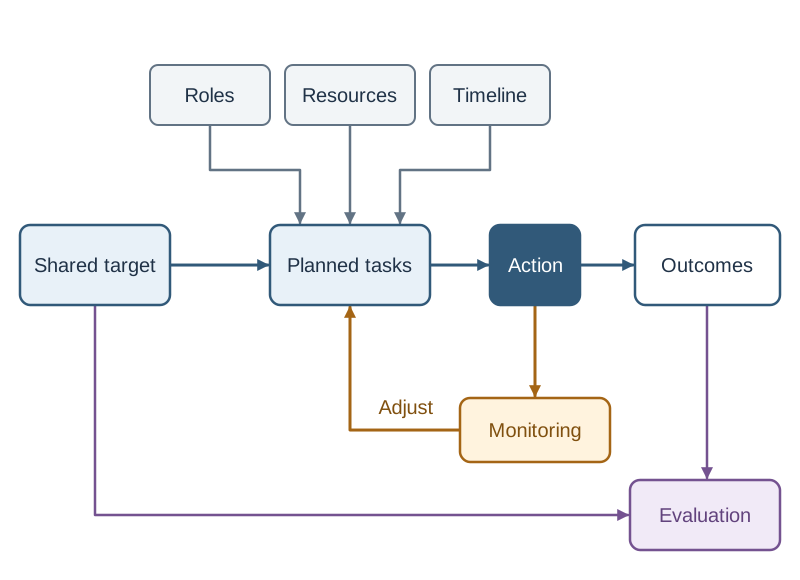
Action plans translate goals into measurable outcomes through team cooperation. Effective projects distinguish between personal goals (what an individual aims to achieve or practice, such as "I will design the five campaign infographics by Tuesday") and collective goals (the shared target agreed by the entire group, such as "We will collect 250 verified survey responses on student mental health facilities").
Checklist for Constructing an Action Plan
A comprehensive action plan incorporates seven operational steps:
- Define the target: Establish a clear, socially relevant objective adhering to SMART criteria (Specific, Measurable, Achievable, Relevant, Time-bound).
- Break down into steps: Map out sequential operational phases (baseline survey, expert interview, public presentation).
- Assign roles: Distribute responsibilities according to members' individual skills and learning needs (researcher, communications officer, liaison).
- Set timelines: Establish strict milestone dates to keep the team accountable.
- Identify resources: Secure logistical needs, printing facilities, teacher permissions, and background NGO briefing papers.
- Set monitoring methods: Establish weekly checkpoints and digital spreadsheets to measure task completion.
- Evaluate: Review whether targets were met against the original deadline and reflect on how realistic the planning process was.
Group Cooperation in Action
Effective collaboration requires matching tasks to strengths and actively communicating needs. For example, during a project on local pedestrian safety, a student realized they could not attend after-school council meetings due to work commitments. Instead of letting the task lapse, they communicated this to the team, trading the in-person liaison duties for evening data analysis of municipal traffic counts.
Personal Qualities and Self-Appraisal
Community work often involves unexpected hurdles. Learning outcome 3.5 highlights that while new situations bring uncertainty and personal challenge, four core qualities enable citizens to succeed:
- Initiative: Stepping forward to take responsibility rather than waiting for others to act (e.g. independently drafting an interview script for a local TD).
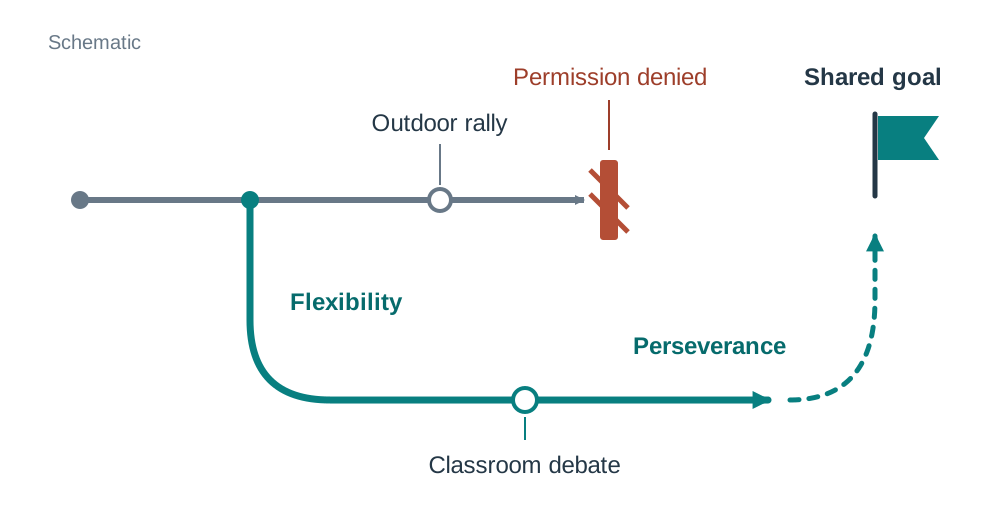
- Flexibility: Adapting methods when initial plans fail. If school management denies permission for an outdoor guest rally, a flexible group switches to a lunchtime classroom debate.
- Reliability: Consistently following through on agreed commitments and meeting project deadlines, which builds group trust.
- Perseverance: Continuing to work towards a goal when difficulties arise, rather than giving up at the first setback.
Self-Appraisal and Feedback
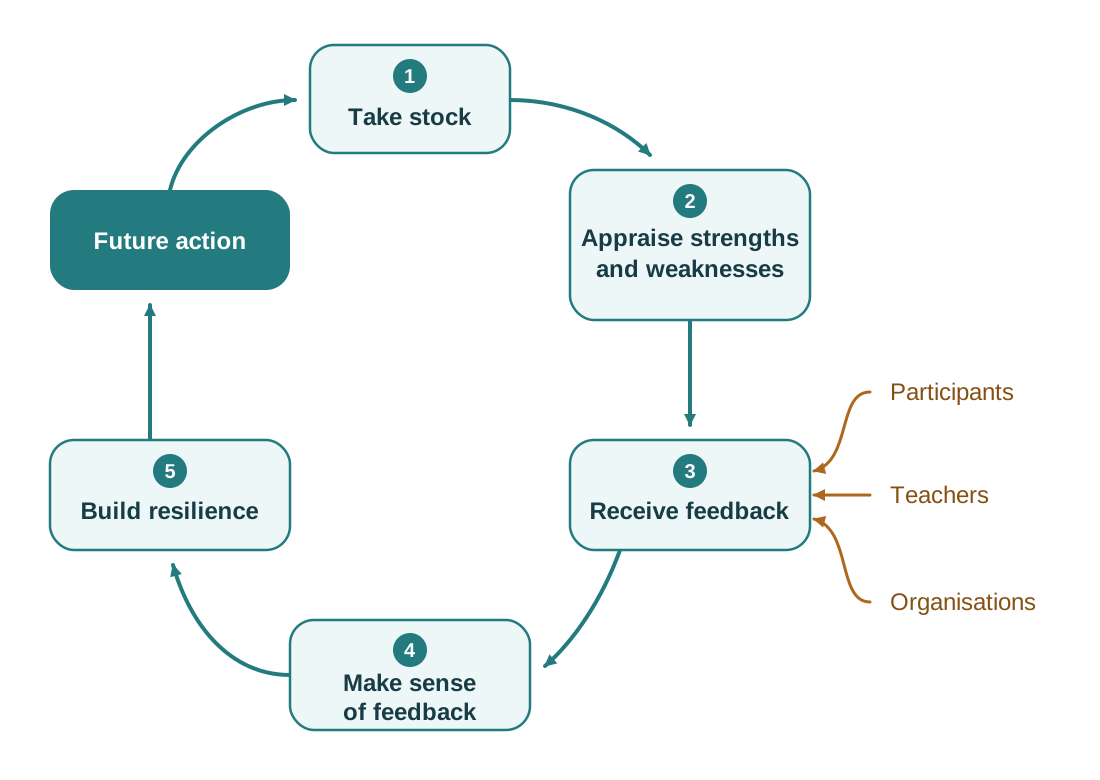
Reviewing performance is about learning from experience and developing resilience. It involves five stages:
- Taking stock of achievements: Recording concrete outcomes (e.g. 150 surveys completed, 3 local councillors engaged).
- Appraising strengths and weaknesses: Honestly reviewing what went well (clear division of labour) and where the team struggled (missed initial deadlines).
- Receiving external feedback: Gathering balanced appraisals from participants, teachers, and outside organisations.
- Making sense of feedback: Talking through feedback with others to decide which points are fair and useful, and what you will change as a result.
- Building resilience: Treating unexpected challenges or critical feedback as constructive evidence for future democratic action rather than as personal failures.
Theoretical Perspectives: Freire, Nussbaum, and Appiah
While Topic 3 outcomes do not prescribe specific thinkers, drawing on recognized social theorists enriches essay evaluations and project reflections:
- Paulo Freire (Pedagogy of the Oppressed, 1970): Freire introduced praxis, defined as action informed by critical reflection; he argued that reflection without action becomes empty talk (what he called 'verbalism'), while action without reflection becomes mere 'activism'. Freire warned against paternalistic charity that acts as "false generosity", which softens the symptoms of injustice while keeping marginalized groups dependent. Genuine empowerment requires critical awareness (conscientização*) and dialogue to transform unjust structures. Use Freire when critiquing voluntary action or explaining why action plans must include reflection.
- Martha Nussbaum (Creating Capabilities, 2011): Nussbaum's capabilities approach* argues that societies should be judged by what people are actually capable of doing and being. Developing action plans, negotiating roles, and resolving group disagreements build crucial human capabilities, including practical reason, affiliation, and control over one's environment. Use Nussbaum to evaluate the personal development gained through citizenship projects.
- Kwame Anthony Appiah (Cosmopolitanism: Ethics in a World of Strangers, 2006): Appiah argues that all humans belong to a shared global community, generating ethical duties toward strangers across national borders. Cosmopolitanism* justifies local community action on global problems, such as organising a local fair-trade audit or coordinating letter-writing campaigns for overseas prisoners of conscience.
Key terms
- Active Citizenship
- The informed, reflective, and active engagement of individuals in civic, social, and political life to improve communities and address social injustices.
- Legal Precedent
- A binding principle or rule established in a previous legal case that courts must follow when deciding subsequent cases with similar facts.
- Civil Disobedience
- The deliberate, open, and non-violent refusal to obey an unjust law or state command, accepting legal penalties to expose moral wrongs and compel political reform.
- Personal Goals
- Specific, measurable targets an individual sets for their own skill development, tasks, and responsibilities within a project.
- Collective Goals
- Shared targets agreed upon by an entire group, requiring cooperative effort and shared accountability to accomplish.
- Action Plan
- A detailed operational plan that organizes goals into sequential steps, assigned roles, timelines, required resources, and monitoring methods.
- SMART Criteria
- A framework ensuring targets are Specific, Measurable, Achievable, Relevant, and Time-bound.
- Initiative
- The personal willingness to take action and assume responsibility independently without waiting for instructions from others.
- Flexibility
- The capacity to adapt methods and try alternative approaches when original plans encounter obstacles, while keeping sight of the overall goal.
- Reliability
- The quality of consistently following through on agreed commitments, completing assigned tasks, and honouring deadlines.
- Perseverance
- The personal quality of continuing to work towards a goal despite setbacks, public indifference, or unexpected challenges.
- Resilience
- The capacity to absorb critical feedback, view mistakes as learning opportunities, and sustain civic engagement after difficulties.
- Praxis
- Paulo Freire's concept describing the continuous cycle of action informed by critical reflection, ensuring community work is purposeful and transformative.
- Conscientização
- Paulo Freire's term for critical consciousness: the process through which individuals learn to perceive social, political, and economic contradictions and take action against oppression.
- Capabilities Approach
- Martha Nussbaum's philosophical framework evaluating human development by whether people have the practical opportunities and freedoms to do and be what they value.
- Cosmopolitanism
- Kwame Anthony Appiah's philosophical view that all human beings belong to a single global community, establishing moral obligations that reach beyond national borders.
Check yourself
Name a person who used the law to bring about social change and state one concrete outcome of their action.
David Norris took legal action that led to Norris v. Ireland (1988) at the European Court of Human Rights, resulting in the decriminalisation of homosexuality in Ireland in 1993.
What are the four personal qualities for handling new and difficult situations outlined in learning outcome 3.5?
Taking initiative, being flexible, being reliable, and being able to persevere when difficulties arise.
What is the primary structural limitation of relying solely on voluntary charity to resolve social problems?
Charity addresses immediate symptoms and provides essential frontline relief, but it lacks statutory legislative power and leaves the underlying political and economic causes of inequality intact.
Give one advantage and one limitation of civil disobedience as a strategy for social change.
An advantage is that it commands high moral legitimacy and mobilises mass public pressure to challenge unjust laws. A limitation is that it exposes participants to state retaliation or imprisonment and depends on the state being responsive to public moral pressure.
How does Paulo Freire define 'praxis', and why is it important in community action?
Praxis is the continuous cycle of action informed by critical reflection. It ensures community engagement moves beyond uncritical activism while preventing reflection from stalling into empty talk.