

Topic 3 explores how physical activities are organised, adapted, and regulated. You will examine team structures, tactical modifications during competition, and choreographic design in dance and gymnastics. The topic also analyses the distinct physical, personal, and technical demands on players, coaches, choreographers, and match officials, alongside the safety protocols, injury treatments, rules, rituals, and conventions that govern fair competition.
Structures, Strategies, Tactics, and Analysis
Before breaking down a competitive match, you need to separate three ideas that students often mix up: structures, strategies, and tactics.
A structure is the physical setup or formation of a team or event. In soccer, that might mean lining out in a 4-4-2 or 3-4-3 shape where players cover designated zones across the pitch. In Gaelic football, it could look like a 3-3-2-3-3 setup with a designated sweeper screening the full-back line. In individual sports like track athletics, the structure refers to how the competition itself is arranged into lanes, heats, semi-finals, and finals.
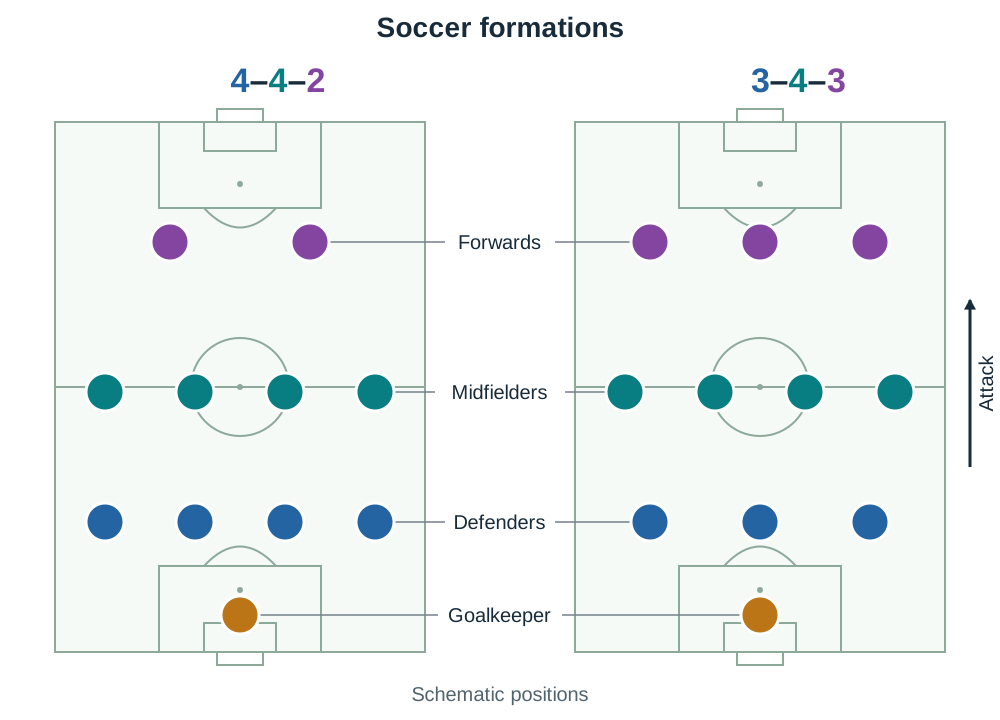
A strategy is the overarching game plan you build before the contest starts. For example, a team might choose to sit in a compact, deep defensive block and hit their opponents with rapid counter-attacks. Choosing a strategy depends on your squad strengths, opponent weaknesses, and outside variables like pitch dimensions or gusting wind.
A tactic is a split-second decision a player makes during live action to carry out that strategy. If your team plan is to exploit space out wide, a wing-back choosing to overlap their winger the moment an opposing defender steps inside is a tactic.
Evaluating Strategies with Methods of Analysis
Under Learning Outcome 3.1, you cannot rely on guesswork to judge whether a plan works. You must evaluate structures and strategies using objective performance data:
- High press in field hockey: you tally how many turnovers your forwards win inside the opposition's defensive 23-metre area using a structured notational tally sheet.
- Zone defence in basketball: you plot an opposition shot chart across four quarters to see whether your 2-3 zone forces low-percentage shots from outside the arc instead of high-percentage layups inside the key.
- Width in attack in soccer: you review match video or map pass completions to verify whether switches of play actually create 2-on-1 overloads in the wide channels.
Modifying Strategy in Competition
When an initial plan comes undone on the pitch, athletes and coaches have to adapt immediately. You can track this process using the Recognise → Anticipate → React framework:
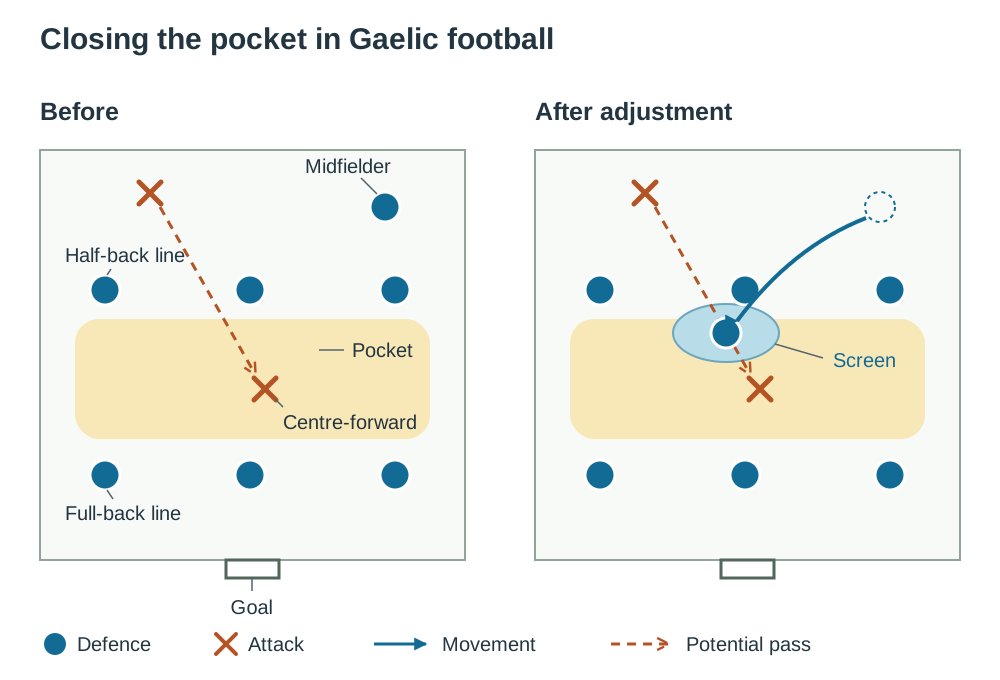
First, you recognise the tactical breakdown happening in front of you. A Gaelic football coach might spot that an opposing centre-forward keeps finding space in the pocket between the half-back and full-back lines.
Next, you anticipate what will happen if nobody fixes it. If that forward continues to turn unopposed, they will keep scoring points or creating goal chances. The coach anticipates that withdrawing a midfielder to sit deep will cut off those passing lanes.
Finally, you react by making the practical adjustment. The coach signals the positional shift, the players reorganise on the pitch, and the sideline monitors objective indicators, like counting whether the opposition's shots on target decrease over the next ten minutes.
Compositional Elements and Choreography
In artistic disciplines such as dance and gymnastics, routines are composed and evaluated on movement quality, expressive range, and structural coherence rather than scored points against an opponent.
Choreographic Approaches
Choreographers and performers build routines using three distinct approaches:
- Choreographer-led (directed): the coach or choreographer creates the entire sequence, and the performers memorise, practice, and polish the set movements.
- Collaborative: the choreographer and dancers share ideas, exploring and selecting movement material together through guided improvisation.
- Stimulus-led: the composition takes inspiration from an external source, such as a musical score, a spoken poem, a visual painting, or a historical narrative.
Compositional Elements and Devices
Performers shape their routines by weaving together several core compositional elements:
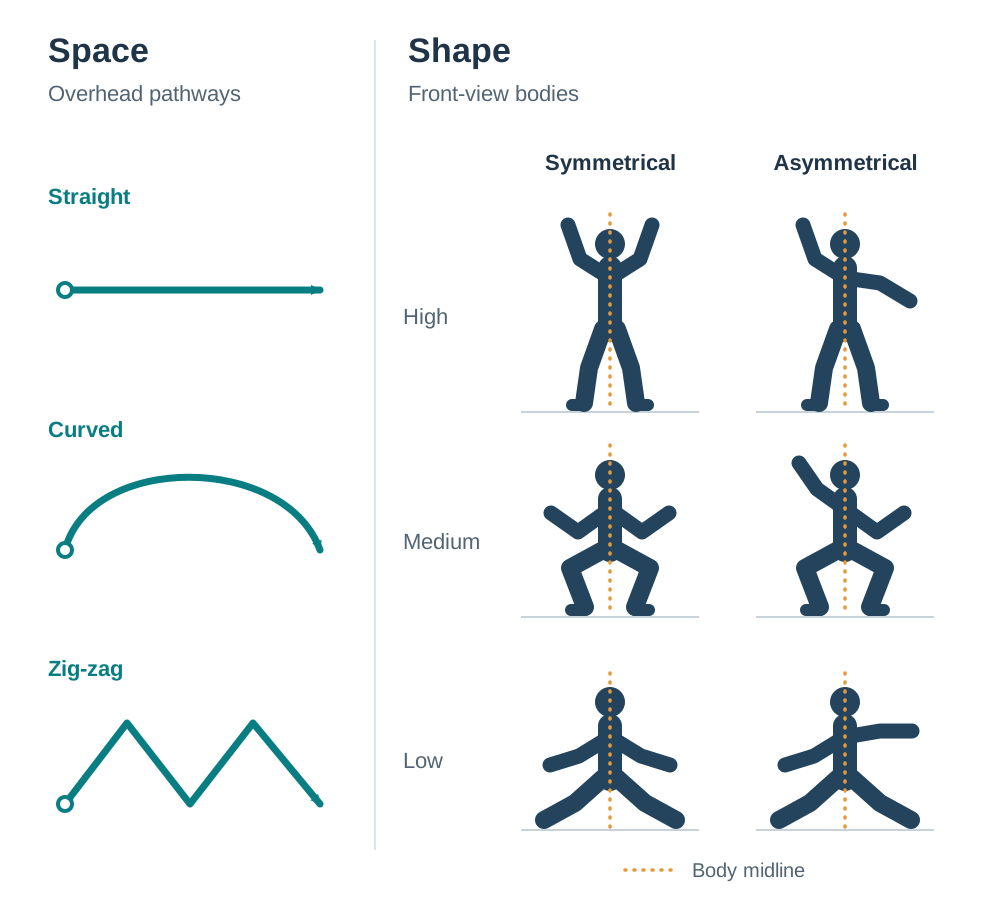
- Space: where the movement travels across the performance area. Dancers make deliberate choices about pathways (curved, straight, or zig-zag), directions, and floor patterns to maintain visual interest.
- Shape: the physical line of the body. Routines contrast symmetrical shapes (where both sides of the body mirror each other to show balance and stability) with asymmetrical shapes (where contrasting limb angles introduce tension and drama) across low, medium, and high levels.
- Timing: the speed and precision of execution relative to musical beats or cues, such as landing a leap exactly on a downbeat.
- Dynamics: the weight, force, and flow behind each movement. A gymnast might contrast an explosive, powerful tumbling pass with slow, soft, sustained floor transitions.
- Rhythm: the recurring patterns of accents and phrasing that give a routine continuous flow and artistic pulse.
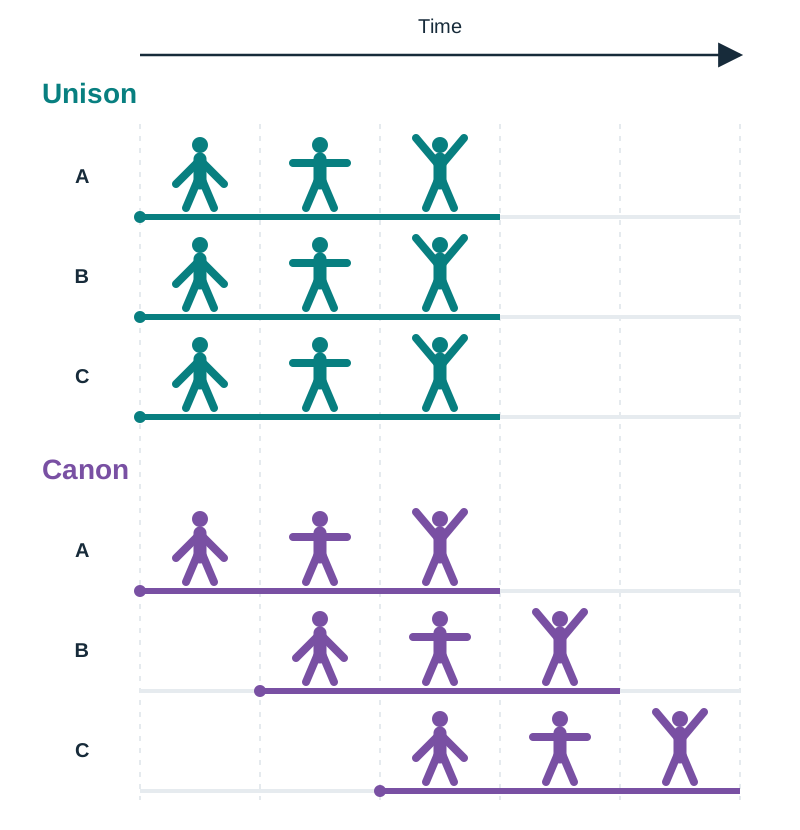
- Relationships: how performers interact with each other, with apparatus, or with props. Common choreographic devices include unison (two or more athletes executing identical movements at the exact same moment) and canon (performers executing the same movement phrase one after another in succession), alongside mirroring, contrast, and building to a clear dramatic climax.
Roles, Relationships, and Exploiting Weaknesses
Every physical activity relies on different roles working in harmony. Each role places distinct physical, personal, and technical demands on the person fulfilling it.
| Demand Dimension | Player / Performer | Coach / Choreographer | Official / Referee |
|---|---|---|---|
| Physical | High aerobic stamina, anaerobic power, and position-specific speed (e.g. a Gaelic football half-back covering around 8 to 10 kilometres per match with repeated high-intensity sprints). | Baseline fitness to demonstrate technical skills cleanly and move actively along the sideline across multiple training blocks. | High aerobic endurance and repeat-sprint ability (e.g. a hurling referee covering 8 to 10 kilometres to stay close to play and secure clean sightlines). |
| Personal | Composure under intense match pressure, emotional control, and mental resilience after unforced errors (e.g. a tennis player resetting quickly after serving a double fault). | Empathy, active listening, patience, and clear verbal communication (e.g. giving supportive feedback to an athlete who was substituted early). | Impartiality, calm authority, high stress tolerance, and confidence to make contested calls firmly despite player or crowd dissent. |
| Technical | Precise motor skill execution and sharp tactical decision-making (e.g. executing a reverse stick strike under defensive pressure in field hockey). | Tactical analysis, biomechanical error detection, periodised session planning, and video analysis expertise. | Comprehensive rule knowledge, clear whistle signalling, precise timekeeping, and accurate scorecard management. |
Exploiting Opponent Weaknesses
To gain a competitive edge, athletes and coaches systematically look for vulnerabilities in the opposition across three main areas:
- Physical mismatches: if a soccer centre-back lacks recovery pace on the turn, you play early through-balls into the channels for a fast winger to chase.
- Technical limitations: if a badminton player has a weak backhand overhead clear, you direct deep, high clears repeatedly into their backhand rear court to force a weak return.
- Psychological vulnerabilities: if an opposing point guard in basketball gets frustrated easily when pressured, you assign a tight man-to-man marker to deny them easy inbound passes, provoking turnovers and personal fouls.
Affiliation, Team Building, and Leadership
Affiliation is the feeling of belonging to a team or sporting group. It is one of the main reasons people stay involved in sport over their lifetime. Teams build cohesion through collective goal-setting, clear individual positional duties, pre-game team talks, and shared post-match routines. Team captains demonstrate leadership by working hard in training, speaking constructively to teammates after mistakes, and talking respectfully with officials during match stoppages.
Safe Practice, Injury Protocols, and Training Load
Safe practice means controlling injury risks before, during, and after activity. This covers proper physiological preparation, personal attire, and facility checks.
The RAMP Warm-Up Protocol
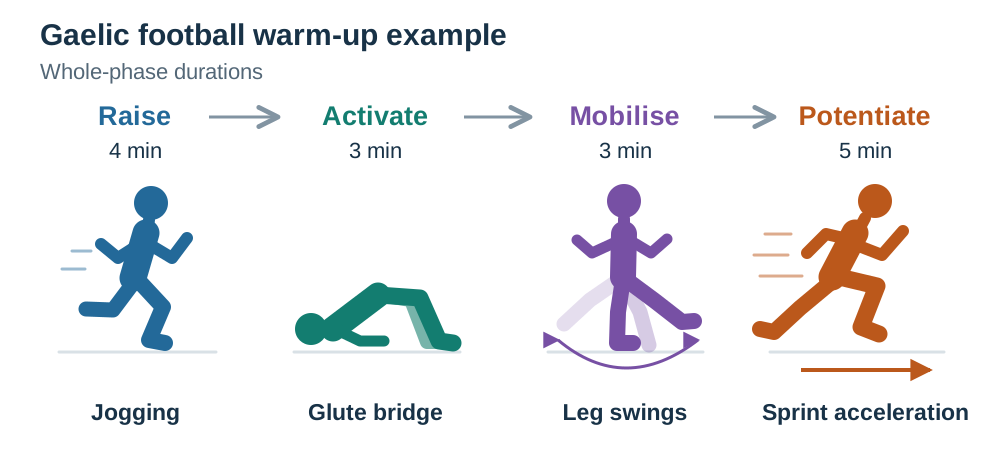
A structured warm-up prepares the cardiovascular and nervous systems while protecting against muscle strains. Holding static stretches for long periods right before explosive competition can temporarily decrease muscle force output, which is why modern warm-ups rely on dynamic mobility. The RAMP model structures this preparation:
- Raise (R): you gradually increase heart rate, blood flow, and deep muscle temperature with low-intensity jogging, skipping, or footwork games. Warm muscles have lower internal resistance, so they stretch and contract more freely.
- Activate (A): you engage the primary stabilising muscle groups needed for your sport through exercises like glute bridges, mini-band lateral walks, or bodyweight squats.
- Mobilise (M): you move major joints through sport-specific ranges of motion using dynamic movements like leg swings, walking lunges with an open torso twist, and shoulder arm swings.
- Potentiate (P): you ramp up to full match intensity with short, sharp efforts such as 5-metre sprint accelerations, reactive agility cuts, or contested jump catches to prime your nervous system for the speed of play.
Example (15-Minute Gaelic Football Warm-Up):
- Raise: 4 min of jogging and a handpassing tag game (gradually raises heart rate and increases blood flow to working muscles).
- Activate: 3 min of glute bridges and squats (activates the gluteal and quad muscles to prepare them for jumping and deceleration).
- Mobilise: 3 min of leg swings and walking lunges with a twist (dynamically moves hip and knee joints through full match-specific ranges of motion).
- Potentiate: 5 min of 10 m sprints, catching high balls and kicking at match pace (primes the nervous system for high-velocity match play).
Cool-Down
A 10-minute active cool-down brings your body back down to rest. Light aerobic jogging and walking keep your leg muscles contracting gently. This muscle pump action keeps blood flowing back toward the heart instead of pooling in your lower extremities, which prevents post-exercise dizziness. Once your heart rate has dropped, you finish with static stretches held for 20 to 30 seconds to ease muscle tightness and restore resting muscle length.
Attire, Equipment, and Facilities
- Mandatory protective gear must be checked and maintained. Approved helmets with faceguards are compulsory in hurling and camogie at all grades. Mouthguards are mandatory in Gaelic football and rugby.
- Playing surfaces must be free from debris, holes, or standing water. Indoor hall floors must be dry and slip-resistant, and outdoor goalposts must be weighted or pegged securely into the ground.
Common Injuries and First Aid Protocols
Injuries fall into two categories: acute injuries, which happen suddenly from immediate trauma, and chronic injuries, which develop slowly over time from repetitive overuse.
| Injury | Typical Cause (Named Sport) | First Aid Treatment |
|---|---|---|
| Ankle sprain (acute ligament tear) | Landing awkwardly on another player's foot after jumping for a rebound in basketball. | Stop play immediately. Apply PRICE (Protect, Rest, Ice, Compress, Elevate). Refer for medical imaging if the athlete cannot bear weight. |
| Hamstring strain (acute muscle tear) | Sprinting at full velocity without completing an adequate warm-up in soccer. | Stop play. Apply PRICE. Do not stretch, massage, or apply heat to the muscle during the first 48 hours. |
| Cuts and grazes | Sliding tackle on an abrasive artificial 3G pitch in soccer. | Put on sterile gloves, clean the graze with sterile saline, and dress it securely. Enforce the blood rule: the player must leave the pitch until bleeding stops and blood-stained clothing is changed. |
| Dislocated shoulder | Heavy, awkward impact onto an outstretched arm following a tackle in rugby. | Do not attempt to force the joint back into place. Support the arm in a comfortable sling, manage shock, and arrange immediate transfer to hospital. |
| Concussion | Direct head clash while two players contest a high ball in hurling. | Follow the 6 Rs Concussion Protocol (Recognise, Remove, Refer, Rest, Recover, Return). If in doubt, sit them out. An athlete with suspected concussion cannot return to play on the same day. |
| Shin splints (chronic overuse) | Repeated running on hard tarmac surfaces wearing worn, unsupportive shoes during pre-season athletics. | Rest from high-impact running, apply ice packs to reduce pain, check footwear cushioning, address running gait biomechanics, and return to training gradually. |
When an athlete goes down injured during a match, the referee halts play and calls the qualified team first-aider onto the pitch. The first-aider assesses the player systematically using SALTAPS: See the incident, Ask the athlete what happened, Look at the injury site for swelling or deformity, Touch gently to locate tenderness, test Active movement, test Passive movement, and finally perform a Stand and Skill test before clearing them to resume.
Evaluating Training Schedules for Overtraining
Overtraining happens when training volume and intensity consistently outstrip recovery time. This leads to chronic muscle soreness, elevated resting heart rate, sleep disruption, frequent illnesses, and unexplained drops in performance.
When you evaluate a weekly training schedule for safety in an exam question, check for these warning signs and safeguards:
- At least one complete rest day every week.
- Easy recovery sessions or light active recovery alternating with high-intensity training days.
- Progressive loading that increases total volume or intensity by no more than 10% each week.
- A planned reduction in training load (periodisation taper) in the 7 to 14 days leading up to a major championship competition.
- Multi-team monitoring to make sure student athletes are not training at full intensity across school, club, and representative squads on consecutive days.
You can track training strain mathematically using the session load formula: . For example, a 60-minute interval session rated as an 8 on the RPE scale gives an athlete a training load of 480 arbitrary units.
Rules, Rituals, Conventions, and Event Organisation
Sporting events run on four distinct regulatory concepts that keep competition safe, orderly, and respectful.
- Rules: formal, written regulations published by governing bodies (such as the GAA, FAI, or World Athletics) and enforced by match officials. Rules create equality and safety, and breaking them brings specific in-game penalties or disciplinary cards (e.g. the 4-step rule in Gaelic football or offside in soccer).
- Roles: the specific duties assigned to participants within an event, such as a goalkeeper, team captain, referee, or line umpire.
- Rituals: set actions, routines, or ceremonial customs performed before, during, or after competition that participants believe have purpose or power to aid team unity, focus, or performance. Examples include cultural ceremonies like the New Zealand Haka, team traditions like walking behind the brass band in an All-Ireland senior final parade, or an individual golfer's fixed sequence of practice swings before driving. While individual rituals help athletes settle nerves and narrow their attention, team and cultural rituals build solidarity.
- Conventions: unwritten, traditional codes of sporting etiquette and conduct that participants respect to demonstrate fair play. Examples include kicking the ball out of play in soccer when an opponent is injured, or shaking hands at full-time regardless of the result. When performers honour conventions, they show sportsmanship. When performers deliberately exploit or bend rules and conventions for competitive advantage—such as taking minutes to retrieve a throw-in to protect a lead—they are engaging in gamesmanship, a concept explored in Topic 6.
Organising a Safe Event
Under Learning Outcome 3.4, setting up a tournament requires four operational pillars:
- Rules and competition structure: you publish clear fixture schedules, match durations, pitch allocations, tie-breaker criteria, and rest intervals.
- Role allocation: you assign trained referees, umpires, scorekeepers, timekeepers, and qualified first-aid personnel to every pitch.
- Safety audit: you inspect pitches for hazards, test goalpost anchors, check first-aid kits, and inspect mandatory personal protective equipment before kickoff.
- Rituals and conventions: you host a pre-tournament captains' briefing, schedule time for structured warm-ups, and coordinate post-match handshakes between teams.
The Role of the Coach and Choreographer
A coach or choreographer guides the physical, tactical, and artistic growth of performers while helping them develop into self-directed, reflective athletes.
Interpersonal Skills and Coaching Styles
Good coaching relies on strong interpersonal skills: active listening, empathy, clear verbal instruction, and constructive feedback. Many coaches deliver feedback using the sandwich technique: opening with positive praise, offering one specific technical correction, and closing with encouragement. Coaching styles generally fall into three categories:
- Autocratic: the coach makes every decision with little or no player input. This style works best with beginner groups, large squads, or time-sensitive safety briefings.
- Democratic: the coach involves players in decision-making and tactical discussions. This approach fosters shared ownership and problem-solving skills among experienced athletes.
- Laissez-faire: the coach provides equipment and facilities but lets athletes direct their own practice tasks with minimal intervention.
Goal-Setting and Motivation
Coaches nurture both intrinsic motivation (internal enjoyment, pride, and personal mastery) and extrinsic motivation (external rewards like trophies, championship medals, and social praise). To keep athletes focused, coaches set SMART goals (Specific, Measurable, Agreed, Realistic, Time-phased) and maintain a balance between:
- Outcome goals: targets focused on the final competitive result (e.g. winning the county championship).
- Process goals: targets focused on specific technical and tactical execution under the athlete's direct control (e.g. completing 85% of short passes or maintaining a low defensive stance). Process goals build confidence and lower competitive anxiety.
Designing a Fitness and Skills Programme
Under Learning Outcome 3.5, you must know how to design a training plan for a specific performer:
- Needs analysis: test the athlete's fitness baseline (using tests like the Yo-Yo test or sprint gates) and run notational analysis on match play to identify technical weaknesses.
- Set targets: outline short-term process targets (weeks 1 to 3) alongside long-term performance milestones (weeks 8 to 10).
- Map role demands: identify the exact fitness components needed for their position, such as aerobic power for a soccer central midfielder.
- Apply training principles: use progressive overload, specificity, and recovery within the FITT framework (Frequency, Intensity, Time, Type).
- Structure skill practices: choose appropriate drill formats, balancing part versus whole practice, massed versus distributed schedules, and blocked versus variable game-based drills.
- Monitor and adjust: track training diaries, check resting heart rates, re-test fitness halfway through, and scale back volume if you see signs of fatigue.
Managing Practice and Modifying Drills
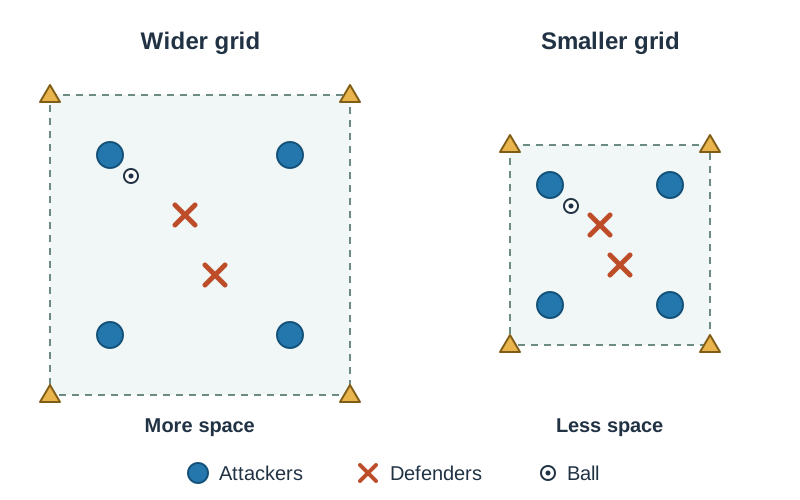
A standard 60-minute training session follows a balanced structure: a 15-minute RAMP warm-up, a 20-minute isolated or semi-conditioned skill drill, a 20-minute conditioned small-sided game, and a 5-minute cool-down with reflection. When a drill breaks down or fails to challenge players, coaches modify the constraints:
- To reduce difficulty: widen the playing area, remove active defenders to create uncontested repetitions, or slow the required movement speed.
- To increase challenge: shrink the playing grid, add active defenders to create pressure, limit the number of touches on the ball, or add a shot clock.
Guiding Reflection and Self-Evaluation
Coaches prompt athletes to examine their own performance using open-ended questions ("Where did you spot space before making that kick?") and video playback. They engage in both reflection-in-action (reading the game and making tactical tweaks during live play) and reflection-on-action (reviewing match statistics and video footage after the final whistle to plan the next training week).
In written exam questions where you evaluate your own performance in a coaching role, you must benchmark your communication clarity, drill planning, and sideline adjustments directly against a named coach you admire.
The Role of the Official
Officials uphold competitive integrity, enforce safety rules, and keep play moving smoothly. In the Leaving Certificate PE examination structure, you can complete the Physical Activity Project coursework as a performer or as a coach/choreographer only. You study officiating for the written examination paper.
Duties Across the Match Day
- Before the contest: inspect facilities for hazards (surface ruts, broken glass, unpadded goalposts), check player gear (compulsory mouthguards, approved hurling helmets, safe studs, removal of rings and watches), check match balls for correct inflation, and brief team captains at the coin toss.
- During the contest: enforce the rules impartially, manage the match clock, record scores accurately, signal infractions clearly with whistle and hand signals, de-escalate player disputes, and enforce the blood rule when a cut occurs.
- After the contest: check score entries with the timekeeper, sign the official match scorecard, and submit a formal referee report detailing match scores, yellow/red card infractions, and serious injuries to the organising committee or governing body.
Scoring Regulations and Kit
Officials must know the scoring rules of their sport thoroughly:
- Gaelic games: a goal is worth 3 points, recorded as goals-points (e.g. 1-12 equals 15 total points).
- Basketball: 1 point for a successful free throw, 2 points for an inside field goal, 3 points for a basket scored from beyond the 6.75-metre perimeter arc.
- Badminton: rally point scoring up to 21 points (a side must win by 2 clear points, with a maximum cap at 30 points).
An official's kit bag contains two whistles, two digital stopwatches, waterproof scorecards, pencils, yellow/red/black sanction cards, a toss coin, and a referee jersey that contrasts clearly with both competing teams.
Communication, Conflict Management, and Mental Readiness
Officials communicate assertively: speaking clearly, firmly, calmly, and respectfully. Assertive officials maintain control without becoming passive (hesitant, quiet, easily swayed) or aggressive (shouting, confrontational). When conflict flares between players, the official blows the whistle decisively, steps in to separate the athletes, calls over the team captains, explains the ruling calmly, and issues the appropriate card without entering a prolonged debate.
Officiating requires high psychological readiness, often described using the 3 Cs:
- Concentration: staying locked on the ball and off-the-ball movement for the entire match duration.
- Coping: managing stress caused by hostile spectators, player dissent, or difficult weather.
- Confidence: trusting your eyesight, rule knowledge, and whistle authority under match pressure.
Officials also use mental imagery (picturing difficult decisions before the game) and controlled breathing to stay composed. In written exam answers, benchmark your positioning, assertiveness, and composure against a named official you admire.
Key terms
- Structure
- The formal physical formation, tactical lineup, or competitive organisation of a team or sporting event.
- Strategy
- The overarching game plan decided before a contest to achieve competitive success and target opponent weaknesses.
- Tactic
- A specific in-game decision or technical adjustment made by performers during play to execute the wider strategy.
- Compositional Elements
- The movement components used to structure routines in artistic disciplines like dance and gymnastics, including space, shape, timing, dynamics, rhythm, and relationships.
- Unison
- A choreographic device where two or more performers execute identical movements at the exact same moment.
- Canon
- A choreographic device where performers execute the same movement phrase one after another in succession.
- Acute Injury
- A sudden-onset injury caused by immediate physical trauma, such as a fractured bone or torn ligament.
- Chronic Injury
- An overuse injury that develops gradually over time due to repetitive strain or poor biomechanics, such as tendonitis or shin splints.
- Overtraining
- A state of persistent physical and psychological fatigue that occurs when training volume and intensity consistently exceed recovery time.
- Periodisation
- The systematic division of an athlete's training calendar into structured phases to manage fatigue and reach peak performance for major competitions.
- Rule
- A formal, written regulation set by a sporting governing body and enforced by match officials to maintain safety, equality, and fair play.
- Role
- A specific positional assignment or functional responsibility carried out by an individual during a sporting activity.
- Ritual
- An established sequence of actions, routines, or ceremonies performed before, during, or after activity, believed to influence performance, team unity, or mental readiness.
- Convention
- An unwritten, traditional code of sporting etiquette and conduct respected by participants to demonstrate sportsmanship and mutual respect.
- Assertive Communication
- A communication style that is clear, calm, firm, and respectful, maintaining authority without showing aggression or passivity.
- Outcome Goal
- A performance goal focused strictly on the final competitive result, such as winning a match or securing a championship trophy.
- Process Goal
- A performance goal focused on controllable technical and tactical execution, such as completing a set percentage of passes or tracking back on defence.
- Reflection-in-Action
- The cognitive evaluation and tactical adjustments an athlete or coach makes during live play while the performance is unfolding.
- Reflection-on-Action
- The retrospective analysis and evaluation of performance data and decisions conducted after a training session or match has finished.
Check yourself
What is the difference between a strategy and a tactic in a team sport?
A strategy is the overarching game plan decided before the match (e.g. counter-attacking), whereas a tactic is an in-game decision made by players to execute that plan (e.g. a wing-back overlapping into space).
What does each letter in the RAMP warm-up protocol represent?
Raise (heart rate and muscle temperature), Activate (key stabilising muscles), Mobilise (joints through dynamic movement), and Potentiate (match-intensity, sport-specific drills).
Name two pre-match safety checks an official must carry out on player attire.
Checking that all players are wearing compulsory protective gear (such as gumshields or approved helmets with faceguards) and ensuring all jewellery has been removed.
Define a sporting convention and give an example from a named sport.
A convention is an unwritten, traditional code of sporting etiquette respected by participants, such as kicking the ball out of play in soccer when an opposing player is injured.
In Gaelic football, what is the total points value of a scoreline of 2-09?
15 points (each goal equals 3 points, so (2 × 3) + 9 = 15).
Identify two training schedule flaws that increase the risk of athlete overtraining.
A schedule lacking at least one full weekly rest day, and scheduling back-to-back high-intensity training sessions without recovery time.