

Sports Psychology: Confidence, Arousal, Anxiety, and Feedback
Bandura's Self-Efficacy Theory
Confidence is an athlete's belief in their general ability. When that confidence applies to a specific situation, we call it self-efficacy. Albert Bandura identified four main sources:
- Enactive mastery: Past success. If a camogie player has scored four frees under pressure in recent matches, she steps up with high self-efficacy.
- Vicarious experience: Watching a peer of similar ability execute the skill ('if they can do it, so can I').
- Verbal persuasion: Positive encouragement from coaches, teammates, or deliberate positive self-talk.
- Physiological and emotional states: How the athlete interprets bodily signals. Viewing a pounding heart as readiness rather than fear boosts self-efficacy.
Arousal vs Anxiety
Do not mix these two terms up in your answers:
- Arousal is a neutral physiological and psychological state of readiness and alertness, spanning from deep sleep to extreme excitement.
- Anxiety is a negative emotional state marked by worry, apprehension, and fear.
- Trait anxiety: A permanent personality trait where a performer tends to view competitive situations as threatening.
- State anxiety: A temporary, situation-specific surge of nervousness caused by a high-stakes moment, like taking a penalty in a county final.
- Cognitive anxiety: Mental symptoms, such as self-doubt, negative thoughts, and poor focus.
- Somatic anxiety: Physical symptoms, such as an upset stomach, sweating, tight muscles, and a racing pulse.
Performance Theories
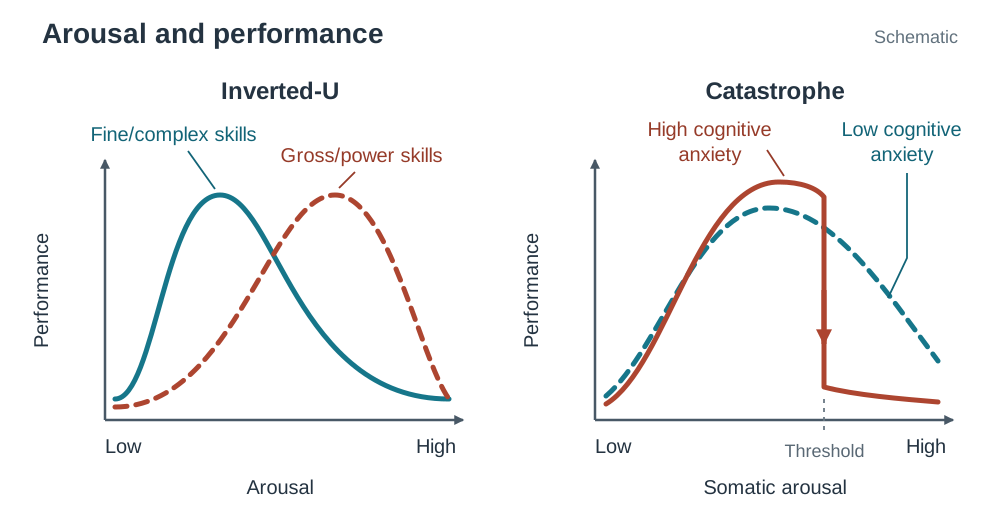
- Inverted-U Hypothesis: Performance improves as arousal rises, up to an optimal midpoint. If arousal climbs past this point, performance drops due to excessive muscle tension and scattered attention. Fine or complex skills (putting in golf, shooting in archery) require a lower optimal arousal level, while gross power skills (a rugby tackle, weightlifting) benefit from higher arousal.
- Catastrophe Theory: Explains what happens when an athlete suffers high cognitive anxiety. If cognitive anxiety is low, performance follows the gradual inverted-U curve. But if cognitive anxiety is high and somatic arousal pushes past the optimal threshold, performance suffers a sudden, catastrophic collapse. The athlete cannot simply make a minor tweak; they must step back, relax physically and mentally, lower their arousal levels, and rebuild their confidence.
Motivation
Motivation is the drive to train and perform. Intrinsic motivation comes from enjoyment or personal satisfaction; extrinsic motivation comes from outside rewards such as praise or trophies.
Use the SMART goals explained in Programme Design to make progress visible. A basketball player might aim to score 7 out of 10 free throws in training within eight weeks. A process goal, such as following the same pre-shot routine every time, gives the player something controllable to practise.
Managing Anxiety and Maintaining Focus
- Cognitive restructuring: Catching negative thoughts ('I will miss this kick') and deliberately reframing them into constructive statements ('I have hit this kick hundreds of times in training').
- Centring: Deep diaphragmatic breathing from the abdomen that stimulates the parasympathetic nervous system, lowering heart rate and easing somatic tension.
- Pre-performance routines: A consistent sequence of physical actions and mental checks before executing a closed skill (such as bouncing the ball three times before a basketball free throw). This creates familiarity and blocks out distractions.
- Attentional focus: Concentration can be broad or narrow, internal or external. A playmaker scans the whole pitch for open runners (broad-external), while a golfer focuses purely on the dimple of the ball at address (narrow-external).
Example: A Personal Psychological Action Plan
For a basketball free-throw shooter, link each action to its purpose:
- Before performance: Use centring during the warm-up to settle physical tension, and recall a successful practice session to build confidence.
- During performance: Follow a consistent pre-shot routine to focus attention. Replace “I will miss” with a useful cue such as “steady routine, follow through”.
- After performance: Review shooting technique with a coach and choose one process goal for the next session. This turns feedback into a controllable action and helps maintain motivation.
Adapt the plan to the performer and activity, and explain the reason for each choice.
Types of Feedback
Feedback gives an athlete information about their movement or the outcome:
- Intrinsic feedback: Information felt directly through kinaesthesis and internal senses, like a tennis player feeling they hit the ball off-centre.
- Extrinsic feedback: Information from outside sources, such as a coach's comment, a video replay, or a stopwatch time.
- Positive vs Negative: Positive feedback praises good execution to build motivation; negative (corrective) feedback pinpoints mechanical errors to guide technical refinement.
- Knowledge of results (KR): Feedback about the outcome of the action (the sliotar went wide; the sprint took ). Highly motivating for beginners.
- Knowledge of performance (KP): Feedback about the quality of the movement mechanics (your elbow was too low on that shot). Essential for intermediate and advanced athletes fine-tuning technique.