

Fitness Testing: Batteries, Validity, Reliability, and Sequencing
A fitness test battery is a planned series of individual tests selected to profile the precise physical demands of a named sport. There is no one-size-fits-all battery. You would never assess a shot-putter with the multi-stage fitness test, because aerobic endurance has little bearing on a single explosive throw.
Standard Tests for Each Component
When answering exam questions on test selection, always state the component, the recognised test, and a sporting justification:
- Cardiorespiratory endurance: Multi-Stage Fitness Test (bleep test) or Cooper 12-minute run.
- Muscular strength: Handgrip dynamometer or 1-rep max (1RM) bench press or squat.
- Muscular endurance: 1-minute press-up test, timed plank hold, or 1-minute sit-up test.
- Flexibility: Sit-and-reach test.
- Body composition: Skinfold calliper assessment at standard sites. Body Mass Index (BMI) is easy to calculate, but it cannot separate muscle from fat mass. A heavily muscled rugby player will often register as overweight or obese on BMI charts.
- Agility: Illinois agility test or T-test.
- Balance: Stork stand test.
- Coordination: Alternate-hand wall toss test.
- Power: Vertical jump test (Sargent jump) or standing broad jump.
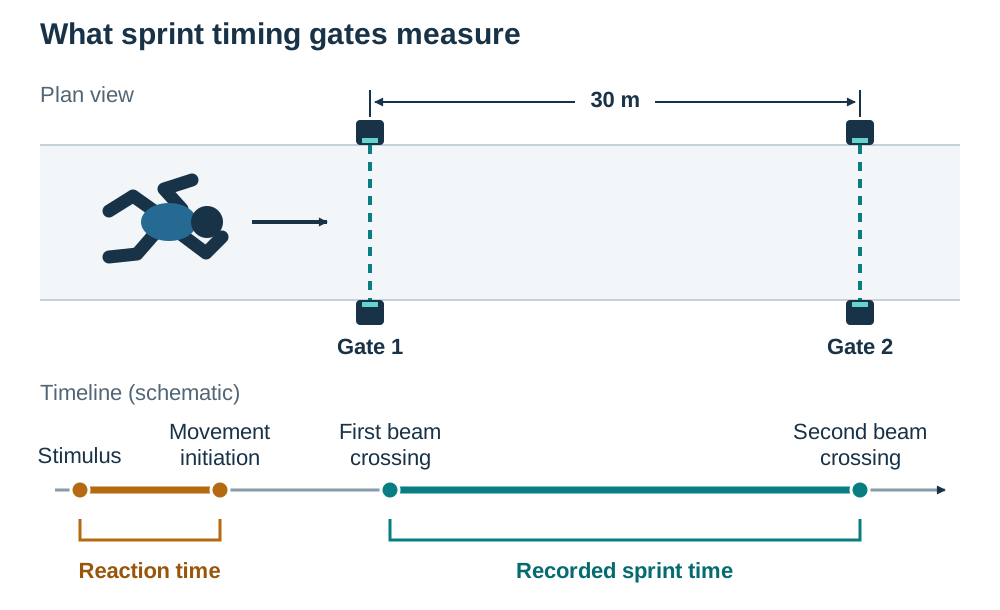
- Speed: 30-metre sprint using electronic timing gates.
- Reaction time: Ruler drop test.
Validity and Reliability
These two principles underpin all sound physical testing:
- Validity means the test measures what it claims to measure. A 30-metre sprint using electronic gates is a valid measure of running speed and acceleration, but it is not a valid measure of reaction time. The timing gates trigger only after the runner moves through the beam, so they capture travel time rather than the gap between a signal and movement initiation.
- Reliability means the test produces consistent, repeatable results under identical conditions. If an athlete retests later the same day without intervening training, their score should be virtually identical. To keep tests reliable, you must standardise the environment, test surface, warm-up protocol, equipment calibration, and tester instructions.
Order of Administration
Fatigue ruins test validity. If you administer a bleep test first, the athlete's legs will be full of lactate, meaning their vertical jump and 30-metre sprint scores will be artificially low. The recommended sequence is:
- Non-fatiguing tests: height, weight, resting heart rate, and skinfold measurements.
- Agility tests: Illinois agility test, which demands a fresh neuromuscular system.
- Maximal strength and power: vertical jump or 1RM.
- Sprint tests: 30-metre sprint.
- Muscular endurance: 1-minute press-ups or timed plank.
- Cardiorespiratory endurance: Multi-Stage Fitness Test. This always comes last because exhaustive aerobic running depletes glycogen and causes severe fatigue.