

Principles of Training, FITT, and Conditioning Methods
Good training programmes do not happen by accident. They follow recognised training principles:
- Readiness: Checking that the athlete has the physical and mental maturity to handle the proposed training load without risking injury or burnout.
- Specificity: Ensuring adaptations match the energy systems, muscle groups, and movement patterns of the chosen sport. A swimmer builds endurance in the pool, not on a road bike.
- Overload: Making the body work harder than usual to trigger physiological adaptations. You apply overload by adjusting frequency, intensity, or duration.
- Progression: Introducing overload gradually as the body adapts. Increasing a weekly long run by 10% each fortnight prevents overuse injuries.
- Rest and recovery: Allowing adequate time for tissue repair and glycogen replenishment. The workout creates the stimulus, but fitness gains occur while resting.
- Reversibility: When training stops, adaptations decline ('use it or lose it').
- Tedium: Keeping sessions varied and engaging so athletes stay motivated.
Applying the FITT Formula
The FITT framework structures progressive overload across different fitness targets:
- Cardiorespiratory endurance: Frequency: 3 to 5 times per week. Intensity: 60% to 80% of maximum heart rate. Time: 20 to 60 minutes. Type: continuous running, cycling, rowing, or fartlek.
- Muscular strength: Frequency: 2 to 3 sessions per week with 48 hours recovery between muscle groups. Intensity: high load, low reps (, 1 to 5 repetitions). Time: 3 to 5 sets with 2 to 3 minutes rest between sets. Type: free weights or resistance machines.
- Flexibility: Frequency: 3 to 7 days per week. Intensity: stretch to mild tension, never pain. Time: hold static stretches for 15 to 30 seconds across 2 to 4 sets. Type: static stretching post-workout or dynamic mobility during a warm-up.
- Power: Frequency: 2 sessions per week. Intensity: maximal explosive effort (100%). Time: low repetitions (3 to 6 reps per set) with long rests between sets (at least about 1:10 work-to-rest; about 2–3 minutes for full recovery). Type: plyometrics such as hurdle hops and box jumps.
Training in the Activity vs Outside the Activity
- Training in the activity develops fitness through the sport itself, such as small-sided conditioned games (e.g., 4 v 4 possession drills in soccer). It trains skill execution, tactical awareness, and decision-making under match conditions. However, the coach cannot control individual workloads precisely, and less active players may drop below target training zones.
- Training outside the activity isolates fitness components using gym equipment, tracks, or swimming pools. It allows exact control over load and targets weaknesses identified during fitness testing. The downside is that it lacks game context and ball-handling practice.
Training Methods
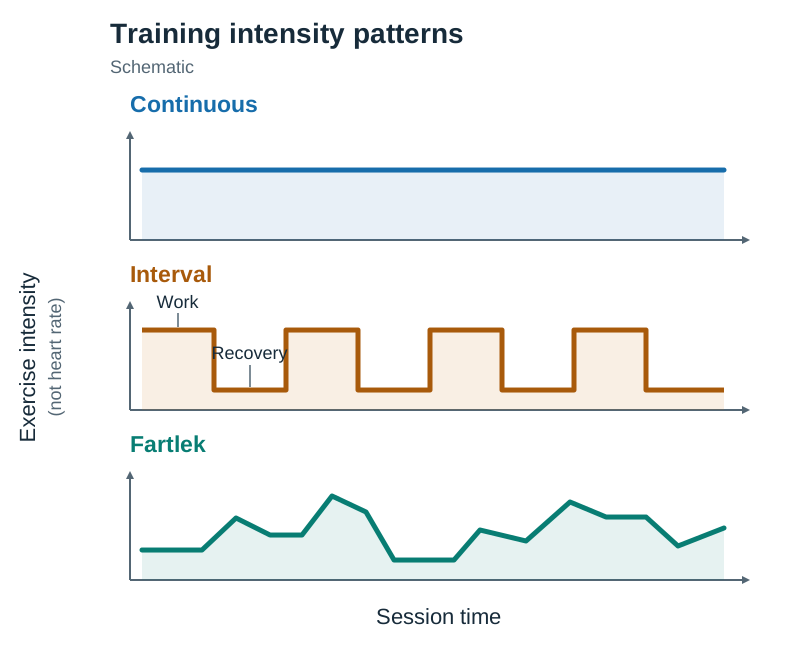
- Continuous training: Steady, uninterrupted exercise for at least 20 minutes in the aerobic zone (). Excellent for building an aerobic base in distance runners and rowers.
- Interval training: Alternating bouts of work and structured rest. The work-to-rest ratio determines what system you train: targets aerobic fitness, or develops lactate tolerance, and trains the ATP-PC system.
- Fartlek training: Swedish for 'speed play'. It blends continuous running with varied paces and changing terrain. This trains both the aerobic and anaerobic systems, mirroring the fluctuating speed demands of field sports.
- Circuit training: A series of 6 to 10 stations working different muscle groups in rotation, with timed work and rest periods. It can be easily adapted for muscular endurance, core stability, or sport skills.
- Weight training: lifting free weights, machines or body weight against resistance. Heavy loads with few repetitions (about 1–5) develop strength. Light loads with many repetitions (about 12–20+) develop muscular endurance. Use good technique and progress the load gradually.
- Plyometrics: Fast, explosive exercises that use the stretch-shortening cycle, where a muscle undergoes a rapid eccentric stretch followed immediately by an explosive concentric contraction. Depth jumps and bounding are typical examples, but athletes need a solid base of strength to do them safely.
Programme Design, Periodisation, Training Zones, and Recovery
Designing a Plan from Fitness Test Data
When an exam question presents test results, follow a logical process: compare the scores to published normative data for that age, sex, and sport; pinpoint the athlete's primary weaknesses; set SMART goals (Specific, Measurable, Achievable, Realistic/Relevant, Time-bound, e.g. improve my bleep-test level from 8 to 9.5 within 6 weeks) targeting those areas; choose appropriate training methods using the FITT formula; and plan a retest after 6 to 8 weeks to track progress.
Combined Approach to Training
A combined plan integrates health-related and performance-related fitness into a single schedule. For instance, an example week for a hockey player in pre-season:
- Monday: interval sprints (speed).
- Wednesday: weight training (strength, muscular endurance).
- Thursday: plyometrics and agility work followed by a 25-minute continuous run (power, agility, cardiorespiratory endurance).
- Saturday: match or conditioned game.
- Stretching after each session (flexibility).
Health- and performance-related components are trained in the same week. Rest days are spread through the week, including the day before the match.
Calculating Heart-Rate Training Zones
To set aerobic and anaerobic training zones, first calculate estimated maximum heart rate:
- Aerobic zone: 60% to 80% of . This develops cardiorespiratory endurance, capillary density, and fat metabolism.
- Anaerobic zone: 80% to 90% of . This builds speed endurance and lactate tolerance.
- Anaerobic (lactate) threshold: The exercise intensity where lactic acid accumulates in the bloodstream faster than the body can clear it. Training just below or at this threshold raises it, allowing athletes to work at higher intensities before fatigue sets in.
Periodisation
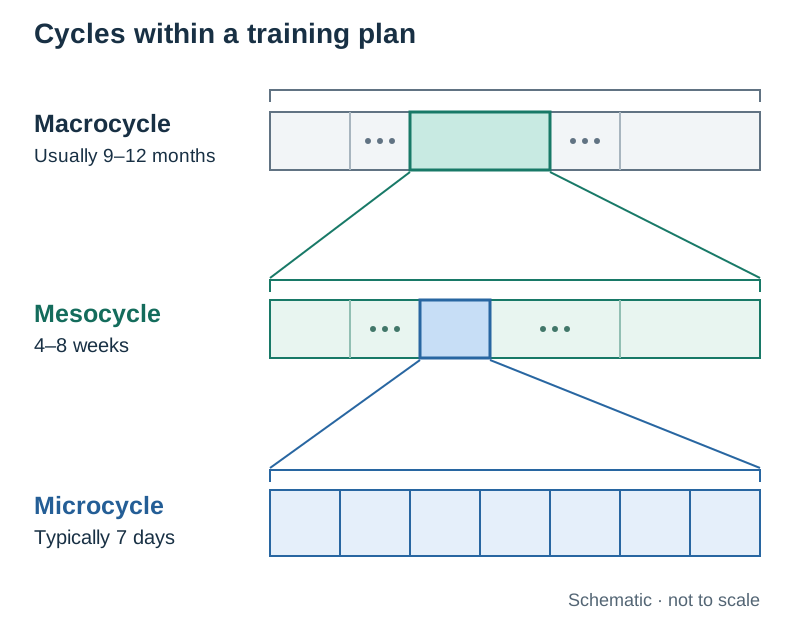
Periodisation is the structured division of a long-term training plan into distinct phases and cycles, ensuring an athlete peaks at major competitions while avoiding overtraining.
- Macrocycle: The entire long-term plan, usually lasting an academic year or competitive season (9 to 12 months).
- Mesocycle: A medium-term block within the macrocycle, lasting 4 to 8 weeks, dedicated to a specific training goal like maximal strength or aerobic base.
- Microcycle: A short block, typically 7 days, detailing individual workouts, intensities, and rest days.
| Phase | Volume and Intensity | Main Aim |
|---|---|---|
| Preparatory Phase | High volume, low-to-moderate intensity | Builds the aerobic base, general strength, and mobility; shifts towards sport-specific power late in the phase. |
| Competitive Phase | Lower volume, high intensity | Refines tactical sharpness and maintains speed and power; includes a pre-event taper ( volume reduction) to eliminate fatigue. |
| Transition Phase | Low volume, low intensity | Active rest and light recreation to let the body heal tissue micro-trauma and provide a mental break. |
Recovery Strategies
Training provides the stimulus, but adaptation happens during recovery. Key recovery strategies include:
- Cool-down: 5 to 10 minutes of light jogging followed by static stretching lowers heart rate gradually, prevents blood pooling in the lower limbs, and helps restore normal muscle length.
- Nutrition: Eating a combination of carbohydrates and protein in a or ratio within 30 to 60 minutes of finishing exercise kick-starts glycogen replenishment and muscle repair.
- Rehydration: Drinking 1.25 to 1.5 litres of fluid for every kilogram of body mass lost through sweat during the session.
- Sleep: Teenagers and competing athletes need 8 to 10 hours of good sleep each night for physical recovery and growth hormone release.
- Hydrotherapy: Contrast water therapy or ice baths () help reduce muscle soreness and perceived fatigue after heavy contact or high-volume matches.