

Biomechanical Analysis: Planes, Axes, and Levers
Biomechanics applies mechanical principles to human movement to improve performance efficiency and reduce injury risk. Movement is described from the standard anatomical position: standing erect, facing forward, arms at the sides with palms facing forward.
Planes and Axes of Movement
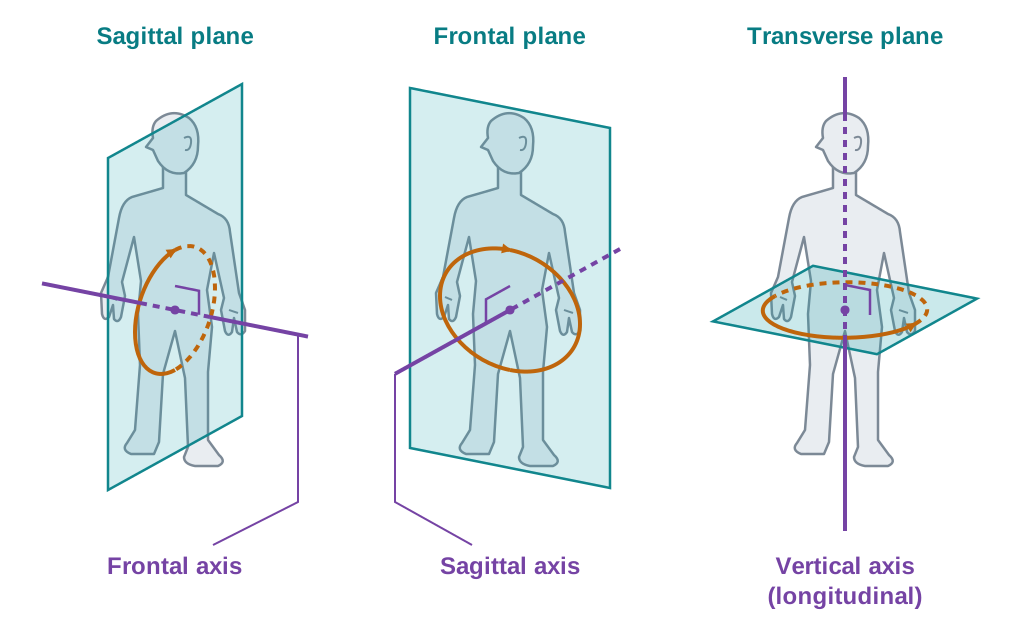
A plane is a flat surface through which the body moves, while an axis is an imaginary straight line around which a body part rotates. Movement in any plane always turns around a perpendicular axis:
| Plane | Division of Body | Joint Movements | Perpendicular Axis | Sporting Example |
|---|---|---|---|---|
| Sagittal | Left and right halves | Flexion and extension | Frontal axis (runs side to side from hip to hip) | Running stride, forward roll, elbow flexion in a biceps curl |
| Frontal | Front and back halves | Abduction and adduction | Sagittal axis (runs through front to back) | Cartwheel in gymnastics, star jump, side-stepping in rugby |
| Transverse | Upper and lower halves | Horizontal rotation | Vertical (longitudinal) axis (runs head to toe) | Discus thrower spinning in the circle, 360-degree pivot in basketball |
Levers in the Human Body
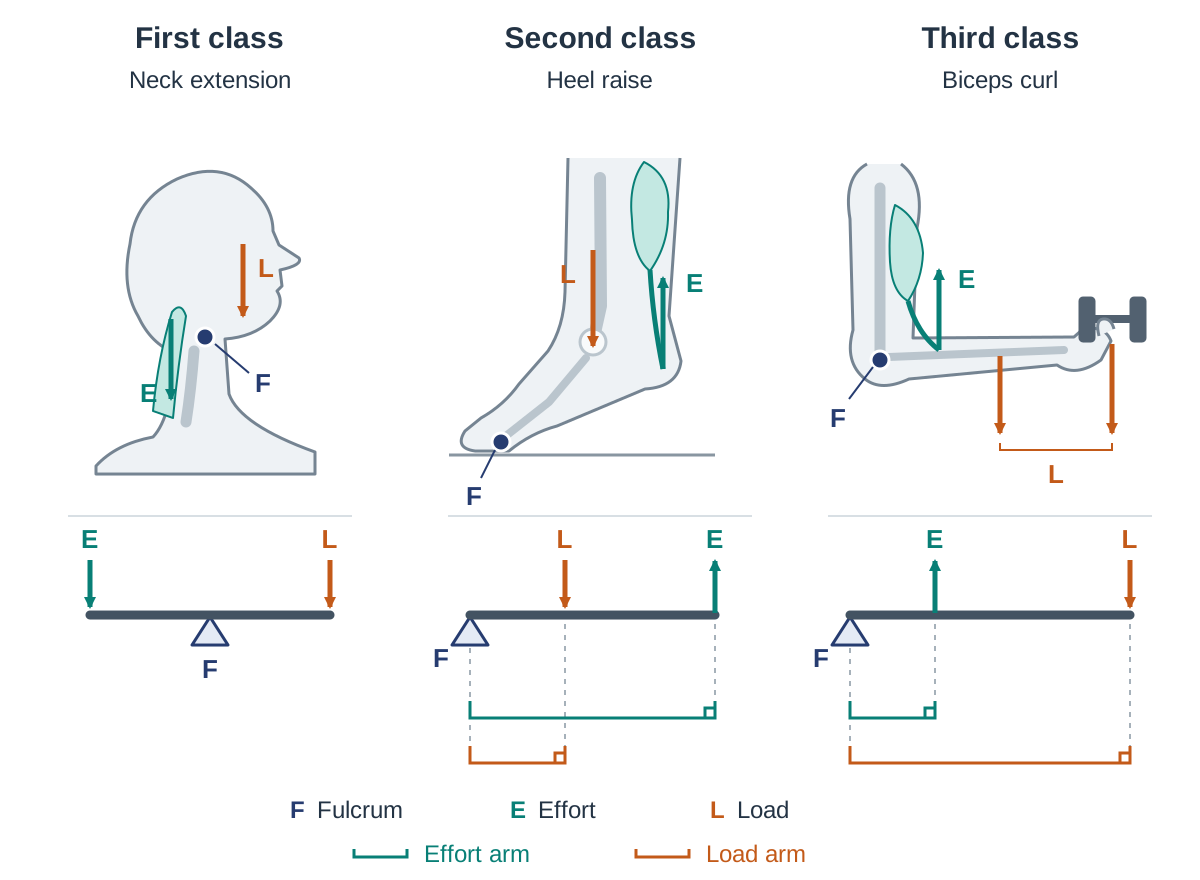
A lever system in the body has three parts: the fulcrum (, the joint pivot), the effort (, the contracting muscle that generates force), and the load (, the resistance to move, including limb weight and equipment). Remember the sequence by noting which component lies in the middle: 1-2-3 = F-L-E.
- First-class lever ( in the middle): Fulcrum sits between effort and load (). An example is neck extension when heading a soccer ball, where the atlanto-occipital joint is the fulcrum, the neck extensors provide the effort, and the head is the load. Elbow extension by the triceps against resistance (such as releasing a shot put) is also a first-class lever.
- Second-class lever ( in the middle): Load sits between fulcrum and effort (). An example is plantarflexion at the ankle when jumping for a rebound in basketball. The ball of the foot acts as the fulcrum, the body's mass acting down through the tibia is the load, and the gastrocnemius contracting via the Achilles tendon provides the effort. This produces mechanical advantage: the effort arm is longer than the load arm, so a large load can be moved with relatively low muscular effort.
- Third-class lever ( in the middle): Effort is applied between the fulcrum and the load (). This is the most common lever in the body. An example is elbow flexion during a biceps curl. The elbow joint is the fulcrum, the biceps inserting onto the radius provides the effort, and the forearm plus weight is the load. This operates at a mechanical disadvantage in force (the effort arm is shorter than the load arm), but it creates a large range of motion and high lever-tip speed, allowing athletes to throw, kick, and strike implements at high velocity.
Movement Analysis: Newton's Laws, Quality, and Effectiveness
Evaluating movement quality requires assessing both the physical forces involved and how an athlete applies skill during play.
Vectors and Scalars
- Scalar quantities describe magnitude (numerical size) only, with no direction. Examples include distance (100 m), speed (8 m/s), mass (70 kg), and time.
- Vector quantities describe both magnitude and direction. Examples include displacement (10 m north), velocity (8 m/s forward), acceleration, and force (Newtons applied at a specific angle).
Newton's Three Laws of Motion
- First Law (Law of Inertia): An object remains at rest or travels at a constant velocity in a straight line unless acted upon by an external, unbalanced force. Application: A stationary soccer ball on the penalty spot will not move until the kicker's boot applies an unbalanced muscular force to overcome its inertia.
- Second Law (Law of Acceleration): The rate of change of momentum is directly proportional to the force applied and takes place in the direction of that force (). Application: Accelerating a tennis racquet or hurley faster into contact applies a larger force, producing a proportional increase in the acceleration and speed of the ball.
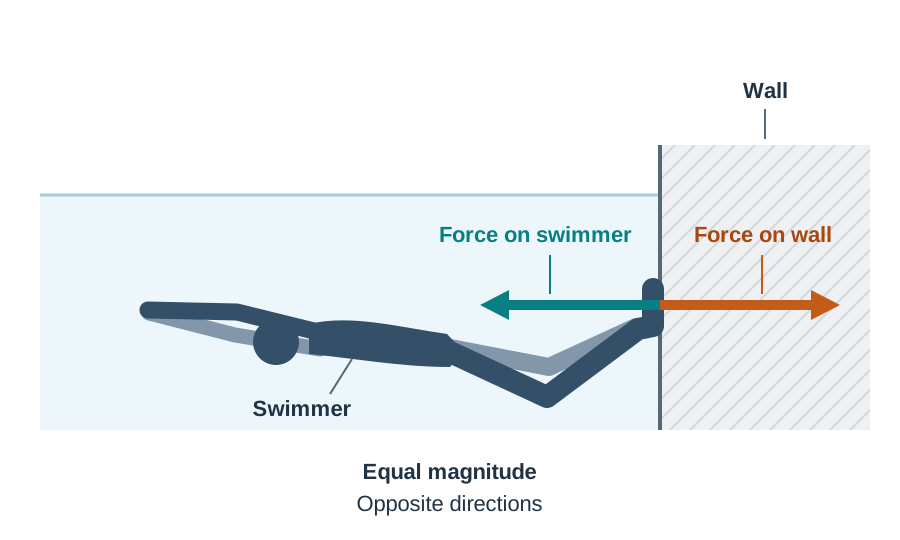
- Third Law (Law of Action-Reaction): For every action force, there is an equal and opposite reaction force. Application: A swimmer pushes backward against the pool wall during a tumble turn (action force); the wall pushes forward with equal force against the swimmer's feet (reaction force), propelling them down the lane.
Quality and Effectiveness of Movement
Economy of movement means performing a skill with minimum energy expenditure for the mechanical work achieved. An economical 5,000 m runner maintains upright posture, relaxed shoulders, and minimal vertical bounce, avoiding superfluous muscle recruitment. This preserves glycogen and delays fatigue.
Creative application of skill involves applying learned techniques in inventive or unexpected ways to outwit opponents and solve dynamic tactical problems. Examples include a disguised 'no-look' reverse pass in basketball, a dummy hand-pass in camogie, or an unexpected chip over an advancing goalkeeper.