

Skill, ability, and skilled performance form the foundation of Strand 1 (Topic 1) in Leaving Certificate Physical Education. This topic explores what distinguishes innate abilities from learned skills, how to analyse movement through biomechanical principles like levers and Newton's laws, and how athletes progress through the stages of learning. You will also learn how to select practice methods, design training schedules, and apply feedback to improve performance across different physical activities.
Defining Skill, Technique, and Ability
A skill is the learned ability to bring about predetermined results with maximum certainty and minimum outlay of time or energy (or both). It is a learned action developed through deliberate practice to solve a specific movement problem.
Technique is the way in which a skill is executed, meaning the mechanical movement pattern used to perform it. In basketball, for example, the jump shot is the skill, while the technique is the physical sequence used to execute it: feet shoulder-width apart, elbow aligned under the ball, extension through the legs, and a fluid wrist snap on release. Two players may possess the skill of shooting effectively while relying on slightly different techniques.
A skilled performance is a sequence of movements performed in a fluent and controlled manner, where the right options are selected, and the skills and techniques used fully reflect the performer's ability and experience.
Skill Versus Ability
An ability is an innate, genetically determined trait that underpins movement. Abilities are stable and enduring foundations such as reaction time, balance, coordination, and speed of limb movement. They are not learned from scratch.
| Feature | Ability | Skill |
|---|---|---|
| Origin | Innate (born with it) | Learned through practice |
| Nature | General: one ability supports many skills | Specific to a defined task |
| Stability | Stable and enduring foundation | Develops, adapts, and improves with training |
| Sporting example | Balance, reaction time, multi-limb coordination | Striking a sliotar, a badminton serve, a soccer penalty |
Linking the two: Abilities act as the building blocks of skills. A goalkeeper with exceptional natural reaction time and hand-eye coordination will usually acquire shot-stopping skills faster and reach a higher performance ceiling. A player with less innate ability can still develop high skill levels through structured practice, though the learning process may require more repetitions.
Characteristics of Skilled Performance and Skill Continua
When observers evaluate performance in physical activity, several key qualities stand out. Characteristics of a skilled performance include:
- Kinaesthetic awareness: The internal sensory feel of body position and movement provided by proprioceptors in the muscles, tendons, and joints. A high jumper relies on kinaesthetic awareness to sense their body clearing the bar without looking at it.
- Anticipation: Reading environmental cues early to predict what will happen next. A Gaelic football defender watches an attacker's approach angle and hip position to execute a block before the kick is released.
- Consistency: The capacity to repeat successful technique and achieve target outcomes reliably under match pressure.
- Accuracy: Executing the movement precisely to hit the intended target, such as a netball shooter repeatedly hitting the centre of the ring.
- Good decision-making (selecting the right option): Choosing the correct skill at the correct moment. A camogie player chooses to point from distance when the path to goal is congested rather than forcing an intercepted pass.
- Fluency and control: Smooth, seamless transitions between movement phases without erratic adjustments or hesitation.
- Technique: Executing biomechanically sound movement patterns that hold up under fatigue and pressure.
Classifying Skills on Continua
Most skills are not simply one type or another, so we place them on a scale called a continuum (such as 'fairly closed' or 'very open'). While classification continua are widely taught to help structure drills, they are tools for analysis rather than rigid categories.
- Environmental continuum (open vs closed): An open skill is performed in a changing, unpredictable environment where the performer must constantly adapt to opponents, teammates, or weather conditions (e.g. passing in hockey under pressure). A closed skill is performed in a stable, predictable environment where the movement can be identical each time (e.g. a basketball free throw or a gymnastics vault).
- Pacing continuum (self-paced vs externally paced): A self-paced skill is initiated and timed entirely by the performer (e.g. a high jumper beginning their run-up). An externally paced skill is initiated or controlled by outside factors (e.g. a sprinter reacting to the starting gun, or returning a serve in tennis).
- Muscular involvement continuum (gross vs fine): Gross skills recruit large muscle groups to produce force (e.g. the leg drive in rowing). Fine skills involve small muscle groups and high hand-eye coordination for precision (e.g. spin bowling in cricket or a short push in table tennis).
Biomechanical Analysis: Planes, Axes, and Levers
Biomechanics applies mechanical principles to human movement to improve performance efficiency and reduce injury risk. Movement is described from the standard anatomical position: standing erect, facing forward, arms at the sides with palms facing forward.
Planes and Axes of Movement
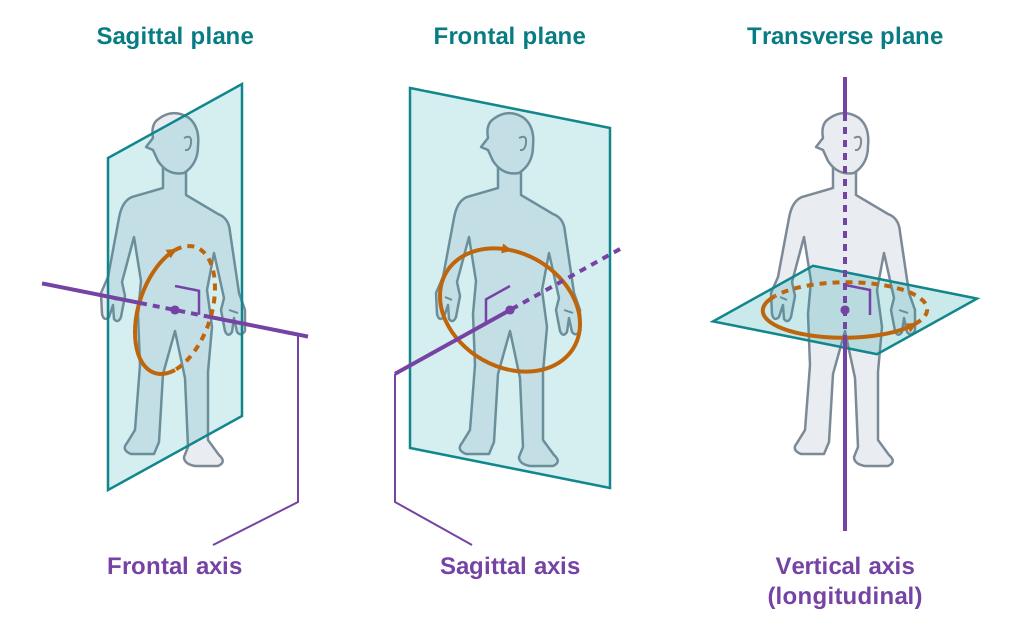
A plane is a flat surface through which the body moves, while an axis is an imaginary straight line around which a body part rotates. Movement in any plane always turns around a perpendicular axis:
| Plane | Division of Body | Joint Movements | Perpendicular Axis | Sporting Example |
|---|---|---|---|---|
| Sagittal | Left and right halves | Flexion and extension | Frontal axis (runs side to side from hip to hip) | Running stride, forward roll, elbow flexion in a biceps curl |
| Frontal | Front and back halves | Abduction and adduction | Sagittal axis (runs through front to back) | Cartwheel in gymnastics, star jump, side-stepping in rugby |
| Transverse | Upper and lower halves | Horizontal rotation | Vertical (longitudinal) axis (runs head to toe) | Discus thrower spinning in the circle, 360-degree pivot in basketball |
Levers in the Human Body
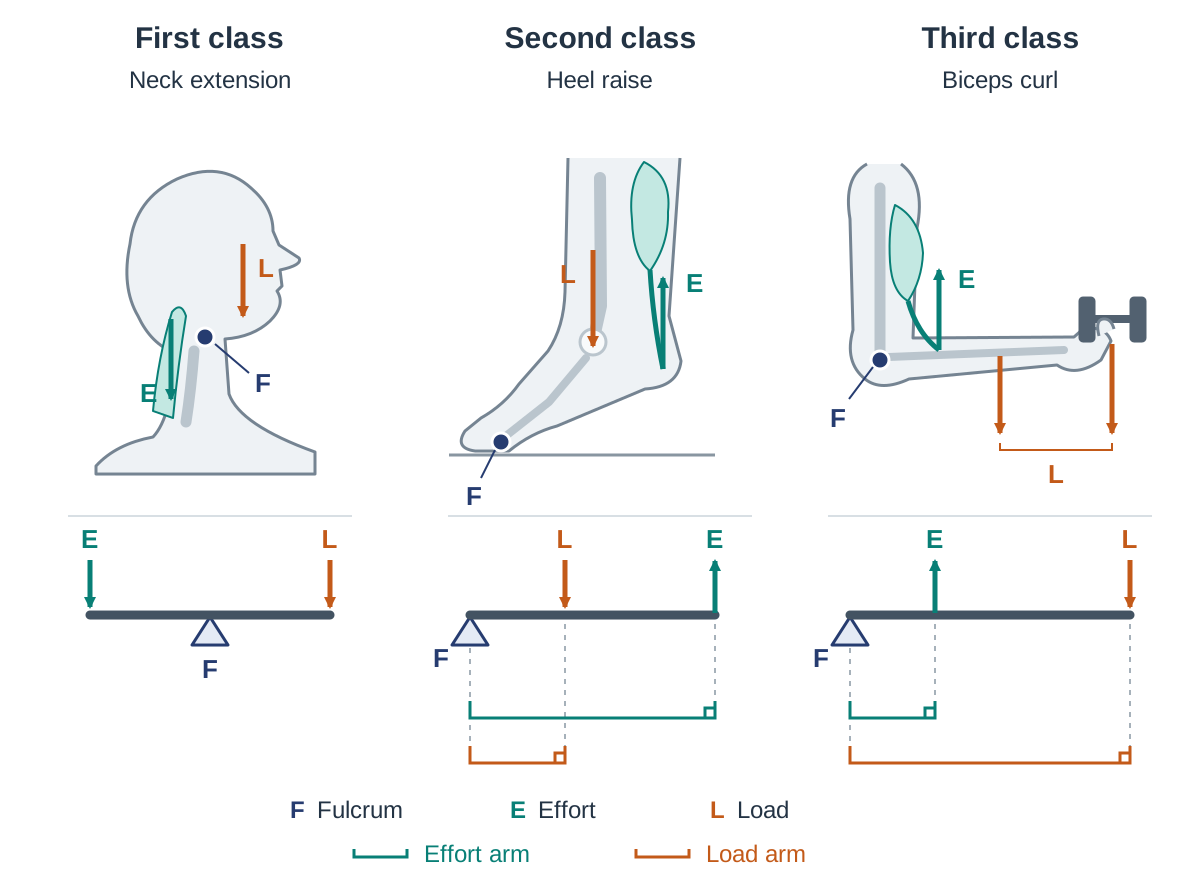
A lever system in the body has three parts: the fulcrum (, the joint pivot), the effort (, the contracting muscle that generates force), and the load (, the resistance to move, including limb weight and equipment). Remember the sequence by noting which component lies in the middle: 1-2-3 = F-L-E.
- First-class lever ( in the middle): Fulcrum sits between effort and load (). An example is neck extension when heading a soccer ball, where the atlanto-occipital joint is the fulcrum, the neck extensors provide the effort, and the head is the load. Elbow extension by the triceps against resistance (such as releasing a shot put) is also a first-class lever.
- Second-class lever ( in the middle): Load sits between fulcrum and effort (). An example is plantarflexion at the ankle when jumping for a rebound in basketball. The ball of the foot acts as the fulcrum, the body's mass acting down through the tibia is the load, and the gastrocnemius contracting via the Achilles tendon provides the effort. This produces mechanical advantage: the effort arm is longer than the load arm, so a large load can be moved with relatively low muscular effort.
- Third-class lever ( in the middle): Effort is applied between the fulcrum and the load (). This is the most common lever in the body. An example is elbow flexion during a biceps curl. The elbow joint is the fulcrum, the biceps inserting onto the radius provides the effort, and the forearm plus weight is the load. This operates at a mechanical disadvantage in force (the effort arm is shorter than the load arm), but it creates a large range of motion and high lever-tip speed, allowing athletes to throw, kick, and strike implements at high velocity.
Movement Analysis: Newton's Laws, Quality, and Effectiveness
Evaluating movement quality requires assessing both the physical forces involved and how an athlete applies skill during play.
Vectors and Scalars
- Scalar quantities describe magnitude (numerical size) only, with no direction. Examples include distance (100 m), speed (8 m/s), mass (70 kg), and time.
- Vector quantities describe both magnitude and direction. Examples include displacement (10 m north), velocity (8 m/s forward), acceleration, and force (Newtons applied at a specific angle).
Newton's Three Laws of Motion
- First Law (Law of Inertia): An object remains at rest or travels at a constant velocity in a straight line unless acted upon by an external, unbalanced force. Application: A stationary soccer ball on the penalty spot will not move until the kicker's boot applies an unbalanced muscular force to overcome its inertia.
- Second Law (Law of Acceleration): The rate of change of momentum is directly proportional to the force applied and takes place in the direction of that force (). Application: Accelerating a tennis racquet or hurley faster into contact applies a larger force, producing a proportional increase in the acceleration and speed of the ball.
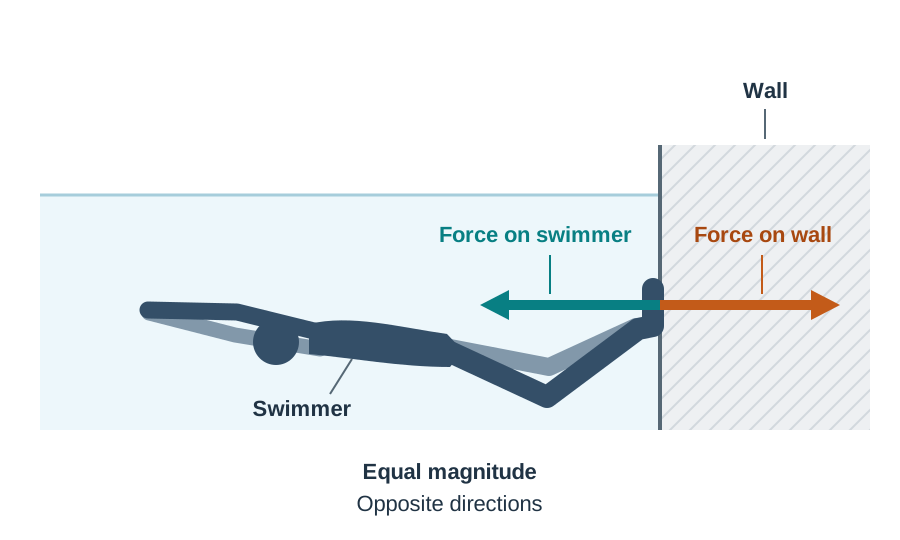
- Third Law (Law of Action-Reaction): For every action force, there is an equal and opposite reaction force. Application: A swimmer pushes backward against the pool wall during a tumble turn (action force); the wall pushes forward with equal force against the swimmer's feet (reaction force), propelling them down the lane.
Quality and Effectiveness of Movement
Economy of movement means performing a skill with minimum energy expenditure for the mechanical work achieved. An economical 5,000 m runner maintains upright posture, relaxed shoulders, and minimal vertical bounce, avoiding superfluous muscle recruitment. This preserves glycogen and delays fatigue.
Creative application of skill involves applying learned techniques in inventive or unexpected ways to outwit opponents and solve dynamic tactical problems. Examples include a disguised 'no-look' reverse pass in basketball, a dummy hand-pass in camogie, or an unexpected chip over an advancing goalkeeper.
Skill Acquisition: Stages of Learning (Fitts and Posner)
Learning a skill produces a relatively permanent change in performance as a result of practice. Fitts and Posner established that performers progress through three distinct stages:
1. Cognitive Stage (Beginner)
- Characteristics: The learner tries to understand what the movement requires. Every part of the skill demands deliberate, conscious attention. Performance is jerky, inconsistent, and marked by frequent gross errors. The performer lacks kinaesthetic feel and cannot self-correct.
- Coaching and practice: Use clear visual demonstrations and simple verbal cues. Break complex skills into manageable parts (part practice) and use stable, fixed practice drills. Provide positive extrinsic feedback to guide understanding.
2. Associative Stage (Intermediate / Practice)
- Characteristics: The performer understands the fundamental mechanics and focuses on refining the technique. Movement becomes smoother, gross errors decrease, and consistency improves. Motor programmes begin to stabilise, and the athlete starts to develop internal kinaesthesis to detect basic mistakes. Sporting example: A camogie player can reliably strike off the hand during drills, but her technique still breaks down under aggressive pressure from a defender.
- Coaching and practice: Introduce variable practice and conditioned games to expose the skill to changing environments. Combine extrinsic feedback with guided self-reflection.
3. Autonomous Stage (Expert)
- Characteristics: The skill is automatic and requires little or no conscious control over mechanics. Movements are fluid, highly consistent, and accurate even under intense competitive fatigue. Spare cognitive capacity is redirected to tactical awareness, scanning passing lanes, and reading opponents.
- Coaching and practice: Athletes rely primarily on intrinsic feedback and can make real-time micro-corrections. Coaching focuses on fine tactical adjustments, pressure scenarios, and video analysis.
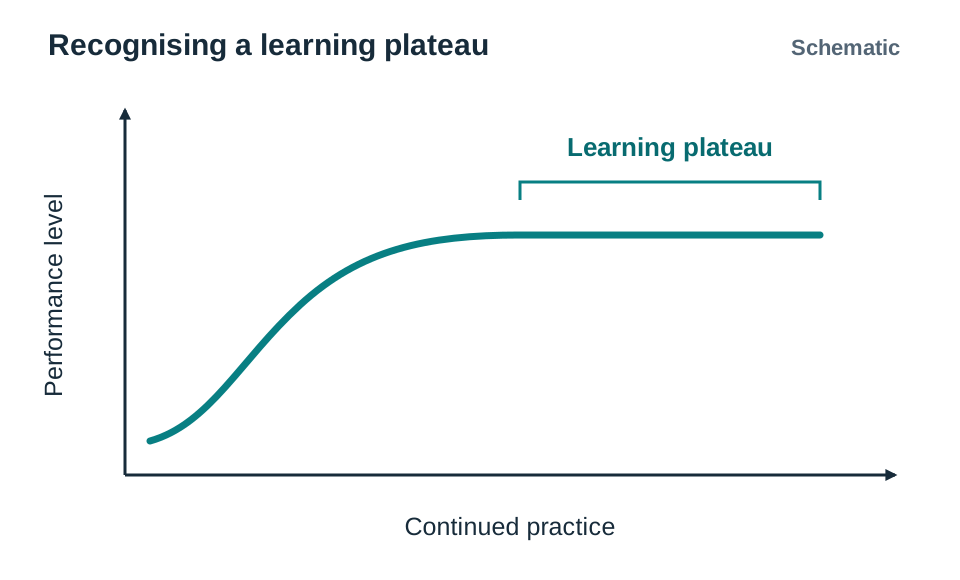
A learning plateau occurs when performance levels flatten despite continued practice. Common causes include physical fatigue, boredom, lack of motivation, inappropriate practice methods, or reaching a temporary ceiling before adopting a more complex technique.
Practice Methods, Feedback, and Schedule Design
Coaches select practice methods and feedback based on the athlete's stage of learning and the nature of the task.
Practice Methods
- Whole practice: Rehearsing the entire skill from start to finish without breakdown. Best for fast skills whose parts are hard to separate without losing the rhythm (e.g. a golf swing or sprint start).
- Part practice: Isolating separate subroutines, mastering them, and chaining them together. Best for complex skills with clearly separate parts (e.g. triple jump phases).
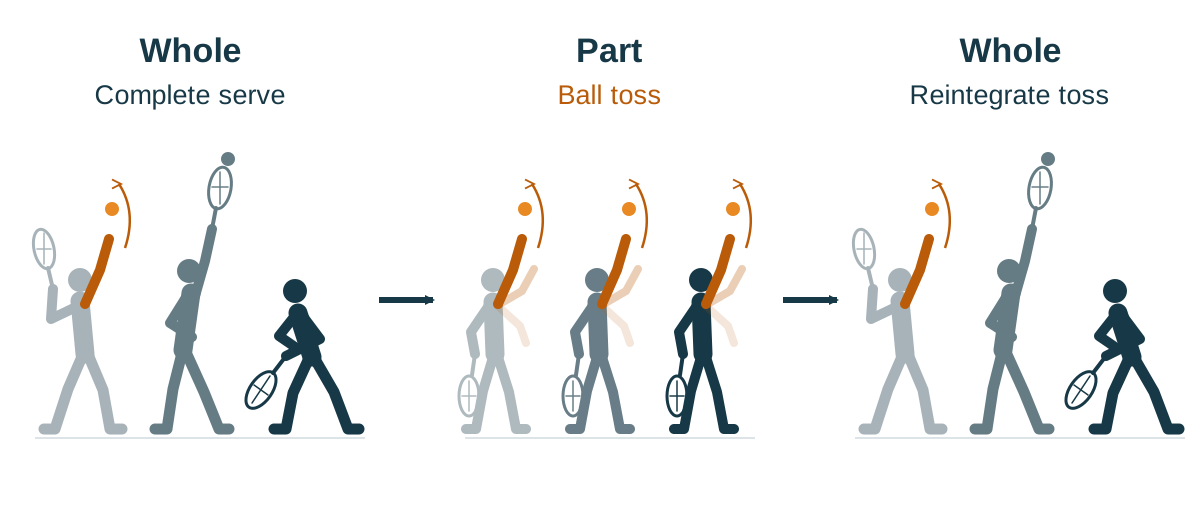
- Whole-part-whole practice: Trying the complete skill, isolating a struggling component to drill separately, and integrating it back into the whole action (e.g. performing a full tennis serve, isolating the ball toss, then returning to the full serve).
Practice Types
- Fixed practice: Repeating the skill in an identical, stable environment (ideal for closed skills).
- Variable practice: Repeating the skill under changing conditions, angles, and pressures (essential for open skills).
- Massed practice: Continuous repetition with very short or no rest breaks (suits simple skills with fit, autonomous athletes).
- Distributed practice: Training with built-in rest and feedback intervals between trials (vital for beginners learning complex skills to reduce fatigue and allow cognitive processing).
- Mental practice: Mentally rehearsing the movement pattern without physical movement, reinforcing motor pathways.
Types of Feedback and Their Benefits
- Intrinsic feedback: Internal sensory information from proprioceptors. Benefit: Allows autonomous athletes to feel errors instantly and self-correct during play.
- Extrinsic feedback: External guidance from coaches, video, or data. Benefit: Directs beginners who lack kinaesthetic awareness toward correct technique.
- Positive feedback: Praise and reinforcement of successful execution. Benefit: Motivates the performer and strengthens correct motor habits, especially for beginners.
- Negative feedback: Constructive details highlighting errors. Benefit: Pinpoints mechanical flaws so experienced athletes can refine technique.
- Knowledge of Results (KR): Outcome data (e.g. whether a penalty went into the top corner). Benefit: Provides objective measurement against performance goals.
- Knowledge of Performance (KP): Information about movement quality (e.g. whether the hips rotated fully). Benefit: Helps the athlete understand movement mechanics regardless of the result.
- Continuous feedback: Delivered during execution (e.g. coxswain calling stroke rate in rowing). Benefit: Enables on-the-fly tactical adjustments.
- Terminal feedback: Provided after execution ends. Benefit: Gives time to reflect and plan corrections before the next attempt.
Principles of Effective Practice
When building training sessions, apply these core principles:
- Goal-setting: Clear, measurable targets keep sessions focused.
- Stage-appropriate practice: Methods must match whether the learner is cognitive, associative, or autonomous.
- Progression: Increase drill complexity gradually as competence builds (e.g. advancing from unopposed 3v1 to contested 3v3).
- Variety: Alternating drill formats maintains engagement and prevents boredom.
- Adequate recovery: Built-in rest (distributed structure) prevents fatigue and mental overload.
- Quality feedback: Timely, specific information guides adjustment.
- Match relevance: Incorporate conditioned games (modifying rules, touch limits, or pitch size) to challenge skills under match-like pressure.
Key terms
- Skill
- The learned ability to bring about predetermined results with maximum certainty and minimum outlay of time or energy (or both).
- Ability
- An innate, genetically determined foundation or capacity that underpins the learning and execution of movement skills.
- Technique
- The specific mechanical movement pattern used to execute a skill.
- Skilled Performance
- A sequence of movements performed in a fluent and controlled manner, where the right options are selected, and the skills and techniques used fully reflect the performer's ability and experience.
- Kinaesthetic Awareness
- The internal sensory perception of body and limb position in space, detected by proprioceptors in muscles, tendons, and joints.
- Open Skill
- A skill performed in an unpredictable, constantly changing environment where the performer must continuously adapt their movements to external factors.
- Closed Skill
- A skill performed in a stable, predictable environment where the movement pattern can be repeated consistently without external interference.
- Sagittal Plane
- The anatomical plane dividing the body into left and right halves, accommodating flexion and extension movements around the frontal axis.
- Frontal Axis
- The horizontal axis running from side to side through the body around which sagittal plane movements rotate.
- Second-Class Lever
- A lever system where the load lies between the fulcrum and the effort, operating at a mechanical advantage to move large loads with relatively low muscular effort.
- Third-Class Lever
- A lever system where the effort is applied between the fulcrum and the load, operating at a mechanical disadvantage in force to produce high limb velocity and wide range of motion.
- Economy of Movement
- The efficiency with which an athlete expends energy relative to mechanical work done, avoiding unnecessary muscular actions to delay fatigue.
- Cognitive Stage
- The initial beginner phase of motor learning, marked by conscious thought, jerky movement, frequent gross errors, and dependence on extrinsic feedback.
- Autonomous Stage
- The expert phase of learning, where skill execution is fluid, automatic, and consistent, freeing mental capacity for tactical decision-making.
- Knowledge of Results (KR)
- Outcome-focused extrinsic feedback that informs the performer whether their action achieved its objective.
- Knowledge of Performance (KP)
- Feedback focused on the biomechanical quality and technical execution of the movement pattern.
- Distributed Practice
- A practice schedule featuring deliberate rest and feedback intervals between training trials to prevent fatigue and support cognitive retention.
- Conditioned Game
- A modified game with specific rules or constraints designed to compel players to practise targeted skills and tactics under realistic pressure.
Check yourself
Is reaction time a skill or an ability? Give a reason for your answer.
Reaction time is an ability. It is an innate, genetically determined physical trait that is stable, enduring, and underpins many different skills (such as a goalkeeper's save or a sprinter's start).
Which plane of movement divides the body into front and back halves, and which axis passes perpendicular to it?
The frontal plane divides the body into front and back halves, and movement within it rotates around the sagittal axis (which runs horizontally from front to back).
Identify the arrangement of the fulcrum, effort, and load in a second-class lever, and provide one sporting example.
The load sits between the fulcrum and the effort (). An example is plantarflexion at the ankle during a basketball jump, where the ball of the foot is the fulcrum, body weight through the tibia is the load, and the gastrocnemius provides the effort.
How does Newton's Second Law of Motion () apply to striking a sliotar in hurling?
The acceleration of the sliotar is directly proportional to the force applied by the hurley and occurs in the direction of the swing. Accelerating the hurley faster into impact applies a larger force, producing higher acceleration and velocity on the ball.
Why is distributed practice more effective than massed practice for a beginner in the cognitive stage?
Beginners lack established motor programmes and fatigue quickly under continuous practice. Distributed practice includes rest intervals that prevent mechanical breakdown caused by fatigue and allow time to process coach feedback.