

Planning for optimum performance is the structured process of assessing current ability, setting clear targets, carrying out an evidence-based training programme, and evaluating the results. In Leaving Certificate Physical Education, optimum performance does not mean setting a world record; it means achieving your own best possible standard at this point in time. This systematic process underpins the Physical Activity Project (PAP) and applies to both purposive sports and artistic disciplines. Rather than relying on guesswork, you analyse your performance using objective and subjective tools, identify areas needing development, design a training plan rooted in the principles of training, plan for potential setbacks, and evaluate your progress through ipsative and normative comparison.
The Four-Stage Performance Planning Cycle
The planning cycle reflects the structure of the Leaving Certificate Physical Activity Project (PAP), an 8- to 10-week digital project worth 20% of your final mark. You can complete the project as a performer (improving your own execution) or as a coach/choreographer (designing a routine or coaching another performer). Note that your PAP activity must be different from the activity you choose for your 30% performance assessment.
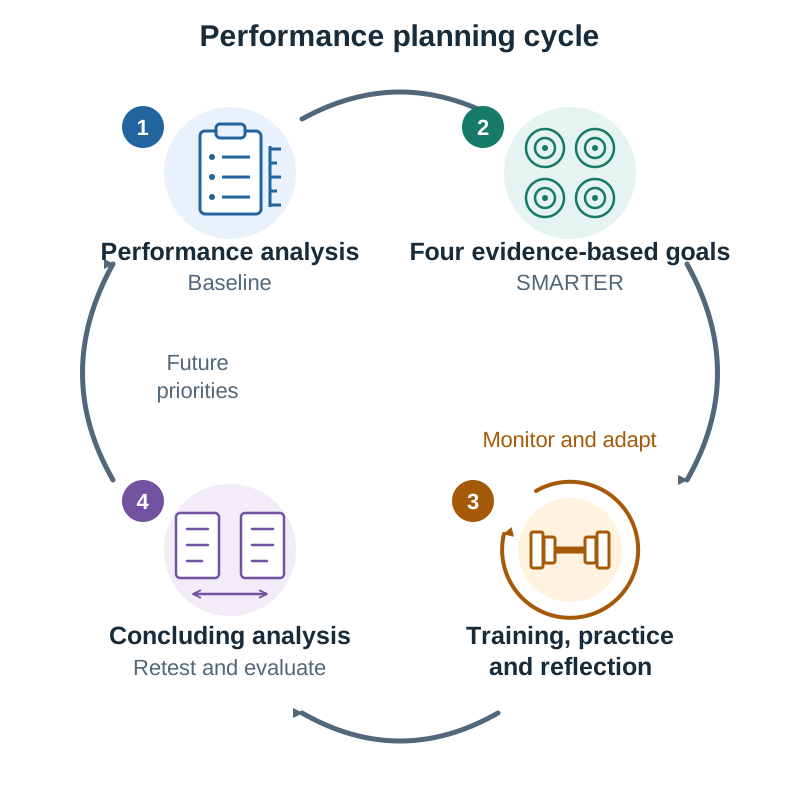
Stage 1: Performance analysis
You conduct a needs analysis by examining the physical, technical, tactical, and psychological demands of your activity and measuring your current ability against them. By comparing your performance to that of a model performer—an athlete who executes the skill with fluent, efficient technique—and using fitness test batteries or notational charts, you identify your strengths and isolate four specific areas needing further development.
Stage 2: Identification of four performance goals
Once you have analysed your data, you choose the four areas that require the most attention. It is usually good practice to spread these four goals across different aspects of performance—such as a technical skill, a tactical strategy, a fitness component, and a psychological factor—to ensure balanced development. However, every goal must be justified directly by evidence from your Stage 1 analysis, written using the SMARTER principle (Specific, Measurable, Attainable, Realistic, Time-bound, Evaluated, Reset).
Stage 3: Evidence of ongoing training/practice and reflection
You implement an 8- to 10-week training plan applying key principles of training. You record weekly training sessions, log adjustments made during practice, and complete regular written reflections that capture your physical and psychological adaptation.
Stage 4: Concluding analysis
At the end of the intervention, you repeat the initial tests under the same conditions. You compare your final results to your starting baseline to evaluate whether your programme design was effective and whether each goal was achieved, before outlining future training priorities.
Factors Influencing Personal Performance
Performance is shaped by a combination of physical, mental, and lifestyle factors:
- Skill and technique: The consistency, accuracy, and efficiency of movement. For example, a badminton player who disguises a drop shot forces weak defensive returns from their opponent.
- Tactics and strategies: Game plans and decisions made under pressure. In distance running, an 800 m runner might run a positive-splits race, running the first 400 m faster than the second to break the field.
- Performance-related fitness: Components required for sport-specific execution: agility, balance, coordination, power, reaction time, and speed. A rugby winger depends on acceleration and agility to beat a defender in wide channels.
- Health-related fitness: Physiological components including cardiorespiratory endurance, muscular strength, muscular endurance, flexibility, and body composition. A rower requires high muscular endurance to sustain blade drive over 2,000 metres.
- Psychological preparedness: Mental attributes such as arousal regulation, concentration, and confidence. A basketball player with elevated cognitive anxiety may experience perceptual narrowing and rush their free-throw shooting routine.
- Biomechanics: Movement efficiency and force application. A swimmer adjusts their body position to reduce frontal water drag, while a high jumper modifies their approach curve to maximise vertical takeoff velocity.
- Nutrition, recovery, and lifestyle: Energy availability, hydration, and sleep quality directly dictate adaptation. A swimmer training early in the morning without adequate carbohydrate intake fades in the final sets due to low muscle glycogen stores.
Methods of Analysis and Data Collection
To evaluate performance accurately, you need to know how to classify your data and choose the correct tool.
Classifying performance data
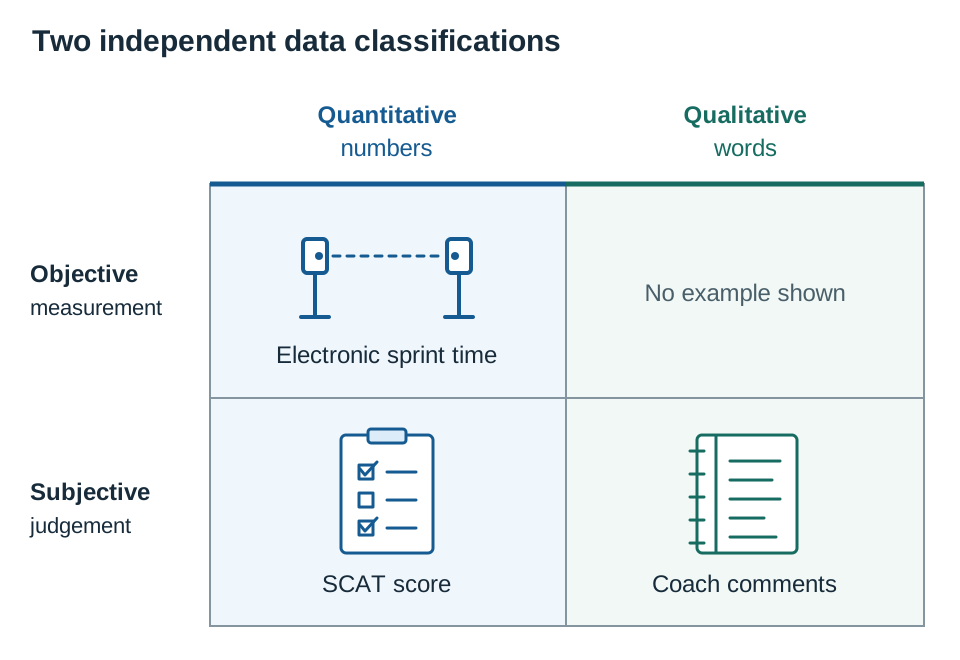
There are two separate ways to classify performance data:
- Quantitative vs Qualitative: Quantitative data is recorded in numbers, such as a 20 m sprint split time, heart rate, or shot conversion percentage. Qualitative data is recorded as descriptive words, such as a coach's spoken critique or a written self-assessment.
- Objective vs Subjective: Objective data is measured without personal bias or opinion, such as an electronic timing gate result. Subjective data relies on personal judgement, interpretation, or feelings, such as an athlete's rating of perceived exertion or an anxiety questionnaire.
A 30 m electronic sprint time is quantitative and objective. A Sport Competition Anxiety Test (SCAT) score is quantitative (a number) but subjective (based on feelings). A coach's written notes on foot placement are qualitative and subjective.
Methods of analysis table
| Performance aspect | Primary method | Practical tool / protocol | Data type produced |
|---|---|---|---|
| Skill and technique | Video and biomechanical analysis | Slow-motion video comparison against a model performer using a video analysis app | Qualitative (form critiques) and quantitative (joint angles) |
| Structures and strategies | Notational analysis | Tally charts, pitch heat maps, pass-completion logs | Quantitative (counts and frequencies) |
| Choreography | Video analysis against criteria | Front-view recording scored out of 5 on use of space, levels, timing, and expression | Qualitative observations converted into numerical scores |
| Performance-related fitness | Standardised fitness testing | Standardised protocols (e.g. Illinois Agility Test, 30 m sprint) | Quantitative and objective |
| Psychological preparedness | Standardised questionnaires | SCAT or CSAI-2 taken before competition and in relaxed states | Quantitative scores of subjective states |
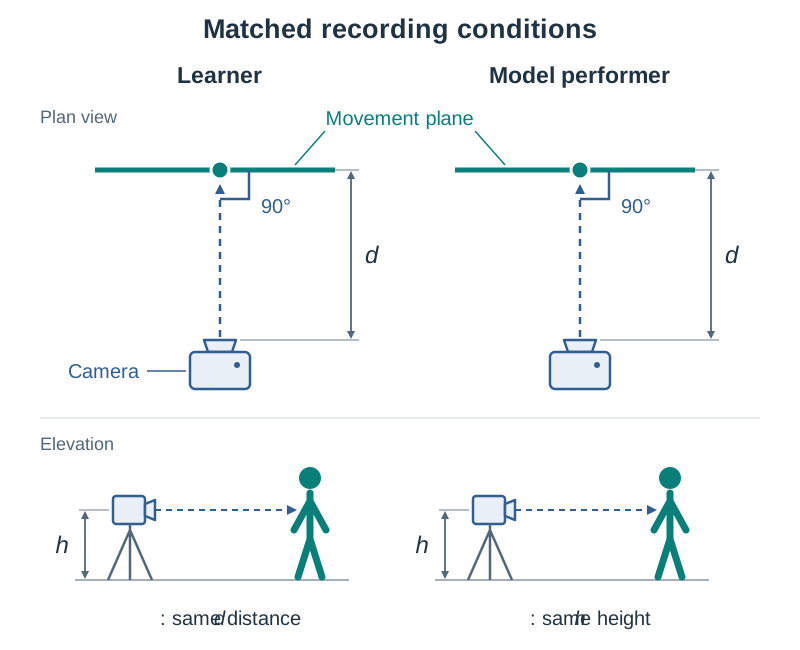
Comparing against a model performer
When recording video to analyse technique against a model performer, keep conditions identical. Film both performers from the same angle (for example, side-on at 90° to the plane of motion), at the same distance, and at the same camera height. This ensures any observed differences in joint angles, release points, or follow-through reflect true technical faults rather than camera distortion.
Principles of Training and Planning for Setbacks
When you design an 8- to 10-week practice or training plan, your sessions must apply established principles of training rather than random drills.
Principles of training
- Specificity: Training must match the exact energy systems, muscle groups, and movement skills of the activity. A Gaelic footballer trains repeated sprint ability with 20–30 m shuttles, not long continuous runs.
- Progression: The training load must increase steadily over time so the body continues to adapt without causing injury or burnout.
- Overload: To improve, you must work harder than usual. You manipulate overload using the FITT formula: Frequency (sessions per week), Intensity (heart rate, pace, or resistance), Time (duration of work intervals), or Type (training method chosen).
- Reversibility: Adaptations are lost when training stops or volume drops too low.
- Individual differences: The plan must account for an individual's training age, baseline fitness, injury history, and position.
- Recovery: Physiological adaptations take place during rest periods, making planned recovery days essential.
- Variety: Changing drills and environments prevents boredom, maintains motivation, and avoids overuse injuries.
Planning for potential setbacks
A realistic plan predicts what could go wrong and explains in advance how the training programme will adapt:
- Injury or illness: Modify training to avoid stressing the injured tissue. If an athlete sprains an ankle, switch to seated core work, upper-body conditioning, and mental rehearsal, returning gradually using progressive loading.
- Loss of facilities or weather disruptions: Prepare alternative sessions beforehand, such as an indoor school hall circuit when outdoor pitches are waterlogged.
- Training plateaus: If performance stalls for several weeks, modify the stimulus by changing the drill complexity, varying the work-to-rest ratio, or breaking a difficult skill into component parts.
- Motivation and confidence dips: Set smaller, immediately achievable process targets, review earlier baseline video to remind the athlete of progress, and incorporate positive self-talk routines.
- Clashes with exams or competition: Reduce the overall training volume (fewer sets and repetitions) while maintaining training intensity, keeping fitness sharp without inducing fatigue.
Aesthetic and Artistic Considerations
Physical activities can be classified along a spectrum based on how performance is evaluated.
Purposive vs aesthetic and artistic activities
- In a purposive activity, the result depends entirely on the outcome (goals scored, points earned, weight lifted, or time elapsed). How the movement looks does not alter the score. Purposive activities can still display aesthetic quality—such as a perfectly flighted cross in soccer or a fluid hurdle clearance—but that visual quality does not influence the official result.
- In an aesthetic activity, visual form, technical precision, elegance, and control are assessed as part of the score (for example, diving or gymnastics).
- In an artistic activity, the primary purpose is to express a theme, mood, or idea to an audience (for example, contemporary dance).
A gymnastics routine is mainly aesthetic, judged largely on execution and difficulty, with some artistic elements such as choreography and musicality. A dance performance communicating grief is an artistic activity.
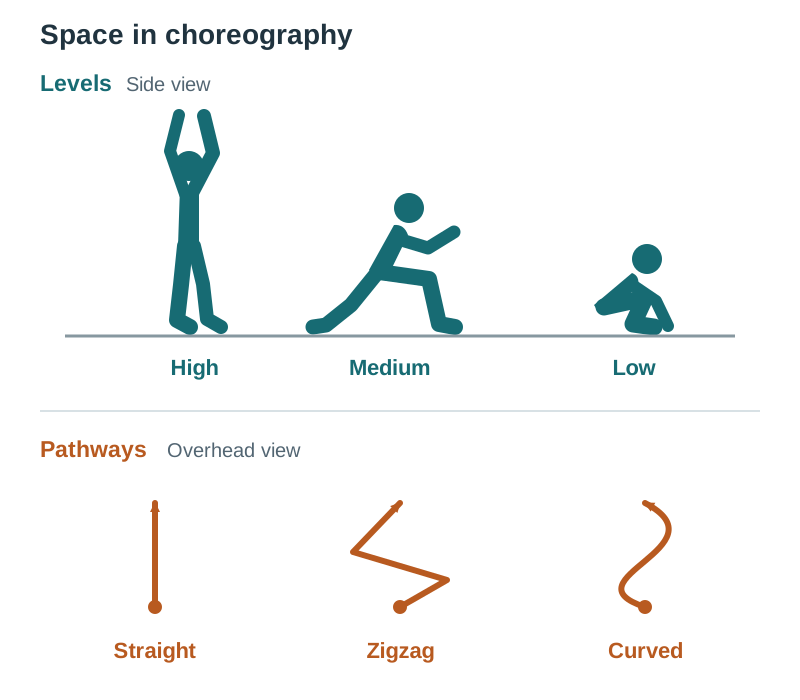
Compositional elements of choreography
When designing or analysing a routine, performers and choreographers manipulate six core elements:
- Body: Shapes, body alignments, extensions, and lines.
- Action: The motor skills performed, including elevations, balances, turns, travels, and gestures.
- Space: Use of levels (high, medium, low), pathways (straight, zigzag, curved), and floor patterns.
- Time: Rhythm, tempo, syncopation, speed changes, and dramatic pauses.
- Energy: Dynamic movement quality (e.g. sharp, percussive, sustained, or flowing).
- Relationships: Interaction with partners, props, or music (e.g. unison, canon, mirroring, and physical contact).
Aesthetic evaluation criteria
Criteria vary across disciplines, but judges commonly examine:
- Execution: Body alignment, control, precision, and clean finishes (e.g. pointed toes on landing).
- Creativity: Original sequences or innovative use of choreographic elements.
- Expression: Conveying emotion, narrative, and musicality through facial expression and movement.
- Flow and coordination: Fluid transitions linking individual movements smoothly.
- Degree of difficulty: Mechanical complexity and risk of the selected skills.
Reflective Practice and Evaluating Effectiveness
Athletes adapt their training through regular reflection and thorough concluding evaluations.
Reflection-in-action and reflection-on-action
- Reflection-in-action occurs live during a practice drill or competitive performance. The athlete or coach reads situational cues and makes immediate adjustments. For example, a tennis player notices their first serves are consistently landing long in the first set, so they immediately brush up the back of the ball more to add topspin, bringing the ball down inside the service box.
- Reflection-on-action takes place after the session has finished. The performer looks back on performance data, notes what worked, and plans the next session. For example, a sprinter reviews video footage after training, notices their hips were dropping during the acceleration phase, and schedules hip-flexor strengthening drills for the following week.
Evaluating effectiveness
In Stage 4, you repeat your diagnostic tests under identical conditions and evaluate your progress:
- Ipsative comparison: Comparing your final scores directly to your own earlier baseline scores. This is the primary measure of progress in the Physical Activity Project. For example, an athlete's 30 m sprint time improving from 4.32 s to 4.18 s over eight weeks provides ipsative proof of training adaptation.
- Normative comparison: Comparing your test scores against published normative tables for your age and sex. For example, checking whether a 17-year-old's Illinois Agility Test time of 16.4 seconds ranks as 'good' or 'excellent' against national standards helps establish overall competitiveness.
Key terms
- Optimum Performance
- The highest personal standard of physical, technical, tactical, and psychological execution an individual can achieve at their current stage of development.
- Needs Analysis
- The process of assessing the physical, biomechanical, tactical, and psychological demands of a sport and comparing them against an athlete's current capacity.
- Model Performer
- An athlete demonstrating fluent, efficient, and technically sound execution of a skill, used as a reference standard during video analysis.
- Quantitative Data
- Performance information collected and recorded as numbers, such as times, split distances, heart rates, or success percentages.
- Qualitative Data
- Performance information collected and recorded in words or descriptions, focusing on movement quality, technique, and decision-making.
- Objective Data
- Data collected using impartial, standardised measurements (such as electronic timing or distances) that do not depend on personal opinion.
- Subjective Data
- Data derived from personal interpretation, feelings, or observer judgements, such as coach rating sheets or wellness questionnaires.
- Ipsative Comparison
- Evaluating an athlete's current performance against their own prior baseline scores to measure personal improvement over time.
- Normative Comparison
- Evaluating an athlete's performance by comparing their test scores against standardised tables established for their age, sex, or sporting group.
- Purposive Activity
- A sport or physical activity where the outcome is determined entirely by an objective measurement such as goals, points, distance, or time.
- Aesthetic Activity
- A physical activity where the visual appearance, technical execution, elegance, and control of body movement directly contribute to the score.
- Reflection-in-Action
- The process of evaluating sensory cues and making immediate adjustments to movement, effort, or tactics while the performance is ongoing.
- Reflection-on-Action
- The retrospective review and analysis of a training session or competitive performance carried out after the event has ended.
- SMARTER Goals
- A target-setting framework requiring goals to be Specific, Measurable, Attainable, Realistic, Time-bound, Evaluated, and Reset.
Check yourself
What are the four official stages of the performance planning cycle in the specification?
Stage 1: Performance analysis; Stage 2: Identification of four performance goals; Stage 3: Evidence of ongoing training/practice and reflection; Stage 4: Concluding analysis.
Why is it useful to spread performance goals across different aspects of performance?
Spreading goals across skill, tactics, fitness, and psychological or artistic components ensures balanced, well-rounded athletic development rather than over-focusing on a single area.
A coach rates a gymnast's floor routine expression as 7 out of 10. Classify this data in terms of quantitative/qualitative and objective/subjective.
It is quantitative (expressed as a number) but subjective (based on personal opinion and judgement).
What is the difference between an ipsative comparison and a normative comparison?
An ipsative comparison evaluates an athlete's result against their own previous baseline score, whereas a normative comparison evaluates their score against published population tables for their age and sex.
How does a purposive activity differ from an aesthetic activity?
A purposive activity is decided solely by an external objective outcome such as goals or times, whereas an aesthetic activity is scored directly on the visual quality, form, and precision of movement.
Name four compositional elements used when analysing or creating choreography.
Body, Action, Space, Time, Energy, or Relationships.