

Topic 5 examines how physical activity is defined, experienced, measured, and sustained across all life stages. In Leaving Certificate Physical Education, physical activity sits along a broad continuum stretching from spontaneous play for health and fun at one end to elite, rule-bound competitive sport at the other. At Higher Level you need to be able to do four things: explain the benefits of being active and split them into personal, social and economic; work out what helps and what stops people taking part, using activity biographies and your own collected data; judge how well different promotion programmes and policies actually work; and describe how a performer can progress from school sport to elite level.
The Physical Activity Continuum and Core Concepts
In physical education, physical activity is defined as any bodily movement produced by skeletal muscles that results in energy expenditure. It is useful to distinguish this from exercise, which is physical activity that is planned, structured, and repetitive, carried out with the deliberate goal of improving or maintaining physical fitness or health. Walking to school is physical activity; a planned 30-minute interval run is exercise.
The Leaving Certificate specification organises physical activity along a continuum from casual movement to elite performance, identifying six core concepts:
- Play: Freely chosen, spontaneous, and intrinsically motivated activity undertaken for fun. In childhood, unstructured play develops gross motor coordination, fundamental movement skills (FMS), problem-solving, and imagination without adult-enforced competition.
- Leisure and Recreation: Leisure is uncommitted free time free from work, school, or domestic duties. Physical recreation is the voluntary physical pursuit chosen during that leisure time for personal enjoyment, refreshment, and relaxation (such as a casual cycle or swim). Winning is secondary to participation.
- Physical Education (PE): A planned, teacher-led curricular programme in schools. It builds physical literacy, tactical appreciation, and personal-social responsibility across distinct activity areas (games, athletics, gymnastics, dance, aquatics, and outdoor adventure).
- Mass-Participation Sports: Large-scale organised events that cater to thousands of participants of all abilities, such as the Dublin Marathon, the VHI Women's Mini-Marathon, or weekly 5 km parkruns. They prioritise community belonging, personal milestones, and health rather than elite selection.
- Outdoor and Adventure Activities: Pursuits in natural environments (such as hillwalking, kayaking, or orienteering) that involve authentic challenges and objective physical risks. They rely on the principle of challenge by choice, where participants choose their own degree of challenge within safe boundaries.
- Sport: Structured, goal-directed physical activity bound by codified rules, standard facilities, and formal governance. Sport involves scheduled competitions officiated by referees, offering intrinsic satisfaction alongside extrinsic rewards such as trophies, titles, and public recognition.
Benefits Across Categories and Life Stages
Exam questions often require you to categorise physical activity outcomes into personal, social, and economic benefits. Keep the three categories strictly separated:
| Category | What happens in the body or the group | Examples and outcomes you can quote |
|---|---|---|
| Personal | Enhances cardiorespiratory endurance, strengthens bones and muscles, improves insulin sensitivity, and releases mood-regulating neurotransmitters such as serotonin and endorphins. | Reduces risk of chronic diseases (type 2 diabetes, stroke, cardiovascular illness); relieves exam anxiety; improves sleep quality. |
| Social | Builds interpersonal networks, social capital, and cooperative communication. | Fosters teamwork; prevents social isolation; combats loneliness in older adults; strengthens community cohesion. |
| Economic | Lowers state healthcare spend, lifts commercial activity, and raises workplace output. | Cuts absenteeism; generates direct employment in coaching and sports facilities; drives sports tourism revenue. |
Research on the economic value of sport in Ireland has estimated that the sector supported around 38,000 jobs (roughly 2% of the workforce) and relied on approximately 270,000 volunteers, with about €149 returned to the economy for every €100 of State investment.
Benefits at Different Life Stages
The written examination often names a life stage. State the benefit, explain how it works, and tie it directly to that stage of life:
- Childhood (roughly 5–12 years): Weight-bearing activity such as running and jumping builds peak bone density; play-based movement builds fundamental movement skills and coordination; early confidence predicts lifelong physical activity habits. Socially, it teaches turn-taking, sharing, and cooperation.
- Adolescence (roughly 13–18 years): Helps manage healthy body composition during rapid growth; regular moderate-to-vigorous activity reduces stress and exam anxiety while improving sleep quality; team and club membership gives a sense of peer belonging and identity at the exact age when sporting dropout is highest.
- Adulthood (19–64 years): Lowers the risk of cardiovascular disease, type 2 diabetes, and certain cancers; lowers workplace stress and absenteeism while improving productivity; provides social outlets outside of work; active adults model healthy behaviours for their children.
- Older Adulthood (65+ years): Balance, coordination, and functional strength exercises reduce the risk of trips, falls, and bone fractures; maintains functional mobility for everyday tasks (climbing stairs, carrying groceries), preserving independent living; group activities (such as bowls or social walking groups) combat loneliness and isolation.
Physical Activity Guidelines and Intensity
- Children and Young People (5–17 years): At least 60 minutes of moderate-to-vigorous physical activity (MVPA) daily. Muscle-strengthening, bone-loading, and flexibility exercises should occur on at least three days per week.
- Adults (18–64 years): At least 30 minutes of moderate-intensity activity on five days a week (150 minutes a week in total). International (WHO) guidance notes that 75 minutes of vigorous activity can substitute, and recommends muscle-strengthening work on at least two days.
- Older Adults (65+ years): At least 150 minutes of moderate activity weekly, with balance and functional strength work twice weekly to reduce fall risk.
- Adults with Disabilities: At least 150 minutes weekly of adapted physical activity matched to functional capacity.
Use the talk test to gauge intensity: during moderate activity (like brisk walking), heart rate rises and breathing quickens, but conversation is easy; during vigorous activity (like match sprinting), breathing is laboured and only short phrases can be spoken.
Participation Patterns, Biographies, Supports, and Barriers
A physical activity biography is a reflective qualitative tool that records a person's physical activity history from early childhood to the present day. It documents critical turning points—such as the transition from primary to post-primary school, sitting state exams, or starting employment—revealing why people maintain, alter, or abandon physical activity. The specification specifically requires you to present two contrasting biographies: your own and that of someone with a markedly different activity profile, broken down stage by stage (early childhood, primary school, post-primary school, and present day) highlighting the turning points, supports, and barriers at each stage. For example, consider comparing two profiles: Student A maintained high participation through a local GAA club with active parental encouragement, a parent serving as coach, and early competitive success; in contrast, Student B enjoyed primary-school swimming but ceased when school lessons finished because the nearest public pool was 20 km away, and subsequently dropped out of juvenile camogie after non-selection for the team damaged her perceived competence. In an examination comparison, note that both were active children, meaning the divergence occurred during the primary-to-post-primary transition. Student A's adherence was sustained by social support, geographical proximity, and early achievement, whereas Student B faced structural barriers (transport and lack of local facilities) alongside personal psychological hurdles (selection pressure and declining perceived competence). Consequently, Student B is far more likely to re-engage through non-competitive community recreation, such as an adult beginner swimming session or a social walking group, than through traditional competitive club teams.
Supports and Barriers: School versus Community
| Setting | Supports | Barriers |
|---|---|---|
| School | Timetabled PE for all students; on-site facilities (sports hall, pitches, gym); teacher-coaches; lunchtime leagues and no-cost participation; Active School Flag initiatives; non-playing roles (referee, coach, event organiser). | Small or shared facilities and poor weather with no indoor alternatives; PE timetabled once a week or dropped in exam years; academic homework pressure; selection-based school teams where only the top performers play; narrow range of traditional team sports on offer. |
| Community | Local sports clubs, Local Sports Partnership (LSP) programmes, parkrun, greenways, and public pitches; family and peers who train; subsidised or free beginner sessions (such as Gaelic4Teens or Couch to 5K). | High membership, gear, and travel costs; lack of public transport to facilities; no local club offering the desired pursuit; club culture over-focused on winning; unlit or unsafe walking and cycling routes; gender stereotyping of specific sports. |
Personal barriers that affect both settings: lack of time, fatigue, self-consciousness about body image, and a gap between perceived competence (a person's self-belief in their ability) and actual competence (their demonstrated motor skill).
Patterns to Look For When Analysing School Data
When analysing participation data in a school cohort, candidates are expected to recognise and explain established trends:
- Age-related drop-off: Physical activity drops sharply through adolescence, with the steepest decline occurring during senior cycle and examination years.
- Gender gap: Participation among teenage girls drops earlier and more severely than among boys, with girls more likely to abandon organised club sports entirely.
- Socio-economic gradient: Participation rates are lower among groups where transport, gear, and registration fees present financial obstacles.
- Activity type shift: As individuals grow older, participation moves away from competitive, team-based games towards individual, flexible recreation (such as gym workouts, running, or walking).
- Volume versus guideline: Most secondary students fall well short of the recommended 60 minutes of daily MVPA, showing that timetabled school PE alone cannot meet the national target.
Data Collection Methods
There are two ways to collect data on how active people are: subjective methods, where people report their own activity, and objective methods, where a device measures it.
- Physical Activity Diaries and Self-Report Questionnaires (Subjective): Participants record their activity across the FITT framework (Frequency, Intensity, Time, Type). They provide rich context (such as social setting and mood) at minimal financial cost, but are prone to recall errors and social desirability bias (exaggerating activity to impress the researcher).
- Pedometers and Wearable Monitors (Objective): Pedometers measure daily step counts without relying on memory. While 10,000 steps a day is a common adult rule of thumb, it is not the national guideline, which is measured in minutes of MVPA. Accelerometers and heart rate monitors record intensity and duration accurately. However, pedometers cannot track non-impact activities (such as swimming or cycling) and provide zero qualitative information regarding personal enjoyment or context.
Promotion Policies, Governance, and Adherence Strategies
Physical activity promotion relies on aligned strategies across national government, local authorities, governing bodies, and community champions.
Evaluation of Promotion Approaches
- Public awareness campaigns reach mass audiences cheaply to improve health literacy, but awareness alone rarely changes deeply ingrained daily habits.
- Community programmes (such as Couch to 5K) overcome beginner anxiety through structured walk-run progressions and peer social support, but participants risk dropping out once the multi-week programme ends if clear exit pathways into local clubs or parkruns are missing.
- Mass-participation events generate high excitement, community spirit, and clear training targets, but often act as isolated one-day spikes in activity rather than sustaining year-round adherence.
- Built environment changes (such as dedicated cycle corridors, greenways, and urban walkways) make active travel safe and accessible, though they require substantial capital funding and long municipal planning processes.
- School-based initiatives (such as the Active School Flag) ensure equitable, free access to physical activity during formative years, though they face severe timetable competition against exam subjects.
National and Local Policy Frameworks
- Get Ireland Active! (National Physical Activity Plan): A whole-of-government policy coordinating health, transport, and education to embed physical activity into daily Irish life.
- National Sports Policy (2018–2027): Sets explicit national targets to close the gender participation gap, raise adult activity levels, and fund high-performance structures.
- Healthy Ireland Framework: Positions physical activity as a core preventive measure against lifestyle-related chronic disease.
- Local Sports Partnership (LSP) Strategic Plans: County-level bodies funded by Sport Ireland that develop multi-annual plans targeting underrepresented groups (teenage girls, older adults, people with disabilities, and disadvantaged communities).
- Local Authority Sport and Recreation Plans: City and county councils build and maintain public swimming pools, playing pitches, greenways, and playgrounds, and create Community Sport and Physical Activity Hubs in disadvantaged areas to give residents a single, accessible base for local sports clubs.
Adherence Strategies: A Named Toolkit
Adherence means sticking with physical activity over months and years rather than repeatedly starting and stopping. Use these seven strategies when designing interventions for any target group:
- SMART goal setting: Specific, Measurable, Achievable, Realistic, and Time-bound targets give participants a clear sense of purpose.
- Self-monitoring: Using an activity diary, pedometer, or wearable app makes personal progress visible and reinforcing.
- Social support: Joining a group programme or training with an exercise buddy creates accountability and enjoyable social connection.
- Convenience: Scheduling activities close to home or school at suitable times removes travel and time barriers.
- Enjoyment and variety: Offering varied, enjoyable activities builds intrinsic motivation rather than viewing exercise as a chore.
- Appropriate starting point and gradual progression: Beginning at the participant's current fitness baseline avoids early injury, severe muscle soreness, and feelings of failure.
- Rewards and recognition: Marking milestones with certificates, club shout-outs, or personal rewards reinforces long-term commitment.
Significant People and Advocates
Advocates—such as dedicated teachers, parents, club coaches, and development officers—promote participation through positive role modelling, enthusiasm, approachable communication, sport-specific knowledge, and ethical leadership.
Pathways to Excellence and Irish High-Performance Structures
Sustaining athletic development requires structured pathways from school physical education into community clubs, and from competitive club sport into elite international performance.
Strengthening School-to-Community Pathways
To prevent the common drop-off in activity during the teenage years, schools and local communities can strengthen links through practical measures:
- Deploying National Governing Body (NGB) development officers (such as GAA Games Promotion Officers or FAI development officers) to deliver coaching clinics and taster blitzes in schools.
- Implementing shared facility agreements where community clubs use school sports halls and all-weather pitches during evenings and weekends.
- Running Transition Year sports leadership and coaching courses that certify senior students to coach in local primary schools and juvenile clubs.
- Supplying subsidised club membership vouchers or beginner taster programmes (such as rugby's 'Give It a Try').
Theoretical Models of Athlete Progression
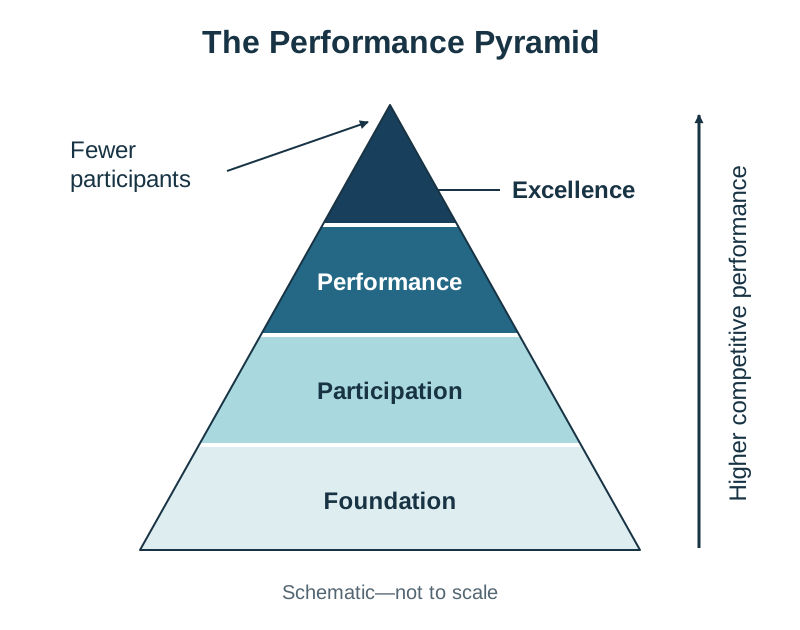
1. The Performance Pyramid
A four-tier hierarchical model showing how participant numbers narrow as competitive performance increases:
- Foundation: Early mastery of fundamental movement skills and physical literacy through primary PE and unstructured play.
- Participation: Voluntary recreational engagement for health, social connection, and fun during leisure time.
- Performance: Coached training and competitive league play at school, club, or regional grade.
- Excellence: Elite national squads, Olympic programmes, and professional competition supported by full sports science teams.
2. The Long-Term Athlete Development (LTAD) Model
The Long-Term Athlete Development (LTAD) framework plans training, competition, and recovery around biological maturation rather than chronological age. Because individual growth spurts occur at different times, two 14-year-olds may be at entirely different developmental stages.
- Active Start (early childhood): Unstructured play developing gross motor agility, balance, and coordination.
- FUNdamentals (childhood): Multi-sport participation focusing on basic movement skills in fun, low-pressure environments.
- Learn to Train (pre-adolescence): Learning sport-specific skills and basic tactical decision-making (70% training, 30% competition).
- Train to Train (adolescence): Building aerobic fitness and movement mechanics around the growth spurt (60% training, 40% competition).
- Train to Compete (mid-teens to early twenties): Sport-specific physical conditioning and tactical role mastery under intense match pressure (50% training, 50% competition).
- Train to Win (late teens onwards): Maximising performance output for international competition and podium success (25% training, 75% competition).
- Active for Life (any age): Transitioning from competitive sport into lifelong physical recreation, coaching, officiating, or club administration.
Specialisation Pathways
- Early Specialisation: Concentrating exclusively on one sport year-round before age ten. While common in acrobatic or aesthetic sports (such as gymnastics and diving) where peak performance occurs before full physical maturity, it carries high risks of repetitive overuse injuries, chronic psychological burnout, social isolation, and premature dropout.
- Late Specialisation (Diversification): Sampling a wide range of sports through childhood and early adolescence before specialising in the mid-teens. This develops a broad base of fundamental motor skills, encourages positive skill transfer (such as basketball footwork transferring to Gaelic football), and sustains long-term intrinsic motivation.
Provision and Support for Excellence in Ireland
When evaluating high-performance provision in Ireland, examine the specific structures available to elite athletes:
- Sport Ireland: The statutory authority distributing state funding to NGB high-performance programmes. It administers the International Carding Scheme, which gives direct financial grants to identified elite athletes to support full-time training and living expenses.
- Sport Ireland Institute (National Sports Campus, Abbotstown): Provides accredited sports science and medicine support to carded athletes, including physiotherapy, strength and conditioning, sports nutrition, physiology testing, performance analysis, and sports psychology.
- NGB High-Performance Structures: Talent identification pathways, county development squads, provincial academies, and full-time national performance directors (e.g., GAA development squads, FAI Emerging Talent, provincial rugby academies, Swim Ireland high-performance centres).
- Facilities: Specialist infrastructure such as the National Indoor Arena, the National Aquatic Centre, and regional university training facilities supported by the Sports Capital and Equipment Programme (SCEP).
- Third-Level Sport Scholarships: Irish universities provide sports scholarships featuring academic flexibility, campus accommodation, gym access, and medical support, enabling performers to combine degree studies with elite training.
- Limitations to critique in an exam answer: Elite funding is heavily concentrated on a small number of top-tier carded athletes; minority sports receive significantly less commercial and government funding than mainstream field sports; geographical centralisation around Dublin requires athletes from regional areas to travel long distances for sports science support; and specialist facilities (such as Olympic 50 m swimming pools) remain scarce outside major urban centres.
Key terms
- Physical Activity
- Any bodily movement produced by skeletal muscles that results in energy expenditure.
- Exercise
- Physical activity that is planned, structured, and repetitive, carried out with the deliberate goal of improving or maintaining physical fitness or health.
- Physical Literacy
- The motivation, confidence, physical competence, knowledge, and understanding to value and take responsibility for engagement in physical activities for life.
- Physical Recreation
- Voluntary physical pursuits chosen during discretionary leisure time for personal enjoyment, refreshment, and relaxation without formal competition.
- Moderate-to-Vigorous Physical Activity (MVPA)
- Physical activity ranging from moderate (raises heart rate while permitting comfortable conversation) to vigorous (causes heavy breathing, high cardiovascular exertion, and restricts speech to short phrases).
- Perceived Competence
- An individual's personal belief and self-evaluation regarding their capability to successfully execute a movement skill or physical task.
- Challenge by Choice
- An outdoor adventure principle where participants choose their own level of challenge and risk within a supportive group setting.
- National Governing Body (NGB)
- An organisation that oversees and administers a specific sport nationally and locally, while affiliating with international federations and selecting national teams.
- Local Sports Partnership (LSP)
- A county-level body funded by Sport Ireland that coordinates community initiatives to increase participation among underrepresented groups.
- Performance Pyramid
- A four-stage sports development model illustrating the progression of participants through Foundation, Participation, Performance, and Excellence.
- Long-Term Athlete Development (LTAD)
- An athlete development framework that matches physical, tactical, and psychological training loads to biological maturation rather than chronological age.
- Early Specialisation
- Intensive, year-round training and competition in a single sport before age ten, carrying risks of overuse injury and psychological burnout.
- Late Specialisation (Diversification)
- Participating in a variety of sports and activities through childhood before specialising in a single sport in the mid-teens.
- Physical Activity Biography
- A reflective personal record documenting an individual's history of movement, key transition points, supports, and barriers across their lifetime.
- Adherence
- The practice of maintaining regular physical activity over an extended period rather than discontinuing participation.
- Active School Flag
- A national Department of Education initiative that recognises schools that strive to achieve a physically educated and physically active school community.
- International Carding Scheme
- A Sport Ireland programme providing direct financial grants to elite Irish athletes to support their training and competition costs.
Check yourself
What is the recommended daily physical activity target for children and adolescents aged 5 to 17 in Ireland?
At least 60 minutes of moderate-to-vigorous physical activity (MVPA) every day, including muscle- and bone-strengthening exercises on at least three days.
Give one personal and one economic benefit of physical activity specific to older adults.
Personal: improved balance and functional strength reduces the risk of falls and preserves independent living. Economic: fewer fall-related injuries and fractures reduces emergency hospital admissions, lowering State healthcare spending.
How does physical recreation differ fundamentally from competitive sport?
Recreation is voluntary, flexible, and intrinsically motivated for enjoyment during leisure time, whereas sport is structured, governed by codified rules, officiated, and involves extrinsic rewards.
Name two specific supports Sport Ireland provides to elite carded performers.
Direct annual financial grants through the International Carding Scheme, and accredited sports science and medicine support (such as physiotherapy, physiology testing, and sports nutrition) at the Sport Ireland Institute in Abbotstown.
Distinguish between perceived competence and actual competence.
Perceived competence is an individual's personal belief about their ability to carry out a skill, whereas actual competence is their objective, demonstrated motor capability.
Why does the LTAD model structure training stages around biological maturation rather than chronological age?
Adolescents enter their growth spurts and mature physically, cognitively, and emotionally at different chronological ages, meaning individuals of the same calendar age require different training loads and skill challenges.