
Sight-reading is an unprepared practical test where you perform an unfamiliar piece of music at first sight without prior rehearsal. In the Leaving Certificate Music examination, performing accounts for 25% of your total marks (or 50% if you choose the Higher Level performing elective). Every candidate must present a practical performing activity alongside one compulsory unprepared test taken individually before a visiting examiner. If you present the ukulele, you can choose sight-reading as this test. Because the ukulele is an unlisted instrument in the syllabus, your prepared repertoire must match or exceed the standard of the listed instruments under Appendix E(f), while the unseen sight-reading test is set directly by the examiner at Higher Level standard. You should prepare on the basis that the test will be presented in standard notation on the treble staff rather than tablature or chord boxes, requiring a direct connection between the written staff and your fretboard.
The Unprepared Test in the Practical Examination
Under Section 2.1 and Appendix D of the syllabus, practical candidates must perform one individual unprepared test chosen from three options: a sight-reading test, an aural memory test, or an unprepared improvisation. Even if your prepared performance takes place within a group, your unprepared test is always taken on your own.
Higher Level candidates present three prepared songs or pieces, or alternatively two Ordinary Level performing activities. In both cases, the unprepared test must be taken at Higher Level standard. If you select improvisation, the syllabus requires you to choose an option from the official list in Appendix A; because the ukulele is not listed there, sight-reading and aural memory are the most straightforward routes.
The test is assessed on musical and technical fluency (Section 2.1.2(d)). This means presenting accurate pitches and a steady pulse while shaping phrases with dynamics and articulation. The examiner listens for playing that keeps moving forward and sounds like real music, rather than a halting exercise where every note is questioned.
The Silent Preview Strategy: K-T-E-P-D-T
You are given a short window of silent preparation before you play. Use every second of it. Work through the same six checks every time, using the checklist K-T-E-P-D-T:
Step 0: check your ukulele is in tune and that the lowest and highest notes fit your instrument.
- K – Key: look at the key signature and check the opening and closing notes to see whether the piece is major or minor. Locate any sharps or flats on your fretboard immediately.
- T – Time and metre: check the time signature (such as 2/4, 3/4, 4/4, or 6/8). Notice whether the piece starts on beat 1 or begins with an anacrusis (upbeat).
- E – Expression and navigation: scan for tempo words (Allegretto, Andante), dynamic markings (p, mf, f, hairpins), articulation dots, slurs, repeat barlines, or pause marks.
- P – Patterns: look for scalic runs, arpeggio leaps, and melodic sequences that repeat a motif higher or lower.
- D – Danger spots: find the hardest bar, such as sudden accidentals, rapid quaver groups, or shifts past fret 4. Ghost-finger these bars silently on the strings.
- T – Tempo: set your internal pulse based on that hardest bar. Never start the first bar faster than you can cleanly play the danger bar.
Ukulele Range and the First-Position Fretboard Map
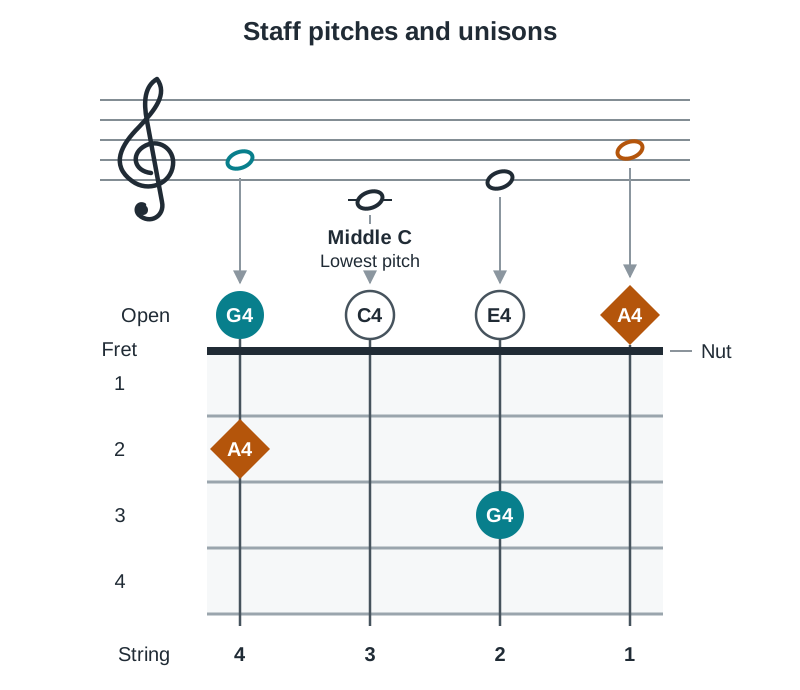
Sight-reading tests for ukulele are written on the treble staff (G clef). Standard soprano, concert, and tenor tuning is re-entrant tuning: G4–C4–E4–A4 (from string 4 to string 1). Because string 4 is tuned higher than string 3 and string 2, the lowest available pitch on a standard ukulele is middle C (C4), located on the open third string.
Middle C (C4) sits on the first leger line below the treble staff. Anything written lower than middle C cannot be played on a standard re-entrant ukulele; check this during your preview. First position covers frets 1 to 4 using one finger per fret (index on fret 1, middle on fret 2, ring on fret 3, and little finger on fret 4).
| String | Open (0) | Fret 1 | Fret 2 | Fret 3 | Fret 4 |
|---|---|---|---|---|---|
| String 4 (G) | G4 | G♯4 / A♭4 | A4 (unison with open string 1) | A♯4 / B♭4 | B4 |
| String 3 (C) | C4 (Middle C) | C♯4 / D♭4 | D4 | D♯4 / E♭4 | E4 |
| String 2 (E) | E4 | F4 | F♯4 / G♭4 | G4 (unison with open string 4) | G♯4 / A♭4 |
| String 1 (A) | A4 | A♯4 / B♭4 | B4 | C5 | C♯5 / D♭5 |
Re-entrant tuning creates unisons: open string 4 is the same pitch as string 2 fret 3 (G4), and string 4 fret 2 is identical to open string 1 (A4). Playing G4 on the E string keeps your fretting hand settled when moving directly from F♯4, whereas open string 4 is easier when moving across from string 3 or sustaining another note.
Melodies sometimes reach above the staff. On string 1 (A), fret 5 is D5 and fret 7 is E5. For notes at fret 5, either stretch your little finger from first position or shift your whole hand so your index finger takes fret 5, then shift back.
Key Signatures, Accidentals, and Minor Keys
The Higher Level syllabus requires general literacy in major and minor keys up to four sharps and four flats. While practical sight-reading extracts are chosen for clear tonality, you should be able to place these accidentals instantly:
Sharp Keys
- One sharp (G major / E minor): F♯ sits at string 2, fret 2.
- Two sharps (D major / B minor): F♯ (string 2, fret 2) and C♯ (string 3, fret 1, or string 1, fret 4).
- Three sharps (A major / F♯ minor): F♯, C♯, and G♯ (string 2, fret 4, or string 4, fret 1).
- Four sharps (E major / C♯ minor): F♯, C♯, G♯, and D♯ (string 3, fret 3).
Flat Keys
- One flat (F major / D minor): B♭ sits at string 1, fret 1.
- Two flats (B♭ major / G minor): B♭ (string 1, fret 1) and E♭ (string 3, fret 3).
- Three flats (E♭ major / C minor): B♭, E♭, and A♭ (string 4, fret 1, or string 2, fret 4).
- Four flats (A♭ major / F minor): B♭, E♭, A♭, and D♭ (string 3, fret 1, or string 1, fret 4).
In minor keys, watch for the raised 7th (leading note) of the harmonic minor scale. It is never printed in the key signature; it appears as an accidental in the melody, such as G♯ in A minor, D♯ in E minor, or C♯ in D minor. An accidental applies for the rest of that bar unless cancelled by a natural sign.
Metre, Rhythm, Navigation Signs, and Damping
At Higher Level, be fully secure reading note and rest values from semibreves down to quavers, including dotted values, in simple metres (2/4, 3/4, 4/4) and compound duple time (6/8). Examiners can also introduce semiquaver pairs or dotted-quaver figures, so be comfortable counting subdivisions.
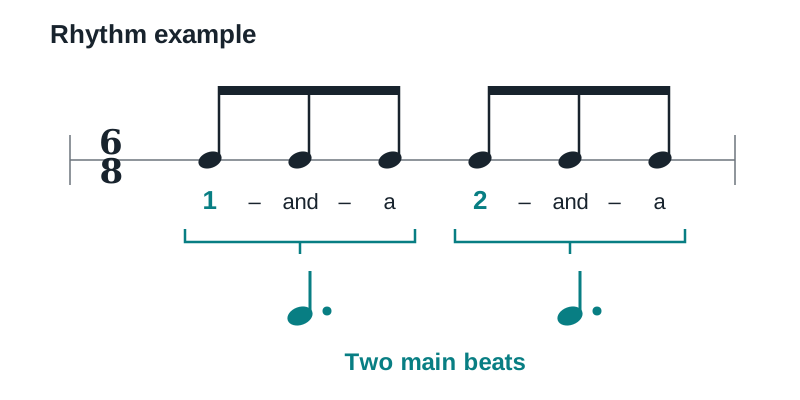
In simple time, subdivide beats steadily ('1-and, 2-and'). In 6/8 time, feel two dotted-crotchet beats in each bar, dividing each beat into three quavers ('1-and-a, 2-and-a').
Navigation Signs
- Anacrusis (upbeat): an incomplete opening bar. Count a full silent bar first and play the upbeat on the final beat, ensuring bar 1 lands on beat 1.
- Tie: a curved line joining two notes of the same pitch. Pluck once and hold for the total value; do not pluck the second note.
- Slur: a curved line over different pitches, indicating smooth playing (legato).
- Repeat marks: repeat the section unless instructed otherwise; take the second-time bar on the repeat.
- D.C. al Fine: return to the start and stop at the word Fine.
- Fermata (pause): hold the note longer than its written value, then resume the pulse.
Because the ukulele has resonant nylon strings, notes continue to ring after they are plucked. Written rests and staccato marks require damping. Cut the sound cleanly by easing fretting pressure off the fretboard without lifting off the string, or by placing your plucking fingers back against the vibrating strings.
Tempo, Expression Vocabulary, and Reading Ahead
Tempo and character markings indicate how the music should feel, not a mechanical speed. A steady, musical Allegretto played slightly below speed sounds convincing; an overambitious Allegro that stumbles mid-piece does not.
Common Markings
- Andante: at a walking pace
- Moderato: at a moderate, comfortable pace
- Allegretto: fairly quick, slightly slower than Allegro
- Allegro: lively and fast
- Rallentando (rall.): gradually slowing down
- A tempo: return to the main speed
- Legato: smooth; Staccato: short and detached; Dolce: sweetly
- p (piano, soft), mp (mezzo-piano, moderately quiet), mf (mezzo-forte), f (forte, loud)
- Crescendo (<) and diminuendo (>): getting gradually louder or softer
Reading Ahead and Recovery
While your fingers pluck beat 1, your eyes should already scan beat 2 and the next bar. Never stare down at your fretting hand while reading. If you misfret a note, do not stop and do not replay it. Keep your internal count going, drop the missed note, and rejoin at the next strong beat or barline. An examiner marks overall fluency; an uninterrupted pulse protects your performance far more than stopping to fix a wrong pitch.
Build a 10-minute practice habit three or four times a week: pick a fresh 4- to 8-bar melody, run your K-T-E-P-D-T preview, clap and count the rhythm, name the string and fret coordinates aloud, and play it through exactly once with a metronome.
Recognising Patterns of Predictability
Appendix D of the syllabus specifies that Higher Level test pieces feature patterns of predictability. Spotting these shapes during your preview reduces the amount of new information you have to read note by note:
- Stepwise (conjunct) motion: notes moving to adjacent scale degrees (a tone or semitone apart). Once you know the starting note, your fingers follow scale runs you already know.
- Leaps (disjunct) and arpeggios: wider intervals outlining primary chords (I, IV, or V). For example, notes D4–F♯4–A4 outline the D major tonic triad and fall directly on familiar fretboard positions.
- Melodic sequences: a motif repeated immediately at a higher or lower pitch. Identify the rhythm once, and simply shift your fingering pattern up or down the scale.
- Cadence shapes: phrases often end predictably, such as the leading note stepping up to the tonic (7–1) or the supertonic stepping down to the tonic (2–1).
Key terms
- Sight-Reading
- The performance of an unfamiliar piece of music at first sight without prior practice or coaching.
- Patterns of Predictability
- Structured musical conventions, such as diatonic scales, primary triad arpeggios, sequences, and standard cadence formulas, incorporated into Leaving Certificate sight-reading pieces.
- Re-entrant Tuning
- A tuning scheme where string pitches do not run strictly low to high; standard ukulele tuning features a high fourth string (G4-C4-E4-A4).
- First Position
- A fretting-hand setup covering frets 1 to 4, assigning one finger per fret (index on fret 1, middle on fret 2, ring on fret 3, and little finger on fret 4).
- Compound Duple Time
- A metre containing two dotted-crotchet beats per bar, each subdivided into three quavers, written with a 6/8 time signature.
- Damping
- The physical technique of stopping string vibration with either the fretting or plucking hand to produce silence on rests and staccato notes.
- Raised 7th (Leading Note)
- The seventh scale degree in a harmonic minor key, raised by a semitone using an accidental to lead into the tonic.
- Anacrusis
- One or more unaccented upbeat notes written before the first complete bar of a piece.
- Musical and Technical Fluency
- The primary syllabus assessment standard for performing, demanding unbroken pulse, accurate pitch, dynamic control, and clear phrasing.
Check yourself
What is the lowest playable note on a standard soprano or concert ukulele in re-entrant tuning?
Middle C (C4), played on the open third string.
How do you distinguish between a tie and a slur in sight-reading notation?
A tie joins two notes of the identical pitch (pluck once and hold for the combined length); a slur connects different pitches to be played smoothly (legato).
Why does the leading note in a minor key appear as an accidental rather than in the key signature?
Key signatures show the natural minor scale; the raised 7th belongs to the harmonic minor scale and must be marked with an accidental in each bar it occurs.
An extract in 3/4 opens with one crotchet before the first barline. How do you count your entry?
Count one full silent bar of three ('1, 2, 3'), play the opening crotchet on beat 3 of the count, and land on beat 1 of the first full bar.
On an unseen extract with one flat (B♭) in 4/4 time, Bar 1 contains F4 (crotchet), A4 (crotchet), C5 (minim). What string and fret fingering should you use?
F4 on string 2 fret 1; A4 on open string 1 (or string 4 fret 2); C5 on string 1 fret 3.
What should you do if your eye loses its place or your finger misses a fret during the practical examination?
Keep the internal pulse ticking, leave out the missed note without stopping, and re-enter cleanly on the next beat or barline.