
In Question 3 of the Leaving Certificate Music Composing paper, Higher Level students compose a complete 16-bar melody based on a specified dance rhythm, metre, or form, usually continuing a given four-bar opening. Melody writing carries 40 marks out of the 100 available on the Composing paper (the chosen harmony question carries 60). Success requires maintaining the dance's rhythmic fingerprint across all 16 bars, following the form set on the paper (most commonly AA¹BB¹), shaping the contour to a single clear melodic climax, providing full performing directions for a chosen instrument, and—when specifically asked on the examination paper—executing a confirmed modulation to the dominant key.
Exam Setup and the Task Checklist
On the Higher Level Composing paper you answer one melody question (chosen from Questions 1, 2, or 3) and one harmony question (chosen from Questions 4, 5, or 6). Melody writing carries 40 marks; the harmony question carries 60. That makes melody writing 40% of your composing mark, so allocate your time strictly (around 35 to 40 minutes) and never let it cut into your harmony question.
Always read the bulleted instructions on the question paper before writing a single note. The tasks set by the State Examinations Commission typically specify:
- Continuing the given opening (or writing from a given metre) to make a 16-bar melody.
- Using a specified structure (usually AA¹BB¹ form).
- Including a modulation to the dominant at a suitable point (only if explicitly requested).
- Adding appropriate performing directions (tempo, dynamics, articulation, and phrasing).
- Choosing a suitable instrument from a printed list on the paper.
If a modulation is not requested in the bulleted list (as in several recent exam years), do not force one into the melody. A brief chromatic passing note is fine, but building an unasked-for key change risks destabilising your phrase structure.
Structural Architecture and Cadence Map
Examiners reward an excellent sense of shape and structure. Most dance questions prescribe an AA¹BB¹ form, consisting of four balanced four-bar phrases. A melody sounds structured when its cadence points fall in the right places.
The Four-Bar Phrase Structure
- Phrase A (bars 1–4): Usually supplied on the examination paper. It establishes the home key, introduces the dance motif, and ends with an open, unresolved feeling.
- Phrase A¹ (bars 5–8): A varied repetition of Phrase A. It begins with the familiar motif, develops it using sequence or rhythmic variation, and brings the first half of the melody to a midpoint resting point.
- Phrase B (bars 9–12): Introduces fresh, contrasting material. It frequently moves into a higher register to create variety.
- Phrase B¹ (bars 13–16): Balances Phrase B, introduces the melodic climax (the highest note of the melody, usually around bar 13 or 14), and drives toward a final resolution.
The Phrase-Ending Cadence Map
To make your phrase structure clear to the examiner's ear, plan which note ends each four-bar phrase before writing the middle bars:
- Bar 4 (end of A): End on scale degree 2, 5, or 7. This creates an imperfect cadence (sounding like a musical comma) and leaves the listener waiting for Phrase A¹.
- Bar 8 (end of A¹): If no modulation was asked for, end on the tonic note (scale degree 1) or scale degree 3 or 5 to close the section. If a modulation was requested, end on the tonic note of the new dominant key, approached from its leading note (the raised 4th of the home key).
- Bar 12 (end of B): End on an open note again—scale degree 2 or 5 of the home key—so that the final phrase is necessary to complete the thought.
- Bar 16 (end of B¹): End squarely on the tonic note on a strong beat, approached by step from above (scale degrees 2 to 1) or from the leading note below (7 to 1) to create an unmistakable perfect cadence.
For example, in D major: bar 4 ends on E or A; bar 8 ends on D (or on A approached from G♯ if modulating); bar 12 ends on E or A; bar 16 ends on D approached from E or C♯.
Dance Fingerprints and Metres
Examiners award dedicated marks for rhythmic integrity, meaning the melody must sound like the named dance from bar 1 right through to bar 16. The characteristic rhythmic figures and beat groupings must not fade away into plain, generic crotchets in the second half.
| Dance Type | Metre / Time Signature | Characteristic Rhythmic Feel | Structural and Melodic Features |
|---|---|---|---|
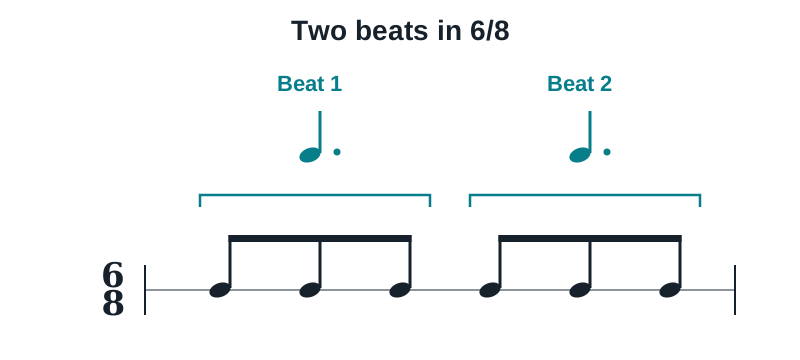
| Jig / Gigue | 6/8 (compound duple time) | Two dotted-crotchet beats per bar; continuous quavers grouped in threes (3+3). | Bouncing lilt; crotchet–quaver figures and arpeggiated leaps. |
| Slip jig | 9/8 (compound triple) | Three dotted-crotchet beats per bar; nine quavers grouped in threes (3+3+3). | Lilting and graceful. (Examined primarily in Irish dance identification.) |
| Reel | 4/4 (or 2/2) | Fast, driving pulse of continuous even quavers. | Stepwise runs with natural accents on beats 1 and 3. |
| Hornpipe | 4/4 | Distinctive dotted rhythm (dotted quaver followed by a semiquaver). | Jaunty, swung feel; phrases often conclude with three emphatic crotchets. |
| Minuet | 3/4 | Stately, unhurried triple pulse at a moderate tempo. | Steady crotchets mixed with pairs of quavers; phrases settle gracefully on beat 1. |
| Waltz | 3/4 | Flowing, lilting triple dance with an energetic downbeat on beat 1. | Slower harmonic movement; minims on beat 1 followed by lighter movement. |
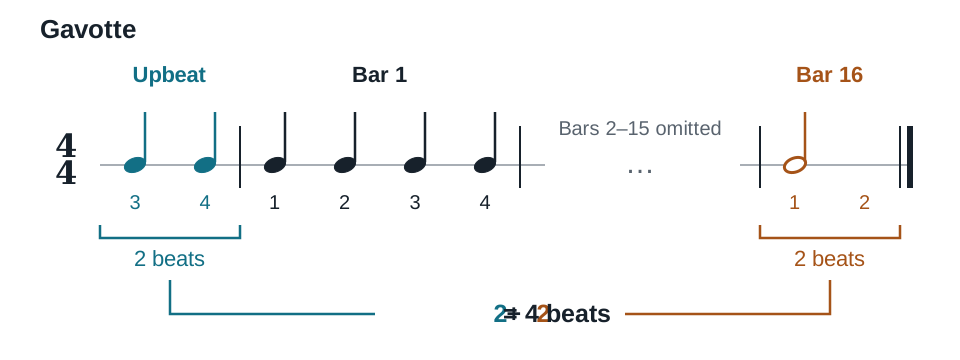
| Gavotte | 4/4 (or 2/2) | Stately French dance starting on a two-crotchet anacrusis (half-bar upbeat). | Internal cadences fall mid-bar on beat 2; phrases begin on beat 3. |
| Polka | 2/4 | Brisk, bouncy duple dance. | Crisp off-beat accents, short semiquaver figures, and light staccato phrasing. |
In 6/8 time, quavers must be beamed strictly in threes to reflect the two dotted-crotchet beats. Never write three plain crotchets across a 6/8 bar: three crotchets equal six quavers in total time, but placing a crotchet across the middle of the bar breaks the compound pulse and destroys the dance feel.
Starting from Scratch: Composing with No Given Opening
When the examination paper provides only a dance name and metre without a printed opening, you must construct your own four-bar Phrase A. Follow this step-by-step sequence:
- Clef and Key: Draw the clef and choose a straightforward key—G major, D major, F major, or B flat major are ideal. Mark the correct key signature and time signature.
- Rhythm First: Write out the rhythm for bars 1 and 2 using the dance fingerprint before picking pitches. For a gigue, sketch crotchet–quaver figures in 6/8; for a hornpipe, sketch dotted quaver–semiquaver pairs in 4/4.
- Add Pitches: Fit pitches to that rhythm using notes of the tonic triad mixed with stepwise movement (conjunct motion). Start on the tonic, mediant, or dominant note.
- Shape to Bar 4: Guide the line in bars 3 and 4 toward an imperfect cadence, resting on scale degree 2, 5, or 7 in bar 4.
Once Phrase A is written, continue with the remaining phrases exactly as you would for a continuation question: vary A in A¹, introduce contrast in B, and resolve with the climax and perfect cadence in B¹.
Upbeats (Anacrusis) and Bar Balancing
An anacrusis, or upbeat, consists of one or more pickup notes before the first full bar. An upbeat does not count as bar 1; bar 1 is always the first full measure. Look at the opening measure: if it has fewer beats than the time signature indicates, it is an upbeat.
Whenever a piece begins with an anacrusis, the final bar must be shortened by the exact duration of that upbeat to preserve metric balance:
- Gavotte in 4/4 (two-crotchet upbeat): The piece starts on beat 3. Bar 16 must contain exactly two crotchet beats (beats 1 and 2), filled by a minim or two crotchets. Phrases cross the barline: Phrase A begins on beat 3 of the upbeat and finishes on beat 2 of bar 4; beats 3 and 4 of bar 4 then act as the upbeat into Phrase A¹.
- Gigue in 6/8 (one-quaver upbeat): The final bar must total five quavers in duration (for example, a crotchet followed by a dotted crotchet: 2 + 3 = 5 quavers).
- Waltz in 3/4 (one-crotchet upbeat): The final bar must contain exactly two crotchets (a minim), balancing 1 + 2 = 3 beats.
Modulation to the Dominant: Rules and Limits
At Higher Level, composing questions remain within major and minor keys up to four sharps and four flats. In practice, the given openings use keys with one or two accidentals, such as C, G, D, F, or B flat major.
When a question requires a modulation to the dominant, you move to the key built on the 5th scale degree of the home key. To establish this key change in a single line, introduce the leading note of the dominant key, which is always the raised 4th scale degree of the home key.
| Home Key | Key Signature | Dominant Key | New Accidental (Raised 4th) | Cadential Arrival in Dominant |
|---|---|---|---|---|
| C major | None | G major | F♯ | F♯ to G (over implied D to G) |
| G major | 1♯ (F♯) | D major | C♯ | C♯ to D (over implied A to D) |
| D major | 2♯ (F♯, C♯) | A major | G♯ | G♯ to A (over implied E to A) |
| A major | 3♯ (F♯, C♯, G♯) | E major | D♯ | D♯ to E (over implied B to E) |
| F major | 1♭ (B♭) | C major | B♮ | B♮ to C (over implied G to C) |
| B♭ major | 2♭ (B♭, E♭) | F major | E♮ | E♮ to F (over implied C to F) |
| E♭ major | 3♭ (B♭, E♭, A♭) | B♭ major | A♮ | A♮ to B♭ (over implied F to B♭) |
| A♭ major | 4♭ (B♭, E♭, A♭, D♭) | E♭ major | D♮ | D♮ to E♭ (over implied B♭ to E♭) |
| A minor | None | E minor | D♯ (new leading note; cease G♯) | D♯ to E (over implied B to E) |
| D minor | 1♭ (B♭) | A minor | G♯ (new leading note; cease C♯) | G♯ to A (over implied E to A) |
An accidental lasts only for the bar in which it is written. In Phrase B or B¹, bring back the original 4th scale degree from your key signature (such as writing C♮ in G major after having used C♯ in bar 7) to guide the ear back to the home key.
Melodic Contour, Climax, and Decoration
A high-scoring melody exhibits architectural shape rather than aimless wanderings across the stave:
- Stepwise Movement: Most of your melody should move by step (conjunct motion)—as a rough guide, no more than one leap every bar or two. When you use a leap (disjunct motion), leap between notes of the underlying harmony (such as a third, fourth, or fifth) and resolve it by stepping in the opposite direction.
- Range and Climax: Aim for an overall compass of about a tenth to a twelfth across the 16 bars. Reserve the single highest note of the piece for the melodic climax, placed roughly two-thirds of the way through in bar 13 or 14 (Phrase B¹). Build toward it with an ascending sequence, and step down smoothly from it.
- Motif Development: Develop the opening ideas using a tonal sequence (repeating an idea a step higher or lower while staying in the key) or rhythmic variation (keeping the pitch contour while changing note lengths).
- Non-Chord Notes: Decorate your line using unaccented steps on weak beats. A passing note moves by step between two different chord tones (for instance, G–A–B over chord I in G major). An auxiliary note steps away from a chord tone and returns to that same tone (such as B–C–B).
Instrument Compass and Performance Directions
Marking schemes allocate marks for choosing a suitable instrument from the printed list on the paper and adding complete performing directions.
Safe Instrumental Ranges
- Violin: G3 to E6. Very agile and equally at home in fast runs and singing lines, so it suits almost any dance.
- Flute: C4 to G6. Fluent and light in its middle and upper registers; avoid lingering near its lowest notes.
- Oboe: B♭3 to G6. Expressive, reedy character; ideal for moderate, lyrical dances.
- Clarinet in B flat: Written E3 upwards (a safe examination range is written E3 to C6). It sounds a major second lower than written, but you write the melody exactly at the pitch on the exam paper—no transposition is required.
- Trumpet: Safe written range C4 to G5 (absolute bottom F♯3 up to A5). Best suited to bold, rhythmic dances; include occasional rests for breathing.
Score Annotations
- Instrument Name: Write the chosen instrument clearly above the first bar on the stave.
- Tempo: Supply an appropriate Italian tempo term matching the dance (Tempo di Minuetto, Allegro vivace, Moderato).
- Dynamics: Provide an opening dynamic (p, mp, or f), and add at least two further dynamic changes or hairpins (crescendo and diminuendo) supporting the climb to the climax and the descent to the cadence.
- Phrasing and Articulation: Slur in musical units of one or two bars, not four, and leave a natural breathing point at the end of each four-bar phrase. A four-bar unbroken slur is unplayable in one breath on wind and brass instruments. Mix slurs with staccato dots to highlight the dance pulse.
Final Two-Minute Presentation Checklist
Before handing up your composing paper, spend two minutes checking these six mechanical details that cost marks every year:
- Clef and Key Signature: Check that the clef and key signature are present at the start of every stave line, with no accidental forgotten.
- Bar Arithmetic: Count the beats in every single bar. In 6/8, ensure each bar contains two dotted-crotchet beats (six quavers beamed 3+3).
- Exact Bar Count: Check that there are exactly 16 bars. An upbeat does not count as bar 1, and the final bar must be shortened to balance it.
- Accidentals: Confirm that any modulation accidental is placed directly on the correct line or space in front of the note head.
- Score Directions: Verify that the instrument name, tempo marking, dynamic marks, and articulation slurs appear throughout all 16 bars—not just in bars 1 to 4.
- Double Barline: Finish bar 16 with a clean double barline.
Key terms
- Rhythmic Integrity
- Keeping the rhythm sounding unmistakably like the named dance all the way through, using consistent beat grouping and characteristic note patterns from bar 1 to bar 16.
- AA¹BB¹ Form
- A 16-bar musical structure consisting of an opening four-bar phrase (A), its varied repetition (A¹), a contrasting four-bar phrase (B), and a concluding varied phrase (B¹).
- Anacrusis
- An upbeat or pickup note occurring before the first full bar, which requires the 16th bar to be shortened by the exact duration of that upbeat to preserve metric balance.
- Compound Duple Time
- A metre with two dotted-crotchet beats per bar, each subdivided into three quavers (6/8 time), characteristic of jigs and gigues.
- Modulation to the Dominant
- A key change to the fifth scale degree of the home key, accomplished by raising the fourth scale degree to act as the new leading note and confirmed with a cadential arrival.
- Leading Note
- The seventh scale degree of a key, located a semitone below the tonic, which provides a strong melodic pull upward into the tonic note.
- Perfect Cadence
- A chord progression moving from chord V to chord I, creating a strong, complete full stop, with the melody resolving to the tonic note.
- Imperfect Cadence
- A musical phrase ending that pauses on chord V (ending on scale degree 2, 5, or 7), leaving the phrase feeling open and demanding continuation.
- Passing Note
- A non-chord note on a weak beat that moves by step to bridge the gap between two different harmony notes.
- Auxiliary Note
- A non-chord note on a weak beat that steps away from a harmony note and returns immediately to the same harmony note.
- Tonal Sequence
- The repetition of a melodic motif at a higher or lower pitch level while remaining strictly within the prevailing key signature.
- Conjunct Motion
- Smooth melodic movement that progresses predominantly by step between adjacent scale degrees rather than by large leaps.
- Melodic Climax
- The single highest pitch and expressive peak of a melody, positioned roughly two-thirds of the way through the composition (usually in bar 13 or 14).
Check yourself
What proportion of marks does the melody writing question carry on the Leaving Certificate Music Composing paper?
It carries 40 marks out of 100 (40%), with the chosen harmony question carrying the remaining 60 marks.
Which scale degree should you end on in bar 4 to create an imperfect cadence in a major key?
Scale degree 2, 5, or 7, which implies chord V and leaves the phrase open.
A gavotte opening is given in C major, 4/4 time, with a two-crotchet upbeat (beats 3 and 4: G4, C5). Bar 4 ends on D5 on beat 2. In note names and rhythms, write a four-bar A¹ phrase (bars 4–8) that varies the opening and ends on the dominant note.
Upbeat into A¹ (bar 4, beats 3–4): G4(crotchet), E5(crotchet). Bar 5: F5(crotchet), E5(quaver), D5(quaver), C5(crotchet), E5(crotchet). Bar 6: D5(crotchet), C5(crotchet), B4(crotchet), A4(crotchet). Bar 7: B4(crotchet), C5(quaver), B4(quaver), A4(crotchet), F#4(crotchet). Bar 8: G4(minim on beats 1–2). This varies the A phrase through melodic inversion and passing quavers, uses F# (raised 4th) as leading note, and ends on G (dominant tonic) on beat 2.
Which accidental must be written to modulate to the dominant in B flat major?
E natural (E♮), which raises the 4th scale degree of B flat major to act as the leading note of F major.
What is the lowest written note playable on the B flat clarinet?
Written E3 (which sounds as D3).
What is the time signature of an Irish slip jig, and how are its quavers grouped?
9/8 (compound triple time), with nine quavers grouped in three sets of three (3+3+3).