
Harmonic Vocabulary, Cadences, and Bass Lines
Composing exercises require you to choose chords, write supporting bass notes, and punctuate phrases with standard cadences.
Cadence Formulas
- Perfect Cadence ( or ): Sounds finished, like a full stop. The bass normally moves soh to doh.
- Imperfect Cadence (any chord , most often or in major; or in minor): Sounds unfinished and pauses on chord V, like a comma.
- Plagal Cadence ( or ): Sounds finished but softer, often described as the 'Amen' cadence. The bass moves fah to doh.
- Interrupted Cadence ( or ): Deceptive. You expect resolution to chord I, but the music moves unexpectedly to chord vi, requiring the phrase to continue.
Chord Vocabulary at Higher Level
- Root Position: In major keys: I, ii, IV, V, vi. In minor keys: i, iv, V, VI. The diminished triad on the second degree () is not used in root position. Remember to write the necessary accidental to raise the leading note in chord V in minor keys.
- First Inversion Chords (): The third of the chord is in the bass. Higher Level requires Ib, iib, IVb, and Vb in major keys, and ib, , ivb, and Vb in minor keys. First inversions create smooth, stepwise bass lines.
- Dominant Seventh (): A major triad with an added minor seventh above the root (for example, G–B–D–F in C major). The chordal seventh resolves downward by step to the third of chord I.
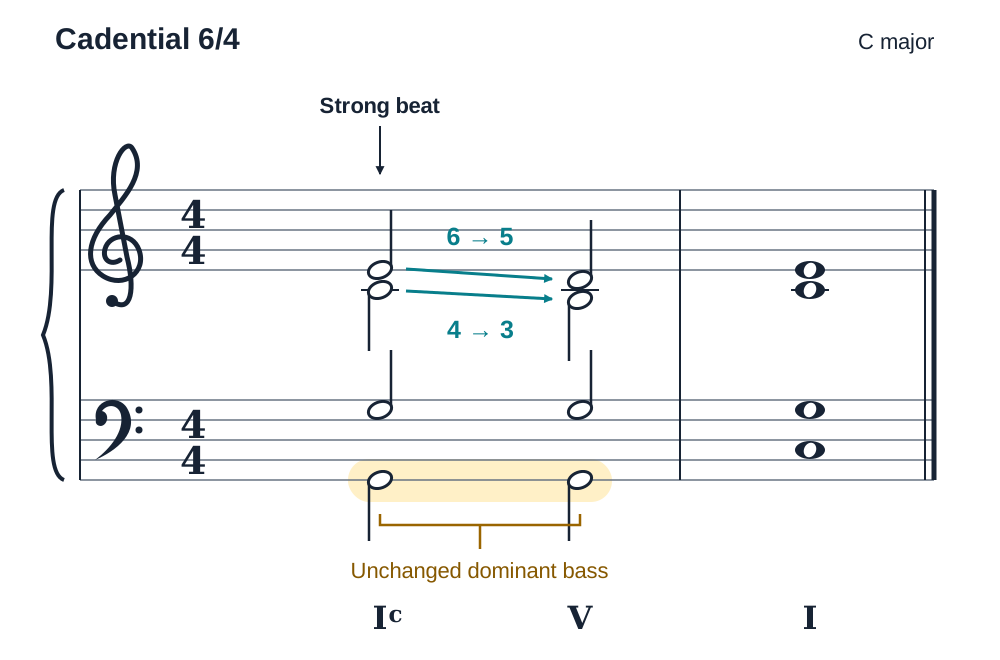
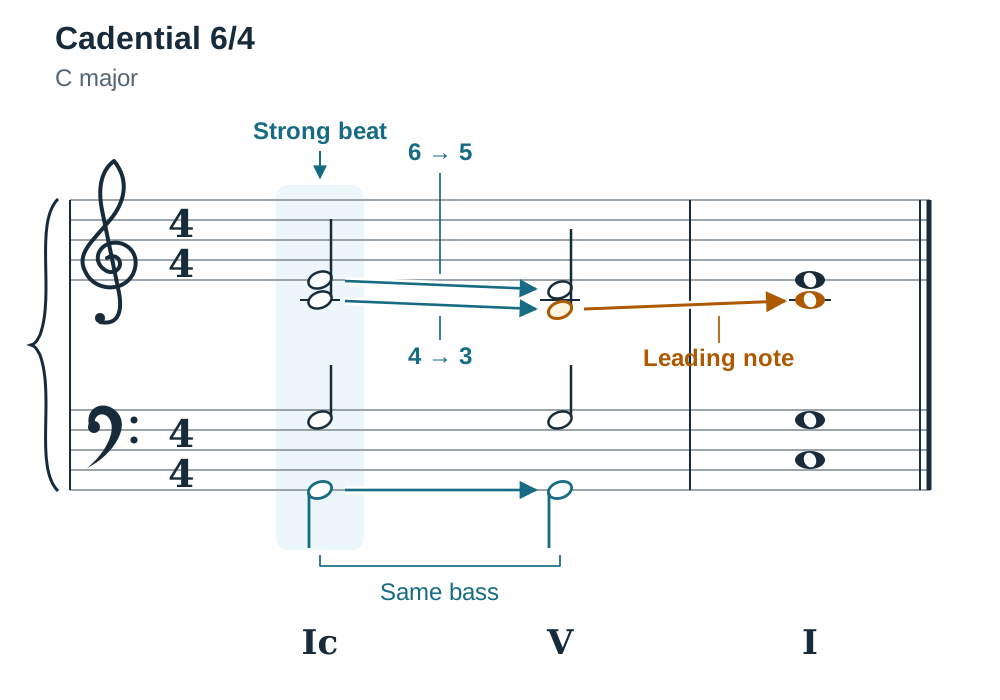
- Cadential Progression (): Tonic chord in second inversion (, fifth in the bass) falls on a strong beat, resolving directly to chord V before closing on chord I.
Non-Chord Notes
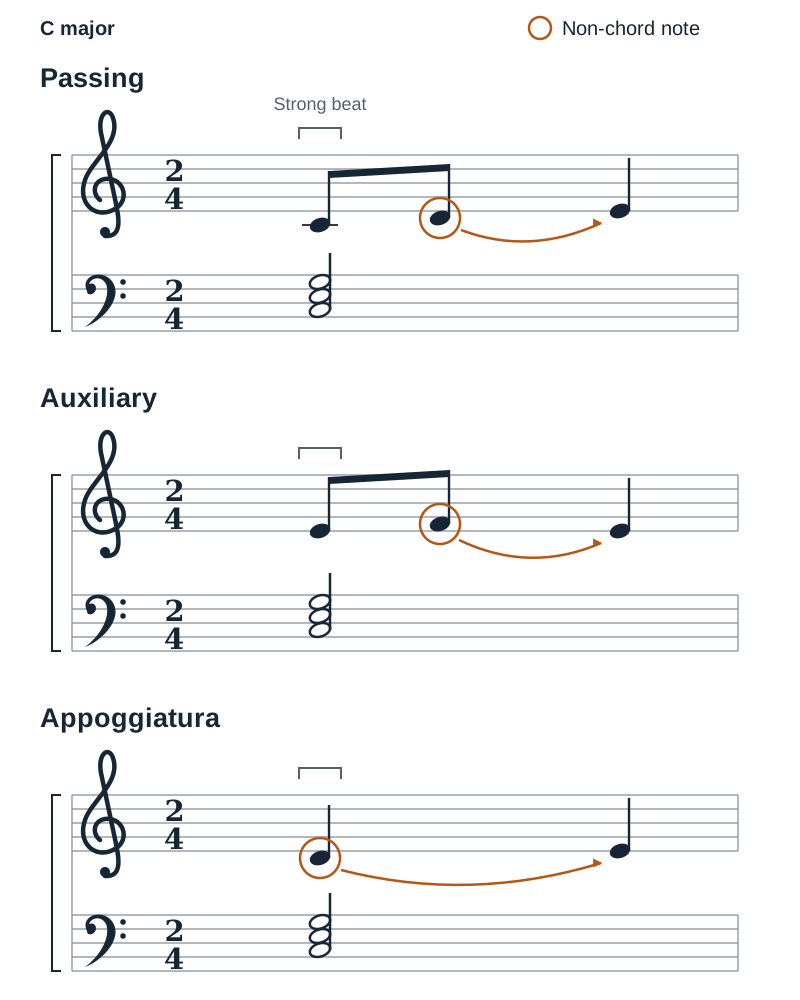
A non-chord note is a melody note that does not belong to the harmony underneath. It generally occurs on a weak beat and moves by step:
- Passing note: Steps between two different chord notes a third apart in the same direction.
- Auxiliary note: Steps away from a chord note (up or down) and returns immediately to the same chord note.
- Appoggiatura: An expressive dissonance on a strong beat that resolves by step to a chord note.
Adding a Bass and Chords to a Given Tune
When harmonising a melody at Higher Level:
- Write out the chord bank for the key (roots and chord notes).
- Plan the cadences at phrase ends first (for example, an imperfect cadence at the halfway point and a perfect cadence at the end).
- Match strong-beat melody notes to suitable chords.
- Write a bass line using roots or first inversions (), aiming for contrary motion against the melody.
- Check your part-writing to eliminate consecutive (parallel) fifths and octaves between the outer parts.
Harmonic Vocabulary, Inversions, and Cadences
At Higher Level you need to know these chords in all major and minor keys up to four sharps and four flats:
| Context | Permitted Root-Position Chords | Permitted First Inversions | Stock Cadential Formats |
|---|---|---|---|
| Major Keys | , , , , | , , , | , Cadential () |
| Minor Keys | , , , | , , , | , Cadential () |
Essential Vocabulary Rules
- Minor Chord ii: In minor keys, chord is diminished (). The syllabus excludes root-position ; it is permitted exclusively in first inversion (, such as in C minor voiced with in the bass).
- Raised 7th in Minor Keys: Dominant chords in minor keys (, , ) must use the raised leading note from the harmonic minor scale (for example, in A minor, producing ).
- Cadential 6/4 (): The tonic chord in second inversion ( or ) must be placed on a strong beat (beat 1 in 3/4 or 4/4, or beat 3 in 4/4) with the dominant note in the bass, resolving directly to chord over that same bass pitch.
- Dominant Seventh (): normally resolves to (or ) in a perfect cadence. It can also resolve to (or ) in an interrupted cadence. The 7th of the chord falls by step.
The Four Cadences
A cadence consists of the final two chords of a phrase:
| Cadence | Chords (Major Keys) | Chords (Minor Keys) | Musical Effect |
|---|---|---|---|
| Perfect | (or ) | Final, finished; use at bar 16 | |
| Imperfect | Ends on (, , , ) | Ends on (, , ) | Incomplete, like a comma; use at bars 4 or 12 |
| Plagal | Gentle, 'Amen' resolution | ||
| Interrupted | Deceptive surprise; moves to instead of |
Question 5: Bass Realisation and Voice Leading
In Question 5, you add backing chords and a bass line to a given melody. Treat the bass line as an elegant countermelody rather than an unshaped string of roots.
Step-by-Step Harmony Procedure
- Plot the chords: follow the question’s instructions, using the chord bank grid when provided. Write out the available chord notes: , , , , and their first inversions in major keys; , , , , , , and in minor keys.
- Fix the cadences: lock in the cadence chords at bars 4, 8, 12, and 16 before filling in intermediate bars.
- Select fitting chords: choose chords whose notes contain the melody pitch on each strong beat.
- Check adjacent boxes: avoid repeating identical chords in identical positions.
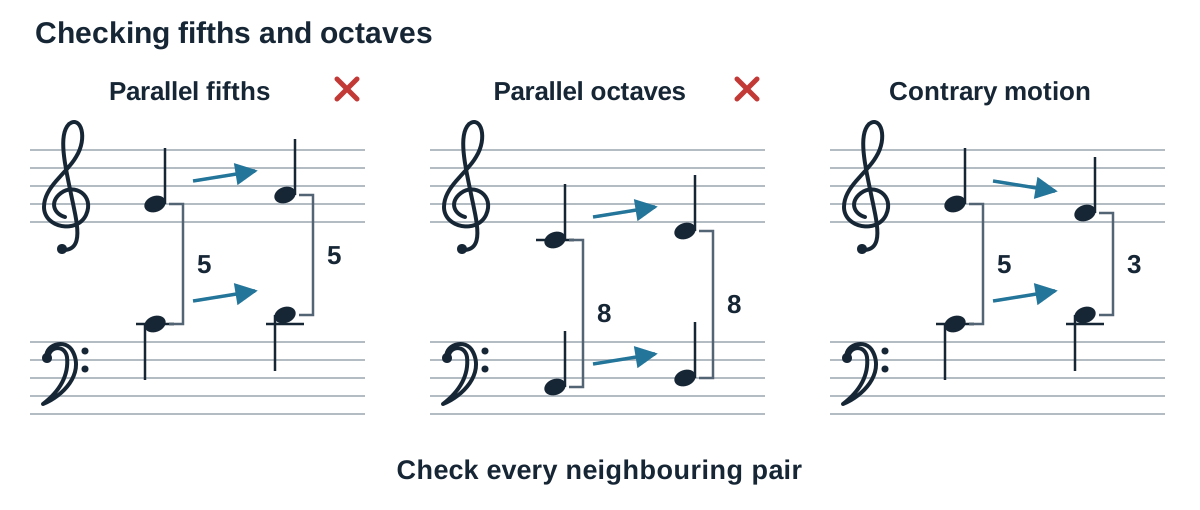
- Check for consecutive fifths and octaves: verify that the outer voices do not move in parallel 5ths or octaves.
- Shape the bass line: introduce first inversions to create stepwise movement.
Voice-Leading Principles
- Consecutive fifths and octaves: if the melody and bass are a 5th (or an octave) apart, they must not move to another 5th (or octave) in the same direction. Check each pair of neighbouring beats. Moving the bass in contrary motion can help, but it does not replace checking the intervals between successive notes.
- The adjacent-box repetition rule: State Examinations Commission marking schemes penalise using identical chords in identical inversions across adjacent boxes. If consecutive boxes share the same harmony, you have two options: change the bass note by using an inversion (such as to ), or add a seventh ( to ). Note that followed by is not accepted.
- Leading note resolution: in chord at cadence points, the leading note must resolve upward by semitone to the tonic in chord . Never double the leading note.