
Keys, Scales, and Modes
At Higher Level, you are examined on major and minor keys up to four sharps and four flats.
Reading Key Signatures
- Sharp Keys: Sharps appear in the fixed order F♯ – C♯ – G♯ – D♯ – A♯ – E♯ – B♯ (Father Charles Goes Down And Ends Battle). The major tonic note is always one semitone above the final sharp. For example, three sharps end on G♯, making A major the tonic.
- Flat Keys: Flats appear in the reverse order B♭ – E♭ – A♭ – D♭ – G♭ – C♭ – F♭ (Battle Ends And Down Goes Charles's Father). The major tonic is the second-to-last flat in the signature. For example, three flats end on A♭, so E♭ major is the tonic. F major (one flat: B♭) is the single exception you must memorise.
- Relative Minor: Every major key shares its signature with a relative minor whose tonic lies three semitones (a minor third) below the major tonic (for example, G major pairs with E minor, and E♭ major pairs with C minor).
Scale Construction
- Major Scale: Follows the pattern Tone – Tone – Semitone – Tone – Tone – Tone – Semitone ().
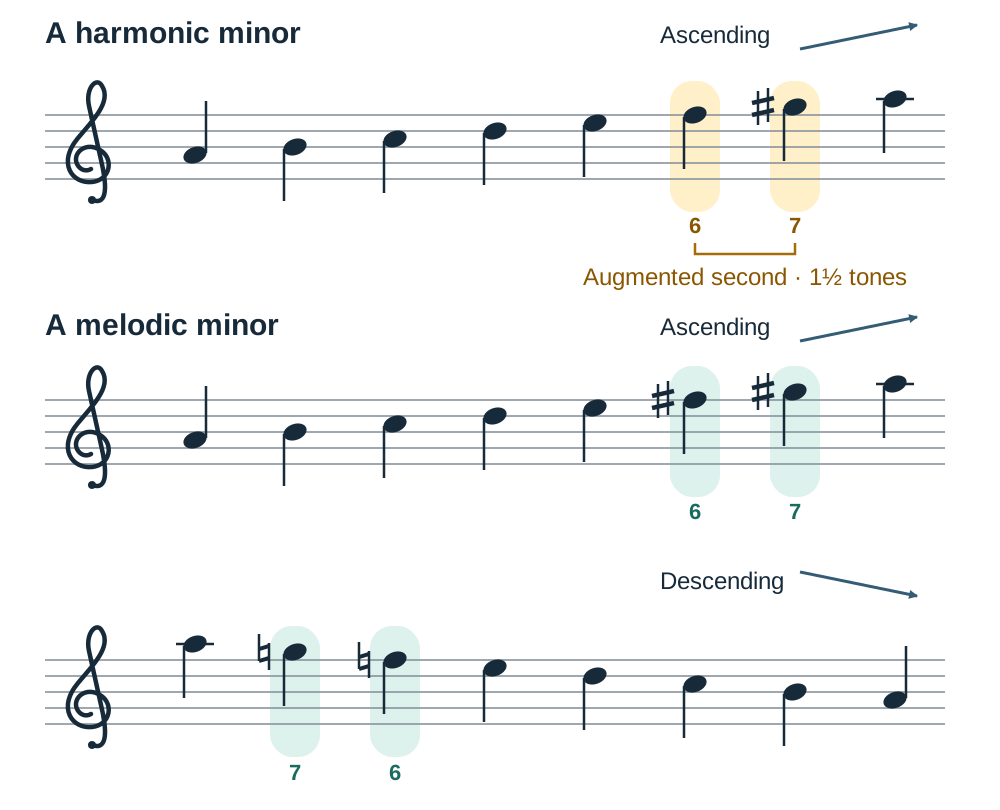
- Harmonic Minor: Follows the pattern Tone – Semitone – Tone – Tone – Semitone – Tone-and-a-half – Semitone. This produces an augmented second interval between the 6th and 7th degrees. The raised 7th degree functions as a leading note pulling upward into the tonic.
- Melodic Minor: Ascends with raised 6th and 7th degrees (), but descends using the natural minor scale ().
- Pentatonic Scale: A five-note scale containing no semitones (such as C–D–E–G–A), heard in folk traditions worldwide and in some traditional Irish airs.
Modes in Irish Traditional Music
A mode is a seven-note scale with its own pattern of tones and semitones. Many Irish dance tunes and airs are modal rather than major or minor. You can find their patterns on the white notes of a piano:
- Ionian: C to C (identical to the major scale).
- Dorian: D to D (a minor sound featuring a raised 6th degree).
- Mixolydian: G to G (a major sound featuring a flattened 7th degree).
- Aeolian: A to A (identical to the natural minor scale).
Reels and jigs frequently employ the Dorian and Mixolydian modes.
16-Bar Melody Structure and Development
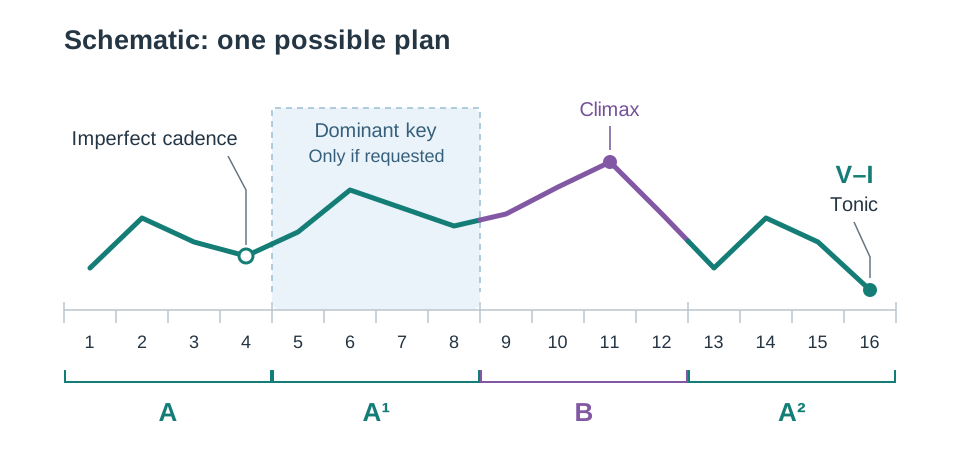
A Higher Level melody is 16 bars long, usually structured into four balanced 4-bar phrases ( or ). The music must sound cohesive rather than like four disconnected fragments.
One Possible Four-Phrase Plan
This is a planning aid for a 16-bar continuation, not a compulsory pattern. Include the modulation below only when the question asks for it.
- Phrase 1 (bars 1–4): Establishes the home key using the given opening. It introduces the rhythmic motif and style, ending on an imperfect cadence (usually resting on scale degree or , implying chord ).
- Phrase 2 (bars 5–8): Develops the opening motif. If a modulation to the dominant is requested, this phrase is one suitable place to make it and cadence in the new key.
- Phrase 3 (bars 9–12): Introduces melodic and rhythmic contrast. It climbs toward the melodic climax—the highest, most expressive note of the piece, ideally around bar 10 or 11—before steering back toward the tonic key.
- Phrase 4 (bars 13–16): Returns definitively to the home tonic, echoing motifs from Phrase 1 to restore unity. It finishes on a strong beat in bar 16 with a conclusive perfect cadence () resolving onto the tonic note (scale degree ).
A quick way to remember the phrase plan:
- Bar 4: imperfect cadence
- Bar 8: cadence in the dominant if the requested modulation is placed here; otherwise use a cadence suited to the question
- Bar 12: imperfect cadence or climax area
- Bar 16: perfect cadence on the tonic
Melodic Contour and Voice Leading
Keep the line singable (cantabile). Move predominantly by step and keep leaps small (mostly 3rds and 4ths, with the occasional 5th or octave). Balance any leap of a 4th or wider by immediately stepping back in the opposite direction.
Starting with an Upbeat (Anacrusis)
If the given opening begins with an anacrusis, you must deduct that exact rhythmic duration from bar 16. In 4/4 time, an opening pickup of one crotchet means bar 16 must contain exactly three crotchet beats, so the upbeat and the last bar add up to one complete bar.
Motivic Development
Examiners look for organic development of the opening ideas:
- Tonal sequence: repeating a motif immediately at a higher or lower pitch while staying within the diatonic scale.
- Real sequence: repeating the motif with exact interval qualities preserved; accidentals may be needed.
- Melodic inversion: turning the melodic contour upside down, so every upward step or leap becomes an equivalent downward step or leap.
- Rhythmic variation: using augmentation (lengthening note values), diminution (shortening values), or subtle syncopation.
Avoiding the Augmented Second in Minor Keys
In a minor key, the raised 7th creates an awkward interval of an augmented 2nd between degrees and (such as to in A minor). To keep the line smooth, use the melodic minor scale: raise both the 6th and 7th degrees when the melody ascends (), and use the natural notes when it descends ().
Melody Writing Alternatives
The syllabus also provides options to set a text or use a dance metre:
- Setting a given text: write one note per syllable, except where you deliberately slur a syllable across two notes. Place stressed syllables on strong beats. Follow the punctuation of the text by ending musical phrases at line breaks and placing cadences at full stops. Reflect the meaning of the words using word-painting, and write words clearly beneath the stave with hyphens separating syllables.
- Dance rhythms: maintain the rhythmic metre and characteristic tempo of the requested dance throughout while following the specified formal structure.
Examiner Checklist for Melodies
Before finishing Question 1, check your work against the marking points: style and imagination, shape and balance, development of opening ideas, clear climax, accurate modulation where requested, suitable instrument choice, and complete performing directions.
Modulation and Instrumental Compass
If the question asks for a modulation to the dominant, Phrase 2 (bars 5–8) is one possible place, with a cadence in the new key at bar 8. Do not add a modulation merely because it appears in a memorised plan: follow the question’s exact instructions.
Modulating to the Dominant Key
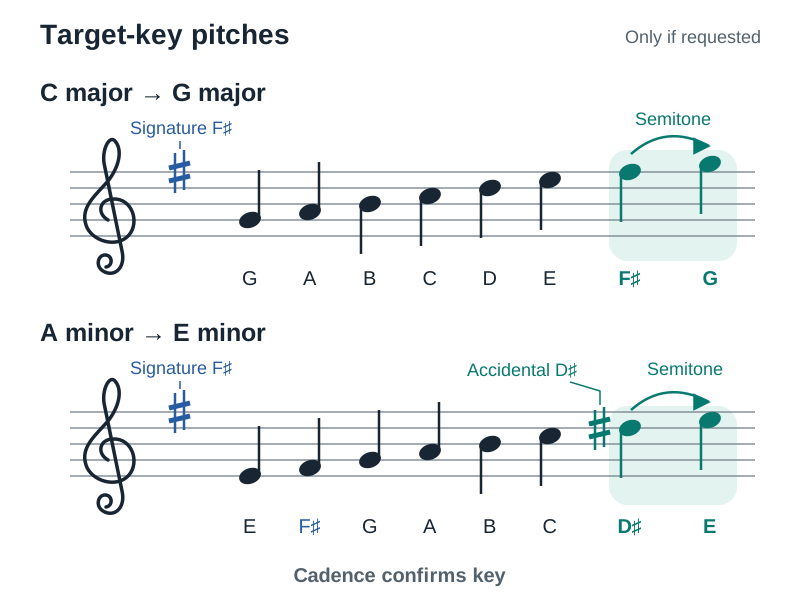
- Major keys: the dominant key is major. Raise the 4th degree of the home scale to create the new leading note. For example, in C major modulating to G major, introduce . In major modulating to major, introduce .
- Minor keys: the dominant key is the dominant minor. For example, A minor modulates to E minor. This requires as the new leading note, and to match the key signature of E minor. Check the key signature of the new key and insert every accidental it requires.
- Return to the tonic: in Phrase 3, cancel the new accidentals (restoring or ) to bring the tonality securely back home.
Instrumental Compass
Follow the question’s instructions about the instrument, range and notation. The ranges below are approximate practical ranges for these exercises, not each instrument’s complete compass; they are shown at concert pitch (for a B-flat clarinet and B-flat trumpet). Pitch notation here uses scientific pitch, where represents middle C:
- Flute: to
- Oboe: to
- Clarinet: to
- Violin: to
- Horn: approximately to (most comfortable in its middle register)
- Trumpet: to
If you are ever unsure of extreme ranges, keep the melody between and , as this octave falls comfortably within the compass of every instrument listed.
Performance Directions
Always include complete performance directions to earn full marks:
- Tempo: confirm or add an appropriate tempo marking (Allegro, Andante, Moderato).
- Phrasing and articulation: add phrase slurs over 2-bar or 4-bar units, along with staccato dots, tenuto dashes, or accents.
- Dynamics: place dynamic markings (, , , ) underneath the stave, using crescendo and diminuendo hairpins to shape the contour toward the climax.