
Question 4: Composing over Chord Symbols
Question 4 requires composing an original melody and bass line to complete a piece from given chord symbols. This question carries substantial marks for showing awareness of key and harmonic structure.
Fitting a Melody to Chord Symbols
Each chord symbol specifies which pitches are consonant in that bar or half-bar:
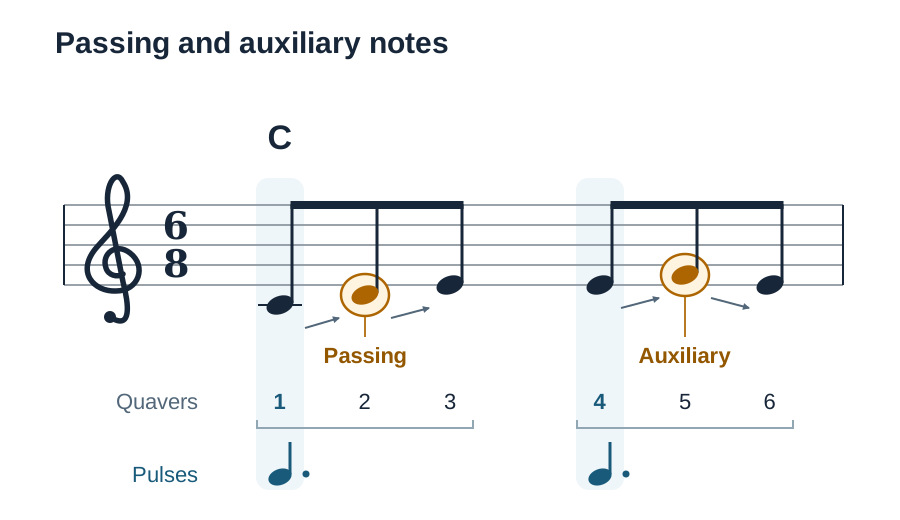
- Strong beats: use a chord note. In 4/4 time, beats 1 and 3 are strong. In 3/4 time, beat 1 is strong. In 6/8 time, quavers 1 and 4 are the strong dotted-crotchet beats.
- Weak beats: you may introduce a non-chord note to keep the line lyrical and moving:
- Passing note: moves by step between two different chord notes (for example, over C major, , where is the passing note).
- Auxiliary note: steps away from a chord note and returns to the same note (for example, over C major, , where is the auxiliary note).
- Never leap to or from a non-chord note; always approach and leave it by step.
Reading Chord Symbols and Slash Chords
- A capital letter alone indicates a major triad: D = .
- An m indicates a minor triad: Em = .
- A degree circle (°) indicates a diminished triad: F#° = .
- A 7 indicates a dominant seventh: B7 = .
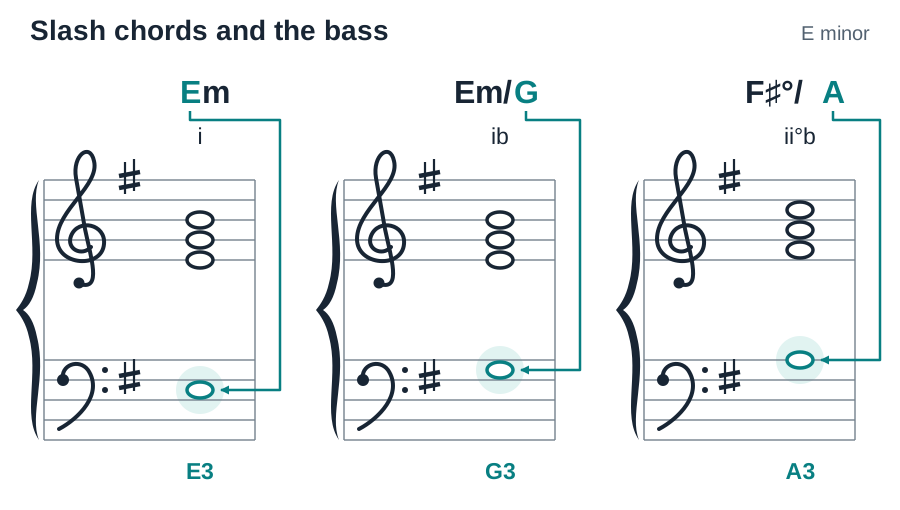
- Slash chords: the letter after the slash dictates the bass note. For example, Em/G is an E minor chord with in the bass, forming a first inversion (). F#°/A in E minor is , requiring in the bass.
Rule: with no slash, write the chord root in the bass. With a slash, write the pitch following the slash in the bass. Shape the bass line so it steps smoothly into and out of each inverted chord.
Working in 6/8 Compound Duple Time
Compound duple time has two dotted-crotchet beats per bar, each dividing into three quavers. Always beam quavers in groups of three (1-2-3, 4-5-6), never across the middle of the bar. Common rhythmic figures include crotchet-quaver (♩ ♪) and three quavers (♪ ♪ ♪). The main pulses fall on quavers 1 and 4. Use chord notes and chord changes on these pulses; a cadential 6/4 (Ic) belongs on a strong pulse. Ordinary first inversions are not restricted to strong pulses.