
Setting music to a given text is one of three options in the melody-writing question on the Higher Level composing paper; the alternatives are continuing a given opening and writing to a given dance rhythm or metre. You answer one option only. Check the front of your examination paper for the current question numbering. The exam supplies the first four bars setting line 1, which establishes the key, metre, tempo, motif, and opening dynamic. Your task is to set the remaining three lines of the poem across 12 additional bars to create a balanced 16-bar vocal melody. The question carries significant credit within the composing paper (top-band responses earn 34 to 40 marks), so allocating roughly 25 to 30 minutes gives you adequate time to scan the poetry, draft rhythms, shape melodic contours, and check phrase lengths. Success depends on achieving what marking schemes call an excellent marriage of words and music: matching spoken syllable accents to musical metre, maintaining phrase symmetry and cadential logic, reaching an expressive climax in phrase 3, and providing thorough vocal performing directions.
The 16-Bar Architectural Plan and Completeness
A vocal melody needs a clean structure so the singer can breathe naturally and the listener can follow the musical thought. The most dependable structure for a four-line poem is a four-phrase layout of four bars each, creating a 16-bar melody in an A A' B A'' design.
Phrase 1 (Bars 1–4)
This is the printed opening that sets line 1. It gives you the home key, metre, initial tempo, starting dynamic, and core motifs. It usually pauses on an imperfect cadence on chord V or rests on a sustained note.
Phrase 2 (Bars 5–8)
This phrase sets line 2 and acts as an answering phrase. It should reuse rhythmic and melodic ideas from Phrase 1 to establish unity. To keep the music moving forward, end bar 8 on an imperfect cadence (ending on the 2nd, 5th, or 7th degree of the scale, such as A, D, or F sharp in G major) or a modulation to the dominant.
Phrase 3 (Bars 9–12)
This phrase sets line 3 and functions as your departure or development section. It introduces contrasting rhythmic patterns, explores a higher register, and establishes the musical climax on an expressive word before ending on an open cadence.
Phrase 4 (Bars 13–16)
This phrase sets line 4 and rounds off the architecture. The most convincing strategy is to recall the opening motif from bar 1 either exactly or in variation (creating a rounded A A' B A'' form). It then modifies the final two bars to resolve with a decisive perfect cadence (chords V to I) onto a sustained tonic note in bar 16.
Completeness as a Marking Point
Every remaining word of the poem must appear under your melody. Recent marking schemes treat text completeness as an explicit credit point. A musically neat 14 bars that cuts off halfway through line 4 loses substantial credit compared to a setting that finishes the entire poem. Before writing pitches, divide the words across your bars in pencil: line 2 across bars 5 to 8, line 3 across bars 9 to 12, and line 4 across bars 13 to 16. If you genuinely run out of space, the rubric permits you to exceed 16 bars, so add bars 17 and 18 rather than leaving lines unset. You may also repeat a short final phrase for emphasis, which is standard songwriting practice.
Developing the Given Motif
Examiners reward continuing the style of the opening and showing excellent style and imagination. The four printed bars provide rhythmic cells and contours that you are expected to develop across bars 5 to 16 rather than inventing entirely unrelated material.
Repetition
Begin bar 5 with the identical rhythm and melodic contour of bar 1. This immediately binds the second phrase to the first and reassures the listener.
Sequence
Repeat a recognisable melodic pattern from the opening a step or a third higher or lower. A rising sequence is one of the most effective tools for building tension towards the climax in Phrase 3. For example, if bar 1 in G major presents a minim G4 followed by a crotchet B4, bar 5 can state this pattern one step higher as a minim A4 followed by a crotchet C5. Bar 9 can step higher again with a minim B4 followed by a crotchet D5, driving directly into the high register.
Inversion
Turn the opening contour upside down. If the opening motif in bars 1 and 2 outlines a rising triad from G4 up to D5, answer it in bars 5 and 6 with a falling figure from D5 down to G4.
Rhythmic Augmentation and Diminution
Lengthen the note values of an opening motif (augmentation) to set a calm or solemn word. Conversely, halve the note values (diminution), turning crotchets into quavers, to match rapid or agitated text.
Text Scansion and Natural Prosody
Prosody is the alignment of natural speech stress with musical metre. When an unstressed syllable lands on an accented musical beat, the text sounds distorted and clumsy. Always scan your text aloud before choosing pitches.
Accented Beats by Metre
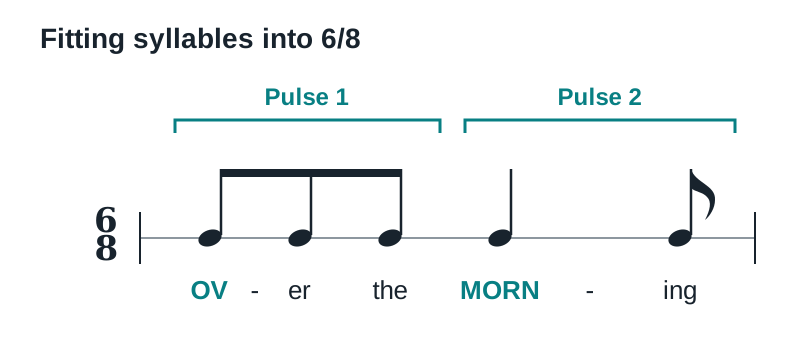
In 4/4 time, beat 1 carries the primary pulse and beat 3 carries the secondary pulse. In 3/4 time, beat 1 is the strong downbeat while beats 2 and 3 are weaker. In 6/8 time, the pulses fall strictly on quavers 1 and 4.
Weak Syllables and the Anacrusis
Articles, prepositions, and conjunctions (such as the, a, and, in, of, to) should never land on beat 1. When a poetic line opens on an unaccented syllable, set it as an anacrusis (upbeat) before the first complete bar of the phrase. If a phrase begins with an upbeat, the bar before it must be short by exactly that rhythmic value. In 3/4 time, a bar with a minim note leaves room for a crotchet upbeat, completing three beats across the barline.
Handling 6/8 Metre
Count a 6/8 bar as two dotted-crotchet beats: ONE-and-a, TWO-and-a. A crotchet followed by a quaver (two quavers plus one quaver) fits a trochaic two-syllable word such as MORN-ing. A dactyl (one strong syllable followed by two weak syllables, such as OV-er-the) requires three quavers within a single dotted-crotchet beat.
Melodic Contour, Non-Chord Notes, and Climax
Vocal melodies require singable, conjunct lines. Wide leaps and instrumental-style runs are hard to sing and will read as unvocal writing on paper.
Vocal Compass and Leaps
Keep the entire melody within about an octave to a tenth. Working from the register of the given opening, a comfortable range on the treble stave is roughly C4 to E5. Only venture above E5 for the single climax note, and do not drop below the lowest pitch of the printed opening. Move mostly by step or in thirds that outline triads. If you write a leap wider than a fourth, change direction immediately and step back into the gap. For instance, leaping upward from G4 to E5 on a climax word works well if you resolve it downward through D5, C5, and B4. Leaping from G4 up to F5 followed by another leap upward is unvocal and sounds unstylised.
Non-Chord Notes in a Melodic Context
A melody that uses only chord tones sounds like an exercise in broken chords. Higher Level rudiments require the correct melodic use of non-chord notes:
- Passing Note: Fills the gap between two chord tones a third apart on an unaccented beat. In G major over chord I (G-B-D), moving G4 to A4 to B4 uses A4 as an unaccented passing note.
- Auxiliary Note: Steps away from a chord note by step and returns immediately to the same chord note on a weak beat (such as B4 to C5 to B4 over chord I).
- Appoggiatura: Reaches a non-chord note on an accented beat by leap, resolving downward by step onto a chord note. This adds expressive tension on poignant words.
Keep the strong beat of each bar on an implied chord note so your underlying harmony remains clear.
Reaching the Climax
A well-shaped melody contains one prominent peak. Place your highest pitch in Phrase 3 (bars 10 to 12) on an emotionally charged word. Mark it with your loudest dynamic (forte), and let the line descend by step towards the home key in Phrase 4.
Word Painting and Dominant Modulation
Word painting occurs when the musical contour or rhythm mimics the literal meaning of a lyric. Leaving Certificate poems regularly feature nature imagery that invites musical illustration.
Examiner-Friendly Word Painting Responses
- Rising, climbing, dawn, hill: Ascending stepwise line or rising arpeggio paired with a crescendo hairpin.
- Falling, sinking, floods, night, grave: Descending scale or falling interval into a lower register with a diminuendo.
- Calm, still, rest, peace, sleep: Sustained note values (minims or dotted minims), quiet dynamics (piano), and a cantabile or dolce marking.
- Breeze, fluttering, singing birds, streamlet: Lively quaver passages, light staccato articulation, or a short two-note melisma under a slur.
- Roaring, storm, thunder: Louder dynamic (forte), accented notes, and firm leaps.
Modulating to the Dominant
The syllabus limits melody writing to keys up to four sharps and four flats, simple metres, and compound duple (6/8) time. The only modulation required is to the dominant key, which is optional but adds interest in Phrase 3. To modulate to the dominant, raise the 4th degree of the home key by a semitone using an accidental. That raised note becomes the leading note of the new key, so it pulls up to the new tonic.
- In G major, write C sharp in bar 10 on a stressed syllable, resolve up to D in bar 11 or 12, then insert a C natural in bar 12 to return safely to the tonic.
- In F major, write B natural to move towards C major, then restore B flat before cadence bar 16.
- In D major, write G sharp to lead towards A major, then cancel with G natural in Phrase 4.
- In E major, write A sharp to lead towards B major, restoring A natural on the return.
Score Presentation and the 3-Minute Final Checklist
Performing directions are a distinct credit point in published marking criteria. Clear text underlay is essential so the examiner can evaluate your word setting.
Underlay and Notation Rules
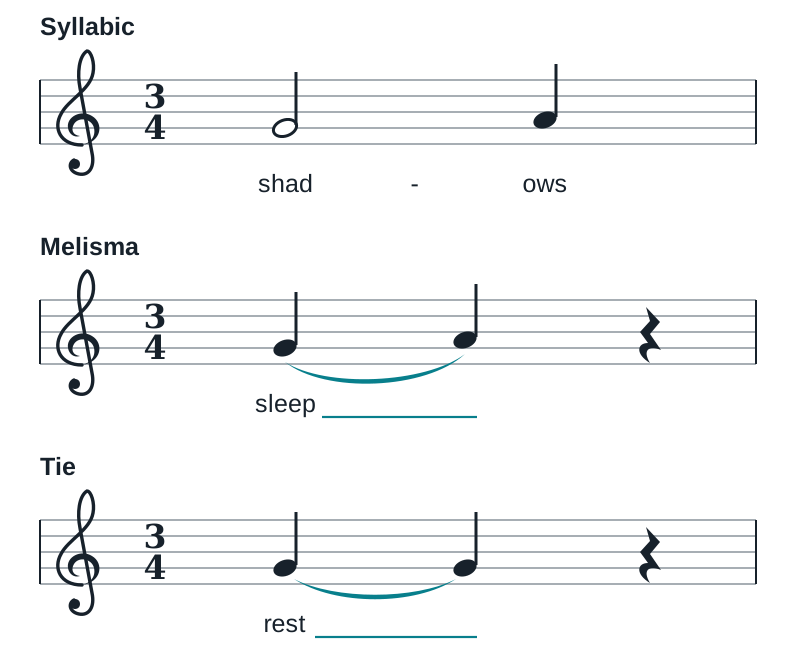
- Write text neatly beneath the stave. Break multi-syllable words into components using hyphens (shad-ows).
- Keep one note per syllable for a syllabic setting. When two or more notes are sung to one syllable (a melisma), join those pitches with a slur.
- Never confuse a tie with a slur. A tie connects two identical pitches to sustain a single sound; never start a new syllable on a tied continuation note.
- If a syllable is held across multiple notes, draw an extender line from the vowel under those notes. Stop the line where the sound stops; never draw an extender line through a rest.
Required Performing Directions
Aim for at least six distinct markings across bars 5 to 16:
- Smooth phrase marks (slurs) over each four-bar phrase.
- A crescendo hairpin leading into the Phrase 3 climax.
- A diminuendo hairpin falling away from the climax.
- A dynamic path matching the poem: mp in bar 5, building to f at bar 11, falling to p in bar 16.
- An Italian expression term matching the text (dolce, cantabile, or espressivo).
- A rit. or rall. in bar 15 resolving onto a long tonic note in bar 16.
The 3-Minute Final Checklist
Before leaving the question, review your score systematically:
- Completeness: Is every single word of the poem written under a note?
- Bar arithmetic: Does every bar contain the exact number of beats specified by the time signature?
- Anacrusis balance: If phrase 2, 3, or 4 opens on an upbeat, does the preceding bar deduct that exact rhythmic value?
- Syllable alignment: Are hyphens visible and syllables positioned directly under their corresponding note heads?
- Prosody check: Are weak words (the, and, of) kept off beat 1?
- Accidental audit: Are dominant modulation accidentals cancelled before the final phrase?
- Phrasing and dynamics: Are overarching phrase marks, hairpins, dynamics, and tempo alterations (rit.) fully visible?
- Cadence structure: Does bar 8 stay open on an imperfect cadence, and does bar 16 settle on a sustained tonic note?
Key terms
- Prosody
- The relationship between poetic metre and musical rhythm, ensuring natural speech stresses coincide with accented musical beats.
- Anacrusis
- An upbeat; an unaccented note or group of notes occurring before the first downbeat of a phrase.
- Syllabic Setting
- A vocal setting where each syllable of text is assigned to exactly one musical note.
- Melisma
- A vocal technique where a single syllable of text is sung across multiple notes grouped under a slur.
- Word Painting
- A technique where musical contour, rhythm, or register illustrates the literal meaning of a specific word.
- Imperfect Cadence
- A cadence ending on chord V (dominant), leaving the phrase open and incomplete.
- Perfect Cadence
- A cadence moving from chord V to chord I, creating a finished, definitive musical resolution.
- Sequence
- The immediate repetition of a melodic pattern at a higher or lower pitch.
- Climax
- The highest pitch and peak of emotional tension in a melody, typically placed in Phrase 3.
- Non-Chord Note
- A melodic note that does not belong to the underlying harmony, such as a passing note, auxiliary note, or appoggiatura.
- Dominant Key
- The key built on the fifth degree of the tonic scale, accessed by raising the fourth degree by a semitone.
Check yourself
What is the standard phrase architecture and form for a 16-bar vocal setting at Higher Level?
Four balanced four-bar phrases (16 bars total) organised in an A A' B A'' structure, where Phrase 1 is given, Phrase 2 answers, Phrase 3 provides contrast and climax, and Phrase 4 recalls the opening before resolving.
Which beats carry the primary and secondary accents in 4/4 and 6/8 metres?
In 4/4 time, beat 1 is the primary accent and beat 3 is the secondary accent. In 6/8 time, quaver 1 is the primary pulse and quaver 4 is the secondary pulse.
Identify the fault in setting the words 'in the deep' to a 4/4 bar with 'in' on beat 1 as a minim, 'the' on beat 3 as a crotchet, and 'deep' on beat 4 as a crotchet. How should it be corrected?
The weak preposition 'in' receives the strongest pulse and longest duration, while the stressed noun 'deep' is buried on a weak beat. It should be corrected by placing 'in the' on an anacrusis of two quavers before the bar, landing the stressed word 'deep' on the downbeat (beat 1) as a minim.
What accidental is needed to modulate to the dominant in G major, and how should it be handled before bar 16?
Raise the 4th degree of G major by a semitone (C to C sharp), which acts as the leading note in D major. In Phrase 4, insert a C natural to cancel the modulation and return to G major.
What is the difference between a tie and a slur in vocal music notation?
A tie joins two identical pitches into a single held note for one syllable. A slur groups two or more different pitches together to indicate a melisma on a single syllable.
Name two non-chord note types that can be used to connect chord tones in a vocal line.
A passing note (which moves by step between two chord tones a third apart on an unaccented beat) and an auxiliary note (which steps away from a chord tone and returns to it immediately).