
In Section B (Harmony) of the Leaving Certificate Higher Level Music written paper, candidates answer one question out of three. The descant and countermelody option is worth 60 marks: 20 marks for inserting chord indications in the boxes beneath the stave, and 40 marks for composing an independent upper line to complete the tune. You are usually given a 16-bar tune with the first two to four bars completed as a style guide; in some years a few chord boxes are already filled in. The question gives you two staves and chord boxes: you fill the boxes and write the upper part only. Because the added line carries twice the marks of the chord boxes, planning the harmony efficiently leaves the majority of your time to shape an expressive, well-balanced countermelody or descant.
Question Structure, Mark Allocation, and Starting Routine
The 60 marks for this question break down into two distinct tasks. The chord indications earn 20 marks (roughly one mark per box for a chord that fits the melody and belongs to a good progression, plus marks for overall cadence quality). The added line earns 40 marks, awarded in qualitative bands for harmonic accuracy, contrapuntal independence, and consistency with the opening style. Spending twenty minutes labouring over chord boxes leaves too little time for the line that carries the bulk of the score. Aim to complete your chord plan in about ten minutes, then dedicate the remaining time to writing and checking your melody.
How to Start in the Exam Room
- Name the key from the key signature and the final cadence note.
- Write out your chord bank in the rough-work margin, listing the notes of chords I, ii, IV, V, and vi (or minor-key equivalents).
- Mark the phrase ends in light pencil at bars 4, 8, 12, and 16, and assign your cadences.
- Harmonise the cadence boxes first, then work backwards to connect the intervening chords.
- Compose the added line bar by bar, checking the interval against the melody on every accented beat.
The Higher Level Harmonic Toolkit
The Leaving Certificate Higher Level syllabus requires major and minor keys up to four sharps and four flats, simple metres (, , ), and compound duple metre (). You must be able to deploy root-position triads, specific first inversions, the dominant seventh, and the cadential .
| Harmony Type | Major Keys (e.g. G major) | Minor Keys (e.g. E minor) |
|---|---|---|
| Root Position Triads | I (G), ii (Am), IV (C), V (D), vi (Em) | i (Em), iv (Am), V (B), VI (C) |
| First Inversions () | Ib (G/B), iib (Am/C), IVb (C/E), Vb (D/F♯) | ib (Em/G), ii°b (F♯dim/A), ivb (Am/C), Vb (B/D♯) |
| Dominant Seventh | (D7: D–F♯–A–C) | (B7: B–D♯–F♯–A) |
| Second Inversion () | Cadential : (G/D) | Cadential : (Em/B) |
In a minor key, chord ii is a diminished triad (F♯–A–C in E minor). At Higher Level you use it in first inversion only, written ii°b, which puts the third of the chord in the bass and softens the diminished fifth. Furthermore, chord V and chord in a minor key must always contain the raised leading note (for instance, D♯ in E minor, G♯ in A minor, or B♮ in C minor). Write the accidental clearly in both the chord box and on the stave.
16-Bar Cadence Planning and Reading the Melody
A 16-bar tune consists of four 4-bar phrases. Planning phrase endings first gives your music a clear architectural direction before you harmonise individual notes.
Cadence Types and Phrase Functions
- Perfect cadence: (or ). Conclusive full stop; mandatory at bar 16, ideally approached via a cadential 6/4 ().
- Imperfect cadence: any chord moving to V (such as , , or ). Sounds open and unresolved; ideal at bar 8 or bar 12.
- Plagal cadence: . Gentle resolution; useful at bar 12 or as an alternative cadence.
- Interrupted cadence: (or in minor). Pulls the ear away from the expected tonic; excellent at bar 12 to build momentum into the final phrase.
16-Bar Chord Plans
Major Key Model (G major; boxes usually fall on beats 1 and 3; where only one chord is shown, that bar has a single box):
- Phrase 1 (bars 1–4): Given opening ending on I.
- Phrase 2 (bars 5–8): I | vi | IV – Ib | ii – V (Imperfect cadence at bar 8).
- Phrase 3 (bars 9–12): I | IV | V | vi (Interrupted cadence at bar 12).
- Phrase 4 (bars 13–16): I – vi | IV – iib | Ic – | I (Cadential resolving to a perfect cadence).
Minor Key Model (E minor; boxes usually fall on beats 1 and 3; where only one chord is shown, that bar has a single box):
- Phrase 1 (bars 1–4): Given opening ending on i.
- Phrase 2 (bars 5–8): i | iv | VI – ib | ii°b – V (Imperfect cadence at bar 8 with D♯ in chord V).
- Phrase 3 (bars 9–12): i | ivb | V | VI (Interrupted cadence at bar 12).
- Phrase 4 (bars 13–16): i – VI | iv – ii°b | ic – | i (Cadential resolving to a perfect cadence).
Reading Melody Notes Under a Box
A chord box often governs several melody notes. Harmonise the accented note on the beat, checking that other notes are chord tones or stepwise decorations. For example, in F major with melody notes A4–B♭4–C5–A4 under one box, the accented note is A. Chords containing A are F (I: F–A–C) and Dm (vi: D–F–A); B♭ (IV: B♭–D–F) does not contain A, so it is not an option here. Choosing I fits A and C as chord tones, while B♭ acts as an unaccented passing note between them. In time, boxes normally cover a dotted crotchet: harmonise the first quaver of each three-quaver pulse.
Crafting the Upper Line: Descant versus Countermelody
Look at the texture supplied in the opening bars to determine whether you are continuing a descant or a countermelody.
- A descant sits clearly above the main tune, usually between a third and an octave higher, and stays there. It uses broader, simpler note values that soar above an active tune without competing rhythmically.
- A countermelody works as a second tune in its own right. It answers the main melody through rhythmic dialogue: it moves when the tune holds a long note or rests, and it holds or rests when the tune is busy.
Melodic Guidelines for the 40-Mark Component
- Stepwise contour with balanced leaps: Keep your line mostly conjunct. When you leap by a third, fourth, fifth, or sixth, follow it with stepwise motion in the opposite direction. Never leap an augmented fourth or an augmented second.
- Single climax: Place the highest note of your line in the third or fourth phrase (bars 13–14 is ideal) and do not exceed it afterwards.
- Vocal range: Keep the overall compass within an octave to a tenth.
- Joining at bar 5: Examine the last note of the model line. Start bar 5 on the same note, a step away, or a small consonant leap away (no larger than a sixth). Reusing the rhythmic motif from bar 1 in bar 5 immediately secures style marks.
- Finishing convincingly: The final note must belong to chord I—the tonic itself or the third. Match the note value of the melody's final note and approach it by step, ideally using contrary motion.
Contrapuntal Rules, Voice-Leading Faults, and Non-Chord Notes
Your upper line must relate correctly to the melody on every beat. Use contrary motion (parts moving in opposite directions) or oblique motion (one part holding while the other moves) to preserve independent voices.
Voice-Leading Faults to Avoid
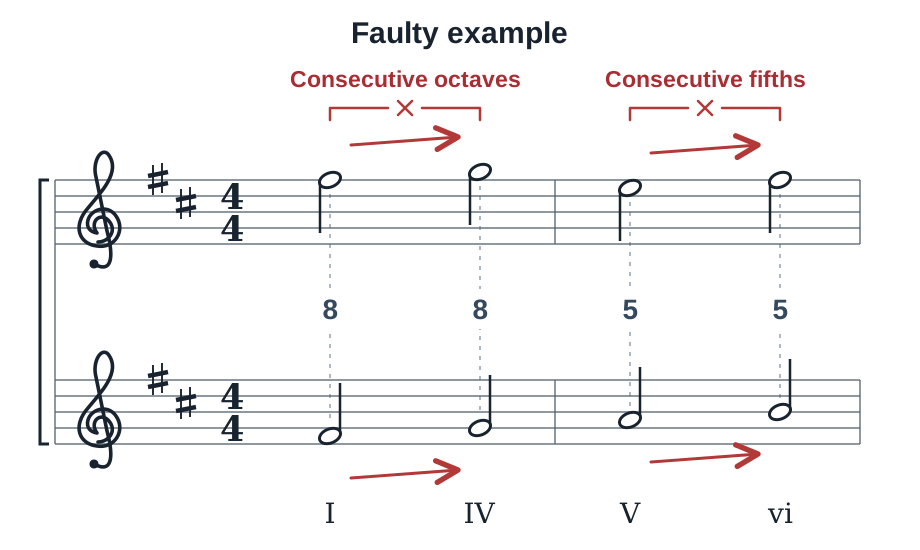
- Consecutive octaves and consecutive fifths: Both parts must not move in parallel motion from one octave to another, or from one fifth to another. Check across every barline and chord change.
- Accented harsh dissonances: Seconds and sevenths on accented beats sound harsh in two-part writing. Accented intervals should be thirds, sixths, fifths, or octaves. Fourths are completely acceptable provided both notes belong to the underlying chord.
- Overusing parallel thirds or sixths: Brief parallel motion creates colour, but four bars of continuous parallel movement reads as mechanical harmonisation rather than counterpoint.
- The minor-key augmented second: Moving between the natural 6th scale degree and the raised 7th degree (e.g. C to D♯ in E minor) creates an augmented second, an awkward interval of three semitones avoided in vocal counterpoint.
Decorating with Non-Chord Notes
A passing note is an unaccented note moving by step between two chord tones a third apart. An auxiliary note steps above or below a chord tone and returns to the same tone. An anticipation sounds a chord tone early on a weak fraction of a beat. Ensure every accented note belongs strictly to the underlying chord; keep non-chord decorations on weak beats.
Special Techniques: Cadential 6/4, Modulations, and Final Checklist
At Higher Level, using a cadential 6/4 () or an intentional modulation to the dominant earns upper-band marks.
The Cadential 6/4 Formula
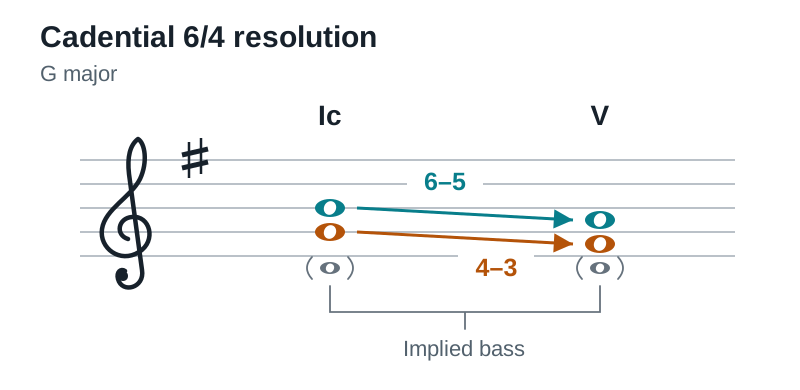
On the accented beat before chord V, write chord (the tonic triad with the 5th degree in the bass). Over this implied dominant bass, the upper voices form a 6th and a 4th. These resolve downward by step to the 5th and 3rd of chord V. For example, in G major over an implied bass D: the 4th (G) falls to the 3rd (F♯), while the 6th (B) falls to the 5th (A).
Modulating at the Midpoint
In bars 7–8, the tune may introduce an accidental indicating the leading note of the dominant key (e.g. C♯ in G major, or G♯ in D major). Identify the pivot chord that links the two keys, harmonise the new leading note with chord V of the new key, and resolve it by step to the new tonic.
Two-Minute Exam Checklist
- Is every box filled? An empty box forfeits marks instantly.
- Have you used Roman numerals throughout or chord symbols throughout, without mixing systems?
- Did you avoid writing the same chord in the exact same position in adjacent boxes?
- Are raised leading notes marked with accidentals on chord V in minor keys, both in boxes and staves?
- Did you scan every accented beat for consecutive fifths and octaves?
- Does the piece conclude with both parts resting together on a tonic chord note?
Key terms
- Descant
- A decorative upper melodic line set clearly above the main tune, using simpler, longer note values to add brightness and height.
- Countermelody
- An independent second melody designed to converse with the main tune by moving when the tune rests or holds, and sustaining when the tune is busy.
- Contrary Motion
- Voice movement where one part ascends while the other descends, preserving contrapuntal independence.
- Oblique Motion
- Voice movement where one musical line sustains or repeats a pitch while the other line moves up or down.
- Consecutive Fifths
- A forbidden voice-leading fault where two parts move in the same direction while maintaining an interval of an exact perfect fifth between them.
- Consecutive Octaves
- A voice-leading fault where two voices move in parallel motion from one octave interval directly to another.
- Cadential 6/4
- A cadential formula where a tonic triad in second inversion (Ic) on a strong beat resolves its 6th and 4th downward by step to the 5th and 3rd of chord V over a dominant bass.
- Raised Leading Note
- The seventh scale degree in a minor key, raised by a semitone using an accidental to form a major dominant triad (V or V7).
- Augmented Second
- A melodic interval of three semitones occurring between the natural sixth and raised seventh scale degrees in harmonic minor, avoided in smooth vocal writing.
- Pivot Chord
- A chord shared by both the home key and a target key, used to effect a seamless modulation.
- Passing Note
- An unaccented decorative note moving by step between two consonant chord notes a third apart.
- Auxiliary Note
- An unaccented decorative note moving a step above or below a chord tone and immediately returning to the same chord tone.
- Perfect Cadence
- A conclusive harmonic progression from chord V (or V7) to chord I, functioning like a musical full stop.
- Imperfect Cadence
- An open harmonic progression ending on chord V, functioning like a comma to leave the phrase unresolved.
- Plagal Cadence
- A harmonic resolution moving from chord IV to chord I, creating a gentle conclusion.
- Interrupted Cadence
- A progression where chord V resolves unexpectedly to chord vi (or VI in minor), diverting the anticipated arrival on the tonic.
Check yourself
What is the mark breakdown for the descant/countermelody question in Section B?
60 marks total: 20 marks for inserting chord indications in the boxes, and 40 marks for composing the added melodic line.
A tune in D major has melody notes F♯4 on beat 1 and A4 on beat 3. The previous chord was V. Suggest two suitable chords for this bar and explain why.
Beat 1: Chord I (D major: D–F♯–A), which resolves the preceding V properly. Beat 3: Chord V (A major: A–C♯–E) or V7, because A4 is a chord tone and sets up forward momentum. A progression of I followed by V is logical and strong.
Why is the progression V followed by IV usually avoided?
Chord V creates tension that the ear expects to resolve forward to I (or vi). Going back to IV weakens that pull, so the progression sounds as if the music has lost direction. While not automatically wrong, examiners reward progressions that move forward.
How do upper voices move during a cadential 6/4 progression (Ic–V–I)?
Over a sustained dominant bass note, the notes forming the 6th and 4th above the bass in chord Ic resolve downward by step to the 5th and 3rd of chord V, before resolving to chord I.
What quick check can you perform in the exam room to catch consecutive fifths and octaves?
Write the interval number (3, 5, 6, 8) in pencil between the melody and descant on each strong beat. If you see two 5s or two 8s in a row where both parts move in the same direction, you have a consecutive fifth or octave.