
In the Leaving Certificate Music practical examination, every Higher Level candidate must present prepared performance pieces alongside one compulsory unprepared test. Candidates may choose an unprepared sight-reading test, an aural memory test, or an unprepared improvisation from a syllabus-prescribed list. The syllabus requires you to show appropriate musical and technical fluency. Pitch, rhythm and steadiness all count, but a broken pulse damages the whole performance, while one wrong note does not. So keep going: never stop, apologise or restart from the beginning of the bar. Syllabus Appendix D states that patterns of predictability feature in the test pieces at Higher Level. In practice that means you can expect familiar shapes — stepwise lines, common chord outlines and balanced rhythmic cells — so look for them during your preview.
The Practical Examination and Unprepared Options
Under Section 2.1 of the syllabus, performing accounts for 25% of your total marks at Higher Level, or 50% if you select the Performing elective. At Higher Level, you normally present three songs or pieces and one unprepared test. As an alternative, you may present two Ordinary Level performing activities plus the appropriate Higher Level unprepared test. Either way, the unprepared test is compulsory, taken individually in the practical room straight after your prepared pieces, and assessed at Higher Level standard.
You choose one test from three syllabus options:
- Sight-reading: Singing or playing an unseen piece of music, or clapping an unseen rhythm.
- Aural memory: Singing back, playing back, or clapping back an unseen phrase after the examiner plays it on the piano.
- Unprepared improvisation: Creating a spontaneous melodic or rhythmic response. If you choose this route, you must select one of the specific improvisation types set out in the syllabus (Appendix A, Option 4), such as continuing a given phrase or improvising over an ostinato. It is not free, unstructured invention.
In the exam room, you sit the unprepared test on your own. The examiner will hand you the test sheet, allow you a short time to study it silently, and invite you to begin when you are ready.
Melodic Reading, Sight-Singing, and Sight-Clapping
The syllabus defines sight-reading as singing or playing a test piece. In practice, examiners frequently offer a rhythm test (sight-clapping), particularly for percussion candidates or where rhythm reading is standard. Because the choice offered on the day can vary, confirm with your teacher in advance which format you will sit, and practise both melodic reading and rhythm clapping so you are prepared either way.
| Format | Melodic Sight-Reading / Singing | Sight-Clapping (Rhythm Reading) |
|---|---|---|
| Core Task | Play or sing an unseen four- to eight-bar melody on your instrument or voice. | Clap an unseen four- to eight-bar unpitched rhythm. |
| What Matters | Pitch accuracy, steady pulse, tempo stability, key awareness, and printed dynamic markings. | A steady pulse and tempo, and the exact length of every note and rest. If dynamics are printed, show them by clapping more firmly or more lightly. |
| Common Pitfalls | Hesitating over unexpected accidentals, awkward vocal leaps, or stumbling over an unfamiliar clef. | Rushing through rests, clipping dotted notes, or failing to sustain full note values. |
Because a hand clap cannot sustain sound, duration is shown by when the next clap arrives. A minim is simply one clap followed by two full beats of silence that you count. On rests, pull your hands cleanly apart to show that you are actively counting silence. Keep any foot-tap silent. A loud tap competes with your claps, so the examiner cannot hear the rhythm you are actually performing.
Technique for Vocal Sight-Reading
If you sing your sight-reading test, your first priority is to establish the tonality in your head before producing a sound:
Fix the Key and Tonic Silently
Use the key signature to find the tonic. Silently hear and sing the tonic triad (1–3–5) and the scale up and down. If the examiner gives you a starting note or plays the tonic chord on the piano, lock your ear onto that home pitch immediately.
Navigate by Landmarks
Read the melody as movement away from and back to the tonic, not as isolated notes. Use either tonic sol-fa (doh, re, mi) or scale-degree numbers (1, 2, 3) consistently; pick one system in fifth year and stick with it. Map the easiest landmarks first: stepwise movement, tonic triad outlines, and any repeated bars or sequences. Treat awkward leaps by measuring from the nearest triad tone rather than calculating a raw interval from the previous note.
Maintain Phrasing and Flow
Keep an internal pulse running with a tiny, silent hand or toe movement. Look ahead and breathe at printed phrase marks so you never run out of breath mid-phrase. If you sing a wrong pitch, carry on in time. A steady phrase with one inaccurate pitch preserves your fluency, whereas halting destroys it.
Keys, Accidentals, and the Raised Seventh in Minor Keys
At Higher Level, you are expected to recognise and read music in major and minor keys with up to four sharps and four flats, on both treble and bass staves.
Identifying the Major Key
- In sharp keys, the last sharp in the signature sits one semitone below the major tonic. For instance, four sharps (F#, C#, G#, D#) indicate E major.
- In flat keys, the second-last flat gives the major key directly. For example, four flats (Bb, Eb, Ab, Db) indicate Ab major.
Identifying Minor Keys and the Raised Seventh
A key signature never identifies a key on its own because every signature belongs to both a major key and its relative minor (starting three semitones lower, on the sixth scale degree). Look for two clues:
- The final note (and usually the first note) of the melody resolves to the tonic. Four sharps ending on E indicates E major; ending on C# indicates C# minor.
- Minor melodies almost always feature a raised seventh degree marked by an accidental. In A minor (no sharps/flats), look for G#; in E minor (one sharp), D#; in D minor (one flat), C#; in G minor (two flats), F#; in C minor (three flats), B natural; and in F minor (four flats), E natural.
An accidental that raises a pitch by a semitone right before a tonic resolution is a clear signpost of a minor key. Sing or play it sharpened, and expect it to resolve straight up to the tonic.
Rules for Accidentals
An accidental applies to that note at that pitch for the rest of the bar only; the bar line cancels it. The only exception occurs when a note is tied across a bar line, where the tied note retains the accidental. By contrast, a key signature applies to every octave across every bar.
Rhythmic Framework, Metres, and Off-Beat Figures
The syllabus expects you to read simple time (2/4, 3/4, 4/4) and compound duple time (6/8), with note values from semibreves down to quavers, including dotted minims, dotted crotchets, and matching rests. Semiquaver pairs also appear frequently in tests.
Simple Metres
In simple time, each main pulse is a crotchet that divides into two equal quavers:
- 2/4: Two crotchet beats per bar (
1 & 2 &). - 3/4: Three crotchet beats per bar (
1 & 2 & 3 &). For a dotted minim, clap on 1 and hold silently through beats 2 and 3. - 4/4: Four crotchet beats per bar (
1 & 2 & 3 & 4 &).
Off-Beat Figures (Syncopation)
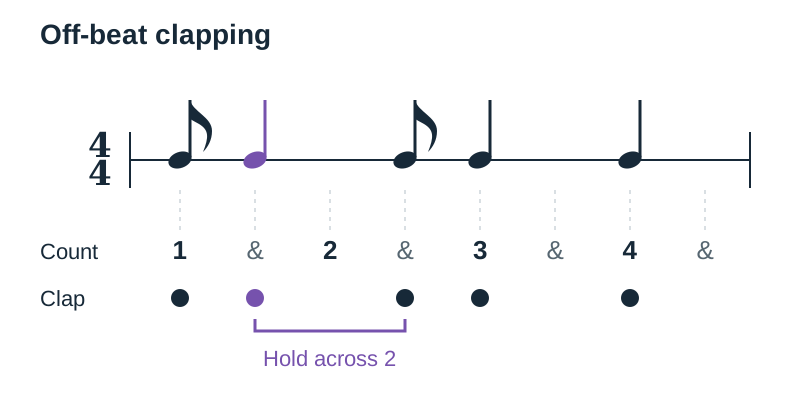
A common rhythm test figure in 4/4 is quaver – crotchet – quaver – crotchet – crotchet across beats 1 to 4. Count 1 & 2 & 3 & 4 & and clap on 1, the & of 1, the & of 2, beat 3, and beat 4. The first crotchet enters on a weak half-beat and holds across beat 2. Never try to guess the feel: keep your internal subdivision running (1 & 2 &) and clap strictly on the counted syllables.
Anacrusis (Upbeat)
If a piece begins with an incomplete bar, those notes form an anacrusis. In 4/4 with a single quaver upbeat, count a full silent preparatory bar (1 - 2 - 3 - 4 &), clapping or singing on the & of 4. The first full bar then lands squarely on your next beat 1. Check the final bar: it is usually shortened by the value of the upbeat, so the first and last bars together add up to one full bar.
Ties Across the Bar Line
A tie joins two notes of identical pitch into a single continuous duration. In 4/4, if a minim on beats 3–4 is tied to a crotchet on beat 1 of the next bar, sustain the sound for three full beats. Clap on beat 3, count 4 and 1 silently, and make your next attack on beat 2 of the new bar. Because nothing sounds on the downbeat, keep counting silently so you do not lose the bar line.
Mastering Compound Duple Time (6/8)
Compound duple time (6/8) consists of two dotted-crotchet beats per bar. Each dotted-crotchet beat subdivides into three equal quavers. Never count 6/8 as a slow 3/4 with three heavy crotchets. Instead, count 1 - 2 - 3, 4 - 5 - 6 or 1 & a, 2 & a, placing the primary pulses on 1 and 4.
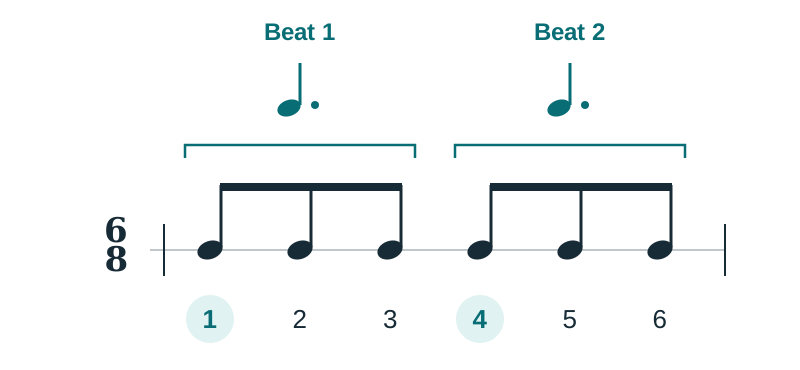
Most 6/8 rhythms are constructed from a small set of one-beat cells:
- Dotted crotchet: 3 quavers (
1 - 2 - 3). One sustained clap on the main beat. - Three quavers: 1 + 1 + 1 quavers (
1 - 2 - 3). Three even claps. - Crotchet + quaver: 2 + 1 quavers (
1 - 2, 3). Long-short lilting pattern; clap on 1 and 3. - Quaver + crotchet: 1 + 2 quavers (
1, 2 - 3). Short-long pattern; the long note starts off the pulse, so keep counting underneath it. - Quaver rest + two quavers: Silence on beat 1, claps on beats 2 and 3.
- Dotted crotchet rest: Three silent quaver beats covering one full main beat.
Your Silent Preview Routine
You are given a short time to study the test before you begin. The examiner will invite you to start, so do not rely on a stopwatch. Work methodically through these steps:
- Check the Signatures and Metre: Identify the clef, key signature, and time signature. Determine whether the key is major or minor by checking the opening and closing pitches and scanning for raised-seventh accidentals. Check whether the extract begins on a downbeat or an anacrusis.
- Check the Bar Arithmetic: Add up the beats in every bar during your preview. Every complete bar must total the right number of beats — the only expected exceptions are an opening anacrusis and the matching short final bar. If any other bar does not add up, you have misread a dot, a tie or a rest. Catch the error now, before performing.
- Find Structural Patterns: Appendix D guarantees patterns of predictability. Identify stepwise runs, repeated bars, arpeggios, and sequences. Spotting these reduces how much unfamiliar notation you must decode live.
- Set Your Tempo from the Hardest Bar: Locate the bar with the most complex rhythm or widest melodic leap. Choose a tempo slow enough that you can perform that specific bar with complete control without slowing down.
- Count Yourself In: Before your first note or clap, count one full bar silently with a small movement of your hand or toe, then begin right on the next beat. Hold that exact tempo to the end, giving the final note its full value without decelerating.
Key terms
- Sight-Reading
- The performance of an unseen musical extract at first sight, delivered either melodically on voice or instrument, or rhythmically by clapping.
- Sight-Clapping
- A practical exam format where a candidate claps or taps an unseen unpitched rhythmic extract.
- Fluency
- The ability to perform continuously with a steady, unbroken pulse and clear musical continuity, free from stops or restarts.
- Patterns of Predictability
- Recognisable musical shapes that Appendix D says will feature in the test pieces; in practice, stepwise scale lines, common chords, sequences and balanced phrases.
- Pulse
- The regular, repeating underlying beat that continues steadily through sound and silence.
- Compound Duple Time
- A metre containing two main dotted-crotchet beats per bar, with each beat dividing into three quavers (written as 6/8).
- Simple Time
- A metre where each main beat divides into two equal parts, such as 2/4, 3/4, or 4/4.
- Anacrusis
- An upbeat: an incomplete opening bar containing one or more unstressed notes before the first full downbeat.
- Tie
- A curved line joining two notes of the same pitch into one unbroken sound, where only the first note is attacked.
- Dotted Note
- A note followed by a dot that increases its duration by half of its original value.
- Accidental
- A sharp, flat, or natural placed before a note that modifies its pitch for that octave until the next bar line.
- Sequence
- The immediate repetition of a melodic or rhythmic phrase at a higher or lower pitch level.
Check yourself
What three options does a Higher Level candidate have for the practical unprepared test?
A sight-reading test (singing, playing, or clapping), an aural memory test, or an unprepared improvisation chosen from the syllabus list.
Write out the counting syllables for this 4/4 bar and state where claps fall: quaver, crotchet, quaver, crotchet, crotchet.
Count 1 & 2 & 3 & 4 &; clap on 1, the & of 1, the & of 2, beat 3, and beat 4. The first crotchet enters on a weak half-beat and holds across beat 2.
A sight-reading extract has three sharps, ends on F#, and features an E# in bar 3. What key is it in?
F# minor. Three sharps indicate A major or F# minor; the final note F# settles the tonic, and E# is the raised seventh leading into F#.
How many main beats are in a bar of 6/8 time, and what note value represents each beat?
Two main beats per bar, each represented by a dotted crotchet (equal to three quavers).
What should you do immediately if you misread a pitch or rhythm in bar 2 of your test?
Keep your internal pulse running and continue without stopping or restarting, entering cleanly on the next downbeat.