
You will be handed a short piece of music you have never seen and asked to play it there and then. Nothing else in the practical exam is quite like it, and because you cannot memorise the piece in advance, what you practise is the process. The Leaving Certificate Music syllabus requires every candidate to present one unprepared test alongside their prepared pieces. If you choose sight-reading on rhythm guitar, you will play an unseen chord chart on demand. The syllabus specifies that Higher Level test pieces feature patterns of predictability, requiring you to demonstrate musical and technical fluency across standard time signatures, diatonic chord progressions, and rhythmic strumming patterns.
The Practical Examination Requirement
The syllabus requires every candidate to present one unprepared test as well as their prepared performing, and it is done on your own with the examiner, usually at the end of your practical. You present one test only, chosen from three options:
- A sight-reading test: you are given music you have not seen and play it. This suits a player with solid chart literacy and an immovable pulse.
- An aural memory test: you are played a short phrase and play it back by ear. This suits a strong ear over sheet reading.
- An unprepared improvisation: you improvise over an unprepared stimulus, choosing from the options set out in the syllabus individual performing list.
Higher Level candidates present three songs or pieces plus the unprepared test. Alternatively, candidates may present two Ordinary Level performing activities, in which case the Higher Level unprepared test is still the one administered. Choosing sight-reading lets you show that you can read music at sight and hold a rock-steady rhythm under pressure.
Anatomy of a Rhythm Guitar Chord Chart
In practice the test is short, usually a few bars of chord chart or lead sheet, and the examiner gives you a brief look at it before you play. Ask your teacher to confirm the current administrative arrangements; in the meantime, train yourself to extract the essential information in well under a minute.
Beat Slashes vs Rhythmic Slashes
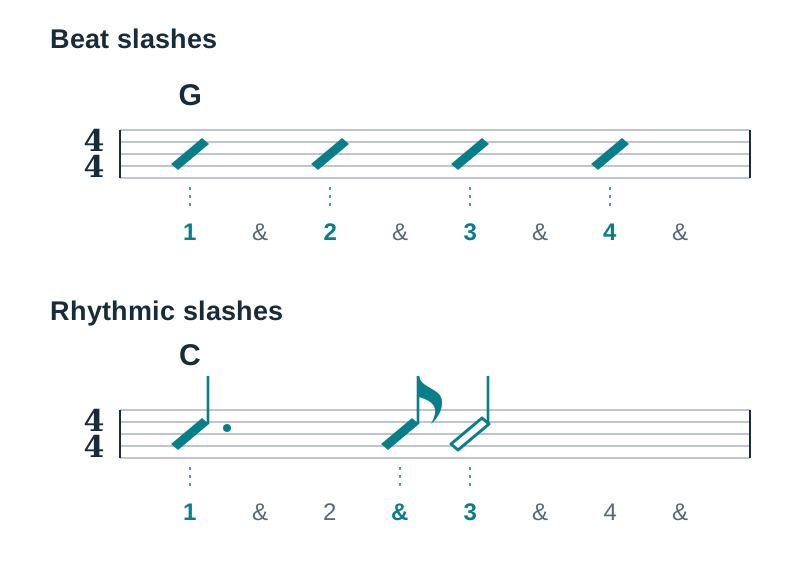
A plain slash without a stem represents one steady beat in the bar. For instance, four plain slashes in 4/4 indicate four crotchet downstrums. In contrast, rhythmic slashes feature stems, flags, beams, and dots that mandate exact rhythms, such as dotted-crotchet and quaver figures.
Chord Symbols and Unfamiliar Extensions
Chords appear directly above the stave or slash line. The course expects Higher Level students to read and write music in keys up to four sharps and four flats, and in 6/8 as well as 2/4, 3/4, and 4/4. Those are the keys and metres you should be completely fluent in before the practical, because they form the backbone of practical sight-reading.
If you meet a chord symbol with extensions you do not recognise, strip it back to the letter name and basic quality, and keep moving:
- Gsus4, Gadd9, or Gmaj7: play G major.
- Em7 or Em9: play E minor.
- Slash chords such as G/B or D/F#: play the chord named before the slash (G major, D major).
Never stop to work out a complex voicing. A clean, in-time triad protects your fluency; a late chord destroys it.
Ties, Pushes, and Rests
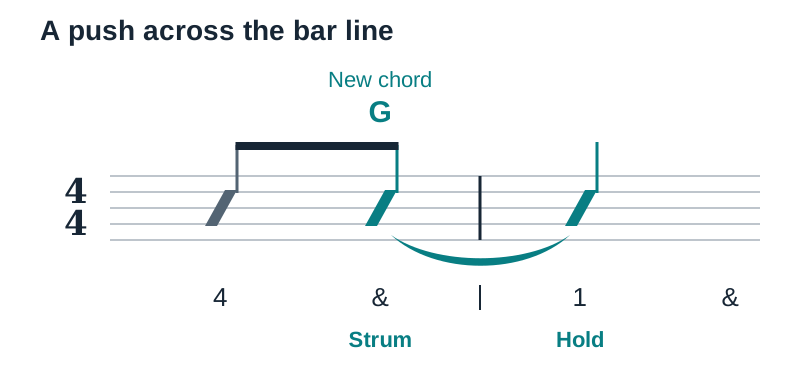
A curved tie connecting two slashes means the chord is held without a fresh strum. When a chord change falls on the final off-beat of a bar (the 'and' of beat 4 in 4/4) and ties across the bar line into beat 1, it creates an anticipatory push where the new chord sounds half a beat early.
Written rests require absolute silence. Do not let open strings ring through them. Execute fret-hand muting by relaxing your left-hand finger pressure while keeping contact with the strings, and reinforce it with palm muting by resting the heel of your strumming hand firmly across the bridge.
The Five-Step Preview Routine
Before you play, you will be given a brief look-over period. Use this time methodically without playing aloud. Drill this five-step checklist on every test you practise:
- Time signature and upbeat: check the metre and see if the piece starts with an anacrusis (an incomplete opening bar). If a 4/4 bar holds only one crotchet, that is beat 4; count '1, 2, 3' silently and strum on '4'.
- Key signature and tonic chord: look at the sharps or flats, then confirm the key by checking the first and last chords.
- Route through the chart: look for repeat signs (:||), first- and second-time brackets (play bracket 1 first time, skip to bracket 2 on repeat), or a D.C. al Fine.
- Hardest bar: locate the bar with the quickest chord change or most syncopated rhythm, and set your overall tempo to suit that bar.
- Ghost the awkward changes: silently place your fingers on the fretboard (ghost-fretting) to rehearse any awkward transitions or barre shapes.
Harmonic Families and Predictability
The syllabus states that patterns of predictability feature in the unprepared test pieces (and that at Ordinary Level the patterns are clearly recognisable). In practice, this means the music behaves logically: chords belong to standard diatonic families, phrases have regular lengths, and cadences fall where the ear expects them.
Identifying Major vs Relative Minor
A key signature always points to two possible keys: a major key and its relative minor (three semitones lower). Look at the first and last chords. If there is one sharp and the chart begins and ends on G, it is G major; if it begins and ends on Em, it is E minor. A second clue is chord V: in minor keys, chord V is almost always major (or a dominant seventh) because the 7th note of the harmonic minor scale is raised. In A minor, the note G is raised to G#, making chord V an E or E7 chord.
Common Chord Progressions
| Progression Type | Harmonic Formula | Example 1 (G Major / A Minor) | Example 2 (D Major / E Minor) |
|---|---|---|---|
| Folk / Pop Loop | I – V – vi – IV | G – D – Em – C | D – A – Bm – G |
| '50s Progression | I – vi – IV – V | G – Em – C – D (or D7) | D – Bm – G – A (or A7) |
| Jazz Turnaround | ii – V7 – I | Am – D7 – G | Em – A7 – D |
| Minor Cadence | i – iv – V7 – i | Am – Dm – E7 – Am | Em – Am – B7 – Em |
Cadences are the punctuation marks of the chart. Watch for an imperfect cadence ending on chord V halfway through, and a perfect cadence (V or V7 moving to I or i) at the final double bar line.
Strumming Mechanics and Metres
Showing musical and technical fluency requires your strumming hand to act as an uninterrupted pendulum, swinging constantly so that subdivisions remain even whether you strike the strings or pass over them.
Simple Metres (2/4, 3/4, 4/4)
Subdivide internally into quavers ('1-and-2-and-3-and-4-and'). Downstrokes cover the beats, while upstrokes catch the 'and'. In 3/4 time, there are three crotchet beats per bar. A standard rhythm-guitar approach is the waltz bass-strum-strum pattern: pick the lowest root note of the chord on beat 1, followed by full chord downstrums on beats 2 and 3.
Compound Duple Time (6/8)
In 6/8, feel two main dotted-crotchet beats per bar, each containing three quavers ('1-2-3, 4-5-6'). Across six even quavers, the safest default is straight alternate strokes: down-up-down, down-up-down, with a firm accent on quavers 1 and 4. (Down-down-up is an alternative folk pattern, but alternate strokes keep the pulse most reliable under exam conditions.)
Dynamics and Performance Practicalities
Make dynamic markings obvious: piano (p), mezzo-forte (mf), and forte (f) should sound distinct. For a crescendo, strum harder and dig slightly deeper into the strings bar by bar, but do not let your tempo speed up with the volume.
On the day of the practical, tune your guitar thoroughly before entering the exam room, carry a spare pick in your pocket, and bring a replacement set of strings. Practise tuning a string quickly so you remain calm if a peg slips.
Key terms
- Patterns of Predictability
- Appendix D states that patterns of predictability feature in the unprepared test pieces (and that at Ordinary Level they are clearly recognisable). In practice, this means the music behaves as your ear expects: the harmony stays in the key, phrases are regular, and cadences fall where you would predict them.
- Musical and Technical Fluency
- The syllabus requires all students to show appropriate musical and technical fluency in performing (criterion 2.1.2d). In practical terms, this means maintaining a steady tempo, an unbroken pulse, clean chord changes, and playing that sounds musical rather than mechanical.
- Rhythmic Slash Notation
- Notation where diagonal slashes carry stems, beams, dots, or rests to prescribe exact strumming rhythms alongside chord symbols.
- Anacrusis
- An upbeat or incomplete bar at the start of a piece; the final bar is shortened by the same duration to complete the metre.
- Push (Anticipation)
- A syncopated figure where a chord change is struck on an off-beat quaver and tied across the bar line, sounding half a beat early.
- Compound Duple Time
- A metre such as 6/8 featuring two dotted-crotchet main beats per bar, with each beat subdividing into three quavers.
- Perfect Cadence
- A musical full stop formed by chord V (or V7) resolving to chord I (or i), providing a sense of completion at phrase endings.
- Imperfect Cadence
- A musical half close ending on chord V, creating an open, unresolved sound that leaves the phrase asking for continuation.
- Fret-Hand Muting
- Releasing fretboard finger pressure while keeping fingers touching the strings to silence them cleanly on rests.
- Palm Muting
- Resting the heel of the strumming hand across the strings near the bridge saddles to deaden ringing tone or silence rests.
Check yourself
What does the syllabus state regarding the predictability of Higher Level sight-reading test pieces?
Patterns of predictability feature in the test pieces, meaning harmony and rhythm follow expected diatonic formulas and cadences rather than unexpected departures.
A 4/4 rhythm chart opens with an anacrusis containing a single crotchet chord. How do you count yourself in?
That single crotchet is beat 4 of an incomplete bar; count '1, 2, 3' silently in your chosen tempo and strum the chord on beat '4', with the first full bar starting on the next downbeat.
A chart shows a key signature of two flats (Bb and Eb) with opening and closing chords of Bb. Identify chords I, IV, and V.
The key is Bb major: chord I is Bb, chord IV is Eb, and chord V is F (or F7).
Why is chord V in A minor an E or E7 major chord rather than E minor?
Because the 7th note of the scale (G) is raised by a semitone to G# in the harmonic minor, forming a major third above the root E.
How do you execute an anticipatory 'push' tied across the bar line into beat 1 of the next bar?
Strum the new chord on the final off-beat ('and' of beat 4), let it ring across beat 1 without striking again, and keep the strumming arm swinging through the air in pendulum motion.
If you encounter an unfamiliar extension symbol such as Gadd9 or D/F# during the test, how should you play it?
Strip the chord back to its root letter and basic quality (play G major or D major) and maintain an unbroken rhythm.