
In the Leaving Certificate Music practical examination, every candidate must complete one individual unprepared test alongside their prepared performance. Performing is worth 25% of your total marks, or 50% if you choose the Performing Elective. Section 2.1.2(d) of the syllabus states that all students must show 'appropriate musical and technical fluency'. Choosing sight-reading means performing an unseen piece of music on your chosen instrument or voice with rhythmic continuity, accurate pitch, and clear expression. The test pieces are not written to trap you: Appendix D specifies that they feature patterns of predictability such as standard scales, arpeggios, and balanced phrases. Keeping the pulse moving through a slip serves your mark far better than stopping to put a note right.
On the Day: Structure and Options
When you enter the examination room, you present your prepared programme first. Under section 2.1.2, Higher Level candidates either perform three songs or pieces, or take the alternative route under 2.1.2(c) by presenting two Ordinary Level performing activities. Once your prepared music is complete, the visiting examiner administers your chosen unprepared test individually.
Every candidate chooses exactly one unprepared test:
- Sight-reading: you perform a short unseen piece from notation. This is the standard choice if your note-reading is secure.
- Aural memory: the examiner plays a short phrase on the piano, and you sing or play it back by ear. This suits traditional Irish musicians or ear players whose reading is less developed.
- Unprepared improvisation: you improvise on material presented on the day. Appendix D(e) restricts this option to the specific formats listed in Appendix A, Option 4 of the syllabus, so you cannot simply make up your own format.
Many candidates believe choosing the 'two Ordinary Level activities' route gives them an easier unprepared test. It does not. Appendix D(b) states that candidates presenting two Ordinary Level activities at Higher Level must still take the Higher Level sight-reading, aural memory, or improvisation test. Whichever performing route you select, the unprepared test is assessed at Higher Level standard.
Higher Level Standard and Working Limits
Appendix D does not set strict limits on keys, metres, or note values for the sight-reading test. It only promises that patterns of predictability will feature in the test pieces. The syllabus describes Ordinary and Higher Level differently here:
- At Ordinary Level, Appendix D(c) states the tests 'will consist of music composed with clearly recognisable patterns of predictability' — the whole piece is built from obvious, familiar shapes.
- At Higher Level, Appendix D(d) states that 'patterns of predictability will also feature in the test pieces.' Predictable shapes are still there to support you, but they are one feature among others. Expect a Higher Level piece to be longer, to move faster, and to contain occasional surprises.
A fair working guide for Higher Level sight-reading is the range of rudiments the syllabus sets out for composing in section 2.2.1:
- Major and minor keys up to four sharps and four flats.
- Simple time (2/4, 3/4, 4/4) and compound duple time (6/8).
- Note values from semibreve to quaver, including dotted minims, dotted crotchets, and their equivalent rests.
- Expressive directions: dynamics (pp, p, mp, mf, f, ff, crescendo, diminuendo), tempo markings (Adagio, Andante, Moderato, Allegretto, Allegro, rallentando, a tempo), and articulations (legato slur, staccato dot, accent, and pause/fermata).
Prepare within these bounds, but be ready for simple semiquaver movement or short syncopations.
Reading by Interval off the Stave
Fluent readers do not spell out letter names note by note. They decode the visual distance between notes and move their hands or voice by that interval. Learn these four basic shapes on the stave:
- Line to the very next space, or space to the very next line: a second (stepwise or conjunct movement).
- Line to the next line up, or space to the next space up: a third (a skip; this is the physical shape of a broken chord).
- Line to the next space but one: a fourth.
- Line to the line after next, or space to the space after next: a fifth.
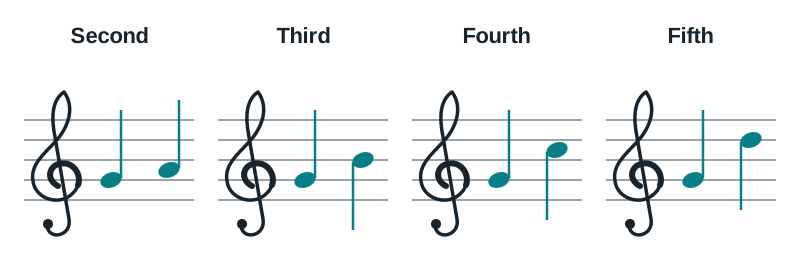
For example, if you see three notes climbing line-line-line on the treble stave (G on line 2, B on line 3, D on line 4), do not read 'G, then B, then D'. Read 'up a third, up a third'. You will recognise the G major triad instantly and your hand will adopt the shape naturally.
Patterns of Predictability and Cadences
The examiner is not trying to test you with strange, key-less music or awkward leaps. The test piece will sound like tonal music you already know, built on four predictable devices:
- Scalic movement: stepwise runs up or down a major or minor scale.
- Broken chords and arpeggio shapes: leaps that outline chord I (the tonic) or chord V (the dominant).
- A sequence: an idea that repeats immediately one step higher or lower. If bar 1 rises D–E–F#–D and bar 2 shows the identical rhythm on E–F#–G–E, read it as the same physical shape shifted up one step.
- Balanced phrasing and cadences: most test pieces are 4, 8, or 12 bars long. In an 8-bar melody, bar 4 often pauses on an imperfect cadence (ending on chord V, sounding like an open question), while bar 8 resolves to the tonic note with a perfect cadence (chord V to chord I, sounding finished). Anticipating this harmonic framework keeps you oriented.
Your Silent Preview Routine
You will be given a short time to examine the test piece before you perform it. Never jump straight in. Work through this five-step checklist in order:
- Clef and key signature: identify the key immediately. For sharp keys, the last sharp is the leading note / raised seventh, one semitone below the major tonic (for example, with F#, C#, and G#, the last sharp is G#, giving A major). For flat keys, the second-last flat names the major tonic (for example, with Bb, Eb, and Ab, the key is Eb major; remember that one flat alone is F major). Scan the final note and check for raised-seventh accidentals to see if the piece is in the relative minor.
- Metre, anacrusis, and rests: check the time signature. Look out for an anacrusis (an upbeat). If the test is in 3/4 and the first bar has only a single crotchet, that note is beat 3, not beat 1. A rest is a measured silence: count it with the same pulse as a note.
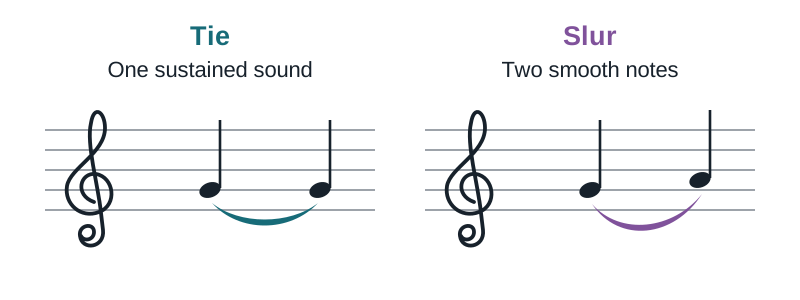
- Accidentals and ties: spot any chromatic alterations. Remember the barline rule: an accidental lasts for the rest of that bar, but the key signature returns once a new bar begins. Distinguish a tie (holding the same pitch across the beat or barline) from a slur (smooth phrasing over different notes).
- The hardest bar: scan the excerpt for the most complex rhythm or widest interval leap. The tempo you choose for the very first bar must be the tempo at which you can cleanly execute that hardest bar.
- Expression: check the tempo word and starting dynamic so your performance sounds musical from note one.
Instruments Reading Two Staves, Bass Clef, and Voice
Sight-reading applies across all instruments and voice, with specific techniques for each medium:
Two Staves (Piano, Organ, Harp)
Scan the bass stave first during your preview. In most test pieces, the left hand is simpler than the right, playing held chord roots or broken-chord outlines. Once you know what the left hand is doing, half the reading load is gone. Check whether the hands move in similar rhythm or whether one sustains while the other moves. Set your hand positions before you begin, and keep your eyes on the sheet rather than looking down at your hands.
Bass Clef Readers (Cello, Bassoon, Trombone, Tuba, Bass)
Fix two reference landmarks on the stave: the bottom line G and the fourth line F (the line framed by the two clef dots). Read all other notes by interval from those two points.
Transposing Instruments (Clarinet, Trumpet, Saxophone, French Horn)
Your test piece is written in your normal transposed reading pitch. Read it as written without altering pitches.
Vocal Candidates
Singers are normally given the key chord and the starting note at the keyboard before singing, but practise establishing the tonic pitch in your head so you are confident either way. Hum the tonic triad softly using solfa (do–mi–sol) or numbers (1–3–5). Most leaps in vocal sight-reading target the tonic or dominant triads. You may sing on solfa syllables, numbers, or a neutral vowel such as lah.
Daily Practice Habit
Sight-reading improves through habit, not theory. Read one short, unseen piece every day at roughly two grades below your current performing standard. Set a metronome slowly, count one full bar in silently, play to the end without stopping once, and do not repeat the piece.
Key terms
- sight-reading
- Performing an unfamiliar piece of written music on first sight without prior rehearsal, demonstrating accuracy, continuity, and expression.
- patterns of predictability
- The syllabus principle where test pieces are built from familiar tonal devices such as scales, arpeggios, sequences, and standard cadence formulas.
- musical and technical fluency
- The requirement in syllabus section 2.1.2(d) to deliver a continuous, steady performance with stable pulse and controlled tone, avoiding stops and restarts.
- compound duple time
- A metre with two main dotted-crotchet beats per bar, each dividing naturally into three quavers, written with the time signature 6/8.
- anacrusis
- An upbeat or incomplete opening bar whose missing beats are accounted for in the final bar of the piece.
- sequence
- The immediate repetition of a melodic motif or phrase at a higher or lower pitch in the same voice or instrument.
- arpeggio
- A broken chord where the individual notes of the harmony are played consecutively rather than simultaneously.
- conjunct
- Melodic movement that proceeds by step (intervals of a second) along the scale, as opposed to disjunct movement which proceeds by leap.
- disjunct
- Melodic movement that proceeds by leap (intervals of a third or larger) rather than by step.
- imperfect cadence
- A chord progression that ends on chord V, creating an unfinished, question-like pause in the middle of a musical phrase.
- perfect cadence
- A chord progression moving from chord V to chord I, creating a complete, finished sense of closure at the end of a phrase or piece.
- tonic
- The first degree of a scale and the home keynote of a piece, providing the harmonic centre of rest and resolution.
- dominant
- The fifth degree of a scale and the harmony built upon it (chord V), which drives the musical tension toward the tonic.
- leading note / raised seventh
- The seventh degree of a scale, placed a semitone below the tonic. In minor keys, it requires a temporary accidental to create harmonic closure.
- tie
- A curved line joining two notes of identical pitch, combining their rhythmic lengths into a single continuous sound.
- slur
- A curved line over two or more different pitches indicating they should be performed smoothly (legato) in one breath, bow, or phrase.
- staccato
- An articulation dot placed above or below a note head instructing the performer to play the note short, detached, and light.
- solfa
- A system of vocal pitch syllables (do, re, mi, fa, sol, la, ti) used to identify and pitch scale degrees relative to the tonic.
Check yourself
Which two things does Appendix D of the syllabus explicitly specify about sight-reading tests?
All tests are conducted individually, and test pieces feature patterns of predictability.
If a Higher Level candidate presents two Ordinary Level performing activities under 2.1.2(c), what standard of unprepared test do they take?
They must take the Higher Level sight-reading, aural memory, or improvisation test, as mandated by Appendix D(b).
What is the difference between how patterns of predictability are described at Ordinary Level versus Higher Level in Appendix D?
At Ordinary Level, tests consist entirely of clearly recognisable predictable patterns; at Higher Level, patterns of predictability feature in the test pieces alongside less predictable movement.
A test in 4/4 begins with a single quaver in the first bar. Which beat is that note, and how do you count yourself in?
It is an anacrusis on the second half of beat 4. Count one full bar silently ('1, 2, 3, 4-and') and begin playing on the 'and'.
Why is it inaccurate to describe the three quavers within a single beat of 6/8 time as a triplet?
In compound time, the dotted-crotchet beat divides into three quavers naturally; a triplet is an irregular group of three notes squeezed into the time of two.
A melody has a key signature of three sharps and concludes on A with no accidentals. What key is it in, and what would indicate the relative minor instead?
It is in A major. If it were in F# minor, it would conclude on F# and feature E# accidentals as the raised seventh leading note.
When sight-reading from the stave, what interval is formed between a line and the line directly above it?
An interval of a third (a skip).