
In the Leaving Certificate Music practical examination, every Higher Level candidate presents three songs or pieces and one unprepared test. You choose your unprepared test in advance from three options: a sight reading test, an aural memory test, or an unprepared improvisation. If you choose improvisation, the examiner gives you an unseen stimulus—such as a melodic phrase, a rhythmic cell, a chord progression, or an expressive mood—and a short preparation window to study it. The syllabus requires you to perform an individual response showing appropriate musical and technical fluency. While the syllabus does not enforce a rigid bar count, building a structured 16-bar response across four balanced phrases is the most reliable strategy to demonstrate active musical development, steady pulse, and a convincing conclusion.
Unprepared Test Options and Exam Requirements
Every Leaving Certificate candidate completes one unprepared test during the practical examination, which takes place in the spring before the written and aural papers in June. This test forms part of your core performing activity (worth 25% of your total marks). If you take the Higher Level performing elective, performing expands to 50% of your total marks.
Choosing Your Unprepared Test
Before the exam, you choose one of three test pathways based on your musical strengths:
- Sight reading suits confident readers who can interpret pitch, rhythm, and dynamics accurately at first glance.
- Aural memory suits musicians with quick melodic or rhythmic recall who find playing by ear more natural than reading notation.
- Unprepared improvisation suits performers who enjoy creating spontaneous music within a style, such as traditional Irish music, jazz, rock, pop, or keyboard harmony.
What the Syllabus Requires
- Programme numbers: At Higher Level you present three songs or pieces and one unprepared test.
- The two-activity alternative: Instead of three pieces on one instrument, you may present two Ordinary Level performing activities (such as solo singing and group flute). However, if you choose this route, you are still assessed on the Higher Level unprepared test. The lower-level standard applies only to the prepared items.
- Individual delivery: Appendix D of the syllabus specifies that all unprepared tests are conducted individually with the examiner, even if your prepared programme consists entirely of group performing or ensemble conducting.
- Predictability: Appendix D specifies that the test material will contain clearly recognisable patterns of predictability, so the prompt will be something you can follow rather than deliberately obscure material.
- The official assessment standard: The syllabus requires all performing to display appropriate musical and technical fluency. Technical fluency means a reliable pulse, clean tone, secure intonation, and no stopping. Musical fluency means expressive phrasing, dynamic contour, and a deliberate structural ending.
What Works in the Room
- Choose a comfortable tempo that allows you to execute subdivisions cleanly without stumbling.
- Keep the underlying pulse internal rather than relying on audible counting, foot-tapping, or spoken rhythm syllables, which can obscure your phrasing.
- If you play an unintended note, keep the tempo moving and incorporate it into the melodic line. An unbroken performance with a minor slip scores considerably higher than a disjointed attempt that stops and restarts.
The Five Headings: Appendix A vs Appendix D
A common point of confusion among candidates is the difference between prepared improvisation and the unprepared improvisation test. Appendix A and Appendix D define two distinct examination components.
Under Appendix A (Option 4), improvisation can be chosen as your prepared performing option. For this option, Higher Level students must demonstrate competence under three of the five syllabus headings:
- Melodic improvisation
- Rhythmic improvisation
- Harmonic improvisation
- Free improvisation to a given mood, visual or text stimulus
- Any combination of the above
For the unprepared test under Appendix D, you choose one of these headings in advance. You are examined on that single heading using unfamiliar material handed to you by the examiner.
Four-Phrase Architecture: Structuring Your Improvisation
Making up music on the spot easily falls apart under exam nerves without an architectural framework. Structuring your improvisation into four balanced four-bar phrases (16 bars in total) gives your response a clear beginning, middle, and end.
Phrase 1 (Bars 1–4): Statement and Antecedent
State the given stimulus clearly in bars 1–2 so the examiner recognises the motif. In bars 3–4, extend or answer it, ending on an open resting point such as scale degree 2 or 5. This forms an antecedent phrase, creating an imperfect cadence feel that leaves the musical question hanging.
Phrase 2 (Bars 5–8): Variation and Consequent
Restate the opening motif using subtle variation, such as rhythmic modification or melodic decoration. Bring this phrase to a more stable resting pitch (such as scale degree 3 or 1). This acts as a consequent phrase, balancing the opening question with a temporary answer.
Phrase 3 (Bars 9–12): Contrast and Climax
Move away from the opening shape to generate musical interest. You can shift into a higher register, introduce syncopation, or apply a sequence. Place your melodic or dynamic climax around bar 11, then guide the phrase toward dominant harmony in bar 12 to prepare the return home.
Phrase 4 (Bars 13–16): Recapitulation and Cadence
Bring back the recognizable contour or rhythm of your initial motif in bars 13–14. In bars 15–16, guide the line into a decisive final cadence, landing firmly on the tonic (scale degree 1) on the downbeat of bar 16.
If you choose a free improvisation to a mood, maintain this same four-part trajectory (statement, development, climax, and close). In non-metrical or atmospheric playing, the phrases may have flexible lengths, and your ending may be a fade, a final sustained gesture, or a sudden cut-off. What matters is that the close sounds entirely deliberate.
Techniques for Motif Development
Examiners listen for active thematic development. Avoid repeating the prompt unchanged, and do not abandon it after two bars to play an unrelated pre-memorised tune. Treat the given material as your starting motif and transform it using four dependable techniques:
Melodic Sequence
Repeat a motif immediately at a higher or lower pitch level while keeping its rhythmic profile intact. For example, in C major, taking the motif C4–E4–G4–G4 and restating it one step higher as D4–F4–A4–A4 creates an ascending sequence that builds momentum.
Diminution and Augmentation
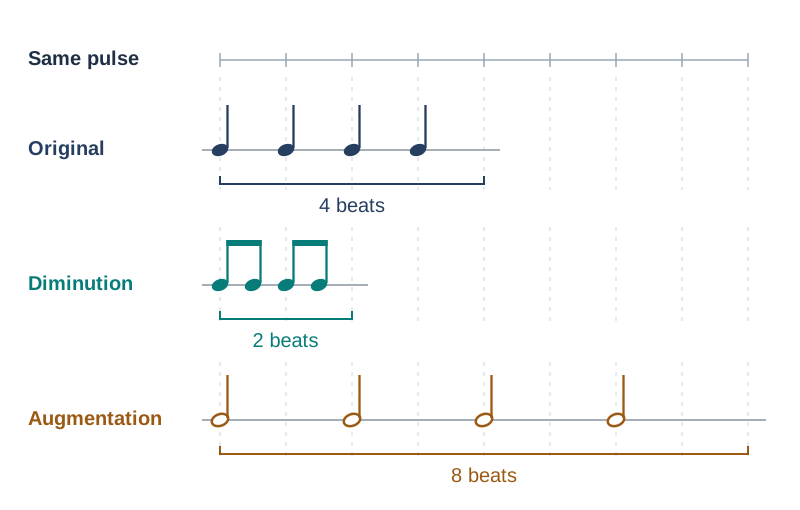
- Diminution halves the note durations of the motif. A four-beat motif of crotchets becomes a two-beat pattern of quavers, driving energy into a phrase.
- Augmentation doubles the note durations. Turning crotchets into minims broadens the line, which is useful when preparing a climactic moment.
Inversion of Direction
Invert the melodic contour of the motif. If the stimulus steps up a second and leaps up a third, answer it by stepping down a second and leaping down a third. This preserves the interval logic while providing directional contrast.
Call and Response
Treat the opening two bars as an open question and answer them with a complementary two-bar phrase. Keep the rhythmic framework similar but steer the pitches down toward a resolving step.
Harmonic, Traditional, and Mood Pathways
Cadences and Harmonic Improvisation
If you present harmonic improvisation over a chord progression, target chord tones on strong beats (beats 1 and 3 in 4/4 time). In major keys, build your lines primarily around chords I, ii, IV, V, and vi; in minor keys, use chords i, iv, V, and VI, incorporating first inversions (Ib, IVb, Vb) or V7 if comfortable.
Use melodic target notes to imply standard cadences at phrase ends:
- Perfect cadence (V–I): The full stop. End your final phrase by targeting the leading note (scale degree 7) or supertonic (scale degree 2) over chord V, resolving to the tonic (scale degree 1) over chord I.
- Imperfect cadence (I–V, ii–V, or IV–V): The comma. End your first phrase on scale degree 2 or 5 to leave the music open.
- Plagal cadence (IV–I): A gentler close, moving from scale degree 4 or 6 down to the tonic note.
- Interrupted cadence (V–vi): A surprise move from the dominant chord to chord vi, ideal for extending phrase 3.
Traditional Irish Music Ornamentation
If you improvise by varying a tune in a traditional idiom, syllabus section 2.1.2(f) requires proficiency in appropriate ornamentation at Higher Level. You should integrate named ornaments naturally into your variations:
- Cut: A rapid grace note struck above the melody note.
- Tap (strike): A quick grace note articulated from below.
- Roll: A composite ornament (main note, cut, main note, tap) executed cleanly across a beat (long roll) or within a shorter value (short roll).
- Cran: A piping and flute ornament used on low notes, built using successive cuts from above.
- Triplet: Three notes played in the time of two (or one beat) to introduce rhythmic drive.
- Slide and vibrato: Expressive pitch bends and subtle finger vibrato, particularly suited to slow airs.
- Melodic variation: Altering the notes of a repeated phrase by substituting intervals or octave leaps.
Free Improvisation: Elements Checklist
When improvising to a mood prompt (such as cheerful, hopeful, or chaotic), establish the character immediately by planning an elements checklist:
- Mode: Major for bright, joyful, or triumphant moods; minor or modal for dark, introspective, or sorrowful prompts.
- Tempo and metre: Lilting compound time (6/8) or brisk simple time (2/4, 4/4) versus slow, unmeasured, or rubato pacing.
- Dynamics: Setting an initial level and planning a distinct crescendo toward your climax.
- Articulation: Crisp staccato for energetic moods versus smooth legato slurs for reflective moods.
- Register and contour: Wide, ascending leaps for optimism versus descending steps or narrow chromaticism for tension.
Using Your Preparation Time
You are given a short period of silent study before you perform. While you should confirm current administrative timings with your teacher, train yourself to run through four practical planning stages:
Stage 1: Frame and Tonality
Identify the clef, key signature, and time signature. Internally hear the tonic triad and the opening interval of the prompt. Establish your home key firmly.
Stage 2: Tempo and the Opening Motif
Set a stable, manageable tempo in your head. Mentally rehearse the first two bars. Choose a pace that leaves you comfortable headroom to play faster note values later without stumbling.
Stage 3: Climax and Technique
Decide which developmental tool you will deploy in phrase 2 (such as an ascending sequence). Pick the pitch and register for your climax note in phrase 3 (often scale degree 5 or high tonic in bar 11).
Stage 4: Pre-Plan the Cadence
Decide on your exact closing notes in bars 15–16 before you play a single sound. Locking whether you will step down (3–2–1) or rise through the leading note (7–1) ensures you arrive at a convincing, definitive finish.
Key terms
- Unprepared Test
- A mandatory practical exam component where the candidate performs unseen material (sight reading, aural memory, or improvisation) following a brief preparation period.
- Prepared Improvisation
- The prepared performing option under Appendix A, Option 4 (presented as part of singing or playing individually), where Higher Level candidates must show ability under three of the five improvisation headings.
- Patterns of Predictability
- The syllabus standard ensuring test prompts feature clearly recognisable patterns of predictability that candidates can follow, rather than deliberately obscure material.
- Motif
- A short, distinct musical idea (melodic, rhythmic, or harmonic) that serves as the thematic seed for development throughout an improvisation.
- Antecedent and Consequent
- A balanced pair of musical phrases where the first (antecedent) ends on an open imperfect cadence, and the second (consequent) provides a resolving musical answer.
- Sequence
- The immediate repetition of an established melodic or rhythmic idea at a higher or lower pitch level within the key.
- Diminution
- A developmental device where the note values of a motif are halved, creating faster motion while retaining the original contour.
- Augmentation
- A developmental device where note values are lengthened (typically doubled), broadening the phrase and slowing its momentum.
- Perfect Cadence
- A harmonic progression moving from chord V to chord I, creating a complete and conclusive full-stop ending.
- Imperfect Cadence
- A harmonic punctuation point ending on chord V (such as I–V or ii–V), producing an open, comma-like pause.
- Leading Note
- Scale degree 7, situated a semitone below the tonic in a major key, which pulls upward strongly to resolve on the home tonic.
- Ornamentation
- Decorative embellishments essential to traditional Irish music performance, including cuts, taps, rolls, crans, and triplets.
Check yourself
What core performance standard does the syllabus require for the unprepared test?
Appropriate musical and technical fluency.
If you present two Ordinary Level performing activities at Higher Level, which unprepared test standard do you receive?
You must take the Higher Level unprepared test. The lower-level accommodation applies only to the prepared items.
How many improvisation headings do you choose for the unprepared test under Appendix D?
Exactly one heading, chosen in advance.
Why should you avoid audible beat counting or loud foot-tapping during the exam?
The examiner evaluates musical and technical fluency; audible counting or heavy tapping distracts from the musical performance and suggests the pulse is not yet internalised.
Given the motif C4–E4–G4–G4 in C major, write an ascending sequence one step higher, and write the same motif in diminution.
Ascending sequence: D4–F4–A4–A4. Diminution: C4–E4–G4–G4 played as quavers instead of crotchets, filling two beats instead of four.
Name three traditional Irish ornaments required to show proficiency at Higher Level.
Any three from: cuts, taps (strikes), rolls (long or short), crans, triplets, or slides.
How do you imply a perfect cadence at the end of a single-line melody?
Target the dominant harmony (such as scale degree 2 or the leading note, scale degree 7) in the penultimate bar, resolving by step onto the tonic note (scale degree 1) on the final downbeat.