
In the Leaving Certificate Music practical examination, the unprepared aural memory test is an option within the performing component (Syllabus Section 2.1 and Appendix D). Performing carries a 25% weighting for all candidates, rising to 50% if you take the performing elective. Alongside your prepared songs or pieces, you must present one unprepared test chosen from sight reading, an aural memory test, or an unprepared improvisation. In the aural memory test, you are examined individually. The examiner plays a short, unnotated musical phrase, and you must sing or play it back accurately at the same tempo on your instrument or voice. Appendix D notes that patterns of predictability feature in the test pieces at Higher level as well as at Ordinary level. This means the test phrases are musically logical, built from balanced bars and recognisable motifs rather than random notes, so success depends on steady pulse, disciplined subdivision, mental chunking, and immediate pitch recall.
How the Aural Memory Test Works
Your teacher will confirm the exact examination arrangements in your school, including how many hearings the visiting examiner gives and whether the phrase is sounded on piano or another instrument. All unprepared tests are carried out individually, even if you performed your prepared pieces in a music group.
The syllabus is explicit about your response mode: you must sing or play the phrase back. Nowhere does the syllabus permit clapping or tapping as the final exam answer. Clapping or silent tapping is strictly a practice and rehearsal tool to help you secure durations before you make a sound. When answering the examiner, you must reproduce the phrase using your voice or the instrument you presented for your practical.
This requires two practical decisions before the exam:
- Choose your medium: If your pitch memory and vocal confidence are secure, singing the phrase back on a neutral syllable such as 'la' or 'ta' is immediate and requires no instrumental resetting. If you are an instrumentalist who thinks through finger patterns, playing the phrase back lets you use your tactile muscle memory.
- Rehearse in three stages: First, silently tap the beat while subdividing. Second, speak the rhythm on a syllable to lock in note lengths. Third, sing or play the phrase in tempo, with correct pitches, in a single fluid take.
Pulse, Metre, and Compound Time
To decode an unnotated phrase quickly, you must distinguish between pulse, tempo, and metre:
- Pulse: The continuous, steady heartbeat underlying the music.
- Tempo: The speed of that pulse. You must sing or play back the test at the examiner's exact speed without rushing or dragging.
- Metre: The recurring pattern of strong and weak beats, defined by the time signature.
These are the metres you are most likely to meet. Learn to feel each one from the inside:
- Simple Duple (2/4): Two crotchet beats per bar. Each beat divides in two (
1 & 2 &). - Simple Triple (3/4): Three crotchet beats per bar (
1 & 2 & 3 &). The primary accent falls on beat 1. - Simple Quadruple (4/4): Four crotchet beats per bar (
1 & 2 & 3 & 4 &), with a strong accent on beat 1 and a secondary accent on beat 3. - Compound Duple (6/8): Two dotted-crotchet beats per bar. Each beat divides naturally into three quavers:
1 & a, 2 & a(or1 la li, 2 la li). It has a lilting, two-pulse swing.
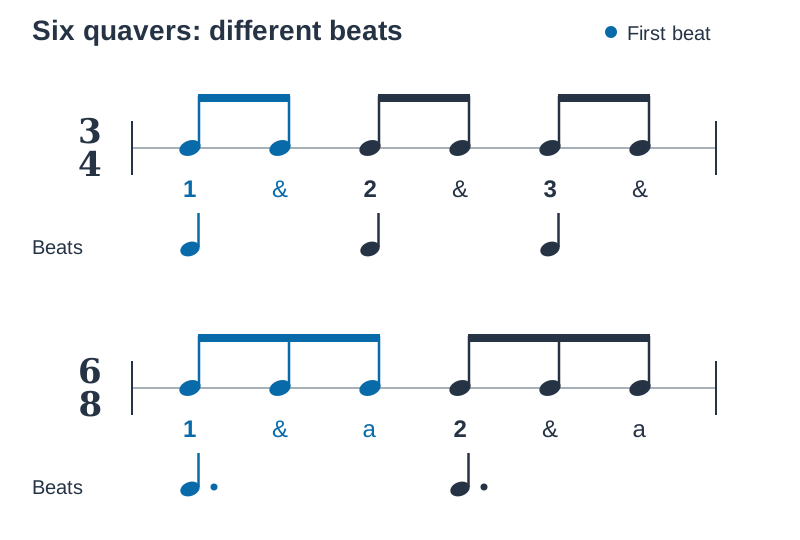
Candidates frequently confuse 3/4 and 6/8 because both contain six quavers in a bar. Their metric accents are completely different. 3/4 divides into three equal beats of two quavers each (). 6/8 divides into two main beats of three quavers each (). In compound time, three quavers make up the normal division of the beat. They are not triplets.
Subdivision and Higher Level Rhythmic Vocabulary
Never try to memorise note lengths by guesswork. Instead, keep an active mental counting grid running throughout the phrase. Higher level extracts test precise subdivisions, syncopations, and smaller note values:
| Pattern | Length in Simple Time | Internal Count Grid |
|---|---|---|
| Minim | 2 crotchet beats | 1 (2) |
| Dotted crotchet + quaver | beats | 1 (2) & |
| Two quavers | beat | 1 & |
| Four semiquavers | 1 crotchet beat | 1 e & a |
| Quaver + two semiquavers | 1 crotchet beat | 1 · & a |
| Dotted quaver + semiquaver | beat | 1 ( e & ) a |
| Syncopated group (quaver, crotchet, quaver) | beats | 1 & (2) & |
| Triplet quavers | 3 notes in the time of 2 | 1 la li |
A triplet is a borrowed division where three notes are squeezed into the time of two notes of the same value. Triplets belong strictly to simple time, where the beat normally divides into two.
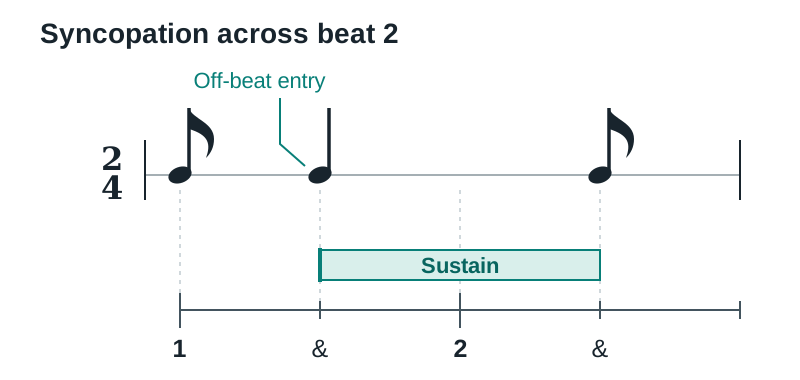
In dotted figures such as a dotted crotchet followed by a quaver, the dotted note takes three of the four quaver pulses across the two beats, while the quaver takes the fourth. In syncopation, the accent shifts away from the strong pulse: a crotchet placed between two quavers enters on an off-beat and sustains across the downbeat.
Connecting Rhythm to Pitch and Phrase Architecture
Because you must sing or play your answer, every rhythmic duration carries a pitch. Never listen to rhythm in isolation. Treat the rhythm as a structural frame and hang the melodic pitches onto it:
- Lock onto the opening note. Identify whether the phrase starts on the tonic (do), the mediant (mi), or the dominant (so).
- Hear the overall contour. Ask whether the melody moves by step (scale passages), by leap, or around an arpeggio (broken chord).
- Attach the melodic shape to your rhythmic chunks. For instance: 'Bar 1 is four crotchets stepping upward; bar 2 is a dotted crotchet and quaver leaping to the top note, resolving to a minim.'
- Check the cadence. Phrases with patterns of predictability usually finish on a sustained tonic or dominant note.
Grouping notes into chunks prevents memory overload. Use shorthand structural labels in your head: an A B A C structure repeats the opening bar in bar 3 before finishing with an altered cadential ending in bar 4. Note that these letter labels are simply personal memory shorthand for the test and should not be confused with formal structural analysis labels used in written listening questions.
Irish Dance Rhythms in Aural Examination
Aural rhythm skills are tested across both the practical test and the written listening paper. In Irish music questions, identifying dance types, time signatures, and representative rhythm bars is a standard exam task. Learn these five core dances as complete factual units:
- Reel: 4/4 time (2/4 or C also accepted). Typical bar: eight continuous quavers, or four crotchets.
- Double jig: 6/8 time. Typical bar: two groups of three quavers ().
- Slip jig: 9/8 time. Typical bar: three groups of three quavers ().
- Hornpipe: 4/4 time, played at a slower tempo with a distinctive dotted lilt. Typical bar: dotted quaver and semiquaver pairs, often ending with three crotchets or a triplet.
- Polka: 2/4 time. Typical bar: two crotchets, or a crotchet followed by two quavers.
Whenever an exam question asks for a bar of rhythm, write the notes clearly on a stave or rhythm line, complete with bar lines, and check that your note durations sum exactly to the time signature.
Syllabus Pathways and Assessment Rules
Under Syllabus Section 2.1, Higher level candidates complete performing via one of two routes:
- Route 1: Three prepared songs or pieces, plus one unprepared test.
- Route 2 (Section 2.1.2(c)): Two Ordinary level performing activities, plus the appropriate Higher level unprepared test.
'Two Ordinary level performing activities' does not mean performing two pieces. The activities are the three distinct modes set out in Section 2.1.1(a): singing or playing individually, performing as part of a group, and rehearsing or conducting a musical group. A candidate presenting individual playing and group singing takes both at Ordinary level standard, but Appendix D(b) strictly requires them to take the Higher level sight reading, aural memory, or improvisation test.
If you take performing as your Higher level elective (Section 2.1.3), you present an expanded programme of approximately 12 minutes to achieve a 50% weighting. The elective requires extra repertoire, not an extra unprepared test. You take only one unprepared test regardless of your chosen pathway.
Key terms
- Aural Memory Test
- An unprepared performing option where a student listens to an unnotated musical phrase and reproduces it accurately by singing or playing.
- Patterns of Predictability
- A syllabus specification (Appendix D) indicating that test extracts follow coherent musical logic, balanced phrasing, and motif repetition.
- Pulse
- The steady, regular underlying beat against which musical notes and rests are measured.
- Metre
- The recurring grouping of beats into regular bars, shown by the time signature.
- Subdivision
- The mental splitting of beats into equal fractions, such as quavers or semiquavers, to measure time values precisely.
- Compound Duple (6/8)
- A metre of two dotted-crotchet beats per bar, with each main beat dividing naturally into three quavers.
- Triplet
- A borrowed rhythmic division where three notes are performed in the time of two notes of the same value in simple time.
- Syncopation
- The deliberate shifting of musical accent from a strong beat to a weak beat or off-beat.
- Anacrusis
- One or more notes appearing before the first complete bar of a phrase; also called an upbeat or pick-up.
- Chunking
- A memorisation technique of grouping individual note values into recognisable motifs or bar-length units.
Check yourself
A 4/4 bar contains a dotted quaver, semiquaver, crotchet, and minim. Count it out and determine whether the bar is mathematically complete.
Counted as
1 ( e & ) a · 2 · 3 (4). Values: 0.75 + 0.25 + 1 + 2 = 4 crotchet beats. Yes, the bar is complete.If a Higher level student presents two Ordinary level performing activities for their pieces, which level of unprepared test must they take?
They must take the Higher level unprepared test (Appendix D(b)).
How should a candidate deliver their response in the aural memory test?
By singing or playing the phrase back accurately; clapping and tapping are not permitted exam response modes.
What is the time signature and typical one-bar rhythm of an Irish reel?
Time signature: 4/4 (or 2/4). Typical rhythm: eight continuous quavers (or four crotchets).
What is the rhythmic difference between 3/4 and 6/8 metre?
3/4 has three crotchet beats per bar divided into three pairs of quavers (2 + 2 + 2), while 6/8 has two dotted-crotchet beats divided into two groups of three quavers (3 + 3).