
In the Leaving Certificate Music practical examination, every candidate must complete one individual unprepared test alongside their prepared repertoire. You can choose between sight reading, an aural memory test, or an unprepared improvisation. If you choose the aural memory test, the examiner plays a short, previously unheard melody on the piano, and you reproduce it by singing or playing it back on your instrument. Appendix D of the syllabus sets a different expectation at each level: at Ordinary level, the test pieces are composed with clearly recognisable patterns of predictability, while at Higher level, patterns of predictability will also feature in the test pieces. The Higher level test is deliberately more demanding, featuring wider melodic intervals, minor keys, and compound metres. Success depends on active audiation, steady rhythmic discipline, and breaking the phrase down into recognisable structural patterns.
What the Examiner Is Judging
The unprepared test is a discrete, compulsory element of your practical examination. A strong set of prepared pieces cannot compensate for a weak unprepared test, and a brilliant unprepared response will not rescue an under-rehearsed recital. Under syllabus rule 2.1.2(d), all candidates must show appropriate musical and technical fluency. In the exam room, the examiner evaluates four qualities at once:
- Pitch accuracy: singing or playing the correct notes in the key the examiner established.
- Rhythmic accuracy: preserving the correct note lengths and beat divisions, rather than flattening the phrase into equal crotchets.
- Fluency: delivering the phrase in one continuous, steady attempt without hesitations or false starts.
- Tonal security: maintaining the home key throughout, without drifting sharp or flat or finishing on the wrong resting note.
If you make an error under pressure, keep your priorities clear: preserve the tempo and key first, then recover the pitches. A performance that maintains a steady pulse and finishes decisively on the tonic, even with an accidental slip along the way, demonstrates musicianship. A performance that stops dead, restarts, or wanders out of key does not.
Choosing Your Unprepared Test Option
Under syllabus rules 2.1.1(b) and 2.1.2(b)(ii), you must present exactly one unprepared option, performed individually (Appendix D(a)). Even if your prepared pieces are presented with a choir, orchestra, or traditional group, you complete this test on your own.
| Option | Best suited to | Main risk to consider |
|---|---|---|
| Sight reading | Candidates who read staff notation fluently and have secure instrumental fingering | Misreading an accidental or rhythm is immediately obvious on the page and to the ear. |
| Aural memory | Candidates with a trained musical ear, singers, and traditional musicians who learn by ear | You must retain the melody purely in your head with no visual notation to guide you. |
| Unprepared improvisation | Fluent players comfortable creating motifs within a set style | Appendix D(e) requires you to choose strictly from the improvisation list in Appendix A, Option 4; free improvisation is not permitted. |
Make your choice with your teacher early in Senior Cycle and practise that specific test weekly. Changing your option late in sixth year is one of the most common ways candidates lose marks.
Patterns of Predictability: The Shape of a Phrase
Most short exam melodies follow a balanced question-and-answer structure. The question phrase (usually bars 1–2) often rises and pauses on an unresolved scale degree such as 2 or 5, creating an imperfect cadence. The answer phrase (bars 3–4) resolves this tension by moving downward to settle decisively on the tonic keynote, creating a perfect cadence. Understanding this framework lets you anticipate where the tune is headed before it finishes.
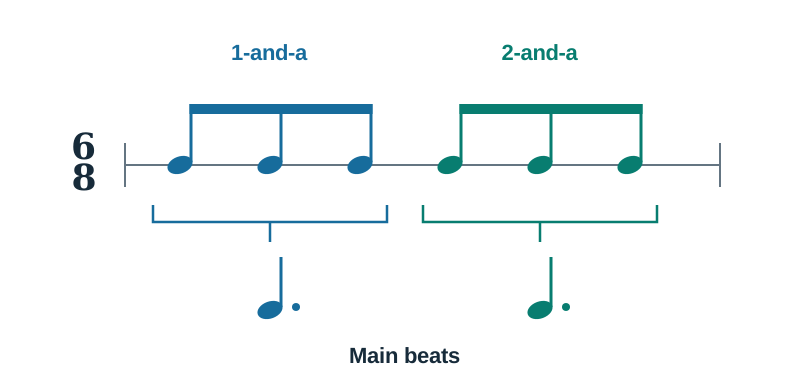
Appendix D does not set rigid limits on length or key signatures for this test. In practice, the melodies are short—typically four bars—and set in standard simple or compound metres. Because Higher level composing requires fluency up to four sharps and four flats, as well as compound duple time (6/8), you should be fully prepared for minor keys and lilting metres.
Recognising common melodic devices reduces the memory load from eight or twelve separate notes to two or three musical shapes:
| Pattern | What you hear | Why it helps your memory |
|---|---|---|
| Stepwise (scalic) motion | Notes moving to immediate neighbours along the scale | Easy to sing using tonic sol-fa or scale degrees (1–2–3). |
| Triadic (arpeggiated) motion | Skips outlining chords I, IV, or V | Leaps are rarely random; they trace primary chords (such as 1–3–5). |
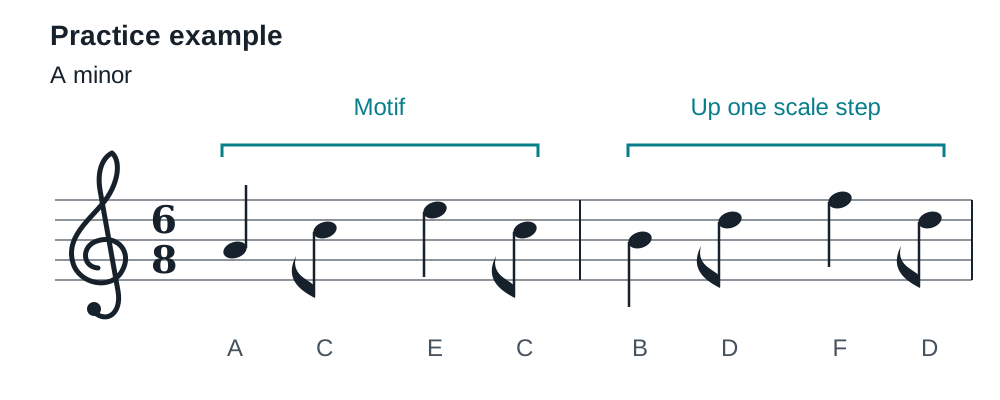
| Sequence | A short motif repeated immediately at a higher or lower pitch | You only memorise the initial shape plus the direction of the step. |
| Exact repetition | A bar or two-bar idea that returns identically | Cuts the memorisation load in half. |
| Balanced phrasing | A two-bar question answered by a two-bar resolution | Lets you anticipate where the midpoint breath and final rest will fall. |
| Cadence points | Pausing on scale degrees 2 or 5, or resolving to 1 | Gives you a tonal anchor at the end of each sub-phrase. |
What Happens in the Exam and the Listening Plan
Appendix D establishes that the test is individual and contains predictable patterns. The exact procedural details—such as the number of hearings and pauses—are governed by the practical examination instructions issued for your exam year, so confirm them with your teacher. Typically, the examiner announces the key and metre, plays the tonic chord and starting note on the piano, provides a count-in, and plays the melody with pauses between hearings.
Trying to hold every note in your head on the first hearing leads to panic. Divide your attention across the playings:
Hearing 1: Metre, Melodic Contour, and Cadence
Focus on the broad architecture. Count the metre (such as 3/4, 4/4, or compound 6/8) and follow the melodic contour: does the line arch upwards, step downwards, or skip across a chord? Spot the midpoint pause and check whether the phrase finishes on the tonic keynote.
Hearing 2: Rhythms and Intervals
Pin down the rhythm. Notice where longer note values (minims, dotted crotchets) occur relative to moving quavers. Identify the pitch steps: separate smooth scalic runs from triadic leaps.
Hearing 3: Problem Spots and Internal Run-Through
Target the most challenging moment, such as an unfamiliar leap or a raised leading note in a minor key. During the silence after the final playing, run the full phrase silently in your head from start to finish before performing.
If your exam instructions specify two playings rather than three, combine Hearings 1 and 2 into your first listen. Always ask the examiner politely if you are unsure whether you may hum or try notes during the pause.
Vocal and Instrumental Reproduction Techniques
Whether you sing or play, this test relies on audiation—the ability to hear, retain, and comprehend musical sounds in your mind when no physical sound is playing.
Singing the Melody Back
You may sing using a neutral syllable such as 'lah', tonic sol-fa, or humming. Singing avoids instrumental fingering errors, but demands confident pitch production. If the examiner's melody sits awkwardly high or low for your voice, sing it in your comfortable octave. The examiner is evaluating intervals, rhythm, and key stability, so keeping the key intact while shifting the octave is completely acceptable.
Playing on Your Instrument
If you choose to play, get your hand into the key before the tune begins. As soon as the examiner announces the key, place your fingers in position and remind yourself of the key signature accidentals. If you play a transposing instrument (such as a B-flat clarinet, B-flat trumpet, or E-flat alto saxophone), work out the routine with your teacher well beforehand. Once you identify your written starting note and key, rely entirely on relative intervals and shape; never attempt to transpose concert pitch in your head under exam conditions.
Weekly Practice Plan and the Written Aural Link
Aural memory is a trained discipline rather than an innate talent. Spending ten minutes three times a week builds reliable retention:
- Key Warm-up (2 mins): Play a tonic chord, sing the major scale, and arpeggiate the tonic triad (1–3–5–3–1). In a minor key, sing the harmonic minor scale so the raised leading note is already active in your ear.
- Interval Drills (2 mins): From a given tonic, sing intervals 1–3, 1–4, 1–5, 1–6, and 1–8, verifying each note on an instrument.
- Partner Dictation (5 mins): Have a classmate or teacher play four-bar phrases on the piano while you play or sing them back. Swapping roles is equally valuable, as composing predictable phrases trains you to recognise them instantly.
- Repertoire Extraction (1 min): Take a short phrase from one of your prescribed set works, listen to it once, and play it back by ear.
This training also directly supports the melody-completion questions on the written aural paper (such as Question 4 or 6, where you are asked to 'insert the missing notes at X'). In those questions, pitches and rhythms are marked separately (usually 0.5 marks per correct pitch and 0.5 marks per correct rhythm). The mental process of identifying scale degrees, directional contour, and rhythmic values is identical.
Assessment Weighting and the Alternative Pathway
At Higher level, the three core activities of performing, composing, and listening each account for 25% of your total marks (syllabus 1.6 and 1.7). The remaining 25% is allocated to your chosen Higher level elective. If you choose the performing elective, performing carries 50% of your total Leaving Certificate grade.
Under syllabus rule 2.1.2(c), Higher level candidates may present two Ordinary level performing activities instead of three Higher level pieces. However, syllabus rule Appendix D(b) states clearly that even if you take this alternative pathway, the unprepared test you must take is the Higher level version. You cannot use the alternative performing route to take an Ordinary level sight reading or aural memory test.
Key terms
- Audiation
- The mental process of hearing, retaining, and understanding musical sounds internally when no physical audio is present.
- Patterns of Predictability
- Structural conventions referenced in Appendix D (including diatonic steps, primary triadic outlines, sequences, and balanced phrasing) that give a test melody musical coherence.
- Melodic Contour
- The overall shape, trajectory, and outline of a melody as it rises, falls, or repeats pitches.
- Tonic
- The first degree of a scale (scale degree 1, or 'doh' in major keys and 'lah' in minor sol-fa), serving as the foundational tonal home.
- Leading Note
- The seventh scale degree, situated a semitone below the tonic. In harmonic minor keys it is raised, creating a strong melodic pull upward to the keynote.
- Sequence
- The immediate repetition of a melodic motif or phrase at a higher or lower pitch level.
- Compound Duple Time (6/8)
- A metre containing two dotted-crotchet beats per bar, with each main beat dividing into three quavers.
- Perfect Cadence
- A musical arrival moving from chord V to chord I, creating a sense of full resolution and completion at the end of a phrase.
- Imperfect Cadence
- A musical pause resting on chord V (or scale degree 2 or 5), sounding open, unfinished, and expectant.
- Stepwise (Scalic) Motion
- Melodic movement between adjacent scale steps (conjunct motion), moving smoothly up or down without skipping.
- Triadic (Arpeggiated) Motion
- Melodic movement that leaps across the notes of a chord (disjunct motion), commonly tracing the root, third, and fifth of primary triads.
Check yourself
What is the difference between Ordinary level and Higher level aural memory test pieces under Appendix D?
Under Appendix D(c), Ordinary level melodies feature clearly recognisable patterns of predictability. Under Appendix D(d), Higher level melodies also feature patterns of predictability, but candidates should expect a more demanding test with wider leaps, minor keys, and compound metres.
If you blank on the pitches of an entire bar during your performance, what should you do?
Do not stop or restart. Use the key, the general contour (up or down), and the rhythm you remember to bridge the gap with stepwise notes, arriving on the known target note at the start of the next bar.
How does practising aural memory melodies directly support your written aural examination paper?
It trains the exact same skill required for melody-completion questions (such as inserting missing notes on an outline score), where pitch and rhythm are marked as separate components.
You are given a melody in D minor that ends 3 – 2 – 1 in the final bar. Which notes are these, and which accidental must you anticipate elsewhere in the tune?
The notes are F – E – D. Because it is D minor, you must watch for B-flat in the key signature and anticipate a raised 7th (C-sharp) resolving to the tonic.