
Unseen Practical Tests and Melody Writing
At Higher Level, candidates present three pieces plus one unseen test, or two Ordinary Level performing activities plus the Higher Level unseen test. You can choose sight reading, an aural memory test, or an unprepared improvisation.
Practical Unseen Test Strategies
- Sight Reading: You will be given a short time to look over the test before playing. Check the clef, key signature, time signature, and accidentals. Tap the pulse silently. When playing, prioritise continuity and rhythmic shape over minor pitch slips. Never stop or double back.
- Aural Memory: The examiner plays an unseen phrase more than once. Use each hearing systematically: first determine tonality and the starting pitch, next trace the contour and rhythmic groupings, and finally verify intervals and the cadence ending before playing or singing it back.
- Unprepared Improvisation: Choose one option from melodic, rhythmic, or harmonic improvisation; free improvisation to a given stimulus; or any combination of these. Keep a steady tempo and shape clear, balanced phrases that resolve to a logical cadence.
16-Bar Melody Writing Options
Melodies can be composed as a continuation of a given opening, a setting of text, or using a dance metre and form.
- Choosing an Instrument: When offered an instrument choice (such as violin, flute, clarinet, or horn), select one whose playable range matches your melody and write its name at the start. Include expressive dynamics and phrasing marks throughout.
- Text Setting: Speak the verse aloud to find the natural word accents. Place stressed syllables on strong beats. Use mainly syllabic word-setting (one note per syllable) with occasional melisma for emphasis, and place cadences at line endings.
- 16-Bar Continuation Plan: A standard approach uses four 4-bar phrases: Phrase 1 gives the opening (cadencing on chord V); Phrase 2 modulates cleanly to the dominant with a perfect cadence at Bar 8; Phrase 3 cancels the accidental and creates melodic contrast; Phrase 4 builds to a climax near Bar 14 and closes on the tonic note with a perfect cadence at Bar 16.
Worked Example: 16-Bar Melody Continuation in G Major
- Phrase 1 (bars 1–4): Establish G major, ending on a note of chord V at bar 4.
- Phrase 2 (bars 5–8): Introduce C♯ as the new leading note and resolve C♯ up to D on the strong beat of bar 8, implying A–D (V–I in D major).
- Phrase 3 (bars 9–12): Use C♮ to return towards G and vary the opening idea.
- Phrase 4 (bars 13–16): Reach the climax around bar 14 and close with F♯→G (or D–G in the implied bass), a perfect cadence in G at bar 16.
- Exam Presentation: Always specify the chosen instrument name (e.g. flute or violin) at the start, and write phrasing slurs and dynamics throughout.
Technology Option: Microtechnology Music-Making
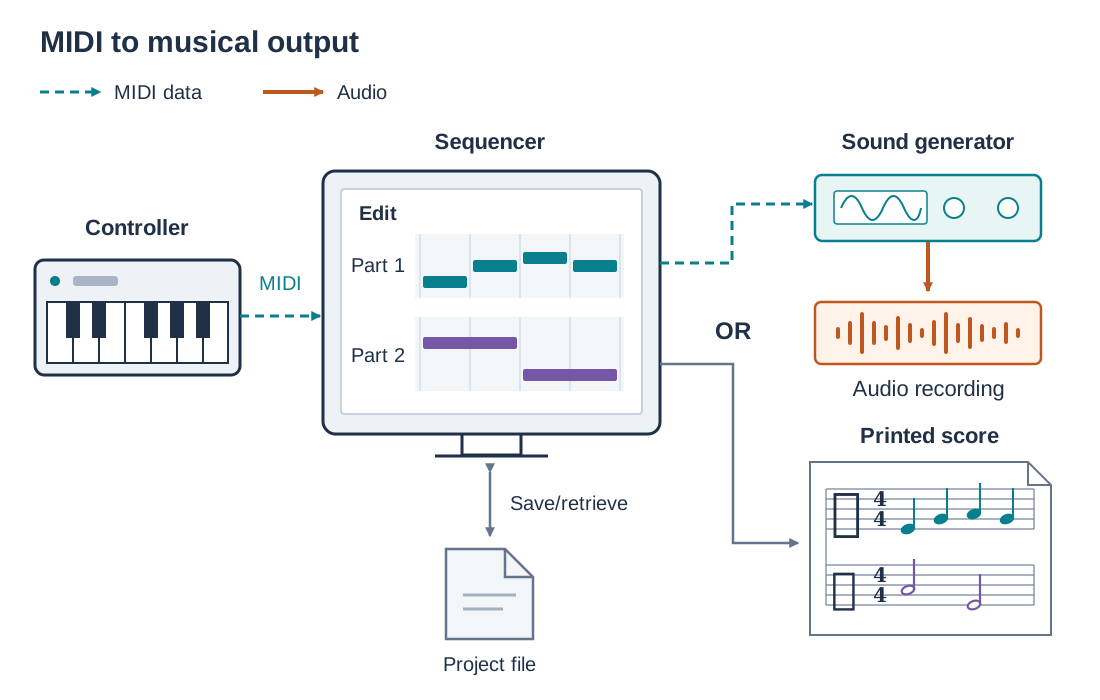
You can present your practical performance using music technology (Appendix A, Option 3) instead of, or alongside, a conventional instrument. MIDI (Musical Instrument Digital Interface) allows electronic instruments and controllers to communicate with sequencing software and sound modules.
Core Examination Requirements
To present this option, you must demonstrate the ability to:
- Input a score of at least two real parts using an electronic instrument or an instrument with a MIDI controller.
- Save, retrieve, and edit that score (for example, altering rhythms, pitches, dynamics, and instrument timbres).
- Produce a final version, either as an audio recording or as a printed musical score.
Higher Level Requirement
Higher Level students must meet one additional requirement: either compile and perform to their own prepared backing track, or play at least two pieces from the standard repertory for electronic instruments.
Preparation Tips
- Choose two genuinely independent musical lines (such as a melody and an active bass line) rather than simple octaves.
- Practise editing operations (quantising, copying, changing patch timbres) until you can complete them smoothly during the practical exam.
- Maintain verified backup copies of all project files on multiple storage devices before exam day.