
Wolfgang Amadeus Mozart composed the Piano Concerto No. 23 in A Major, K.488, in Vienna during the spring of 1786, alongside his comic opera The Marriage of Figaro. The concerto is scored for solo piano, one flute, two clarinets in A, two bassoons, two horns in A, and strings. Mozart deliberately omitted oboes, trumpets, and timpani, giving the entire work an intimate, chamber-music character with rich woodwind dialogue. For Leaving Certificate Higher Level Music, students must understand the structure and thematic landmarks of all three movements, follow printed score extracts, calculate clarinet-in-A transpositions, identify cadences and textures, and evaluate recorded performances using precise musical evidence.
Historical Context, Instrumentation, and Score Reading
Mozart completed this concerto in March 1786 for his Viennese subscription concerts, performing the solo part himself while finishing The Marriage of Figaro (Le nozze di Figaro). The shared creative period explains the work's vocal, singing melodies (cantabile) and conversational interplay between soloist and orchestra.
Scoring and Timbre
- Soloist: Fortepiano (modern concert grand in modern performances).
- Woodwinds: 1 flute, 2 clarinets in A, 2 bassoons.
- Brass: 2 horns in A.
- Strings: Violins 1 and 2, violas, cellos, and double basses.
Mozart deliberately excluded oboes, trumpets, and timpani. Leaving out trumpets and timpani removes the bright, ceremonial sound of Mozart's grander concertos. The result is a soft, transparent texture, close to chamber music, in which the piano can be heard clearly without having to play loudly. Replacing the customary oboes with clarinets in A provides a rich, mellow tone colour that blends smoothly with the piano.
Reading the Printed Score Extract
Exam questions regularly print an unlabelled system and ask you to identify which instrument is playing. The orchestral score is arranged from top to bottom as follows:
- Flute
- Clarinets in A
- Bassoons
- Horns in A
- Solo Piano (grand staff: treble and bass clefs)
- Violins 1 and 2
- Violas (alto clef)
- Cellos and Double Basses (sharing a bass clef staff)
Italian Terms and Ornaments on the Score
- Tempo & Expression: Allegro (fast and lively), Adagio (slow), Allegro assai (very fast), cantabile (in a singing style), tutti (the whole orchestra plays), solo (the soloist alone).
- Articulation & Technique: legato (smooth), staccato (detached), pizzicato (plucked strings), arco (played with the bow).
- Ornaments: trill (tr, rapid alternation between the written note and the note above), turn (ornament circling above and below the principal note), appoggiatura (leaning grace note taking time from the main note), acciaccatura (crushed note with an oblique stroke through the stem).
Clarinet in A Transposition
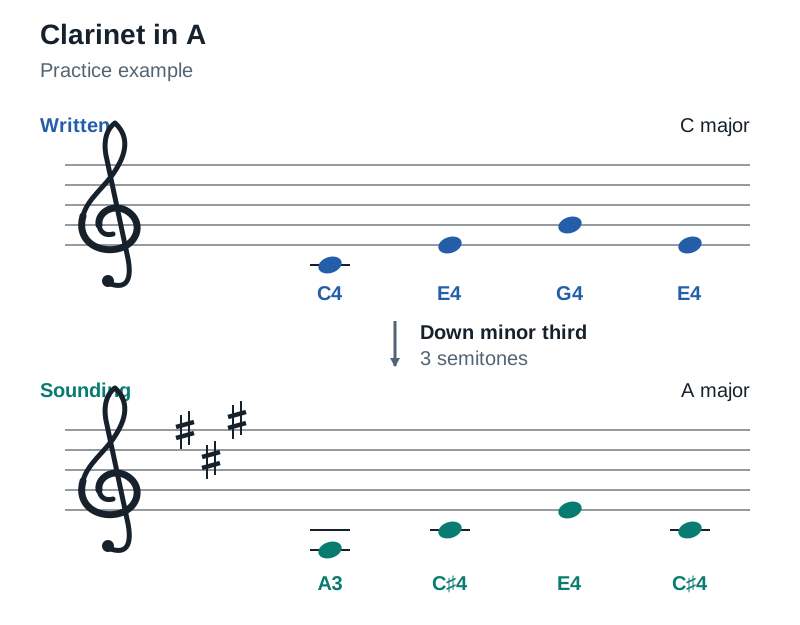
A clarinet in A is a transposing instrument that sounds a minor third lower than written. To find the sounding pitch (concert pitch), transpose every written note and key signature down three semitones:
- If the clarinet staff is written in C major (no sharps or flats), it sounds in A major (three sharps: F♯, C♯, G♯).
- A written note C sounds as A; a written E sounds as C♯; a written G sounds as E.
Architectural Design and Audible Signposts
The concerto follows the Classical three-movement design (Fast–Slow–Fast):
| Movement | Tempo Marking | Key & Tonality | Metre & Beat | Form |
|---|---|---|---|---|
| 1st Movement | Allegro | A major (Tonic) | 4/4 (Simple quadruple: 4 crotchet beats) | Classical Double-Exposition Sonata Form |
| 2nd Movement | Adagio | F♯ minor (Relative minor) | 6/8 (Compound duple: 2 dotted-crotchet beats) | Ternary Form (A–B–A′) with Coda (Siciliano) |
| 3rd Movement | Allegro assai | A major (Tonic) | 2/4 (Simple duple: 2 crotchet beats) | Sonata-Rondo Form |
Five-Second Audio Identification Guide
- Fast, bright major key, quiet strings playing a balanced four-bar tune answered by woodwinds: Movement 1, Orchestral Exposition (1st subject).
- Same opening tune decorated on piano with turns and broken chords: Movement 1, Solo Exposition.
- Piano alone, no orchestra, fast scales, arpeggios, ending on a long trill: Movement 1, Cadenza.
- Solo piano alone, slow, rocking 6/8, mournful minor key: Movement 2, Adagio opening.
- Plucked (pizzicato) strings under quiet, isolated piano sighs, dying away: Movement 2, Coda.
- Very fast, duple time, chattering piano quavers answered instantly by a loud orchestral tutti: Movement 3, Refrain.
Movement 1 (Allegro, A Major): Double Exposition
Classical concerto sonata form uses two expositions: one for orchestra alone, followed by one for soloist with orchestra.
1. Orchestral Exposition
The orchestra introduces the themes in the home key without the piano:
- First Subject: Stated piano by the strings in balanced four-bar antecedent and consequent phrases, answered by the woodwinds. The texture is melody-dominated homophony.
- Transition: A sudden loud (forte) orchestral passage featuring energetic scales and sequences, ending on an imperfect cadence (chord V, E major).
- Second Subject: A playful, lighter theme traded between violins and woodwinds. In the orchestral exposition, the second subject stays firmly in the tonic key of A major. It does not modulate to E major.
- Codetta: Confirms A major with repeated cadential figures, closing on a perfect cadence.
2. Solo Exposition
The piano enters gently, reinterpreting the material with virtuosity and modulation:
- Piano Entry & Embellished First Subject: The soloist states the 1st subject in A major, decorating the line with passing notes, turns, and broken-chord Alberti bass figures.
- Modulating Transition: The piano plays rapid semiquaver runs and arpeggios, actively modulating towards the dominant.
- Second Subject: Now presented in the dominant key of E major. The piano plays expressive melodic turns while clarinets and flutes weave counter-melodies.
- Codetta: Rapid piano passagework and trills bring the solo exposition to a decisive close in E major.
Movement 1: Development, Recapitulation, and Cadenza
3. Development
Mozart does something unexpected at the start of the development: instead of working out the 1st or 2nd subjects, the section opens with an entirely new lyrical theme in E minor, introduced in question-and-answer dialogue between woodwinds and solo piano.
- Motivic Fragmentation: Fragments of this new theme are broken into short melodic cells and passed rapidly between clarinets, flute, bassoons, and piano through minor keys (including C♯ minor, F♯ minor, and B minor).
- Dominant Preparation: The section settles over an extended dominant pedal on E, building harmonic expectation that resolves when the tonic key returns.
4. Recapitulation
- First Subject: Returns in the home key of A major, shared between piano and orchestra.
- Altered Transition: The transitional bridge is rewritten so that it stays in the home key rather than modulating.
- Second Subject: Now returns in the tonic key of A major, resolving the harmonic tension created during the solo exposition.
5. Cadenza and Coda
- Near the close of the movement, the orchestra halts on the tonic chord in second inversion with the dominant note in the bass held under a pause sign. This cadential six-four is the signal that a cadenza is coming.
- Unusually for Mozart, he wrote out the entire cadenza in the autograph score rather than leaving it to be improvised. It explores earlier themes through rapid scales, arpeggios, and wide leaps.
- The soloist concludes the cadenza with an extended trill over the dominant chord, cueing the orchestra to re-enter for the final closing chords of the coda in A major.
Movement 2 (Adagio, F♯ Minor): Poetic Aria
The slow movement is one of Mozart's rarest creations: an entire movement in F♯ minor, the relative minor of A major, sharing the three-sharp key signature (F♯, C♯, G♯).
The Siciliano Rhythm
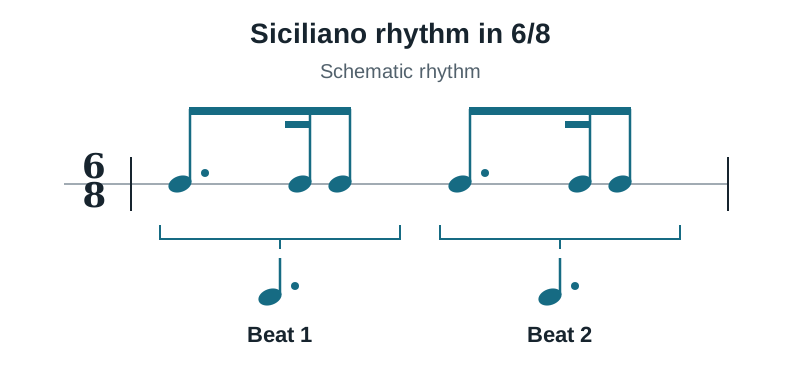
The movement is cast in 6/8 compound duple time (two dotted-crotchet beats per bar, each dividing into three quavers). It is characterised by the lilting, rocking rhythm of a siciliano: dotted quaver – semiquaver – quaver.
Ternary Form (A–B–A′) with Coda
- A Section (F♯ minor): The piano enters completely unaccompanied, playing an exposed, operatic melody with wide expressive leaps (such as minor sevenths) and chromatic notes, resembling a sorrowful vocal lament. The orchestra enters to repeat and extend the melody, enriched by warm clarinets and bassoons (with a poignant Neapolitan chord adding harmonic colour).
- B Section (A major): A serene contrast in the relative major. Flute and clarinet play a gentle woodwind dialogue over flowing piano arpeggios.
- A′ Section (F♯ minor): The lamenting opening melody returns in the piano, now heightened with delicate ornamental embroidery and passing notes.
- Coda: The piano plays isolated, broken melodic fragments over quiet pizzicato (plucked) strings, gradually dying away to a hushed close.
Movement 3 (Allegro assai, A Major): Sonata-Rondo Finale
After the sorrowful Adagio, the finale returns to A major with a fast, light, dance-like theme—a deliberate contrast of mood between the movements. It is marked Allegro assai in 2/4 time (simple duple: two crotchet beats per bar).
Sonata-Rondo Structure
The form alternates a recurring main theme (the refrain, A) with contrasting sections (episodes, B and C), while incorporating the key scheme of sonata form:
- Refrain A (A major): The piano begins alone with an eight-bar theme in buoyant quavers, followed immediately by an energetic orchestral tutti.
- Episode 1 / 2nd Subject (E major): The music modulates to the dominant key. The clarinet introduces a lyrical melody that the piano takes up and decorates with rapid scalic runs.
- Refrain A (A major): The main theme returns briskly in the tonic key.
- Episode 2 / Central Development: The music modulates through related keys (including F♯ minor and D major). Solos and orchestral forces exchange virtuosic semiquaver passagework, cross-hand arpeggios, and woodwind fanfares.
- Recapitulation (A major): Refrain A returns, followed by Episode 1 transposed into the tonic key of A major.
- Coda (A major): Dazzling piano arpeggios and triumphant orchestral chords bring the concerto to an exuberant finish.
Cadence Recognition, Textures, and Classical Style Features
Leaving Certificate aural skills questions require you to name cadences and textures precisely from recordings.
The Four Examinable Cadence Types
- Perfect Cadence (V–I): The dominant chord moves to the tonic, creating a finished, conclusive full stop (e.g. E major chord to A major chord).
- Imperfect Cadence (ending on V): Any chord moving to chord V, sounding like an unfinished musical comma that demands continuation.
- Plagal Cadence (IV–I): The subdominant chord moves to the tonic (in A major, D major to A major). It sounds like a gentle, settled 'Amen' ending—final, but softer than a perfect cadence because there is no leading note rising to the tonic. (Remember: if asked to name a cadence before a cadenza, never answer 'cadential six-four'; cadential six-four describes a chord inversion, not a cadence type).
- Interrupted Cadence (V–vi): Chord V moves unexpectedly to chord vi (in A major, E major moving to F♯ minor), snatching away the expected tonic resolution.
Classical Style Features in K.488
When asked to name features of the Classical style, always pair each term with audible proof:
- Balanced phrasing: Symmetrical four-bar question answered by four-bar answer (opening violin melody of Movement 1).
- Melody-dominated homophony: One clear solo melody supported by chordal accompaniment.
- Alberti bass: Broken-chord accompaniment in the keyboard left hand.
- Diatonic harmony: Clear chord progressions anchored by tonic and dominant relationships.
- Light, transparent texture: Intimate orchestration without trumpets or timpani, allowing woodwinds to act as solo voices.
- Graded dynamics: Smooth crescendos and diminuendos rather than terraced Baroque dynamics.
- Contrast of character: Lyrical cantabile themes set against lively forte tutti passages.
Higher Level Comparative Study and Performance Evaluation
Higher Level students must be able to make comparative judgements between styles and evaluate recorded performances using musical criteria.
Historical Comparison: Classical Concerto vs. Baroque Concerto Grosso
- Solo Forces: The Baroque concerto grosso pitted a small group of soloists (concertino) against the full orchestra (ripieno). Mozart's Classical concerto features a single soloist who acts as an expressive partner in musical dialogue with the orchestra.
- Form: Baroque concertos relied on continuous motor rhythms and ritornello form. Mozart uses balanced double-exposition sonata form with distinct, contrasting themes.
- Woodwind Independence: In Baroque concertos, woodwinds usually doubled string lines or formed part of the continuo. In K.488, the woodwinds (particularly the clarinets) introduce independent melodies and dialogue with the soloist.
Evaluating Performance Recordings
When comparing two recordings of K.488, focus on audible musical differences:
- Solo Instrument: A fortepiano (wooden frame, leather hammers) produces a crisp, delicate tone with rapid note decay, keeping fast passagework transparent. A modern grand piano (iron frame, felt hammers) offers greater sustain, power, and a singing cantabile tone, but its heavier bass resonance can obscure delicate woodwind counter-melodies.
- Tempo in the Adagio: Evaluate whether the tempo maintains the lilting two-beat rocking pulse of the 6/8 siciliano, or drags so slowly that the compound rhythm breaks down into six plodding beats.
- Orchestral Balance: Notice whether the conductor ensures the clarinets and bassoons remain clearly audible when the piano is playing rapid semiquavers.
- Formulating an Evaluation: State your preference with a concrete musical reason, for example: 'I prefer Recording 1 because the transparent tone of the fortepiano allows the clarinet and bassoon counter-melodies to be heard in clear dialogue with the soloist, preserving the intimate chamber texture Mozart intended.'
Key terms
- Double-Exposition Form
- A Classical concerto structure where the main themes are first presented by the orchestra alone in the tonic, and then restated, embellished, and modulated by the soloist with orchestra.
- Clarinet in A
- A transposing woodwind instrument sounding a minor third lower than written, chosen by Mozart for its warm, mellow tone in place of the standard oboe.
- Cantabile
- In a singing style; smooth, connected melodic phrasing that resembles an operatic vocal line.
- Siciliano
- A slow, lilting dance rhythm in compound duple time (6/8), characterised by a dotted quaver – semiquaver – quaver pattern, as used in the second movement.
- Cadenza
- An extended, unaccompanied solo passage near the end of a concerto movement, displaying the soloist's technical artistry and concluding on a trill over chord V to cue the orchestra.
- Sonata-Rondo Form
- A musical form that combines the recurring thematic refrain of a rondo (A–B–A–C–A–B–A) with the tonal development and recapitulation of sonata form.
- Alberti Bass
- A Classical accompaniment pattern of broken chords played in the order lowest, highest, middle, highest.
- Motivic Fragmentation
- The compositional technique of breaking a theme into small melodic cells and passing them sequentially between instruments, as heard in the development of Movement 1.
- Plagal Cadence
- A chord progression moving from chord IV (subdominant) to chord I (tonic), often called the 'Amen' cadence, providing a gentle sense of completion.
- Compound Duple Metre
- A metre with two main dotted-crotchet beats per bar, each subdivided into three quavers, such as 6/8 time.
- Melody-Dominated Homophony
- A musical texture where a single prominent melodic line is supported by chordal accompaniment.
- Antecedent-Consequent
- A balanced Classical phrase structure where a question phrase ending on an open cadence is answered by a resolving phrase ending on a closed cadence.
Check yourself
Which standard orchestral instruments are deliberately omitted from the score of K.488, and which instrument replaces the oboe?
Oboes, trumpets, and timpani are omitted; clarinets in A replace the oboes.
In Movement 1, what key is the Second Subject in during (a) the Orchestral Exposition, (b) the Solo Exposition, and (c) the Recapitulation?
(a) A major (tonic), (b) E major (dominant), and (c) A major (tonic).
What unusual thematic event takes place at the start of the Development in Movement 1?
A completely new lyrical theme in E minor is introduced in dialogue between the woodwinds and the solo piano.
What is the key, metre, and dance rhythm of the second movement (Adagio)?
F♯ minor (relative minor), 6/8 compound duple metre, and the siciliano dance rhythm.
What are the four cadence types that can be examined on the listening paper?
Perfect cadence (V–I), imperfect cadence (ending on V), plagal cadence (IV–I), and interrupted cadence (V–vi).
If a clarinet in A plays a written middle C, what is the sounding pitch?
A3 (a minor third lower than written).
What is the formal structure and metre of the third movement (Allegro assai)?
Sonata-rondo form in 2/4 time (simple duple metre).
How does the soloist signal the orchestra to re-enter at the end of the cadenza?
By performing an extended trill over the dominant chord.