
How Question 5 Works: Structure and Aural Strategy
Question 5 appears on the Listening paper, which accounts for 25% of the total Higher Level marks. The question is split into two distinct parts that demand different examination skills.
Part A: Aural Analysis of Excerpts
You will hear three short recorded excerpts of Irish music. The questions test your ear and your technical vocabulary. Typical prompts require you to:
- Identify the dance tune type (such as reel, double jig, slip jig, or hornpipe) and state its time signature.
- Name solo or accompanying instruments (such as uilleann pipes, fiddle, concertina, or bouzouki).
- Identify specific ornaments (such as rolls, crans, cuts, or triplets) and describe how they are produced.
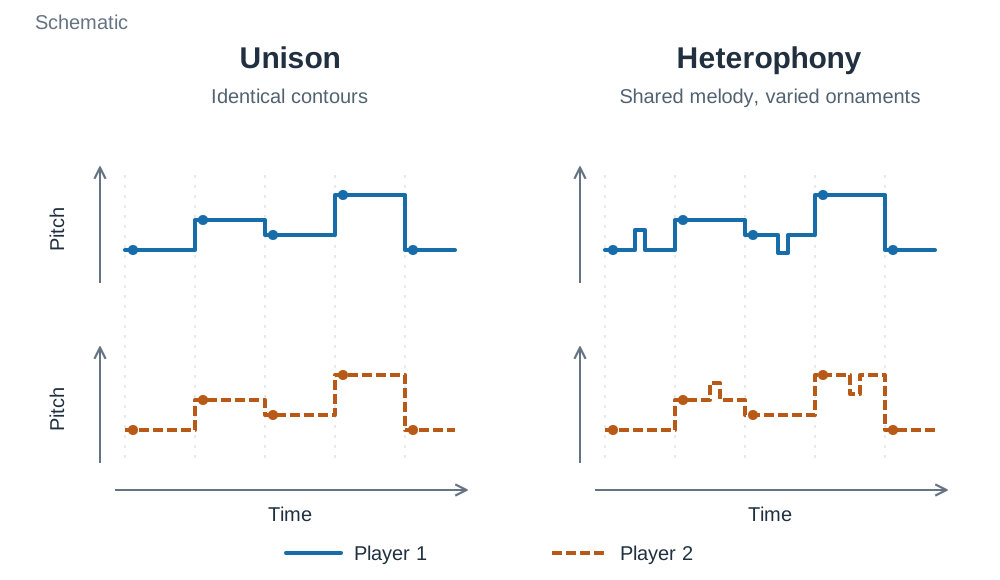
- Describe the musical texture, distinguishing between unison, homophony, and heterophony.
- Determine the structural form of an air or ballad (such as AABA or ABBA) by tracking four-bar phrases.
- Contrast traditional features with non-traditional features in modern arrangements or fusion excerpts.
Always use precise musical terms. An examiner cannot reward vague descriptions such as "lively rhythm" or "modern backing". Instead, write "compound duple time (6/8) with quaver movement" or "chromatic walking bass on double bass with syncopated piano chords".
Part B: The 10-Mark Essay
Part B offers a choice of essay titles. High-scoring essays (8 to 10 marks) require detailed musical knowledge supported by named individuals, ensembles, tune titles, historical dates, and specific stylistic traits. A general narrative without musical terms will lose marks. Structure your answer into three or four well-developed paragraphs, each focusing on a distinct musical point.
Dance Tune Types, Metres, and Structures
Most traditional Irish dance tunes use a 32-bar binary structure consisting of two 8-bar sections, labelled the tune (A part) and the turn (B part). Each section is repeated, creating an AABB form. The B part usually moves into a higher register to contrast with the lower-pitched A part. In performance, musicians rarely play a single tune on its own; they link two or three contrasting tunes together into a continuous set.
Metric Guide to Dance Forms
| Tune Type | Time Signature | Metre | Beat Division & Rhythmic Character | Example Tune |
|---|---|---|---|---|
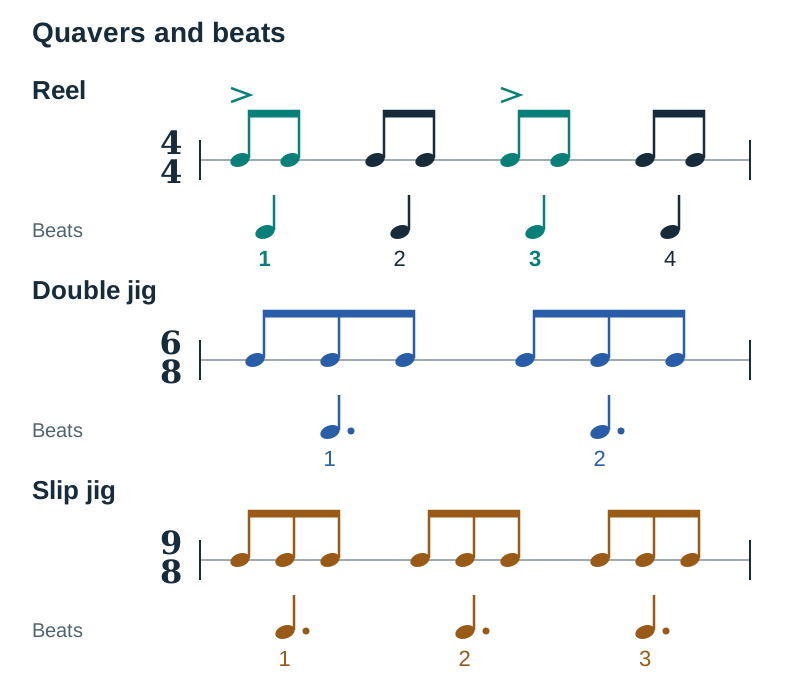
| Reel | 4/4 or 2/2 | Simple quadruple or simple duple | Brisk, driving continuous quavers with accents on the first and third crotchets of the bar (the two main beats in 2/2) | The Maid Behind the Bar |
| Double Jig | 6/8 | Compound duple | Two dotted-crotchet beats per bar, each dividing into three quavers | The Kesh Jig |
| Single Jig | 6/8 | Compound duple | Dominated by a crotchet–quaver (long–short) pattern rather than continuous running quavers | Off She Goes |
| Slide | 12/8 | Compound quadruple | Four dotted-crotchet beats per bar, played fast with a driving, bouncy pulse for set dancing | Denis Murphy's Slide |
| Slip Jig | 9/8 | Compound triple | Three dotted-crotchet beats per bar, each dividing into three quavers, giving an 8-bar lilting, flowing hop | The Butterfly |
| Hornpipe | 4/4 | Simple quadruple | Slower than a reel, featuring swung dotted quaver–semiquaver pairs and a three-crotchet cadence ending each part | The Boys of Bluehill |
| Polka | 2/4 | Simple duple | Fast, energetic two-beat march tempo with crisp, accented off-beats, central to Sliabh Luachra set dancing | The Britches Full of Stitches |
To tell a reel from a double jig at the same tempo, count the subdivision. A reel divides each main pulse into pairs of even quavers. A double jig divides each main pulse into three quavers. Say "rashers and sausages" to feel one bar of a double jig: "ra-shers-and" fills the first beat and "sau-sa-ges" fills the second, three quavers per beat.
Instruments, Ornaments, and Musical Idioms
Traditional instrumental music is driven by variation and personal expression rather than strict repetition.
Core Traditional Instruments
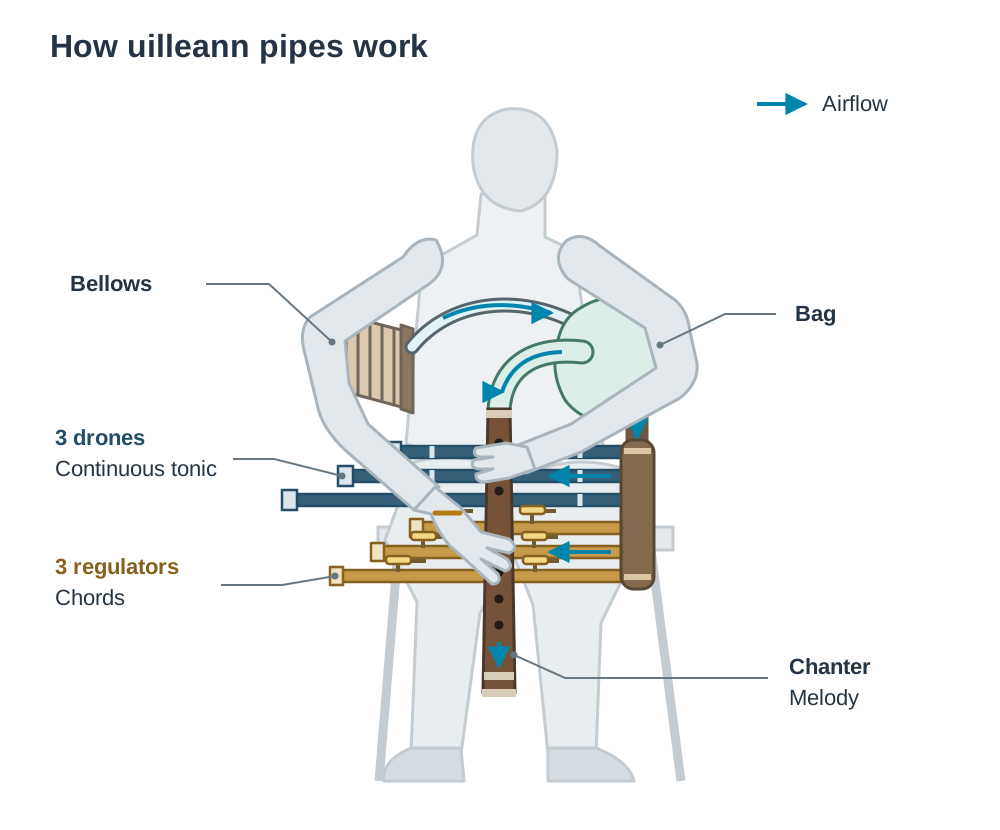
- Uilleann Pipes: Developed in the 18th century, these bagpipes use air pumped by an under-arm bellows rather than lung power. They produce a sweet, mellow tone spanning two octaves. They consist of a chanter (the melody pipe with a double reed), three continuous drones (sounding the tonic pitch in octaves), and three regulators (keyed pipes resting across the thigh, pressed with the piper's wrist to play chordal accompaniment).
- Fiddle: Physically identical to the classical violin, but played with distinctive regional bowing styles, little or no vibrato, and extensive finger ornamentation.
- Timber Flute and Tin Whistle: Simple-system conical wooden flutes produce a dark, breathy tone. The six-hole tin whistle uses identical fingering across two octaves.
- Bodhrán: A shallow wooden frame drum covered with a goatskin head. It is struck using a double-ended wooden stick called a tipper or cipín. The player's free hand presses against the inside of the skin to alter pitch and dampen resonance.
- Free-Reed Instruments: The button accordion (tuned in B/C or C#/D) and the smaller hexagonal concertina (especially prominent in Co. Clare) provide rhythmic, punchy melodic lines.
- Fretted String Accompaniment: The bouzouki entered Irish traditional music in the 1960s; guitars were already used in the ballad scene. Guitarists may use DADGAD tuning; the flat-backed bouzouki commonly uses four-course tunings such as GDAD. These tunings support drones and modal accompaniment.
Core Ornaments
- Cut: A very quick grace note pitched higher than the melody note, inserted to articulate the pitch or separate two notes of the same pitch.
- Tap (Pat): A single rapid grace note struck below the melody note.
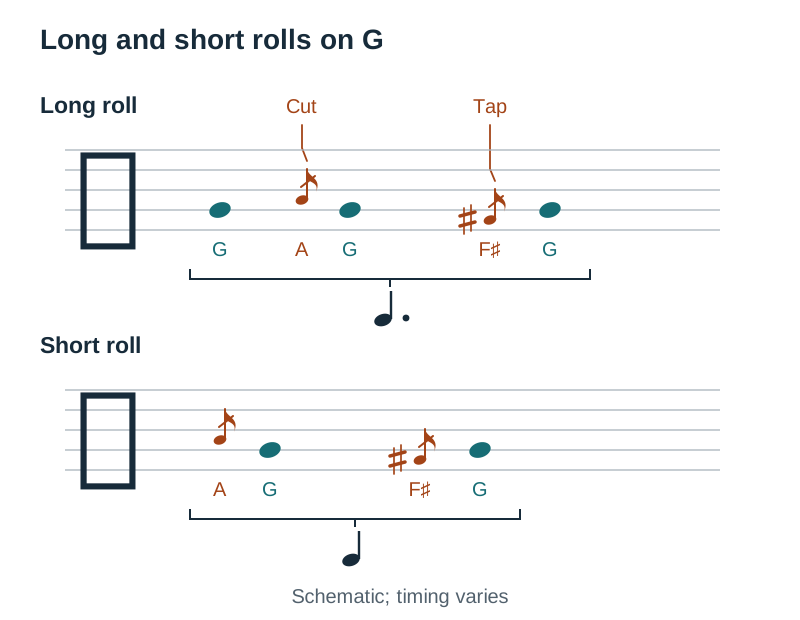
- Long Roll: Replaces a dotted-crotchet note with a five-movement sequence: main note – cut above – main note – tap below – main note. For example, on the note G, the sequence is G–A–G–F#–G.
- Short Roll: Condenses the roll into the duration of a single crotchet beat by omitting the opening main note: cut above – main note – tap below – main note (e.g. A–G–F#–G, with the cut and tap acting as quick grace notes).
- Cran: An ornament associated with the uilleann pipes and also used on flute. Bottom D is the lowest note, so there is no lower note to tap with in a normal roll. Instead, the piper sustains the low D while cutting it rapidly with several higher fingers in quick succession.
- Bowed Triplet: A fiddle technique where three rapid notes are played in the time of a single beat using separate, crisp bow strokes.
- Slide: A smooth, expressive glissando sliding into a note from a pitch just below it.
Irish Musical Idioms and Textures
- Heterophony: The standard texture of an informal traditional session. Several musicians play the same melody simultaneously, but each player adds their own individual ornaments, bowing choices, and minor variations. It is neither strict unison nor multi-part harmony.
- Unison: Everyone plays the exact same melodic notes and rhythms together, as heard across the melody line of a traditional céilí band.
- Modes: Traditional melodies are often built on four main diatonic modes: Ionian (the ordinary major scale), Mixolydian (major with a flattened 7th), Dorian (natural minor with a raised 6th), and Aeolian (natural minor). D Mixolydian (D-E-F#-G-A-B-C-D) is exceptionally common on the whistle, flute, and pipes.
- Gapped Scales: Many older airs use pentatonic (5-note) or hexatonic (6-note) scales, omitting specific scale steps (frequently the 4th or 7th).