
Raymond Deane's Seachanges (with Danse Macabre), composed in 1993–1994, is a prescribed contemporary Irish chamber work in Group B for the Leaving Certificate Music examination in 2027. Scored for a five-player chamber ensemble (piccolo doubling flute in G, percussion, piano, violin, and cello), the piece explores mortality, transformation, and decay. Its title and governing idea stem from Ariel's song in Shakespeare's The Tempest ('suffer a sea-change into something rich and strange') alongside medieval dance-of-death imagery and Mexican Day of the Dead traditions. Because the work has no key and no standard Classical form such as sonata or rondo, you will not be asked to find a second subject or a modulation. Instead, revision focuses on its recurring three-note pitch cell, transformation processes, extended instrumental techniques, and alternating fast and slow tempo zones.
Musical Style and Historical Context
Seachanges (with Danse Macabre) is a work of contemporary Irish art music written in 1993–1994 for the Irish chamber ensemble Concorde, who gave its premiere in 1994. Raymond Deane was born in 1953 on Achill Island, County Mayo, and studied composition in Ireland and across Europe with Karlheinz Stockhausen and Isang Yun before being elected to Aosdána in 1986. The work forms the central panel of his Macabre Trilogy, flanked by Catacombs (1994) and Marche Oubliée (1996).
If asked to identify features that place this work firmly in the late twentieth century rather than the Classical or Romantic eras, quote these key points:
- Atonal harmonic language: There is no key signature, no functional diatonic harmony, and no cadences. Chords are built from pitch groupings and dissonant clusters rather than tonic–dominant relationships.
- Cell-based construction: Rather than developing extended tunes over chord progressions, all musical material grows from a compact three-note cell (G–A–C).
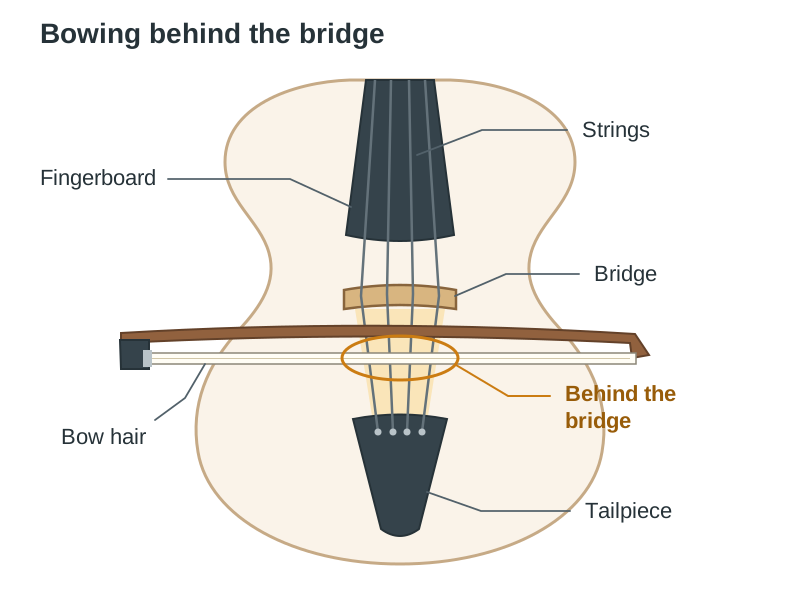
- Extended instrumental techniques: Conventional singing tone is abandoned in favour of percussive attacks, scrapes, and squeals, including col legno, snap (Bartók) pizzicato, bowing behind the bridge, and bowing a suspended cymbal.
- Through-composed structure: The music unfolds in one continuous 12-minute movement articulated by alternating tempo zones (crotchet = 80 and crotchet = 120) rather than traditional repeats or sonata allegro designs.
- Quotation and collage: Deane superimposes disparate historical sources, including the medieval Dies Irae plainchant, the Danse Macabre (Totentanz) tradition, Mexican street percussion sonorities, and a self-quotation known as the Seagull theme.
- Irony and dark humour: Traditional death symbols are mocked; plainchant endings are warped by dissonant wrong notes, treating mortality with theatrical irreverence.
The Performing Ensemble and Instrumental Timbres
Seachanges is written for an unconducted chamber ensemble of five players. Learn the score order and the roles of the instruments:
- Piccolo / flute in G (alto flute): One player doubles on both instruments. The piccolo provides a piercing, shrill high register, while the flute in G offers a dark, breathy, hollow sonority.
- Percussion (one player): The player operates a multi-percussion setup comprising marimba (warm wooden bars), maracas (dry rattling seed shakers), crotales (antique bronze tuned cymbals with brilliant sustain), suspended cymbal (struck or bowed), tam-tam, guiro (scraped ridged gourd), rainstick (shaken grain tube, evoking the sea), and tambourine. Always check the instrument list at the front of the score.
- Piano: Played melodically in hard octaves, percussively with dense clusters, and quietly inside delicate textures. The pianist also picks up a second pair of maracas to play in canon at bars 70–72.
- Violin
- Cello
Notice what is absent: there is no guitar, no vocal part, and no orchestral brass or woodwind section. Guitar-like effects are created entirely by string players strumming with their thumbs, evoking the Mexican street marimba bands Deane heard in Oaxaca rather than a formal mariachi ensemble.
Extended Performance Techniques and Sound Production
Deane instructs the ensemble to abandon lush, romantic tone in order to evoke rattling bones, decay, and macabre atmosphere:
| Technique / Marking | Meaning / Execution | Audible Effect in Score |
|---|---|---|
| Col legno | Striking or drawing the strings with the wooden stick of the bow rather than the hair | Brittle, dry, skeletal tapping sound |
| Snap (Bartók) pizzicato | Pulling the string vertically so it snaps sharply back onto the fingerboard | Explosive, percussive crack without pitched sustain |
| Above / behind the bridge | Bowing the string in the narrow space between the wooden bridge and the tailpiece | Piercing, unpitched metallic screech or whistle |
| Flageolet (harmonics) | Lightly touching string nodes rather than pressing the string down to the fingerboard | Ethereal, glassy, flute-like overtones |
| Bowed cymbal | Drawing a rosined cello or violin bow across the edge of a suspended cymbal | Shimmering, metallic drone rich in sustained overtones |
| Senza vibrato / poco vibrato | Playing with no vibrato (senza) or very little vibrato (poco) | Cold, austere, lifeless tone quality |
| Clusters | Striking groups of adjacent semitones simultaneously (often white notes against black notes on piano) | Dense, dissonant harmonic wall used as a percussive impact |
| Laissez vibrer (L.V.) | Allowing struck percussion (crotales, tam-tam) to ring out naturally without damping | Shimmering, sustained acoustic halo under brittle textures |
Core Pitch Generation: The Cell and Pentatonic Chords
Deane strictly differentiates between a motif (a musical idea with a defined rhythmic identity and melodic shape) and a cell (an abstract collection of raw pitches and intervals without fixed rhythm). The entire piece is derived from the three-note cell (G–A–C).
Intervallic Content of the Cell
Arranged upwards within one octave, the cell yields three fundamental intervals:
- G up to A: Major 2nd
- A up to C: Minor 3rd
- G up to C: Perfect 4th (the outer frame)
Inverting and widening these intervals produces their complementary forms: the Perfect 5th (C up to G), Major 6th (C up to A), and Minor 7th (A up to G). Deane generates continuous variety by applying permutation (reordering the notes, such as A–C–G or C–G–A) and transposition (shifting the interval structure to start on different pitches).
Building Pentatonic Chords
Deane creates bright, open pentatonic chords by combining two transpositions of the cell. Transposing G–A–C up a perfect 5th gives D–E–G. Combining both sets produces the notes C, D, E, G, A. Stacked vertically in the piano and marimba from bar 26 onwards, these notes produce resonant five-note harmonies derived entirely from the original three-note cell.
Systematic Compositional Processes
Deane structures the piece around collisions between order and disorder using strict developmental techniques:
- The Interfering Note and Negation: Once an orderly pattern is established, Deane introduces a foreign note that clashes with the cell and spreads through the ensemble like an infection. The primary interfering note is A♭, entering at bar 15. The A♭ disrupts the G–A–C harmony, takes over the texture, and becomes the new normal until a fresh disruption destabilises it. This process of dismantling is termed negation.
- Progression by Subtraction: A musical unit is repeated with its final note deleted on each statement, creating the impression of physical erosion and decay. In bars 65–67, the piano hammers out a six-note statement of the Seagull theme, followed immediately by five notes, then four, steadily dissolving.
- Progression by Addition: The opposite building process, in which the number of musical units or chord attacks increases bar by bar to accumulate tension. In bars 128–137, the piano plays one chord in bar 128, two chords in bar 129, three in bar 130, systematically climbing to ten chords in bar 137.
- Contrapuntal and Thematic Transformations: Melodic ideas are manipulated using inversion (turning intervals upside down), retrograde (stating phrases backwards), augmentation (lengthening note values, heard in the flute at bar 124), and diminution (shortening note values to quavers, heard in the marimba at bar 117).
- Centre of Gravity: While the music is strictly atonal, Deane uses the pitch B as an acoustic anchor or pedal point (notably at bars 55 and 159). It provides tonal focus without establishing a diatonic key.
Descriptive Vocabulary for Listening Questions
When answering exam questions on printed score excerpts, you will be expected to describe melody, rhythm, texture, and dynamics using standard musical terms:
Melodic Vocabulary
- Conjunct: Moving by step. The Seagull theme (first heard in the violin at bar 27 against its cello inversion) is a short, lyrical, mostly conjunct melody with a narrow pitch range.
- Disjunct / Angular: Moving by wide, awkward leaps. Later transformations of the Seagull theme become increasingly angular and disjointed.
- Chromatic: Moving by consecutive semitones. Heard in the violin parallel 5ths from bar 49 and the interfering notes circling the pitch A (G, G♯, A, B♭) in Section D.
- Fragmentary: Short, broken gestures rather than sustained tunes, allowing phrases to be eroded through subtraction.
Rhythmic and Metre Vocabulary
- Irregular and mechanical: The Danse Macabre rhythm (from bar 46) alternates groupings of 4 and 6 quavers/semiquavers, undermining any sense of steady 4/4 metre.
- Accents and ostinato: Driving, repetitive motor rhythms reinforced by sharp accents and dry, unpitched string attacks.
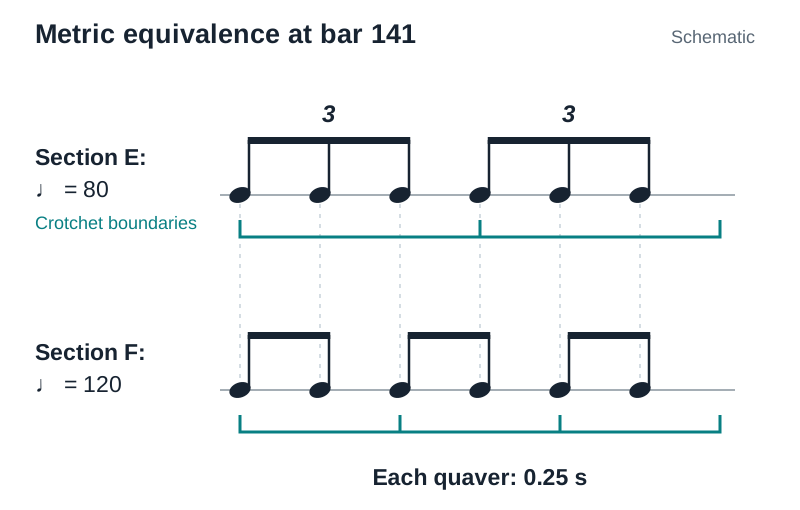
- Metric Equivalence: At bar 141, the music transitions from slow crotchet = 80 to fast crotchet = 120. In Section E (crotchet = 80), marimba triplet quavers equal 240 notes a minute (3 × 80). In Section F (crotchet = 120), ordinary quavers also equal 240 notes a minute (2 × 120). Each note lasts exactly 0.25 seconds across both tempos, creating rhythmic continuity beneath the changing beat.
Texture Vocabulary
- Sparse / Pointillistic: Isolated notes and brief attacks separated by rests (bars 1–14; final disintegration at bars 165–174).
- Contrapuntal / Imitative (Canon): Two parts playing the same material entering sequentially, such as the marimba (dux) and violin (comes) on the Dies Irae at bars 93–98, or the two maracas at bars 70–72.
- Homophonic / Chordal: Statically stacked pentatonic chords in piano and marimba accompanying melodic lines (from bar 26).
- Parallel (Organum-like): Hollow medieval harmonisation in parallel 5ths, heard between cello and violin from bar 99.
- Octaves / Unison: The Seagull theme pounded out mechanically in piano octaves at bar 65.
Dynamics and Expression
Deane employs extreme dynamic contrasts ranging from ppp (whispered scrapes and natural harmonics) to fff (dissonant piano clusters and climactic ensemble crashes near bar 141). Dynamics are terraced with abrupt subito piano, sharp sfz accents, and a final diminuendo al niente (fading away to nothing) as pitched sound dissolves into silence.
Structural Analysis and Identification Key
Seachanges runs continuously for roughly twelve and a half minutes through six through-composed sections defined by alternating tempo markings:
Six-Section Structural Table
| Section | Bars | Tempo | Key Events and Themes | Scoring and Listening Markers |
|---|---|---|---|---|
| Section A | 1–45 | Crotchet = 80 | Cell introduced; interfering note A♭ enters (bar 15); Seagull theme stated lyrically (bar 27) | Broken piano chords; solo violin with cello inversion; pentatonic chords (bar 26); transition clusters (bar 45) |
| Section B | 46–73 | Crotchet = 120 | Danse Macabre rhythm; violin parallel 5ths (bar 49); pedal B anchor (bar 55); Seagull theme in piano octaves (bar 65) | Fast driving pulse; dry percussive string attacks; subtraction on Seagull theme; maracas canon (bars 70–72) |
| Section C | 74–91 | Crotchet = 80 | Second lyrical section; Seagull theme over pedal D; interfering B♭ (bar 75); chord subtraction (bar 85) | Slow reflection; flute states cell; piano drops bottom note of rising broken chords; percussive clusters |
| Section D | 92–127 | Crotchet = 120 | Dies Irae plainchant; dedicated to Conlon Nancarrow; inverted chant and parallel organum; wrong-note phrase endings | Fast tempo; canon between marimba (dux) and violin (comes); cello chant in parallel 5ths; white vs black key piano clusters |
| Section E | 128–140 | Crotchet = 80 | Flute Seagull theme eroded by subtraction; piano progression by addition; marimba triplet ostinato | Slow pulse; flute reduced to repeated G; piano chords multiply from 1 to 10 attacks; notes rotate around pivot A |
| Section F | 141–174 | Crotchet = 120 | Climax; crotales enter (bar 141); unexpected C major triad in strings (bar 144); pedal B returns (bar 159); disintegration | Fast pulse; bright antique cymbals; collision of tonal C major against atonal clusters; parts swap fragments; fades al niente |
Which Section Am I Hearing? Quick Aural Key
- Fast tempo (120) + dry, non-pitched percussion and string clicks = Section B (Danse Macabre)
- Fast tempo (120) + modal plainchant in canon between marimba and violin = Section D (Dies Irae)
- Fast tempo (120) + brilliant high bell chimes (crotales) + surprise C major chord in strings = Section F (Final Section)
- Slow tempo (80) + lyrical violin melody answered upside down in cello = Section A (Seagull Theme, bar 27)
- Slow tempo (80) + ascending broken piano chords steadily losing their lowest notes = Section C (bars 85–87)
- Slow tempo (80) + flute shrinking to a single repeated note while piano chords pile up = Section E (bars 128–140)
Patterns of Repetition, Change, and Higher Level Comparisons
The syllabus requires students to analyse patterns of repetition and change and to formulate comparative judgements across prescribed works:
Repetition and Change Summary
- What repeats: The three-note cell (G–A–C); the Seagull theme; the Danse Macabre rhythm; the alternating tempo markings (80 and 120); and the pitch B acting as a centre of gravity.
- What changes it: Systematic transposition and permutation of the cell; inversion, retrograde, augmentation, and diminution of themes; progression by subtraction (loss of notes) and progression by addition (accumulation of attacks).
- What disrupts it: The intrusion of foreign interfering notes (A♭ at bar 15, B♭ at bar 75), and the sudden shock of a pure C major triad at bar 144 amidst atonal textures.
- The overarching pattern: Order is established, invaded by an interfering element, dismantled, and replaced by the disruption as a new norm. This cycle of negation mirrors Shakespeare's sea-change.
Comparative Judgements: Deane vs Group B Works (2027)
- Deane vs Berlioz, Symphonie Fantastique (March to the Scaffold, Mvt IV): Both pieces depict an execution or dance of death driven by rhythmic momentum. Berlioz achieves this with a massive Romantic orchestra, functional G minor/B♭ major tonality, crashing brass, and a literal programme where the idée fixe is cut short by the guillotine. Deane achieves mortal dread with five chamber players, no key signature, dry unpitched string attacks, marimba, and irregular 4+6 metric groupings. Judgement: While Berlioz overwhelms the listener with theatrical orchestral volume, Deane produces an unsettling terror through dry, skeletal chamber sonorities.
- Deane vs Berlioz, Symphonie Fantastique (The Ball, Mvt II): Both composers interrupt a dance with returning thematic material. Berlioz injects the idée fixe into an elegant A major waltz scored with harps; Deane slams the Seagull theme into the brittle Danse Macabre at bar 65 in heavy piano octaves. Judgement: Berlioz maintains melodic lyricism and diatonic grace, whereas Deane treats dance as a mechanical, decaying ritual.
- Deane vs Mozart, Piano Concerto No. 23 in A major, K.488: Mozart operates within Classical diatonic tonality, balanced antecedent-consequent phrasing, and clear cadential structure, contrasting solo piano with an orchestra. Deane completely rejects keys and symmetrical phrases, treating the piano as an equal chamber partner and percussion instrument. Both composers rely on strict dialogue and imitation—Mozart between soloist and woodwinds, Deane through strict canonic imitation between marimba and violin.
Key terms
- Three-Note Cell
- The foundational pitch material of Seachanges consisting of G, A, and C, generating the intervals of a Major 2nd, Minor 3rd, and Perfect 4th.
- Motif
- A musical idea defined by a distinct melodic contour and rhythm, as opposed to an abstract, unshaped pitch cell.
- Permutation
- Rearranging the internal sequence of notes within a cell (e.g. reordering G–A–C as A–C–G or C–G–A).
- Transposition
- Shifting a collection of pitches up or down to a different pitch level while preserving the exact intervallic relationships.
- Interfering Note
- A foreign pitch (principally A♭ entering at bar 15) deliberately introduced to disrupt the harmonic stability of the cell and destabilise the texture.
- Negation
- Deane's structural process where an established pattern is dismantled by an interfering disruption, which then becomes the starting material for the next stage.
- Progression by Subtraction
- A compositional process where a recurring phrase deletes its final note on each repetition, evoking physical erosion and decay.
- Progression by Addition
- A compositional process in which the number of musical units or chord attacks increases bar by bar to build density and tension.
- Danse Macabre (Totentanz)
- The medieval 'dance of death' tradition; in Deane's work, it informs the fast sections (crotchet = 120) with driving, irregular quaver/semiquaver rhythms and dry, unpitched attacks.
- Dies Irae
- A 13th-century Latin plainchant from the Requiem Mass ('Day of Wrath') quoted and manipulated contrapuntally in Section D.
- Canon (Dux and Comes)
- Strict polyphonic imitation where an initial voice, the dux (leader), is imitated note for note by a subsequent voice, the comes (follower).
- Organum
- An early medieval style of polyphony where a plainchant melody is doubled in parallel intervals, especially parallel 5ths.
- Centre of Gravity
- A prominent sustained or repeated pitch (specifically B at bars 55 and 159) that provides harmonic anchoring in an atonal texture without creating a diatonic key.
- Col Legno
- An extended string technique directing the player to strike or draw across the string using the wooden stick of the bow rather than the hair.
- Snap (Bartók) Pizzicato
- Plucking a string with enough force that it snaps sharply back onto the fingerboard, producing a percussive crack.
- Crotales
- Small, tuned antique bronze cymbals producing a brilliant, bell-like timbre with long natural sustain, heard at bar 141.
- Flute in G
- The alto flute, a transposing woodwind instrument with a dark, breathy lower register, doubled by the flautist alongside the piccolo.
- Aosdána
- The Irish state-sponsored academy of creative artists, to which Raymond Deane was elected in 1986.
Check yourself
What three intervals are contained within the basic G–A–C cell?
A Major 2nd (G to A), a Minor 3rd (A to C), and an outer Perfect 4th (G to C).
What foreign interfering note enters at bar 15 to disrupt the initial cell?
A-flat (A♭).
What medieval plainchant is quoted in Section D, and what do the terms 'dux' and 'comes' mean in its texture?
The Dies Irae. In canon, dux is the leading voice (marimba) and comes is the following voice (violin).
At bars 70–72, which instrument is played in canon, and by which two performers?
Maracas, played by the percussionist (dux) and echoed by the pianist (comes).
Which specific woodwind instrument plays the dark, low registers when the player is not playing piccolo?
Flute in G (alto flute).
What unexpected tonal chord appears in the strings at bar 144 to clash with atonal material?
A pure C major triad.
State one musical contrast between Deane's Danse Macabre and Berlioz's March to the Scaffold.
Berlioz uses a massive Romantic orchestra with functional G minor/B♭ tonality, whereas Deane uses a five-player atonal chamber ensemble with dry string clicks and marimba.