

Trigonometry for Leaving Certificate Higher Level focuses on the relationships between sides and angles in triangles. This topic covers Pythagoras' theorem, trigonometric ratios, exact surd values, the Sine and Cosine rules, triangle area, and 3D trigonometry. Note that trigonometric functions, equations, identities, and graphs are examined separately.
Right-Angled Triangles and Basic Ratios
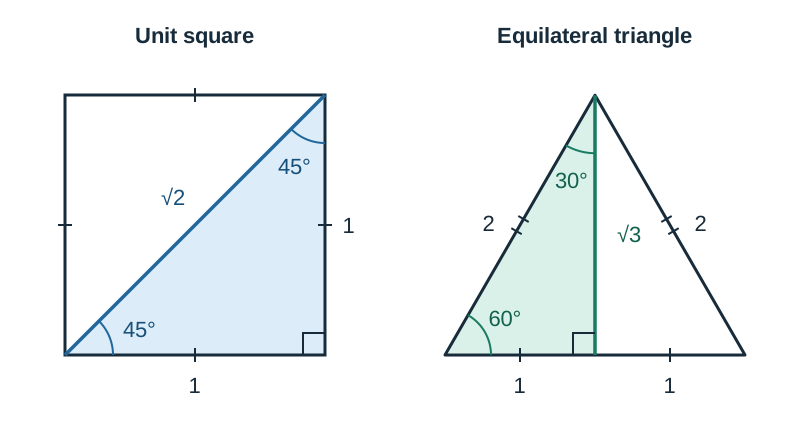
For any right-angled triangle, Pythagoras' theorem states that , where represents the hypotenuse opposite the angle. The primary ratios relate an acute angle to side lengths through sine (), cosine (), and tangent (). You can quickly recall these with the familiar SOH CAH TOA mnemonic. Always confirm the calculator mode before computing: use DEG for angle measures in degrees, and switch to RAD whenever working with radians or multiples of . In Higher Level questions, answers frequently require exact surd form rather than rounded decimals. You can build these exact values from two geometric figures. A square of side with a diagonal gives the triangle, yielding and . Bisecting an equilateral triangle of side gives the - triangle with perpendicular height , producing values such as , , and .
The Sine and Cosine Rules
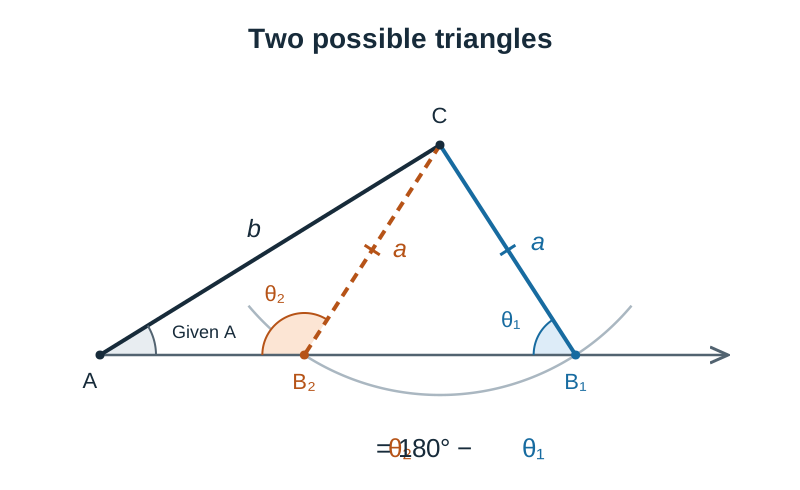
When a triangle does not contain a right angle, you must turn to the Sine Rule or the Cosine Rule. The Sine Rule, , works whenever you know a matched pair consisting of a side and its opposite angle, along with one other piece of data. When computing an unknown angle from two sides and a non-included angle, beware of the ambiguous case. Because , inverse sine returns an acute reference angle , but the obtuse alternative may also form a valid triangle if plus the given angle remains under . The Cosine Rule, , applies in two specific layouts: two sides and the included angle (SAS) to find the third side, or all three sides (SSS) to find an angle. Rearranging for the angle gives . A major advantage of the Cosine Rule is that it never produces ambiguity: if evaluates to a negative number, the angle must be obtuse, whereas a positive value always signals an acute angle.
Area and 3D Strategy
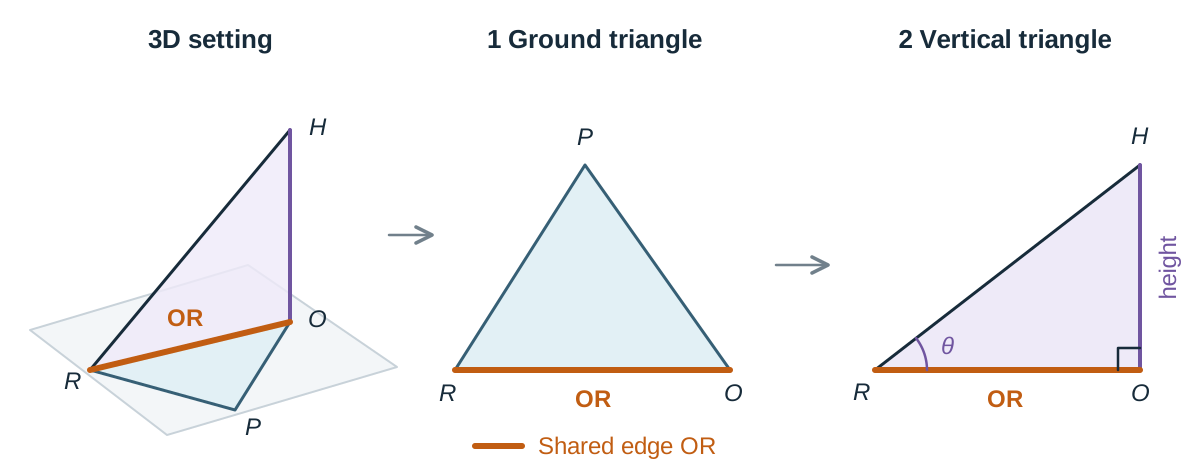
The area of any triangle can be calculated using , provided that is the included angle between sides and . If the question supplies the area and asks for an unknown angle, solve for . Remember to evaluate both the acute solution and its supplement , unless the geometric diagram or context rules out an obtuse angle. Three-dimensional questions often intimidate students, but the secret is breaking the composite shape apart. Never perform trigonometric calculations directly across a perspective 3D sketch. Instead, locate the constituent flat triangles and redraw each one as an individual 2D figure. Most problems follow a two-step sequence: first solve the horizontal ground triangle (frequently non-right-angled, requiring the Sine or Cosine Rule) to establish a shared boundary line, and then use that shared length in a vertical right-angled triangle containing a height and an angle of elevation or depression. An angle of depression is measured downwards from the horizontal to the line of sight; because the two horizontal lines are parallel, the angle of depression from the top point equals the angle of elevation measured from the lower point (alternate angles).
Formulae and Derivations
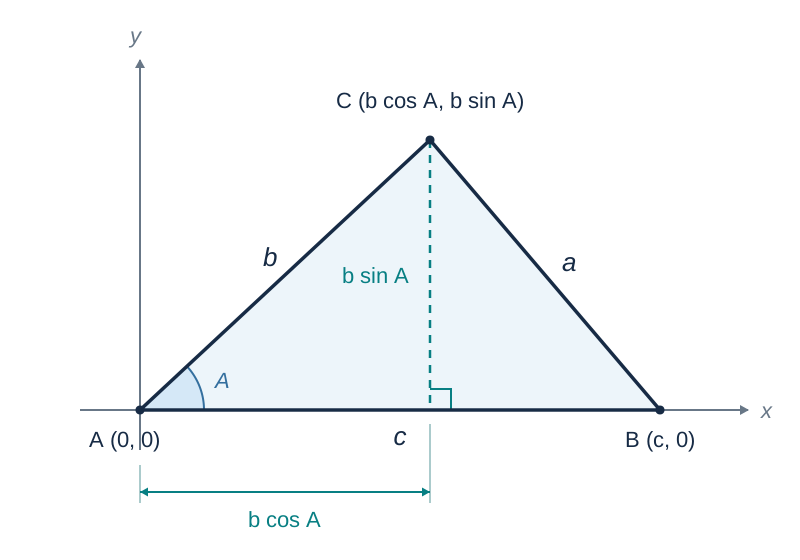
Page 16 of the Formulae and Tables booklet gives the standard Sine and Cosine rules along with the triangle area formula. At Higher Level, however, the syllabus specifically requires you to derive Formulae 1, 2, 3, 4, 5, 6, 7, and 9 from scratch. For Formula 2 (the Sine Rule), you set up two expressions for the triangle's area: and . Equating both expressions and dividing through by immediately delivers , which inverts to . For Formula 3 (the Cosine Rule), place angle at the origin with side along the positive -axis, so vertex rests at . Vertex then lies at coordinates . Applying the coordinate geometry distance formula to side gives . Expanding the brackets yields . Grouping and substituting completes the proof, leaving .
Key terms
- Hypotenuse
- The longest side in any right-angled triangle, always situated directly opposite the 90° angle.
- Included Angle
- The interior angle located directly between two known adjacent sides of a triangle.
- Ambiguous Case
- A Sine Rule scenario where two different triangles can satisfy the given side-side-angle measurements, requiring a check of 180° - θ.
- Surd Form
- An exact numerical expression containing irrational roots (such as √3 / 2) without decimal approximation.
- Bearing
- A navigational angle measured clockwise from due North, conventionally recorded as a three-digit figure.
- Angle of Elevation
- The vertical angle measured upwards from an observer's horizontal line of sight to a target object. An angle of depression is measured downwards from the horizontal; by alternate angles, the two angles are equal.
- Radian
- The angle subtended at the centre of a circle by an arc equal in length to the radius, where π radians equals 180°.
Check yourself
What is the exact area of a triangle with adjacent sides of length 6 cm and 9 cm and an included angle of π/3 radians?
Area = ½ × 6 × 9 × sin(π/3) = 27 × (√3 / 2) = (27√3)/2 cm² (approximately 23.38 cm²).
If applying the Cosine Rule to find angle B in a triangle yields cos B = -7/8, is angle B acute or obtuse?
Angle B is obtuse because the cosine of an angle in the second quadrant (between 90° and 180°) is strictly negative.
What is the exact value of sin 60° in surd form?
√3 / 2, which comes from bisecting an equilateral triangle of side length 2.