

Fractions, Surd Equations, and Identities
Equations with algebraic fractions in the form (or with constant numerators) are solved by multiplying every single term by the lowest common denominator (LCD). This clears all denominators and reduces the expression to a linear or quadratic equation. Always identify values of that make any denominator zero, as these can never be valid solutions.
For example, to solve where :
- The LCD is . Multiply every term across by this LCD to eliminate fractions: .
- Expand and simplify: , which simplifies to .
- Divide by to give .
- Factorise: , giving or .
- Neither solution equals an excluded denominator value, so both are valid.
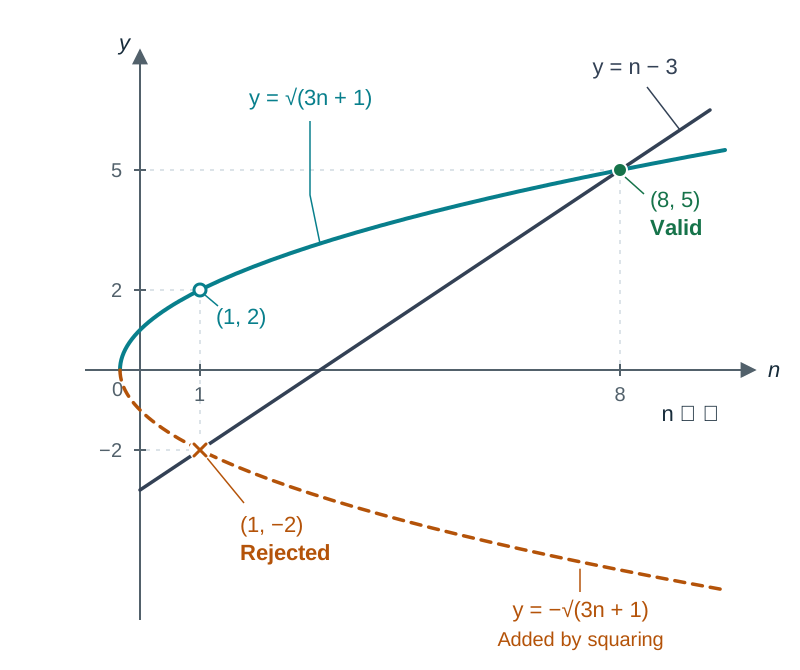
Surd equations contain an unknown under a radical sign. Isolate the square root term on one side before squaring both sides of the equation. Because squaring can introduce false solutions known as extraneous roots, you must test every algebraic answer in the original equation and reject any that fail.
An identity is an equation that holds true for every value of the variable, written with the symbol . If two polynomials are identical, the coefficients of corresponding powers of must be equal. For example, if , expand the left side to get . Equating coefficients gives , (so ), and (so ).
After solving, check each answer against the context of the question. Reject any value that gives a length , a negative count, or a number outside a stated set (such as ), and write the reason. For example, if triangle sides , , and give or , reject because the side would be .