Simultaneous Linear Systems in Two and Three Variables
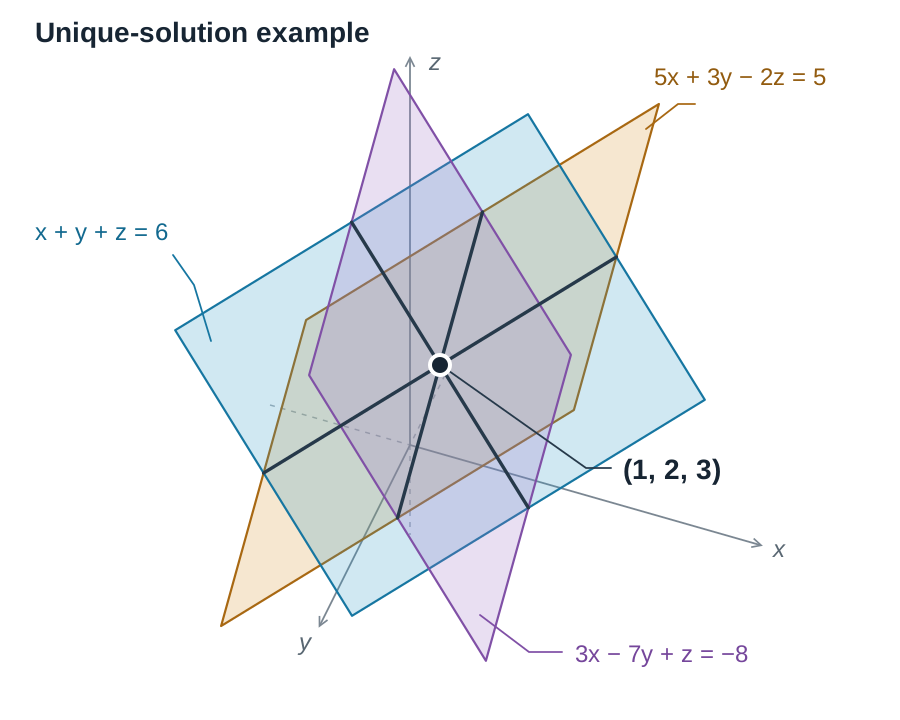
A linear equation in two variables represents a line, while a linear equation in three variables, , represents a flat plane in three-dimensional space. Solving three simultaneous equations means finding the single point where all three planes intersect.
To solve a three-variable system, eliminate the same variable twice using two different pairs of equations. This produces a pair of equations containing only two variables, which you can then solve using standard elimination or substitution.
Take the system:
Eliminating first is efficient. Multiply equation (1) by and add it to equation (2) to get . Next, subtract equation (3) from equation (1) to eliminate again, giving . Solving this two-variable system gives and . Substituting both values back into produces . Always substitute all three answers back into the unused original equations to check your arithmetic.
Simultaneous Equations: One Linear and One Non-Linear
When one equation is linear and the other contains higher powers or product terms like , , or , always use the substitution method. Geometrically, this finds the coordinates where a line intersects a curve such as a circle, ellipse, or parabola.
Rearrange the linear equation to make one variable the subject, choosing whichever variable has a coefficient of to avoid cumbersome fractions. Then substitute this expression directly into the non-linear equation. Never try to substitute from the non-linear equation into the linear one.
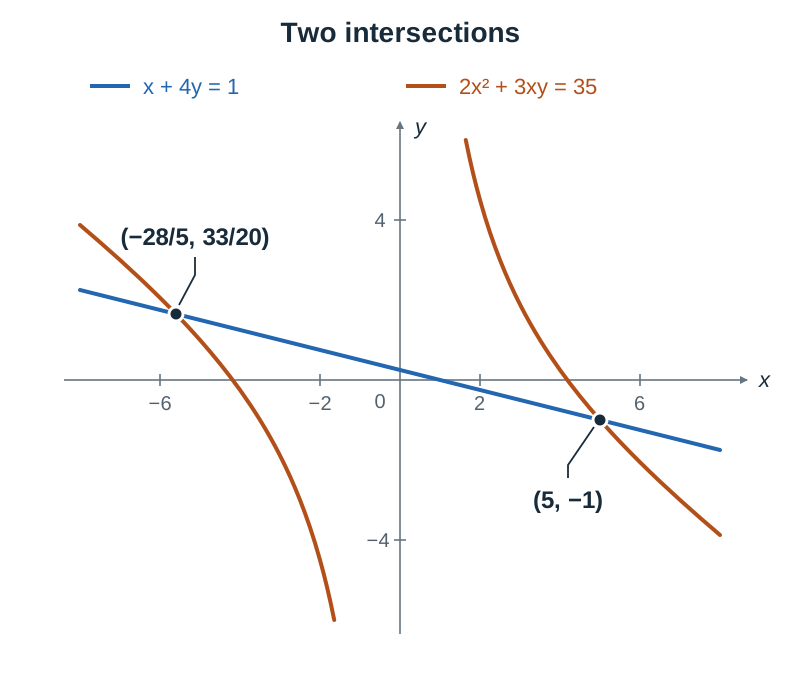
For instance, given and , isolate in the linear relation to obtain . Substituting this into the non-linear equation gives . Expanding and collecting terms leads to the quadratic . Factoring gives , so or . Substituting each value back into yields the coordinate pairs and .