

Solving inequalities at Leaving Certificate Higher Level means identifying complete intervals of real numbers or discrete sets of integers that satisfy algebraic conditions. The syllabus expects candidates to move confidently between algebraic methods and graphical sketches when handling linear, quadratic, rational, and absolute value inequalities, as well as applying discriminant conditions to quadratic equations.
Linear and Double Inequalities
Solving a linear inequality follows standard algebraic steps with one non-negotiable rule: if you multiply or divide across by a negative number, flip the inequality sign immediately. For example, dividing by gives .
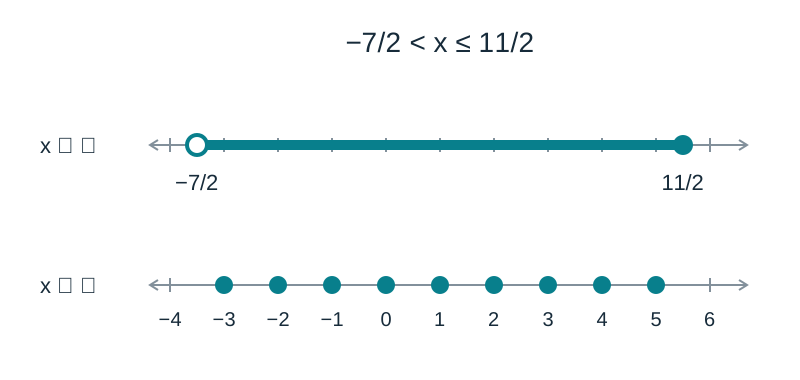
When you face a double inequality such as , you can perform each operation on all three parts simultaneously, or break the problem into two separate statements connected by 'and'. Always pay close attention to the specified replacement set. If the question specifies , your answer is a continuous interval shown as a solid shaded line on the number line. If the question restricts to natural numbers () or integers (), list the discrete values or plot them as isolated shaded dots.
Quadratic Inequalities
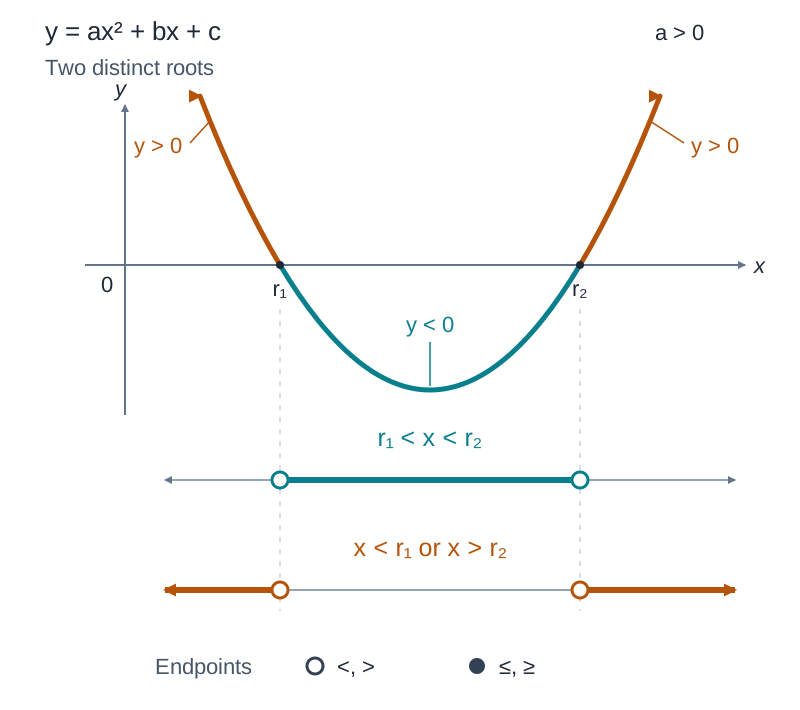
Do not attempt to solve a quadratic inequality by taking square roots directly across the inequality sign. Rearrange all terms to one side so that you are comparing a quadratic expression against zero: or .
First, solve the related equation to identify the roots, which serve as boundary values. Second, sketch a quick parabola. If the coefficient of is positive (), the curve opens upward in a U-shape. If the coefficient of is negative, multiply every term by and reverse the inequality sign first, so the parabola is U-shaped. If you need the expression to be less than zero (), choose the region below the -axis between the roots: . If you need the expression to be greater than zero (), select the two disjoint intervals above the -axis: or . For or the roots themselves are included: , or or .
Rational Inequalities
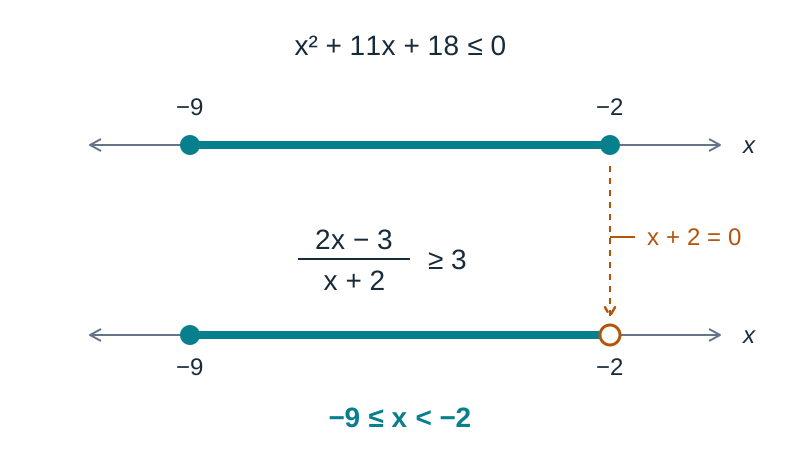
When solving an inequality with an algebraic denominator, such as , you cannot simply multiply across by . The denominator changes sign depending on , so you would not know whether to flip the inequality sign.
The standard method is to multiply both sides by the square of the denominator, , noting that . Because any real non-zero number squared is strictly positive, multiplying by guarantees that the inequality sign keeps its direction. Expanding both sides yields a standard quadratic inequality that you can factorise and solve from a sketch. Always verify that your final interval excludes any values that make the original denominator zero.
Modulus Inequalities
The modulus denotes the absolute value or distance of from zero on the number line. For expressions involving , think of the quantity as the distance between and .
First get the modulus on its own. For example, becomes , then , so .
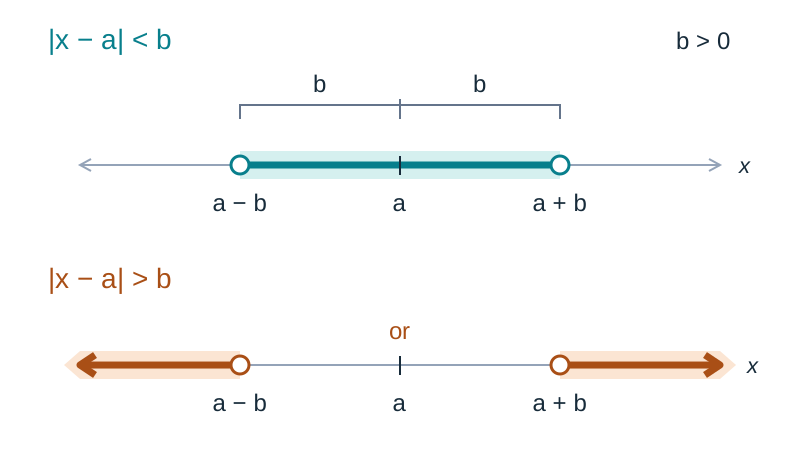
When is positive, unpack these expressions using two standard rules:
- means the distance from is less than , giving the single compound interval .
- means the distance from exceeds , producing two separate intervals: or .
Alternatively, because both sides of (with ) are non-negative, squaring both sides gives . This removes the modulus bars and leads to a quadratic inequality with identical critical boundaries.
The Discriminant and Ranges of Parameters
In quadratic equations of the form , the expression under the radical in the quadratic formula is the discriminant: . Its sign determines the nature of the roots:
- Two real distinct roots:
- Real roots (including repeated):
- One repeated real root (equal roots / tangent to -axis):
- No real roots:
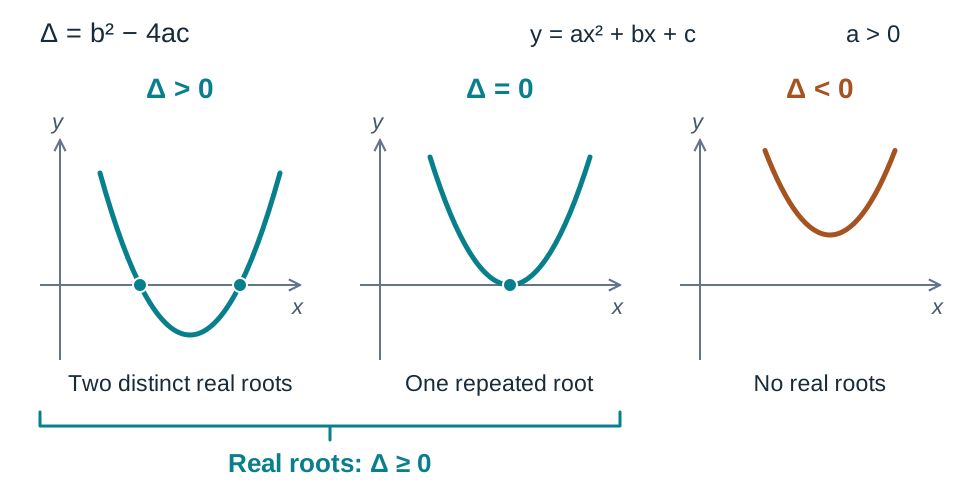
Exam questions frequently introduce an unknown parameter, such as or , and ask for the range of values for which the equation has real roots. Setting up generates an inequality in that parameter. If asked to prove that roots are always real for every value of a parameter, expand the discriminant and complete the square. Showing that can be written as a sum of squares proves , because the square of any real expression is non-negative.
Surd Equations and Extraneous Roots
A surd is an irrational root, such as or . When an equation contains a surd, isolate the radical on one side before squaring both sides. If an equation contains two surds, keep one on the left and move the other to the right before squaring, then isolate the remaining surd and square a second time.
Squaring both sides can introduce extraneous solutions because and both evaluate to . For instance, squaring can turn the false statement into the true identity . You must test every candidate solution back in the original equation and reject any value that fails.
Key terms
- Discriminant
- The expression b² - 4ac from the quadratic formula, whose sign determines the nature and number of real roots of ax² + bx + c = 0.
- Modulus
- The absolute value of a real number, written |x|, representing its non-negative distance from zero on the number line.
- Critical Values
- The boundary values found by solving the equality f(x) = 0, which partition the number line into test intervals for an inequality.
- Extraneous Solution
- A false solution introduced during an algebraic process, such as squaring both sides of an equation, that does not satisfy the original problem.
- Rational Inequality
- An inequality containing a variable in the denominator of a fraction, requiring multiplication by the denominator squared to preserve sign direction.
- Surd
- An irrational number expressed using a root sign, where the value under the radical is rational but not a perfect power.
Check yourself
Solve the inequality |2x - 1| < 7 for x ∈ R.
Write as the compound inequality -7 < 2x - 1 < 7. Add 1 across all parts to get -6 < 2x < 8, then divide by 2: -3 < x < 4.
For what values of k does x² + 4x + k = 0 have exactly one real solution?
Set the discriminant to zero: b² - 4ac = 0. Here, 4² - 4(1)(k) = 0, giving 16 - 4k = 0, so k = 4.
Why must you state x ≠ 3 before solving (x + 1)/(x - 3) ≤ 2?
Division by zero is undefined, so the expression has no value at x = 3, meaning x = 3 cannot be included in any final solution set.