
Algebra - Quadratics

Leaving Cert Higher Level Mathematics revision notes with diagrams.

3 min readHigher LevelBy Studytok
Practise this topic — free →

Quadratic Equations and the Discriminant

A quadratic equation has the standard form ax2+bx+c=0ax^2 + bx + c = 0, where a≠0a \neq 0. When factorising by inspection or the guide number method is awkward, we use the quadratic formula x=−b±b2−4ac2ax = \frac{-b \pm \sqrt{b^2 - 4ac}}{2a}. The term under the square root, Δ=b2−4ac\Delta = b^2 - 4ac, is the discriminant. It tells us the nature of the roots without having to solve the equation completely.

If b2−4ac>0b^2 - 4ac > 0, the equation has two distinct real roots, meaning the graph crosses the x-axis twice. If b2−4ac=0b^2 - 4ac = 0, the equation has one repeated real root, meaning the curve touches the x-axis at its turning point. If b2−4ac<0b^2 - 4ac < 0, there are no real roots, so the parabola never meets the x-axis.
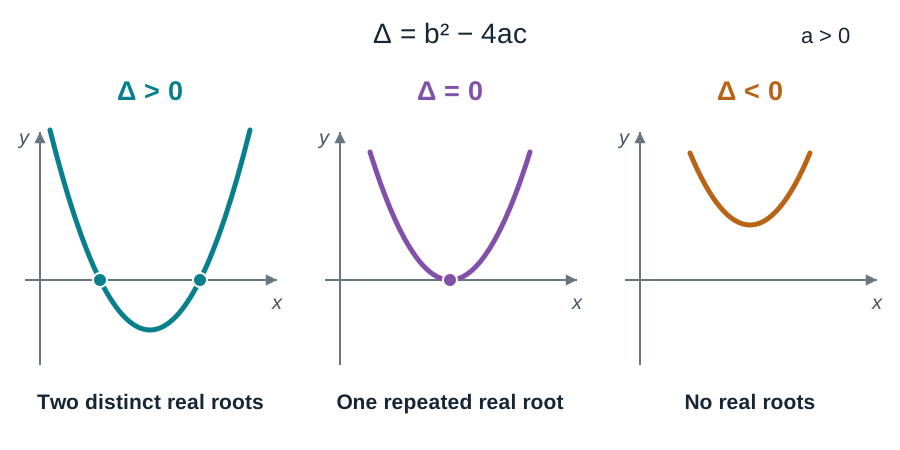
Three parabolas cross the x-axis twice, touch it once, or never meet it.

For example, if you are asked to find the values of m∈Zm \in \mathbb{Z} for which 3x2−mx+3=03x^2 - mx + 3 = 0 has exactly one solution, set the discriminant equal to zero. Here a=3a = 3, b=−mb = -m, and c=3c = 3. Evaluating (−m)2−4(3)(3)=0(-m)^2 - 4(3)(3) = 0 gives m2−36=0m^2 - 36 = 0, which yields m=6m = 6 or m=−6m = -6. If roots α\alpha and β\beta are given, you can rebuild the quadratic using the structure x2−(α+β)x+αβ=0x^2 - (\alpha + \beta)x + \alpha\beta = 0.

You've read the theory
Now turn it into exam marks.

Practise algebra - quadratics as questions and flashcards in Studytok, with explanations when you get stuck.

Continue for free →
  1. ✓
    Read the notes
    1 sections
  2. 2
    Test yourself
    Questions marked instantly
  3. 3
    Keep revising
    Flashcards and exam-style practice