

Trigonometry at Higher Level moves past simple triangles into the study of periodic functions, identities, and equations. You will use the 24 identities in your Formulae and Tables booklet to model and solve complex problems. A key exam requirement is your ability to derive specific formulae, manipulate expressions, and solve equations while correctly choosing between DEG and RAD modes.
Formulae Families & Memory Work
Your booklet provides 24 identities, but you must know how to navigate them: 1 (Pythagorean), 2-3 (Triangle rules), 4, 5, 7, 8, 9, 10 (Compound angles), 6 and 11-14 (Double angles), 15-16 (Squared forms/power reduction), and 17-24 (Product-to-sum/sum-to-product). You do not need to memorise the formulas themselves, but you must know their structures by heart to find them quickly. Crucially, you must memorise: the shapes and periods of sine, cosine, and tangent graphs; the CAST rule; exact surd values for 0°, 30°, 45°, 60°, 90°; and the logical steps to derive formulae 1, 2, 3, 4, 5, 6, 7, and 9.
Mandatory Formula Derivations
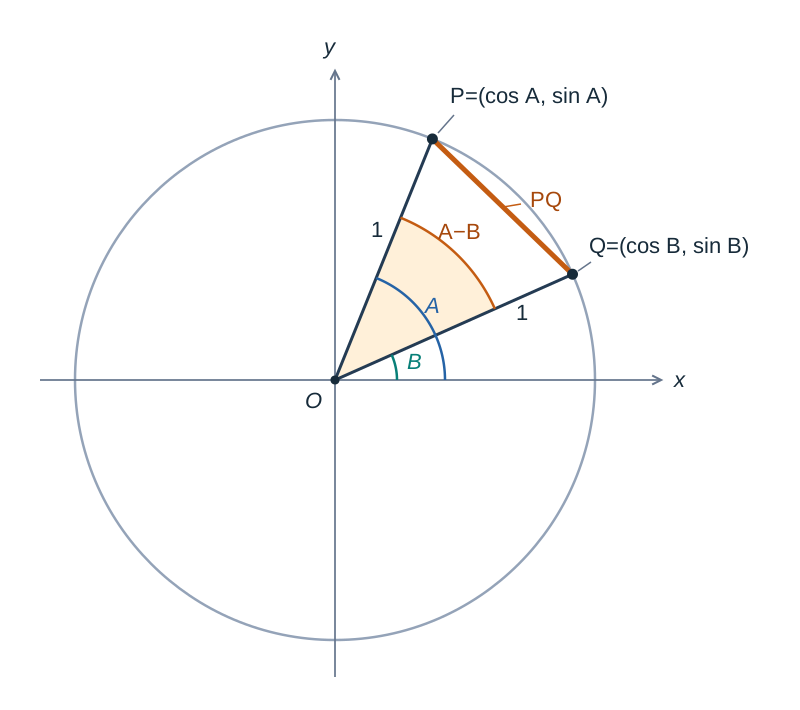
Derivations must follow the order in the booklet. For cos(A-B) (Formula 4): Use the unit circle, centre O, radius 1. Let P=(cos A, sin A) and Q=(cos B, sin B). |PQ|² = (cos A - cos B)² + (sin A - sin B)² = 2 - 2(cos A cos B + sin A sin B). By the cosine rule, |PQ|² = 1² + 1² - 2(1)(1)cos(A-B) = 2 - 2cos(A-B). Equating them gives cos(A-B) = cos A cos B + sin A sin B. For tan(A+B) (Formula 9): tan(A+B) = sin(A+B)/cos(A+B) = (sin A cos B + cos A sin B) / (cos A cos B - sin A sin B). Divide every term by cos A cos B to get (tan A + tan B) / (1 - tan A tan B). For tan(A-B), replace B with -B.
Solving Trigonometric Equations
Follow this recipe: 1. Isolate the trigonometric term. 2. Use identities (like Formula 1 or 11) to get the same ratio and same multiple of θ. 3. Find the reference angle α = inverse of the positive value. 4. Use CAST to pick the quadrants. 5. Write down all values for the multiple angle (e.g., 2θ), adding 360°n/2nπ to capture all solutions. 6. Divide by the coefficient. Rules for General Solutions (n ∈ ℤ): sin θ = sin α ⇒ θ = 360°n + α or θ = 360°n + (180° - α); cos θ = cos α ⇒ θ = 360°n ± α; tan θ = tan α ⇒ θ = 180°n + α (tan repeats every 180°).
Modelling Periodic Phenomena
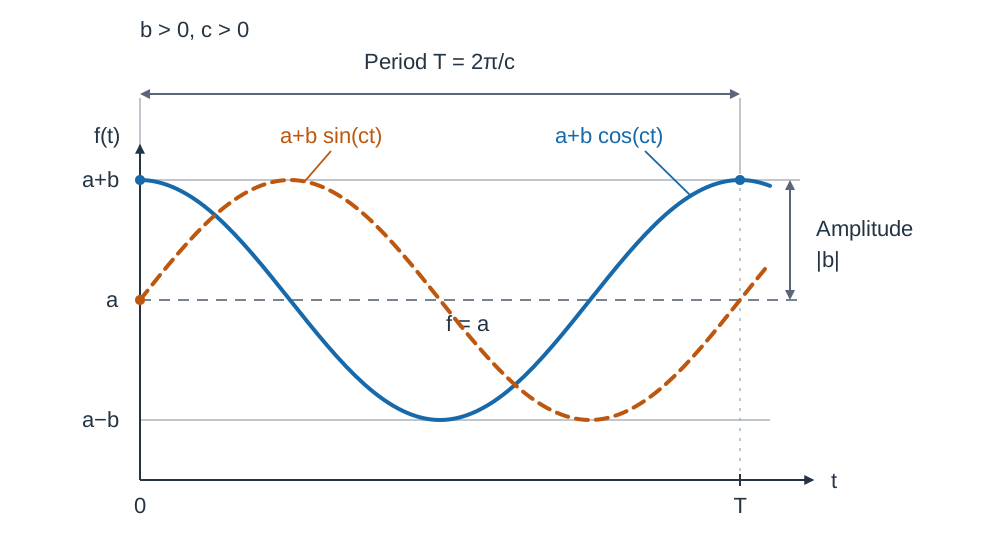
For f(t) = a + b cos(ct) or a + b sin(ct): The central axis is a = (max + min)/2; the amplitude is |b| = (max - min)/2; the period is T = 2π/|c|, so c = 2π/T. If the model starts at a maximum at t = 0, use cosine. If it starts on the central axis, use sine. Always use RAD when differentiation or integration is involved or when the question mentions π.
The Tangent Graph & Identities
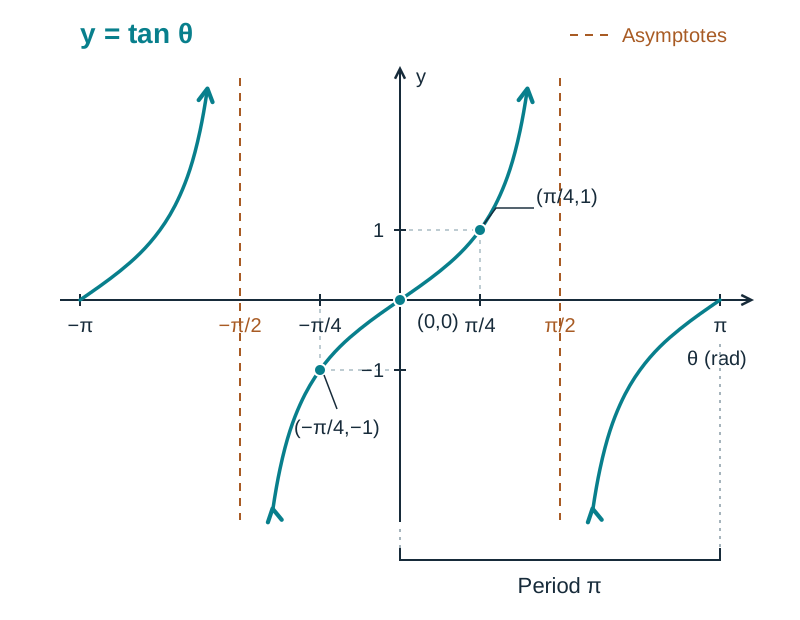
The graph of y = tan θ has vertical asymptotes at θ = π/2 + nπ and period π. It passes through (0,0), (π/4, 1), and (-π/4, -1). For 'Show that' identities, start with the more complex side. If you see sums of sines/cosines, use formulae 21-24: (cos 7A + cos A)/(sin 7A - sin A) becomes (2cos 4A cos 3A)/(2cos 4A sin 3A) = cot 3A.
Key terms
- Amplitude
- The distance from the central axis to the maximum or minimum of a wave, equal to |b|.
- Period
- The horizontal distance for one full wave cycle; 2π/|c| for sin/cos, π/|c| for tan.
- Reference Angle
- The acute angle formed with the x-axis, used to find values in other quadrants via CAST.
- General Solution
- A formula using an integer n to represent all possible angle solutions satisfying an equation.
- Radian
- An angle measure where π radians = 180°; essential for calculus applications.
Check yourself
What is the period of y = sin 4θ?
π/2.
Solve tan θ = 1 for general θ.
θ = 180°n + 45°.
Convert 60° to radians.
π/3.