

Sequences and series are the mathematical language of patterns, covering everything from simple lists to complex financial growth. A sequence is an ordered set of numbers, and a series is the sum of those numbers. At Higher Level, we model evolving growth, loan repayments, and infinite patterns. Success relies on correctly identifying the sequence type, using the right formula from the Formulae and Tables booklet, and mastering rigorous proof techniques like induction.
Identifying Sequence Types
Before starting any calculation, always identify your sequence type using these diagnostic tests. If you subtract T_n - T_{n-1} and get a constant, it is arithmetic with common difference d. If you divide T_n / T_{n-1} and get a constant, it is geometric with common ratio r. If the first difference is not constant, check the second differences; if the second differences are a non-zero constant, it is quadratic (T_n = an^2 + bn + c, with 2a = second difference). Only if the second differences are still not constant and the third differences are a non-zero constant is it cubic.
Arithmetic Sequences and Series
For an arithmetic sequence, the nth term is T_n = a + (n-1)d. The sum of the first n terms is S_n = (n/2)[2a + (n-1)d]. Always remember the vital relationship: T_n = S_n - S_{n-1} for n ≥ 2, and T_1 = S_1. This tool is essential when you are only given a formula for the sum. When calculating the sum of a finite series where you already know the last term l, use the simplified version S_n = (n/2)(a + l).
Geometric Sequences and Series
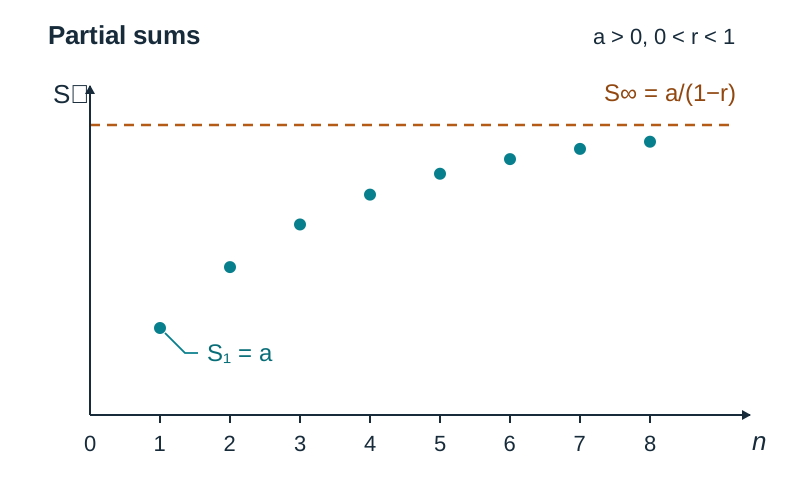
A geometric sequence has the nth term T_n = ar^{n-1} and the finite sum S_n = a(1-r^n)/(1-r) for r ≠ 1. For an infinite series, it only converges if |r| < 1. To derive S_∞, look at the limit of the partial sum: as n tends to infinity, r^n tends to 0, leaving S_∞ = a/(1-r). You may be asked to derive this from memory. For a recurring decimal, a is the first recurring block written as a decimal and r = 1/10^k, where k is the number of digits in the block. Example: 0.454545… = 0.45 + 0.0045 + …, so a = 0.45, r = 0.01, and S_∞ = 0.45/0.99 = 5/11.
Induction Proofs
At Higher Level, you must prove sum identities, inequalities, and factorisation results using induction. The four steps are: 1. Base Case: Show the statement is true for the first value (usually n=1, but n=4 for certain inequalities). 2. Assumption: Assume the statement is true for n=k. 3. Step: Prove it is true for n=k+1 by manipulating the LHS to include the assumption. 4. Conclusion: State that since P(1) is true and P(k) implies P(k+1), it is true for all n in the stated domain.
Financial Maths
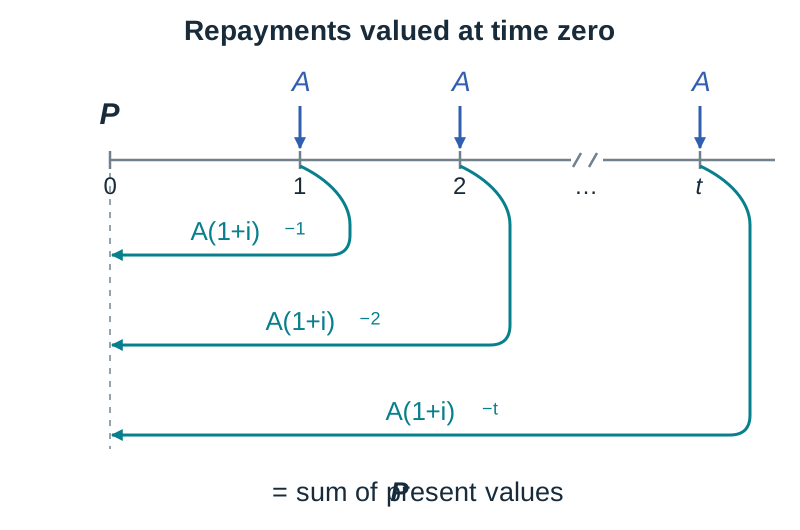
Every repayment or deposit is a geometric series because each subsequent payment is discounted or grown by one extra factor of (1 + i). For amortisation, the repayment A = P * i(1 + i)^t / [(1 + i)^t - 1], where P is the amount borrowed (its present value), i is the interest rate per period written as a decimal, and t is the total number of payments. The present value of a single future amount F is P = F(1 + i)^(-t); the amount borrowed equals the total present value of all the repayments, which is why rearranging the amortisation formula gives P = A[(1 + i)^t - 1]/[i(1 + i)^t]. Always identify the monthly rate i from the AER (I) using i = (1 + I)^(1/12) - 1. Never divide the annual rate by 12. Keep all calculator digits stored until the final rounding step.
Limits and Binomial Theorem
If lim a_n = L and lim b_n = M (both finite), then lim(a_n ± b_n) = L ± M, lim(a_n · b_n) = LM, and lim(a_n / b_n) = L / M provided M ≠ 0. These rules are what let you take the limit of each term separately after dividing by the highest power of n. For rational limits, divide the numerator and denominator by the highest power of n. Recall that lim(n→∞) (1/n^p) = 0 for p > 0. For the Binomial Theorem, (x+y)^n = Σ C(n,k) x^{n-k} y^k. The general term is C(n,k) x^{n-k} y^k; remember that counting starts from 0, so the term in y^k is actually the (k+1)th term.
Key terms
- Common Difference (d)
- The fixed constant added between consecutive terms in an arithmetic sequence.
- Common Ratio (r)
- The fixed constant multiplier between consecutive terms in a geometric sequence.
- Amortisation
- The process of clearing a loan through regular, equal payments that cover both interest and principal.
- Convergent
- A sequence or series that approaches a specific, finite value as n increases.
Check yourself
Is 2, 5, 8, 11, … arithmetic or geometric, and what is T_10?
Arithmetic: differences are all +3, so d = 3 and a = 2. T_10 = 2 + 9(3) = 29.
Does the series 1 + 2 + 4 + 8 have a sum to infinity?
No, because |r| = 2 which is not less than 1.
How do you find the nth term of a sequence with constant second difference 6?
The coefficient of n^2 is 6/2 = 3.