

This note holds every proof and derivation that the Higher Level syllabus asks you to prove or derive: Theorems 11, 12 and 13 on ratios, the trigonometric formulae 1–7 and 9 (with 8, 10 and 11 following on), the irrationality of , the named induction proofs, the two geometric-series derivations, De Moivre's theorem and differentiation from first principles. The proof is usually part (a), with a later part that uses the result. If the proof defeats you, do the later part anyway: you are entitled to use the result you were asked to prove, and those marks are separate. Marks go to a complete, ordered argument with a reason on every line, so each proof is laid out here exactly as you would write it in the answer book.
Theorem 11: parallel lines and transversals
Statement
Given: three parallel lines , and . One transversal meets them at , and , in that order, with . A second transversal meets them at , and , in that order.
To prove: .
Construction: draw parallel to , meeting at and at . Draw parallel to , meeting at . The proof uses the triangles and , and the parallelograms , and .
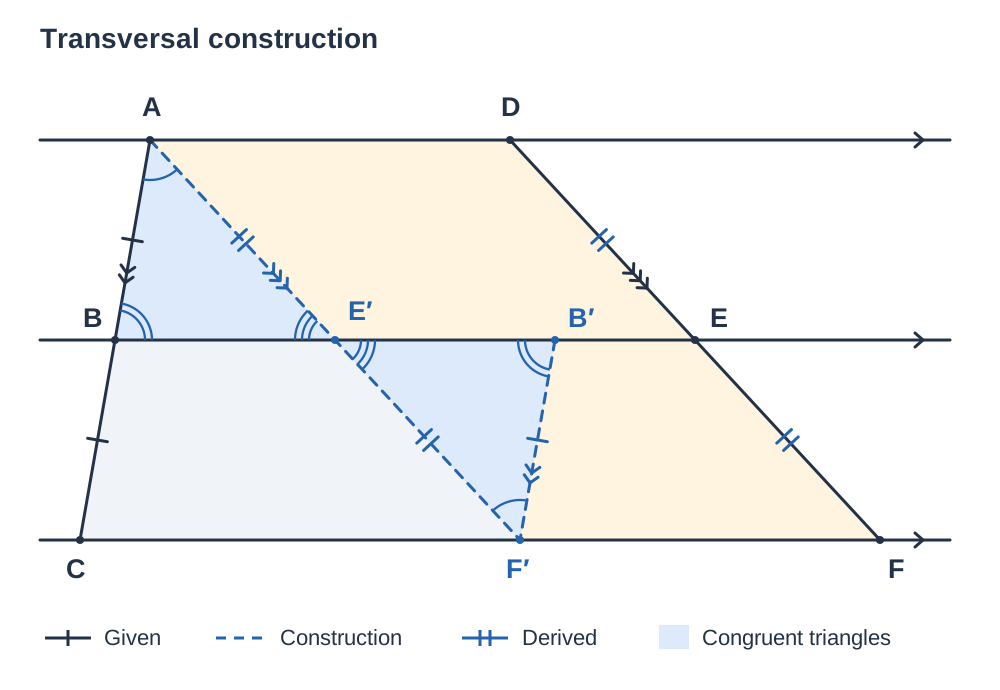
Key idea
The construction copies the given equal lengths into two triangles that meet at . Once those triangles are congruent, three parallelograms carry the lengths back out onto the second transversal.
Proof
- and , so is a parallelogram — was drawn parallel to , and , , lie on one line; lies on and lies on , and is given.
- — Theorem 9: in a parallelogram, opposite sides are equal.
- — step 2 together with the given .
- — Alternate Angles Theorem, with and transversal .
- — vertically opposite angles at , since , , lie on one line and , , lie on the line .
- — the three angles of triangle add to .
- — the three angles of triangle add to .
- — substitute the equal angles of steps 4 and 5 into steps 6 and 7.
- is congruent to — ASA, using (step 4), the included sides (step 3) and (step 8).
- — corresponding sides of congruent triangles.
- and , so is a parallelogram and — the given parallels, the construction, and Theorem 9.
- and , so is a parallelogram and — is given, the line was drawn parallel to the line , and Theorem 9.
- , so — steps 10, 11 and 12. Hence three parallel lines that cut off equal segments on one transversal cut off equal segments on any other transversal.
Where marks are lost
- Starting the proof without stating the construction. Nothing after step 1 makes sense until , and have been introduced.
- Writing with no reason. Name the parallelogram and quote Theorem 9.
- Declaring the triangles congruent without the three matching facts and the case. Steps 4, 3 and 8 are the three facts; ASA is the case.
- Using Theorem 12 or similar triangles. Both come later in the logical order, so quoting them here is circular.
How it is asked
- It has been asked (2024, Paper 2, Question 4(b)) with the parallel lines , , and given in a diagram, and with a reason required for each statement made in the proof.
- In that question the three parallel lines and the equal segments were already printed in the diagram, but the construction lines and were not. Add them to the printed diagram and label , and before you write step 1, because the proof names points that do not otherwise exist on the page.
Theorem 12: a line parallel to a side of a triangle
Statement
Given: a triangle , and a line parallel to meeting at and at , with , where .
To prove: .
Construction: divide into equal segments, using the points . Through each point draw a line parallel to , meeting at , so that and .
This is the commensurable case: and are natural numbers, so both sides can be counted in equal steps. That is the case proved in Geometry for Post-primary School Mathematics, and past questions have stated .
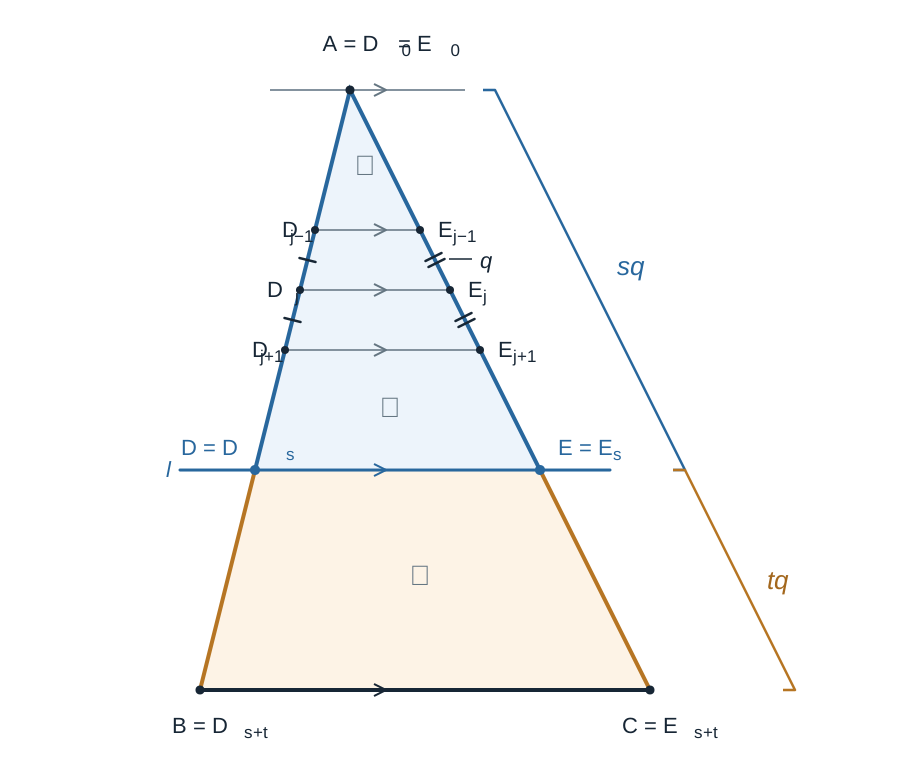
Key idea
Chop into equal steps and send every step across to along lines parallel to . Theorem 11 makes the steps on equal as well, so all that is left is counting them.
Proof
- , so — from we get , since .
- for — the construction divides into equal segments.
- , so — step 2 counted times, step 1, and the Ruler Axiom, which gives only one point at a given distance from along .
- for every — construction, using the Axiom of Parallels: there is exactly one parallel to through each point .
- for — Theorem 11 applied to the three parallel lines , , , which cut off equal segments on the transversal by step 2, and so cut off equal segments on the transversal .
- , where — chain the equalities of step 5 for in turn, and call the common length .
- , so — both lines pass through parallel to , and the Axiom of Parallels allows only one such line.
- — by steps 6 and 7, is made up of the equal segments .
- — by steps 6 and 7, is made up of the equal segments .
- — steps 8 and 9, cancelling .
- So cuts in the ratio , the same ratio in which it cuts , which proves the theorem in the commensurable case.
Where marks are lost
- Leaving out the construction, or dividing into the wrong number of pieces. You need equal segments, which takes marked points.
- Quoting Theorem 11 without saying that it is applied to three neighbouring parallel lines at a time.
- Not explaining why is the same point as . The reason is the Axiom of Parallels (step 7).
- Using similar triangles. Theorem 13 is proved from this theorem, so using it here is circular.
How it is asked
- It has been asked (2018, Paper 2, Question 6(a), and 2025 deferred, Paper 2, Question 5(a)) in the words "prove that if a line is parallel to and cuts in the ratio , where , then it also cuts in the same ratio".
- Both times the answer space was printed as Diagram, Given, To Prove, Construction, Proof, so fill in all five.
Theorem 13: similar triangles
Statement
Given: two similar triangles and , with corresponding vertices , , , so that , and .
To prove:
Construction: name the triangles so that . Mark on with and on with (Ruler Axiom). Draw parallel to , with on .
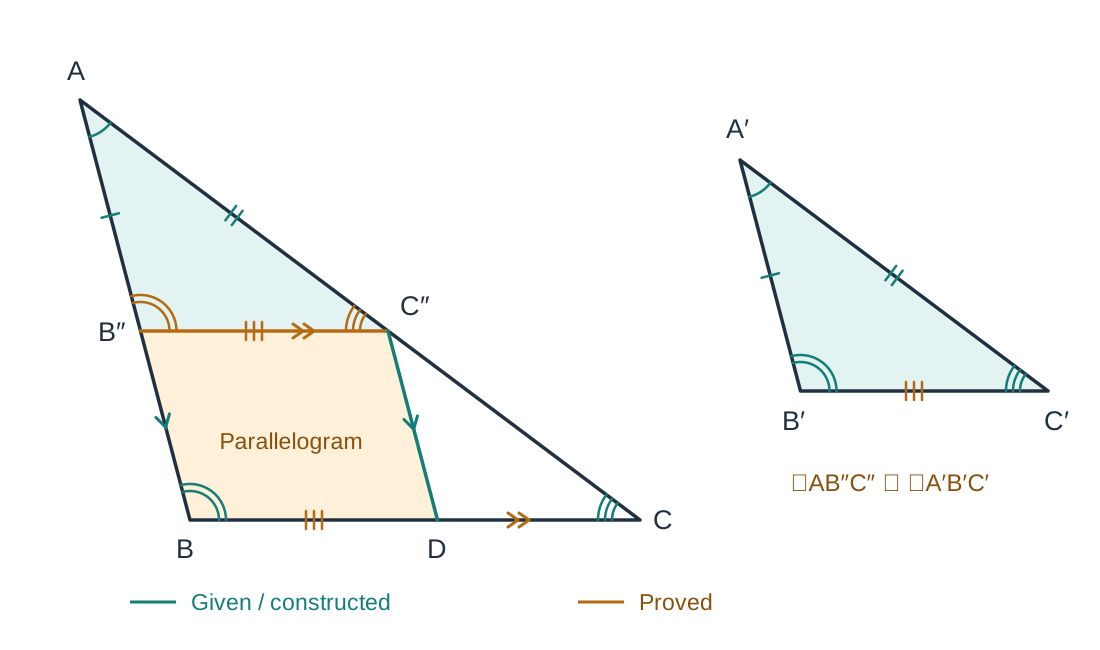
Key idea
Fit a copy of the smaller triangle into the corner at . Its third side turns out to be parallel to , so Theorem 12 supplies the ratios. One extra parallel line, through , delivers the third pair of sides.
Proof
- If , then is congruent to by ASA (the equal angles at and with the included side ), so and , and all three ratios equal . Take from here on.
- , with on , and , with on — construction, by the Ruler Axiom, using and .
- — it is the same angle at .
- — step 3 and the given .
- is congruent to — SAS, using and from step 2 with the included angle from step 4.
- — corresponding angles of the congruent triangles in step 5.
- — step 6 and the given .
- — Theorem 5: two lines are parallel if and only if, for a transversal, corresponding angles are equal; here the transversal is and the equal corresponding angles are those of step 7.
- — Theorem 12 in triangle , since .
- — take reciprocals of step 9; all four lengths are positive.
- — add to both sides of step 10.
- — lies between and .
- — lies between and .
- — substitute steps 12 and 13 into step 11, then use and .
- lies on and , while and lies on , so is a parallelogram — construction and step 8.
- — Theorem 9, opposite sides of the parallelogram in step 15.
- — corresponding sides of the triangles shown congruent in step 5.
- — steps 16 and 17.
- — Theorem 12 in triangle , since .
- — add to both sides of step 19.
- — lies between and .
- — lies between and .
- — substitute steps 21 and 22 into step 20.
- — step 23 with (step 2) and (step 18).
- — combine steps 14 and 24. Hence the sides of similar triangles are proportional, in order.
Where marks are lost
- Starting from proportional sides. Similarity gives you equal angles only; proportional sides are the conclusion, so assuming them is circular.
- Jumping to without the congruence. The parallel comes from equal corresponding angles, which come from step 5.
- Keeping the vertices out of order when writing a congruence or a ratio. must match all the way through.
- Leaving the third ratio unproved. Steps 15 to 24 are where it is earned.
How it is asked
- It has been asked (2021, Paper 2, Question 6(a)) as "prove that if two triangles and are similar, then the lengths of their sides are proportional in order", with printed spaces for Diagram, Given, To Prove, Construction and Proof.
Formula 1: cos²A + sin²A = 1
Statement
For every angle ,
Let be the centre of the unit circle , and let be the point of that circle at the angle measured anticlockwise from the positive -axis, so that .
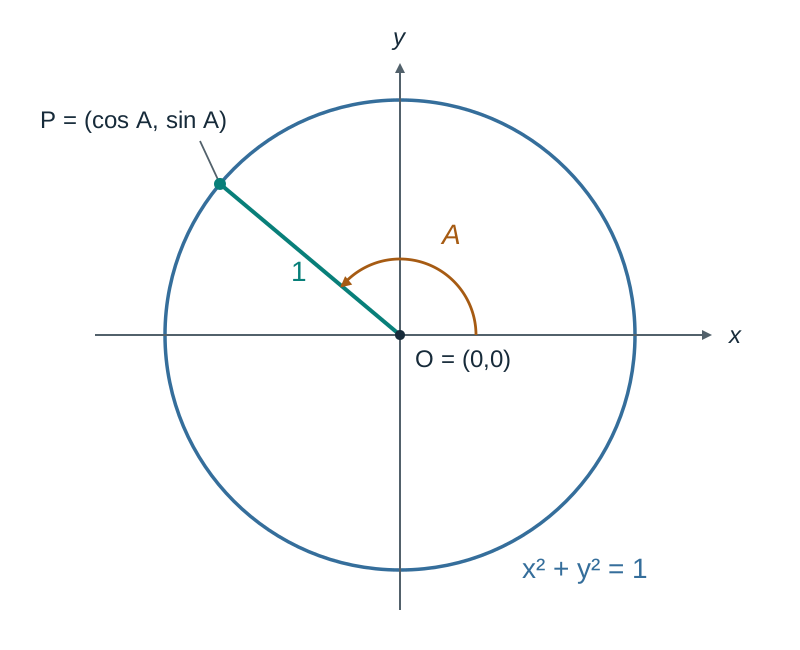
Key idea
Cosine and sine are defined as the co-ordinates of . The distance from to the centre is the radius, , and the distance formula turns that single fact into the identity.
Proof
- — the unit-circle definition of and , which applies to every angle .
- — lies on the unit circle, whose radius is .
- — the distance formula applied to and .
- — steps 2 and 3, subtracting zero inside each bracket.
- — square both sides of step 4. This holds for every angle , because step 1 holds for every angle.
Where marks are lost
- Not saying where the co-ordinates of come from. They are the definition of cosine and sine, so write that as the reason.
- Proving the identity with Pythagoras in a right-angled triangle. That only covers , while the unit circle covers every angle.
- Forgetting that means , and that each co-ordinate is squared separately: the distance formula never produces .
How it is asked
This derivation is on the syllabus and has not been asked as a proof in the supplied papers, though the identity itself has been used, for example to graph from (2026, Paper 2, Question 6(b)).
Formula 2: the sine rule
Statement
In a triangle , let , , also stand for the interior angles, and let , , be the sides opposite them. Then
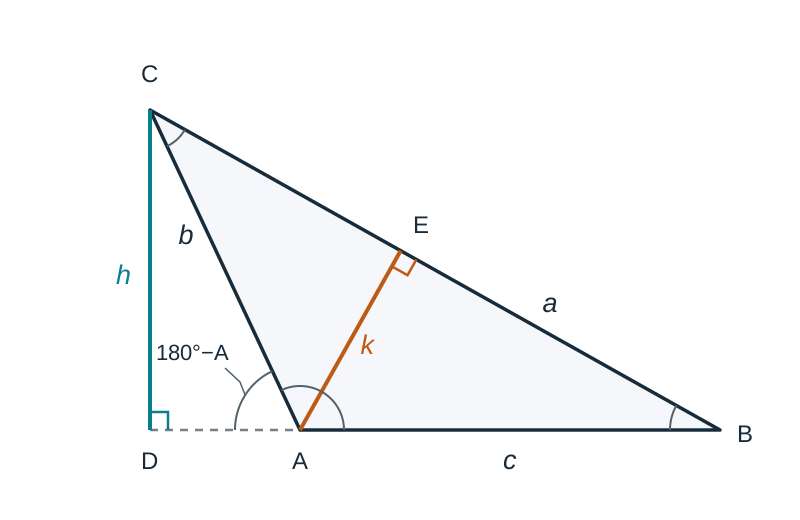
Construction: draw the perpendicular from to the line , with foot , and write . Draw the perpendicular from to the line , with foot , and write . Each interior angle lies strictly between and , so each sine is positive.
Key idea
Write the same height two ways, once with each of the two angles at its ends, and equate. One height gives two of the three ratios, so a second height from another vertex is needed for the third.
Proof
- — on the unit circle the points at and have the same -co-ordinate, and sine is that co-ordinate.
- — if is acute, triangle is right-angled at and ; if is obtuse, lies on produced and the angle is , so by step 1; if then and .
- — the same three cases at : when is acute, when is obtuse, and when .
- — both expressions equal , by steps 2 and 3.
- — divide step 4 by the non-zero product .
- — cancel the common factors in step 5.
- — in the same three cases at for the perpendicular : when is acute, when is obtuse, and when .
- — the same three cases at : when is acute, when is obtuse, and when .
- — both expressions equal , by steps 7 and 8.
- — divide step 9 by the non-zero product .
- — cancel the common factors in step 10.
- — combine steps 6 and 11, which proves the sine rule for every triangle.
Where marks are lost
- Pairing a side with the wrong angle. Match with , with , with every time.
- Not naming the perpendicular height, or not writing both expressions for it.
- Stopping after . One height can never reach .
- Assuming both feet of the perpendiculars lie inside the triangle. If an angle is obtuse, use , as in step 2.
How it is asked
This derivation is on the syllabus and has not been asked as a proof in the supplied papers, though the rule itself has been needed in triangle work, for example with (2024 deferred, Paper 2, Question 4(b)(ii)).
Formula 3: the cosine rule
Statement
In a triangle with , , and the interior angle ,
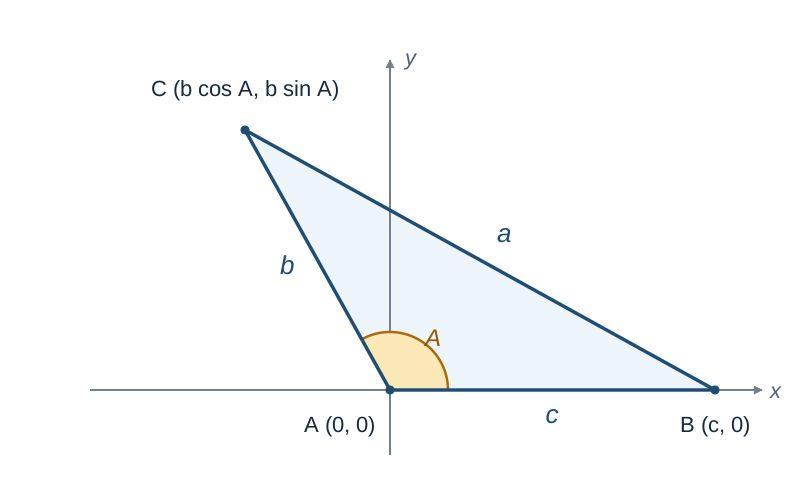
Construction: place at the origin and at on the positive -axis, with above the -axis. Then .
Key idea
Once the triangle sits on the axes, the unknown side joins two points whose co-ordinates you know. Expand the squared distance and let formula 1 collapse the squared sine and cosine into .
Proof
- — is placed on the positive -axis at distance from the origin.
- — the point of the unit circle at angle is , and lies on the same ray from the origin at distance , so each co-ordinate is multiplied by . This holds whether is acute or obtuse.
- — the distance formula applied to and .
- — expand both squares in step 3.
- — collect the two terms containing and factor out.
- — formula 1: .
- — multiply out by , which proves the cosine rule.
Where marks are lost
- Writing down the distance formula before stating the co-ordinates of and . Step 2 is where most of the thinking is, so show it.
- Dropping the middle term when expanding . It is , and it is the whole point of the rule.
- Replacing by with no reason. Name formula 1.
How it is asked
This derivation is on the syllabus and has not been asked as a proof in the supplied papers. It is still worth knowing line by line, because the proof of formula 4 uses the cosine rule.
Formula 4: cos(A − B)
Statement
For angles and ,
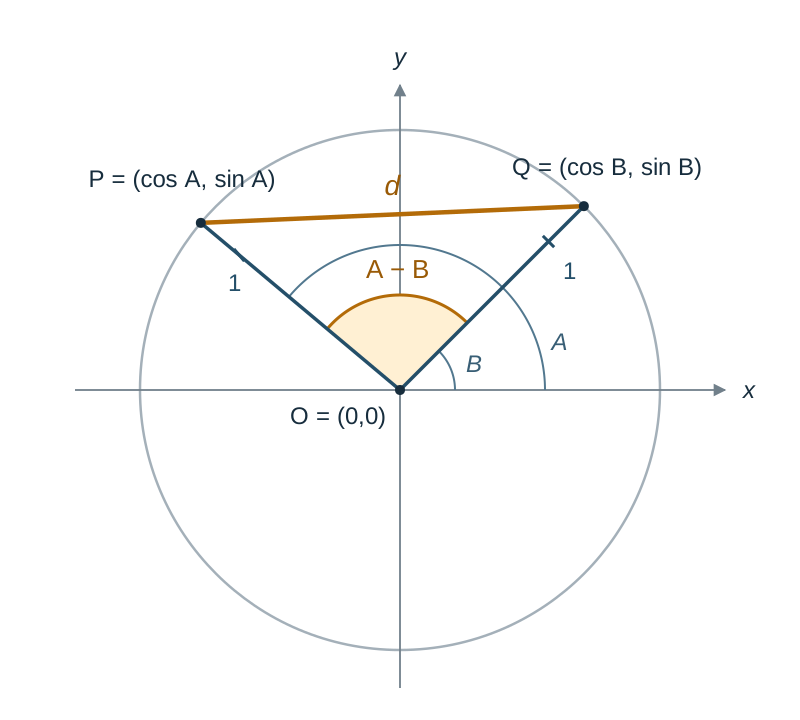
Let be the centre of the unit circle, let be its point at angle and its point at angle , so . Write . Take with , so that , , form a triangle with .
Key idea
Work out the same length, , in two different ways: the distance formula gives products of sines and cosines, while the cosine rule gives . Equating them is the whole proof.
Proof
- — the distance formula applied to and .
- — expand both squares.
- — regroup the six terms.
- — formula 1, used once for and once for .
- — add the constants and take out the factor .
- — formula 3, the cosine rule, in triangle with the angle at .
- — substitute into step 6.
- — the two expressions for , from steps 5 and 7, are equal.
- — subtract from both sides.
- — divide both sides by .
- The two edge cases agree as well: if then , and ; if then is a diameter, and . The derivation above assumed . Both sides of the identity are unchanged if is added to or to , and both sides are unchanged if and are swapped, since and the right-hand side is symmetric in and . Any pair of angles can therefore be reduced to the case already proved, so the identity holds for all angles and .
Where marks are lost
- Not stating the co-ordinates of and , or not saying that the angle between and is .
- Forgetting when substituting into the cosine rule, which leaves the result full of radii.
- Losing a cross term when expanding, so the two products do not appear.
- Using formula 5 or formula 7 to shortcut this. They come after formula 4, so that is circular.
How it is asked
- It has been asked (2026, Paper 2, Question 6(c)) as "prove that where and are angles, with ", with the hint that two points and on the unit circle might help.
Formula 5: cos(A + B)
Statement
For all angles and ,
Key idea
Adding is the same as subtracting , so feed into formula 4. On the unit circle the angle reflects the point in the -axis, which flips the sign of the sine and leaves the cosine alone.
Proof
- The point of the unit circle at angle is the reflection of in the -axis, that is , so and — the unit-circle definitions of cosine and sine.
- — subtracting a negative angle adds it.
- — formula 4, with in place of .
- — substitute step 1 into step 3.
- — multiply out the negative sign, which proves formula 5.
Where marks are lost
- Writing . Cosine is unchanged when the angle changes sign; it is sine that changes sign.
- Replacing only one of the two s, so the sine term keeps the wrong sign.
- Not naming formula 4 as the starting point.
How it is asked
This derivation is on the syllabus and has not been asked as a proof in the supplied papers, but it is used inside formulae 6 and 9 and inside the induction proof of De Moivre's theorem.
Formula 6: cos 2A
Statement
For every angle ,
Key idea
A double angle is a sum of two equal angles, so put into formula 5.
Proof
- — .
- — formula 5, , with .
- — write each repeated product as a square, which proves formula 6.
Where marks are lost
- Starting from or from formula 15. Both are consequences of this formula, so using them is circular.
- Keeping a plus sign between the two squares, which gives instead of .
- Not naming formula 5, or not saying that it is used with .
How it is asked
- It has been asked (2021, Paper 2, Question 4(a)(i)) as "prove that ", with the next part using the result to find from .
- It has also been asked (2025, Paper 1, Question 4(b)) with a different method specified: use De Moivre's theorem on and compare real parts. The worked example "cos 2θ by De Moivre's theorem" shows that route; when a method is named in the question, you must use it.
Formula 7: sin(A + B)
Statement
For all angles and ,
Key idea
Sine is the cosine of the complementary angle. Rewriting as turns the problem into a cosine difference, which formula 4 already handles.
Proof
- for every angle — formula 4 with and , together with and .
- — step 1 with replaced by .
- — step 1 with .
- — remove the bracket and regroup.
- — substitute step 4 into step 3.
- — formula 4, applied to the difference in step 5.
- — substitute from step 1 and from step 2, which proves formula 7.
Also follows
Formula 8: , using formula 7 with and .
Formula 11: , using formula 7 with .
Where marks are lost
- Using with no justification. Step 1 derives it from formula 4 in one line, so include it.
- Dropping the bracket and writing instead of .
- Expanding the cosine difference with a minus sign between its products. Formula 4 has a plus.
- Starting from formula 8 or 11. Both come after formula 7.
How it is asked
- It has been asked (2023 deferred, Paper 2, Question 4(a)(i)) as "prove that ", followed by a part finding and from .
- The consequence has been asked (2024 deferred, Paper 2, Question 4(b)(i)), with the next part using it alongside the sine rule.
Formula 9: tan(A + B)
Statement
For angles and with , and , so that every tangent and denominator below exists,
Key idea
Tangent is sine over cosine. Expand the top with formula 7 and the bottom with formula 5, then divide every single term above and below by so each piece turns into a tangent.
Proof
- — the definition of tangent; the denominator is non-zero by assumption.
- — formula 7 in the numerator and formula 5 in the denominator.
- — divide every term above and below by the non-zero product .
- — cancel the common non-zero factors in each of the four fractions.
- — formula 5 and the condition , which confirms the final denominator is not zero.
- — apply the definition of tangent to each quotient in step 4, which proves formula 9.
Also follows
Formula 10: , by formulae 8 and 4. Dividing every term above and below by gives
The same result comes from replacing by in formula 9, using . It needs , and .
Where marks are lost
- Dividing only the numerator by . Every term, above and below, must be divided by the same product.
- Mixing up the signs: addition on top goes with subtraction underneath, and the other way around for formula 10.
- Not naming the formulae that expand and .
How it is asked
- Formula 10 has been asked (2022, Paper 2, Question 4(a)(i)) as "prove that ", with the next part writing in surd form.
- Formula 9 itself is on the syllabus and has not been asked as a proof in the supplied papers.
√2 is not rational
Statement
Prove that is not a rational number: it cannot be written as with and .
Key idea
This is a proof by contradiction. Assume is a fraction already in its lowest terms, then show the equation forces both the top and the bottom to be even. That breaks "lowest terms", so the assumption has to go.
Proof
- Assume , where , and , have no common factor — assume the opposite of what is to be proved; any fraction can be reduced to lowest terms, so this costs nothing.
- — square both sides of step 1.
- — multiply step 2 by .
- is even — step 3 shows it is times the integer .
- If an integer is odd, with , and , which is odd — expansion, so an even square cannot come from an odd integer.
- is even, so for some — steps 4 and 5, and the definition of an even number.
- — substitute into step 3.
- — square .
- — divide step 8 by and swap the sides.
- is even, so is even — step 9 shows is times the integer , and step 5 rules out being odd.
- and are both divisible by , so they have the common factor — steps 6 and 10.
- Step 11 contradicts step 1, where and were chosen with no common factor. So the assumption in step 1 is false, and is not a rational number.
Where marks are lost
- Leaving "no common factor" out of the first line. Without it there is nothing to contradict at the end, and the proof collapses.
- Writing " is even so is even" with no reason. Step 5 is the reason, and it is one line.
- Finding the common factor but never saying what it contradicts, or never stating the conclusion in words.
How it is asked
- It has been asked (2023, Paper 1, Question 3(a)) as "prove that is not a rational number".
- It has also been asked (2019, Paper 1, Question 6(b)) as "prove, using contradiction, that is not a rational number", so the first line must be the assumption.
Induction: sum of the first n natural numbers
Statement
For all ,
The syllabus names this as an example of an identity proved by induction, so a question may give a different identity of the same type, proved by the same method.
Key idea
Check the first case. Then show that whenever the formula works for some , adding the next term makes it work for . Like dominoes, those two facts cover every natural number. If instead the question supplies a recurrence such as , the recurrence replaces "add the next term": start the step at , substitute the inductive hypothesis , and simplify , which is the target with in place of .
Proof
- Let be the statement .
- Base case : — the sum has only its first term.
- , so and is true — substitution into the formula.
- Assume is true for some : — the inductive hypothesis.
- To prove : — replace by in the statement, noting that .
- — add the next term, , to both sides of step 4.
- — write the second term over the denominator .
- — add the two fractions.
- — take the common factor out of the numerator.
- This is exactly the right-hand side in step 5, so is true whenever is true.
- is true, and true implies true, so by induction for all .
Where marks are lost
- Writing "true for " with no working. Evaluate the left side and the right side separately and state that they are equal.
- Not writing the inductive hypothesis out in full, which leaves you nothing to substitute in step 6.
- Not writing down the target for , so you have nothing to factorise towards.
- Multiplying the numerator out instead of taking out, which hides the result.
- Leaving out the closing sentence that joins the base case to the implication.
How it is asked
- It has been asked (2025 deferred, Paper 1, Question 2(a), and 2024 deferred, Paper 1, Question 2(b)) as "prove by induction" this exact identity.
- The same method has been asked for the sum of the first squares (2020, Paper 1, Question 7(d)) and for the formula built from a given recurrence (2025, Paper 1, Question 10(e)(ii)).
Induction: sum of a finite geometric series
Statement
For with , and for all ,
The syllabus names this as an example of an identity proved by induction, so a question may give a different identity of the same type, proved by the same method. When the sum is just and the fraction is undefined, which is why is stated.
Key idea
The structure is the same as any induction identity. The one new skill is adding onto a fraction whose denominator is , which sets up a cancellation.
Proof
- Let be the statement .
- Base case : — with there is one term, .
- , so and is true — cancel , which is allowed since .
- Assume for some : — the inductive hypothesis.
- To prove : — a sum of terms ends with the exponent .
- — add the next term, , to both sides of step 4.
- — put both terms over the common denominator .
- — expand both products in the numerator, using .
- — the terms and cancel.
- — take out the common factor , which is exactly the right-hand side in step 5, so is true whenever is true.
- is true, and true implies true, so by induction the formula holds for all , provided .
Where marks are lost
- Adding the wrong next term. With terms the last exponent is , so the new term is , not .
- Multiplying the new term by only part of the denominator. It must become .
- Leaving out , which the base case needs before you can cancel.
How it is asked
This induction example is on the syllabus and has not been asked as a proof in the supplied papers. The formula itself is used in the two geometric-series derivations later in this note.
Induction: a factorial inequality (n! > 2ⁿ)
Statement
For every integer ,
where .
The syllabus names this as an example of an inequality proved by induction, so a question may give a different inequality of the same type, proved by the same method. The syllabus prints it with no starting value, but it is false for (since , and ) and true from on, so the base case is .
Key idea
Going from to multiplies the left side by , which is at least . Going from to only multiplies the right side by . The left side pulls further ahead at every step.
Proof
- Let be the statement , for integers .
- Base case : — the definition of factorial.
- , and , so is true — evaluate the power and compare.
- Assume for some integer : — the inductive hypothesis.
- To prove : .
- — the definition of factorial.
- — multiply both sides of step 4 by the positive number .
- — because .
- — multiply step 8 by the positive number .
- — the law of indices for multiplying powers of the same base.
- , so and is true — chain steps 6, 7, 9 and 10.
- is true, and true implies true for every integer , so by induction for every integer .
Where marks are lost
- Starting the base case at , where the statement is false. Check the starting value before you write anything.
- Treating as . The factorial definition multiplies, as in step 6.
- Stopping at . That is not the target; step 9 is what finishes it.
- Writing a chain of inequalities with no reason on each link, especially the reason behind .
How it is asked
- The exact syllabus statement has not appeared in the supplied papers, but the same proof with a different base has been asked (2026, Paper 1, Question 6(a)): "prove by induction that the following is true for all and : ". The step is identical except that you compare with .
Induction: a power inequality (2ⁿ ≥ n²)
Statement
For every integer ,
The syllabus names this as an example of an inequality proved by induction, so a question may give a different inequality of the same type, proved by the same method. The starting value matters: at , .
Key idea
Doubling the assumption gives , which is not yet the target. A separate piece of quadratic algebra is needed to show that already beats once .
Proof
- Let be the statement , for integers .
- Base case : — evaluate the power.
- , and , so is true — the inequality is not strict, so equality is fine here.
- Assume for some integer : — the inductive hypothesis.
- To prove : .
- — the law of indices, then multiply step 4 by the positive number .
- — expand in the difference between what step 6 gives and what is wanted.
- — collect like terms in step 7.
- — complete the square.
- , so and — subtract , then square two non-negative quantities.
- — subtract from step 10.
- , so — steps 8, 9 and 11.
- , so and is true — combine steps 6 and 12.
- is true, and true implies true for every integer , so by induction for every integer .
Where marks are lost
- Stopping at . The gap between and is where the marks are.
- Claiming with no algebra. Steps 7 to 12 are short, so show them.
- Never using . It is the only reason the difference stays positive.
- Changing into in the statement. At the two sides are equal.
How it is asked
- This exact statement has not appeared in the supplied papers. The same exponential-against-polynomial method has been asked (2019, Paper 1, Question 2(b)): prove using induction that for , where and .
Induction: Bernoulli's inequality, (1 + x)ⁿ ≥ 1 + nx
Statement
For a fixed real number and every ,
The syllabus names this as an example of an inequality proved by induction, so a question may give a different inequality of the same type, proved by the same method.
Key idea
The condition makes positive, so multiplying the assumption by it keeps the inequality the same way round. Expanding then leaves a spare term , which can never be negative, so it can be dropped.
Proof
- Let be the statement , for a fixed real .
- Base case : — a first power equals its base.
- , so and is true — substitution; equality satisfies .
- Assume for some , with the same : — the inductive hypothesis.
- To prove : .
- , so — add to both sides of the given condition.
- — the law of indices.
- — multiply step 4 by , which is positive by step 6, so the inequality sign does not flip.
- — multiply out the two brackets.
- — collect the two terms in .
- — and the square of a real number is never negative.
- — by step 11, dropping a non-negative term cannot increase the value.
- , so is true — chain steps 7 to 12.
- is true, and true implies true, so by induction for all and all real .
Where marks are lost
- Multiplying by without saying why the inequality sign stays as it is. Step 6 is the reason and it takes one line.
- Assuming is positive. The statement includes , where is negative but is still positive.
- Dropping silently instead of justifying that it is non-negative.
- Leaving the condition out of the statement and the closing line.
How it is asked
This induction example is on the syllabus and has not been asked as a proof in the supplied papers. Treat it as practice for any inequality where the step multiplies both sides by a bracket whose sign you must check.
Induction: a divisibility result (3 is a factor of 4ⁿ − 1)
Statement
For every , is a factor of ; that is, is an integer multiple of .
The syllabus names this as an example of a factorisation result proved by induction, so a question may give a different divisibility statement of the same type, proved by the same method.
Key idea
Turn "divisible by " into an equation you can substitute into: , so . Then write as , substitute, and take a factor of out of what is left.
Proof
- Let be the statement " is a factor of ".
- Base case : , with , so is true — evaluate at the starting value and display the integer multiple.
- Assume for some : for some — the inductive hypothesis, written as an equation.
- — add to both sides of step 3.
- To prove : is a factor of .
- — the law of indices.
- — substitute step 4.
- — multiply out the bracket.
- — simplify .
- — take the factor out.
- , because and integers stay integers under multiplication and addition, so is a factor of and is true.
- is true, and true implies true, so by induction is a factor of for every .
Where marks are lost
- Writing "assume is divisible by " and never turning it into . Without the equation there is nothing to substitute.
- Treating as rather than .
- Finishing at without factorising, so the factor is never shown.
- Not saying that the second factor is an integer, which is what "is a factor" requires.
How it is asked
- This exact statement has not appeared in the supplied papers, but the same method has been asked twice: "prove by induction that is divisible by for all " (2023 deferred, Paper 1, Question 4(a)) and "prove using induction that is divisible by for all " (2021, Paper 1, Question 4(a)).
The mortgage repayment (amortisation) formula
Statement
A sum is borrowed. The interest rate per repayment period is a fixed decimal , and the loan is cleared by equal repayments of , each made at the end of a period, with no other charges. Then
The syllabus names deriving this formula as an example of a financial application of geometric series. The formula is printed in the Formulae and Tables booklet, but a derivation question wants every line below.
Key idea
A repayment of due periods from now has present value , because that amount invested now would grow to exactly . Since the repayments fall at the end of each period, the first one is already discounted once. The loan is cleared when the amount borrowed equals the total of those present values, and that total is a finite geometric series.
Proof
- The repayment due at the end of period has present value with , so — compound interest over periods at rate .
- — the sum borrowed equals the total present value of the repayments, using step 1 for .
- The right-hand side of step 2 is a geometric series with first term , common ratio and terms, and because — each term is the previous one multiplied by .
- — the formula for the sum of a finite geometric series, with the values from step 3.
- — write the denominator as a single fraction.
- — substitute step 5, and divide by a fraction by multiplying by its reciprocal.
- — cancel the non-zero factor .
- — common denominator.
- — substitute step 8 into step 7.
- — multiply both sides of step 9 by .
- — divide by , which is positive because . This is the repayment formula.
Where marks are lost
- Not saying why the present values are added, that is, why equals the total of the discounted repayments.
- Getting the first term wrong. With repayments at the end of each period, the first present value is , not .
- Not naming the geometric series, or not stating and before using the sum formula.
- Mishandling the stacked fraction in step 4. Tidy the denominator first, as in step 5.
- Using a yearly rate with monthly repayments. The rate must be the rate for one repayment period, written as a decimal.
How it is asked
This derivation is named by the syllabus and has not been asked in the supplied papers, so learn the five-line skeleton: present value, sum of present values, identify and , sum the series, solve for .
Sum to infinity of a geometric series
Statement
For a geometric series with first term and common ratio , where ,
Here means the limit of the partial sums as , and is the same as .
Key idea
Do not put infinity into the formula as if it were a number. Start from the finite sum, which contains , and let the number of terms grow: multiplying by again and again shrinks towards zero.
Proof
- — the definition of the partial sum of the first terms.
- — the formula for the sum of a finite geometric series; guarantees .
- — split the fraction in step 2 into two terms.
- — each extra factor multiplies the size by , so the powers shrink towards zero.
- — the definition of the sum to infinity.
- — apply step 5 to step 3, using the rules for the limit of a difference and of a constant multiple; the constant is well defined since .
- — substitute step 4.
- for — which proves the formula as the limit of the sequence of partial sums.
- If and , then does not tend to , so the partial sums have no finite limit and the formula does not apply.
Where marks are lost
- Writing instead of . A ratio such as satisfies but the series has no sum to infinity.
- Writing "" instead of .
- Starting from the answer. A derivation must begin with and take a limit.
How it is asked
This derivation is on the syllabus and has not been asked in the supplied papers, though the limit idea has been examined directly, for example evaluating (2025, Paper 1, Question 10(d)(iii)).
De Moivre's theorem by induction
Statement
For every angle and every , with ,
Key idea
To climb from power to power , multiply by one more factor of . Once is replaced by , the real part and the imaginary part are exactly the expansions of and .
Proof
- Let be the statement .
- Base case : — a first power equals its base.
- , so and is true.
- Assume for some : — the inductive hypothesis.
- To prove : .
- — the law of indices.
- — substitute step 4.
- — multiply out all four products.
- — replace by and group the real and imaginary parts.
- — formula 5, the cosine addition formula.
- — formula 7, the sine addition formula.
- — substitute steps 10 and 11 into step 9 and factor the angle, so is true.
- is true, and true implies true, so by induction for every .
Where marks are lost
- Leaving in place, which leaves the real part wrong by a sign.
- Collecting the real and imaginary parts without showing the four products first.
- Not naming formulae 5 and 7 at steps 10 and 11.
- Using De Moivre's theorem itself, or the "multiply the moduli, add the arguments" rule, inside the step. That assumes what is being proved.
How it is asked
- It has been asked (2018, Paper 1, Question 4(a)) as "prove, using induction, that if is a positive integer then , where ", with a "hence" part evaluating .
- The theorem is also the tool for root questions — finding values of with has been asked (2025, Paper 1, Question 4(c)) — so the induction proof typically sits as part (a) of a question whose later parts use the theorem with a fractional index.
Differentiation from first principles
Statement
For , where , , are real constants,
The difference quotient is formed for . Putting gives the linear case with .
The syllabus names linear and quadratic functions as the type for this method, so it is a method rather than one fixed proof: you apply the same four steps to whatever function the question gives, and past questions have given a particular quadratic each time.
Key idea
is the slope of the line joining the points at and . Expand and cancel first, divide by , and only then let shrink to zero, when that chord slope becomes the slope of the tangent.
Proof
- — the definition of the derivative from first principles.
- — replace every input by .
- — expand the square and the linear bracket.
- — multiply across the three terms.
- — subtract the whole of , in brackets.
- — distribute the minus sign across the bracket.
- — the pairs , and cancel.
- — take out the common factor .
- — divide by and cancel, which is allowed because .
- — substitute step 9 into step 1.
- — let ; only the term containing disappears.
- Linear case: putting gives and , by the same calculation.
Where marks are lost
- Forgetting the brackets in step 5, so only is subtracted and the and terms are added back by mistake.
- Expanding as , which kills the whole derivative.
- Putting before dividing by . At that point the quotient is undefined, so the division has to come first.
- Dropping the "" from the lines where it belongs, or differentiating by rule. A first-principles question gets no credit for the power rule, though it is a fine way to check your answer.
How it is asked
- It has been asked for a numerical quadratic: (2024, Paper 1, Question 4(a)) and (2022, Paper 1, Question 6(a)).
- It has been asked for a product of two linear expressions, (2020, Paper 1, Question 6(a)). Multiply it out into a quadratic first, then follow the same four steps.
Key terms
- Axiom
- A statement accepted as true without proof, used as a starting point. Examples in the geometry course are the Axiom of Parallels (exactly one parallel to a given line through a given point), the Ruler Axiom and the congruence axiom SAS + ASA + SSS.
- Theorem and proof
- A theorem is a statement established by argument. Its proof is a chain of statements, each following from the ones before it for a stated reason (axiom, definition, earlier theorem or algebra), ending in exactly what was to be shown.
- Corollary
- A result that follows quickly from a theorem just proved. For instance, the result that each angle in a semi-circle is a right angle is a corollary of the theorem that the angle at the centre of a circle is twice the angle at the circle.
- Converse
- The statement with the hypothesis and conclusion swapped. The converse of Theorem 12 is: if a line cuts two sides of a triangle in the same ratio, it is parallel to the third side. A converse is not automatically true and needs its own proof.
- Implies ()
- "" means that whenever is true, must be true.
- Is equivalent to; if and only if ()
- "" means both and : each is true exactly when the other is. Both directions need justification.
- Proof by contradiction
- Assume the opposite of what you want to prove and reason until something impossible appears. The assumption must then be false, so the original statement stands.
- Proof by induction
- Prove a statement for a starting value, then prove that true forces true for an arbitrary allowed . Together these give for every integer from the starting value on.
- Inductive hypothesis
- The explicit assumption, written out in full, that the statement holds for . It is the only thing you are allowed to assume in the step.
- Congruent triangles
- Triangles whose corresponding sides and angles are all equal. Congruence is established by SAS (two sides and the angle between them), ASA (two angles and the side between them) or SSS.
- Similar triangles
- Triangles whose three angles are equal, respectively, to the three angles of the other. Theorem 13 is what proves that their sides are then proportional.
- Transversal
- A line that meets two or more of the lines under discussion. Theorems 11 and 12 are both about what parallel lines do to a transversal.
- Divides in the ratio
- A point on the line , lying between and , with . If and are natural numbers the ratio is commensurable, so both parts can be counted in equal steps.
- Divisibility
- " is a factor of " means for some integer . Naming that integer multiple is the step that finishes a divisibility proof.
- Present value
- What a future payment is worth now. A payment due periods from now, at rate per period, has present value .
- Difference quotient
- The expression , formed for . Its limit as is the derivative .
Check yourself
In the proof of Theorem 11, which two triangles are shown congruent, and by which case?
Triangles and , by ASA: the angles at and are alternate angles, the included sides satisfy (parallelogram and the given ), and the angles at and then match because the angles of each triangle add to .
In the proof of Theorem 12, why is the same point as ?
The line and the line both pass through parallel to . The Axiom of Parallels allows only one such line, so they are the same line and .
Why would it be circular to start the proof of Theorem 13 from proportional sides?
Proportional sides are the conclusion of the theorem. All you are given is that corresponding angles are equal, so the proof must start there and reach the ratios through congruence, parallels and Theorem 12.
Which two calculations are equated in the proof of formula 4, and which earlier formulae do they use?
The squared chord length , worked out with the distance formula (tidied by formula 1) and with the cosine rule, formula 3, in triangle where .
How do formulae 8 and 11 come out of formula 7?
Replace by , with and , to get . Put to get .
Why must the fraction in the proof be in lowest terms?
The contradiction is that both the numerator and the denominator turn out to be even. That only contradicts something if you began by saying they have no common factor.
Why does the induction proof of begin at ?
The statement is false for (, , ) and first holds at , where .
In Bernoulli's inequality, what does the condition do for the proof?
It makes positive, so multiplying the assumption by leaves the inequality sign the same way round.
In the induction proof of De Moivre's theorem, where is used, and which two formulae finish the step?
When the fourth product becomes , which is what makes the real part a cosine of a sum. Formula 5 then gives and formula 7 gives .
Why can you not find by putting into ?
Infinity is not a number you can substitute. You take the limit of the sequence of partial sums: and because , so .