

Indices and logarithms are fundamental tools for modelling growth and decay. Indices provide a shorthand for repeated multiplication, while logarithms act as their inverse, letting you bring an unknown exponent down out of a power so you can solve it. These concepts are essential for solving growth models in finance, population dynamics, and probability, as well as for calculus where you will differentiate and integrate exponential and logarithmic functions.
The Laws of Indices
An index indicates how many times a base is multiplied by itself. The index laws are found in your Formulae and Tables booklet. Key rules: 1. (add indices). 2. (subtract indices). 3. (multiply indices). 4. (the power applies to every term inside). 5. . 6. (). 7. . 8. . Always take the root first to keep numbers small. Note that rules 1 and 2 (adding and subtracting indices) only work when the bases are identical; rules 4 and 5 are the ones that let you split a power over a product or quotient.
Logarithms and Natural Logs
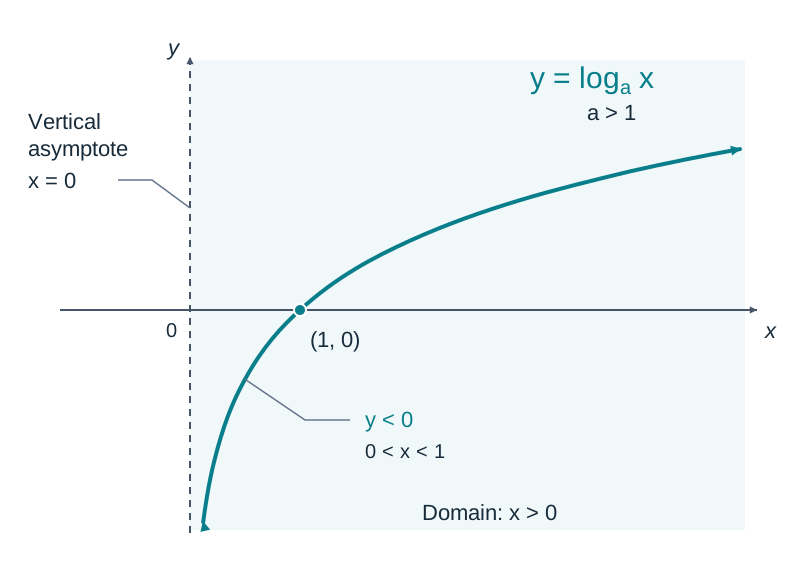
A logarithm asks the question: 'To what power must I raise the base to get this value?' The rule defines the link, where the base and , and the argument (you can never take the log of zero or a negative number — this is why only exists for ). A natural log (ln) uses base and is essential for growth models. Log rules: 1. . 2. . 3. . 4. and . 5. Change of base: . There is no rule for the log of a sum: is not . Using that false rule loses marks.
Solving Equations and Inequalities
For exponential equations with matching bases, write both sides to the same base and equate the indices. If bases do not match (e.g., ), take logs of both sides. If two powers of the same base appear (e.g. and ), write Let — then and the equation becomes a quadratic in . Solve for , then return to for each root, rejecting any negative value of because a positive base to any power is positive. For log equations, combine terms into a single log on each side, convert to index form, and solve. In inequalities, if you divide by a negative log (the log of any number between 0 and 1 is negative), the inequality sign reverses. Always substitute your final answers back into the original equation; any result that makes a log argument zero or negative must be rejected as an extraneous solution.
Graphs and Growth Models
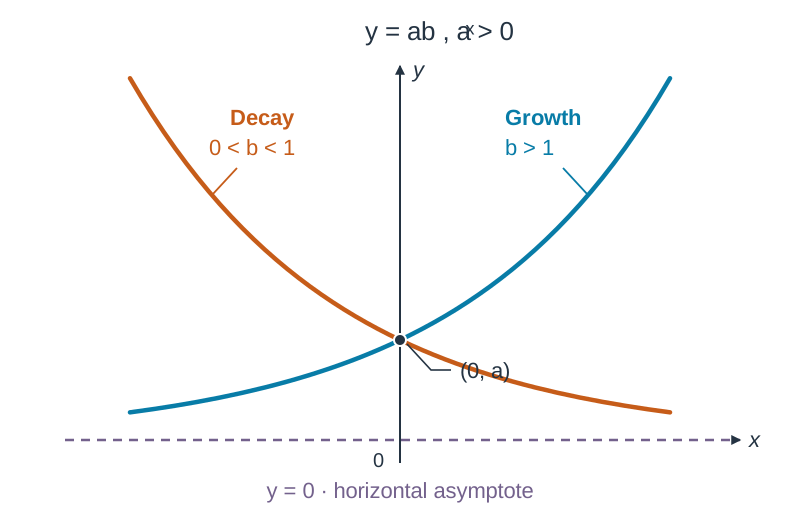
The function has as the y-intercept and as the growth () or decay () factor. It has a horizontal asymptote at . The function has a vertical asymptote at . In growth/decay models , the constant is found by taking of both sides. If the answer counts whole objects (years, swings, trials), round up to the nearest whole integer if the target inequality requires it.
Scientific Notation
Numbers in the form () are standard for scientific context. When multiplying, multiply the coefficients and add the powers of 10. When adding, you must match the powers of 10 first. Always adjust the final coefficient if it exceeds 10; e.g., becomes .
Key terms
- Index Laws
- Algebraic rules for simplifying powers, such as adding indices when multiplying terms with the same base.
- Change of Base
- A technique using the formula to evaluate logs using only the or buttons.
- Extraneous Solution
- A mathematical solution that must be rejected because it results in a non-positive log argument.
- Natural Log (ln)
- A logarithm with base ; used extensively in growth models and calculus.
- Asymptote
- A line that a graph approaches but never touches, such as for exponential functions.
Check yourself
Simplify .
because .
Find the least whole number such that .
, since .
Solve .
, since .