

Synthetic geometry at Leaving Certificate Higher Level moves from discovery to a formal, deductive system. It is built on axioms (accepted truths) and theorems (logical results). You must master the language of proof, including terms like converse, implication, and contradiction. Higher Level candidates are specifically responsible for the formal proofs of ratio Theorems 11, 12, and 13, and must be able to perform constructions 16–22. Constructions 16 and 17 must be done with compass and straight-edge only, and construction 18 without a protractor or set square.
The Logical Hierarchy
Geometric knowledge follows a strict hierarchy. An axiom is a statement we accept as true without proof, used as a starting point for argument. We use five: the Two Points Axiom, the Ruler Axiom, the Protractor Axiom, SAS+ASA+SSS (congruence), and the Axiom of Parallels. A theorem is a statement proven true through logical steps, using only axioms and results that come before it in the course sequence. A corollary is a short extra result that follows immediately from a theorem. If you use a later theorem, you may be quietly assuming the very thing you are trying to prove.
Formal Proofs: Theorems 11, 12, and 13
Theorems 11, 12, and 13 are the three proofs the syllabus names as ones you may be asked to reproduce at Higher Level. Junior Certificate Higher Level material is assumed knowledge, so keep the standard arguments (angle sum of a triangle, alternate angles, Pythagoras) at your fingertips too.
Theorem 11. If three parallel lines cut off equal segments on some transversal line, then they will cut off equal segments on any other transversal.
Given: Three parallel lines , and a transversal line cutting them at , , and with . A second transversal line cuts the parallel lines at , , and .
To prove: .
Construction: Through , draw a line parallel to , meeting at and at .
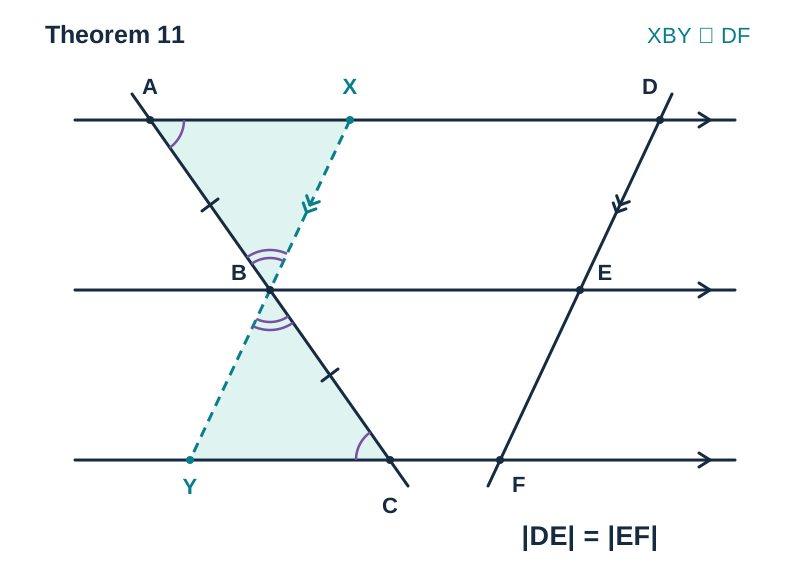
Proof:
- Statement: is a parallelogram. Reason: (given) and (by construction).
- Statement: . Reason: Opposite sides of a parallelogram are equal (Theorem 9).
- Statement: is a parallelogram. Reason: (given) and (by construction).
- Statement: . Reason: Opposite sides of a parallelogram are equal (Theorem 9).
- Statement: . Reason: Given ().
- Statement: . Reason: Alternate angles ().
- Statement: . Reason: Vertically opposite angles.
- Statement: . Reason: ASA.
- Statement: . Reason: Corresponding sides in congruent triangles.
- Statement: . Reason: Since and . Q.E.D.
Theorem 12. Let be a triangle. If a line is parallel to and cuts in the ratio , then it cuts in the same ratio.
A point divides in the ratio if it lies on between and with — so 'cuts in the ratio ' means the point sits two-fifths of the way from to .
Given: , and a line parallel to cutting at in the ratio , with (the commensurable case).
To prove: cuts in the ratio .
Construction: Mark points along dividing it into equal segments, with the -th point, and through each point draw a line parallel to .
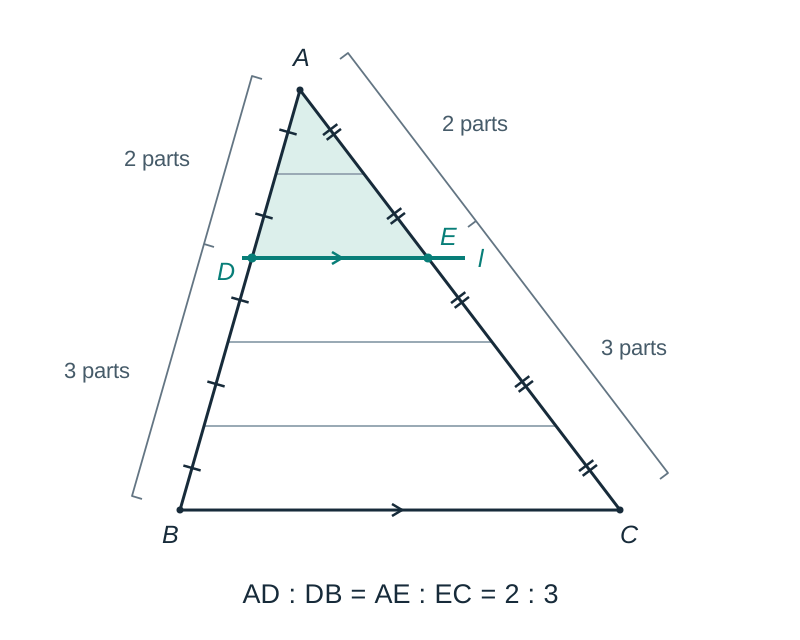
Proof:
- Statement: These parallel lines cut into equal segments. Reason: Theorem 11.
- Statement: There is only one line through parallel to , so is that line and meets at the -th point . Reason: Axiom of Parallels.
- Statement: divides in the ratio (i.e. ). Reason: contains of the equal segments and contains of them. Q.E.D.
Theorem 13. If two triangles and are similar, then their sides are proportional: .
Given: Similar triangles and with equal corresponding angles: , , and . Assume .
To prove: .
Construction: Mark on with and on with . Join .
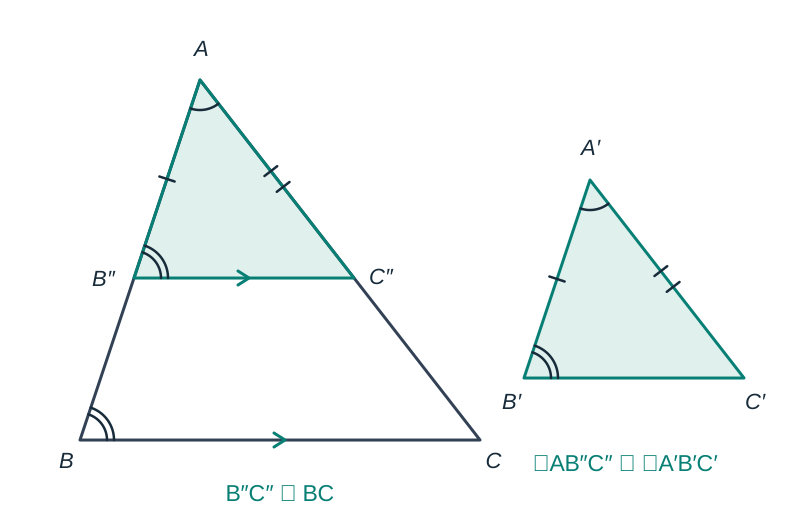
Proof:
- Statement: . Reason: SAS (, , ).
- Statement: . Reason: Corresponding angles in congruent triangles.
- Statement: . Reason: Corresponding angles are equal.
- Statement: , which rearranges to . Reason: Theorem 12, since .
- The same argument starting from vertex gives .
- Therefore, . Q.E.D.
Congruence and Similarity
You are often asked to prove triangles are congruent. Use only: SAS (two sides and the included angle), ASA (two angles and a side), SSS (three sides), or RHS (right-angled triangles: hypotenuse and one other side). Two triangles are similar if all three angles are equal, or if one angle is equal and the sides around it are in proportion. When writing proofs, use a two-column (Statement | Reason) format. Order the vertices so they correspond: if △ACD ≅ △BCE, A must match B, C must match C, and D must match E. Marks are lost if the order is wrong.
Constructions 16–22
Leaving Certificate Higher Level requires knowledge of Constructions 16–22:
- 16. Circumcentre and circumcircle (compass and straight-edge only): Construct the perpendicular bisectors of any two sides of the triangle. Their intersection is the circumcentre. Place the compass at this point, set the radius to any vertex, and draw the circumcircle.
- 17. Incentre and incircle (compass and straight-edge only): Construct the internal bisectors of any two angles of the triangle. Their intersection is the incentre. Construct a perpendicular line from the incentre to one side to find the inradius, then draw the incircle inside the triangle.
- 18. Angle of 60° (without protractor or set square): With the same compass opening, draw an arc from vertex cutting ray at , and from draw an arc crossing the first at . Joining through forms an equilateral triangle, so .
- 19. Tangent to a given circle at a given point on it: Draw the radius from the centre to point on the circle. Construct the line through perpendicular to (Theorem 20).
- 20. Parallelogram (given side lengths and an angle): Draw the base of given length, construct the given angle at one endpoint, mark off the second side length, and construct parallel lines or use compass arcs of the side lengths to locate the fourth vertex.
- 21. Centroid of a triangle: Find the midpoints of two sides (using perpendicular bisectors) and join each midpoint to the opposite vertex. The two medians meet at the centroid.
- 22. Orthocentre of a triangle: Construct the perpendicular (altitude) from one vertex to the opposite side, then repeat from a second vertex. Two altitudes are enough—they meet at the orthocentre. If the triangle is obtuse, extend the sides to drop your perpendiculars; the orthocentre lies outside the triangle.
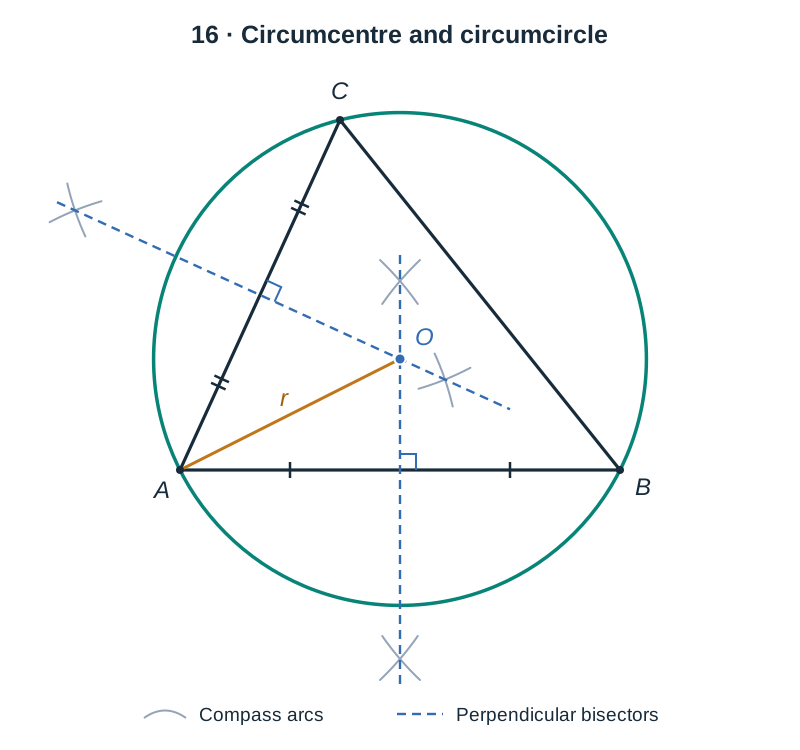
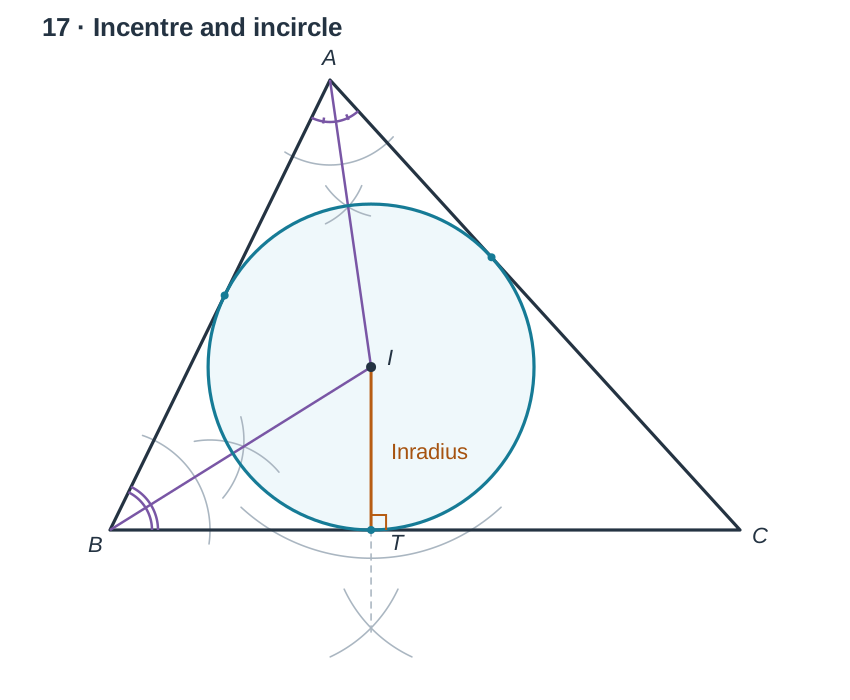
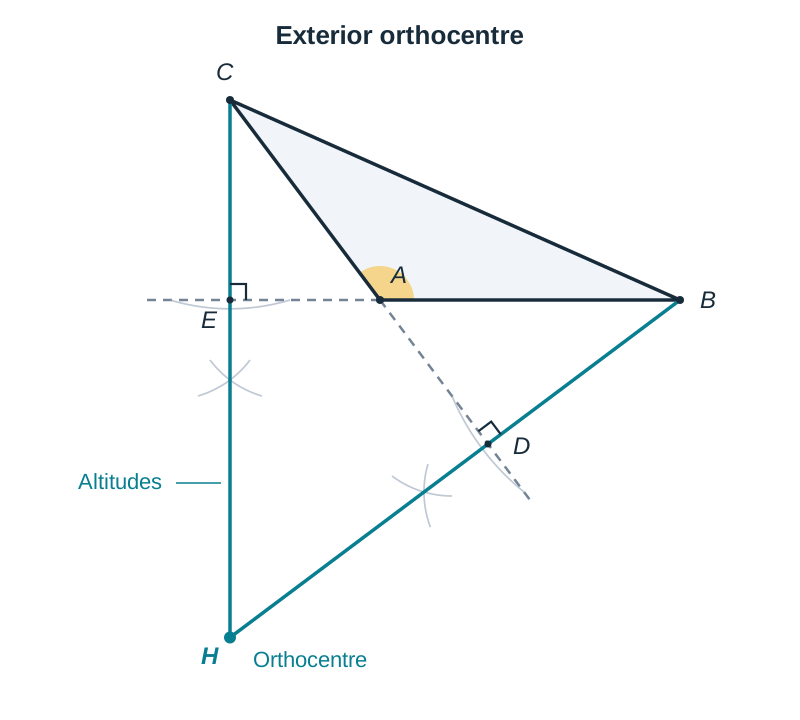
Do not rub out your arcs; they are primary evidence that you used the correct tools.
Key terms
- Axiom
- A statement accepted as true without proof, used as a starting point for all geometric reasoning.
- Converse
- A statement formed by swapping the 'if' and 'then' clauses of a theorem. It must be verified independently.
- Proof by Contradiction
- Assuming the opposite of your target statement and showing it leads to an impossible outcome.
- Circumcentre
- The intersection of the perpendicular bisectors of the sides of a triangle; the centre of the circumcircle.
- Incentre
- The intersection of the internal angle bisectors of a triangle; the centre of the incircle.
- Centroid
- The intersection of the three medians of a triangle.
- Orthocentre
- The intersection of the three altitudes of a triangle.
- If and only if
- A condition meaning that P implies Q and Q implies P; you must provide two separate proofs.
Check yourself
If you are asked to prove 'P if and only if Q', how many proofs must you write?
Two: one for 'P implies Q' and one for 'Q implies P'.
What is the difference between a median and an altitude?
A median joins a vertex to the midpoint of the opposite side; an altitude joins a vertex to the opposite side at a right angle.
Why is the order of vertices important in a congruence statement like △ACD ≅ △BCE?
The order tells the examiner which side/angle corresponds to which. If the order is wrong, the correspondence is incorrect.