

Geometry at Higher Level has two halves. The synthetic half uses axioms and theorems to perform formal deductions ('cuts') and proofs. The co-ordinate half maps these concepts onto the x-y plane using algebra. To succeed, you must know how to name the correct reason in brackets for every line of working and be able to solve complex problems in both synthetic and co-ordinate environments.
Synthetic Geometry: Proofs and Ratios
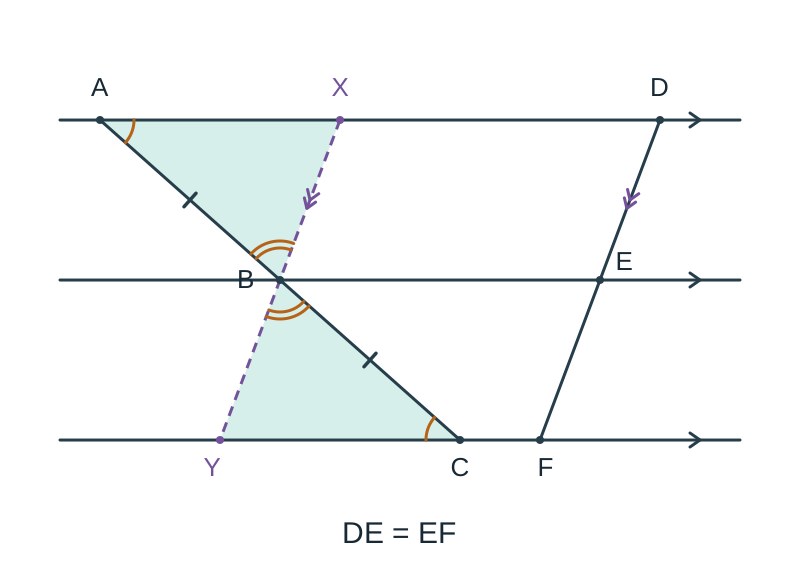
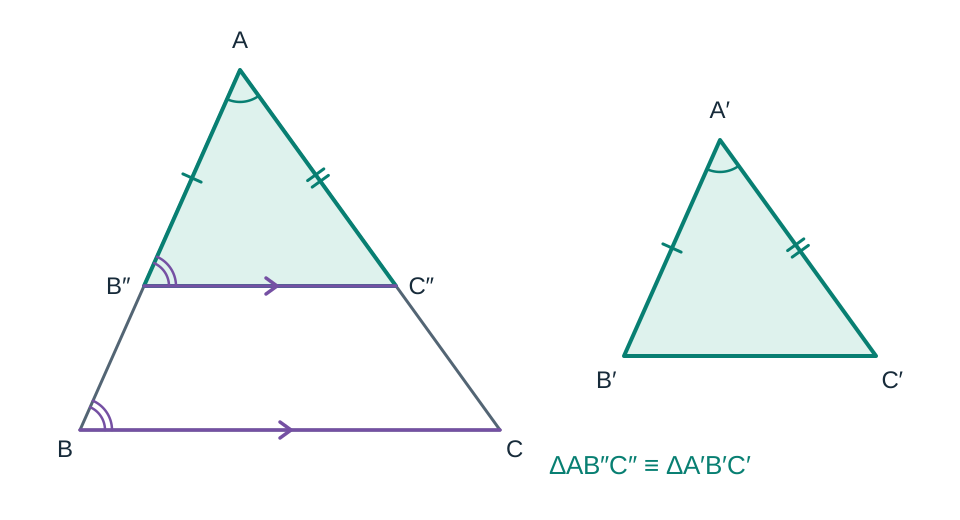
At Higher Level, you can be asked to write out the full proof for three specific ratio theorems. Always signpost these clearly. ### Theorem 11: Equal segments on parallel lines. Given: AD ‖ BE ‖ CF, with |AB|=|BC|. Construction: Draw line through B parallel to DF, meeting AD at X and CF at Y. 1. XBED and BYFE are parallelograms (opposite sides parallel). 2. So |DE|=|XB| and |EF|=|BY| (Theorem 9). 3. In ΔABX and ΔCBY: |AB|=|BC| (given); |∠XAB|=|∠YCB| (alternate angles); |∠ABX|=|∠CBY| (vertically opposite). 4. ΔABX ≡ ΔCBY (ASA). 5. Thus |XB|=|BY|, so |DE|=|EF|. ### Theorem 12: Ratio cut. A line parallel to one side of a triangle divides the other two sides in the same ratio. For ratio m:n, mark m+n equal parts on one side, draw parallels; by Theorem 11, the second side is cut into equal parts with the same ratio. ### Theorem 13: Similarity. If two triangles are similar, then |AB|/|A'B'| = |BC|/|B'C'| = |CA|/|C'A'|. Take B″ on [AB] with |AB″| = |A′B′| and C″ on [AC] with |AC″| = |A′C′|. Then ΔAB″C″ ≡ ΔA′B′C′ (SAS), so |∠AB″C″| = |∠ABC| and hence B″C″ ‖ BC (corresponding angles, Theorem 5). Theorem 12 then gives |AB″|/|AB| = |AC″|/|AC|, i.e. |AB|/|A′B′| = |AC|/|A′C′|; repeating from B gives the third ratio.
Circles and Tangents
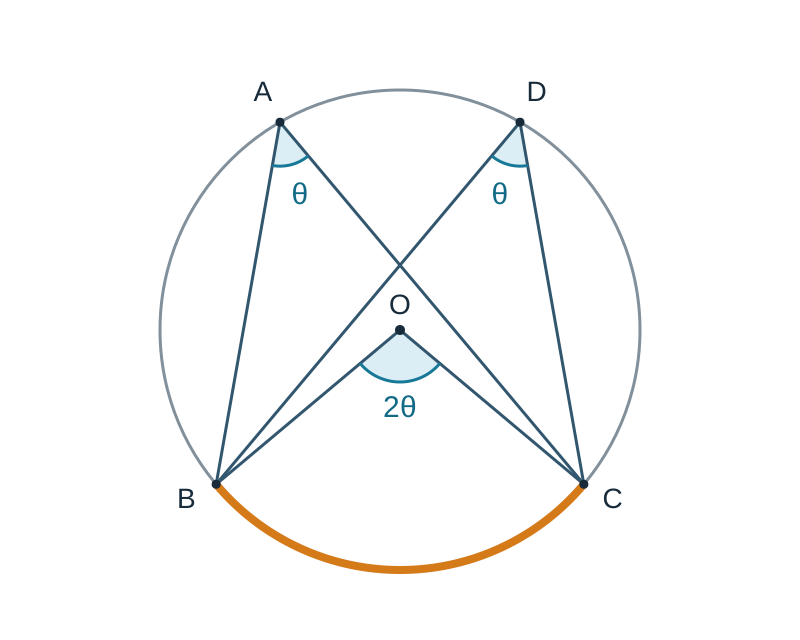
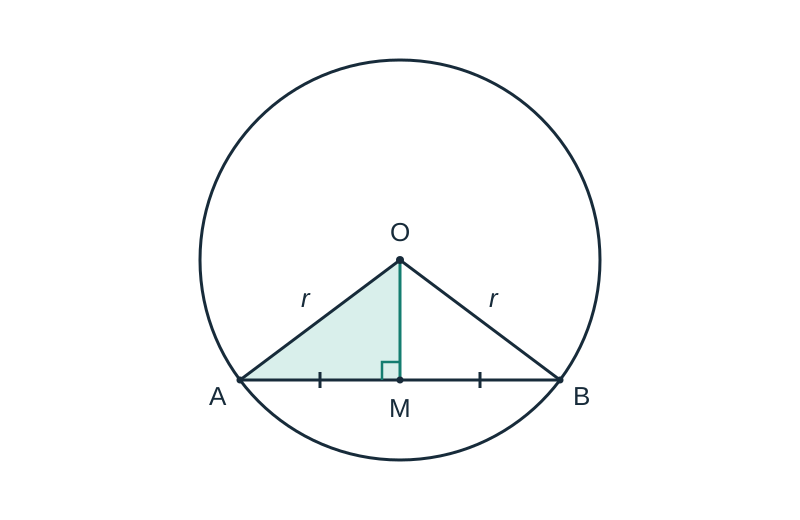
Circle geometry is standard Paper 2 content. ### Core properties: Theorem 19: Angle at centre is twice the angle at circumference standing on the same arc. Corollary 2: Angles at circumference on same arc are equal. Corollary 3: Angle in a semicircle is 90°. Corollary 5: Opposite angles in a cyclic quadrilateral sum to 180°. Theorem 20: A tangent is perpendicular to the radius at the point of contact. Theorem 21: The perpendicular from the centre to a chord bisects the chord; use this to create right-angled triangles and apply Pythagoras.
Co-ordinate Geometry of the Line
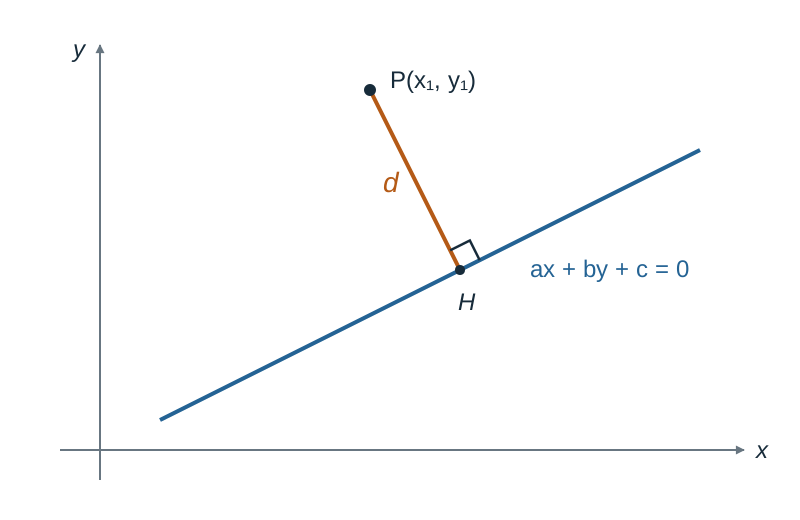
The Formulae and Tables booklet is your best friend, but you must know the context. ### Key formulas: 1. Slope m = (y₂ - y₁)/(x₂ - x₁). Parallel lines have m₁=m₂; perpendicular lines have m₁m₂ = -1. 2. Perpendicular distance from (x₁, y₁) to ax + by + c = 0 is d = |ax₁ + by₁ + c| / √(a² + b²). The line must be in form ax + by + c = 0. 3. Angle between two lines: tan θ = |(m₁ - m₂)/(1 + m₁m₂)|. 4. Division in ratio m:n: Point = ( (n·x₁ + m·x₂)/(m+n), (n·y₁ + m·y₂)/(m+n) ). Note that m multiplies the far point B, and n multiplies A.
Circles on the Plane and Enlargements
The Circle: A circle with centre (h, k) and radius r is (x - h)² + (y - k)² = r². For x² + y² + 2gx + 2fy + c = 0, the centre is (-g, -f) and r = √(g² + f² - c). A line is a tangent if the perpendicular distance from the centre to the line equals r. ### Enlargements: An enlargement is defined by a centre of enlargement O and a scale factor k. Every length is multiplied by k: |A'B'| = k|AB|. Crucially, the area is multiplied by k². If you know the areas of the object and image, k = √(area_image / area_object).
Key terms
- Axiom
- A rule accepted without proof, used as a starting point for geometric reasoning.
- Theorem
- A mathematical statement proven true using axioms and previous theorems.
- Corollary
- A result that follows immediately from a theorem.
- Converse
- The reversal of a theorem; requires separate proof. If and only if (is equivalent to) — both the statement and its converse are true. Vertically opposite angles are equal, but equal angles need not be vertically opposite (the base angles of an isosceles triangle), so 'vertically opposite if and only if equal' is false; one counterexample is enough to show it.
- Congruent
- Triangles identical in shape and size (SAS, ASA, SSS, RHS).
- Similar
- Triangles with equal angles and proportional side lengths.
- Orthocentre
- The intersection point of the three altitudes of a triangle.
- Centroid
- The intersection point of the three medians of a triangle.
Check yourself
What is the relation between the angle at the centre and circumference on the same arc?
Angle at centre is twice the angle at circumference (Theorem 19).
What condition must be met for three lengths a, b, c to form a triangle?
Any two sides must add to more than the third (Triangle Inequality Theorem 8).
If a line cuts ΔABC parallel to BC, what happens to the ratios on AB and AC?
The ratios are equal (Theorem 12).
What is the slope of a line perpendicular to a line with slope m = 1/3?
-3 (product of slopes must be -1).