

Co-ordinate geometry of the line is a core Paper 2 topic that describes geometric shapes using algebra. It appears in short Section A questions and as a structural element in long Section B problems, such as finding tangents to circles or areas of fields. Success relies on correctly identifying which formula to use, showing every step of your substitution, and finishing with the correct units. Because this topic is heavily tested in Section B, you must master the mechanics of building equations and finding intersections, as these are the tools used to solve complex, multi-step problems.
The Basic Toolkit
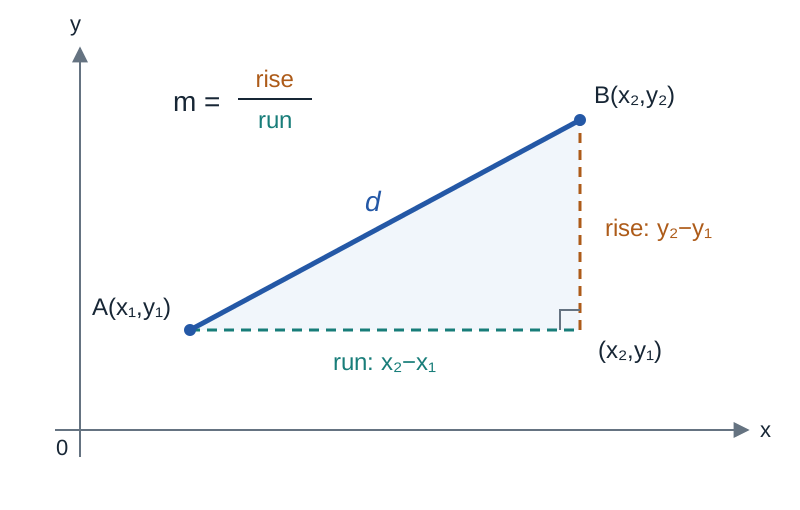
Before starting any problem, label your points (x₁, y₁) and (x₂, y₂) to prevent sign errors. Use these three tools to describe basic properties of a line: Distance (d) = √((x₂ - x₁)² + (y₂ - y₁)²); Midpoint (M) = ((x₁ + x₂)/2, (y₁ + y₂)/2); Slope (m) = (y₂ - y₁)/(x₂ - x₁). For a horizontal line, slope is 0 (y = q). For a vertical line, slope is undefined (x = p); never try to calculate a slope for a vertical line as you cannot divide by zero.
Finding the Equation of a Line
To write an equation, you need a slope and one point. Use the point–slope formula: y - y₁ = m(x - x₁). If given two points, first calculate the slope m = (y₂ - y₁)/(x₂ - x₁), then use either point in the formula. Rearrange your final answer to general form (ax + by + c = 0) if requested. Remember: the slope of ax + by + c = 0 is -a/b (provided b ≠ 0). The slope-intercept form (y = mx + c) is useful for reading the slope (m) and y-intercept (c) quickly, but always move to general form for distance and intersection problems.
Line Relationships and Intersection
Parallel lines have identical slopes (m₁ = m₂). In general form, their a and b coefficients are proportional. Perpendicular lines have slopes that multiply to -1 (m₁m₂ = -1). To find where two lines meet, solve their equations simultaneously. If the lines are parallel and distinct, the system has no solution; if the equations are multiples of each other, they are the same line.
Higher Level Formulas
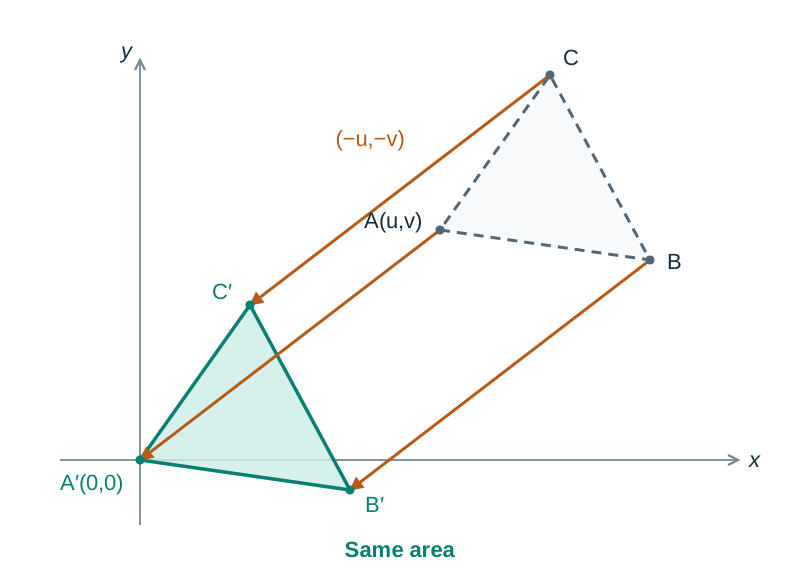
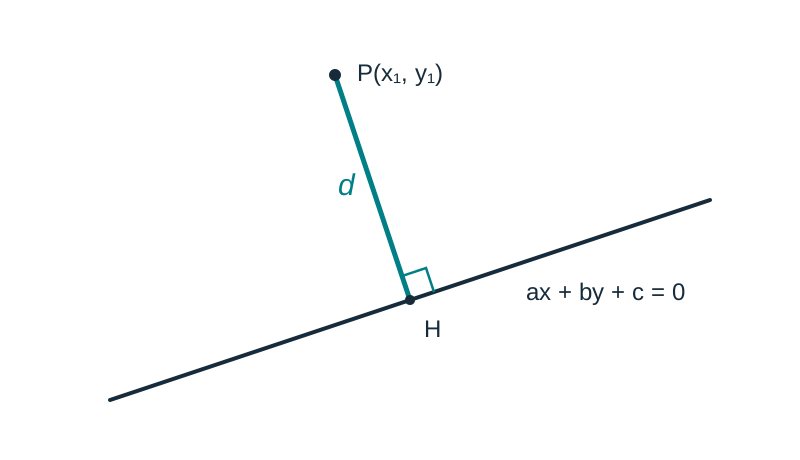
These are the core Higher Level extras: Area of a Triangle = 0.5|x₁y₂ - x₂y₁|. This formula requires one vertex at (0,0); if none is, translate the whole triangle by subtracting the coordinates of one vertex from all three. Internal Division: If P divides [AB] in ratio m:n, P = ((nx₁ + mx₂)/(m+n), (ny₁ + my₂)/(m+n)). Notice the ratio values 'cross' to multiply the points. Perpendicular Distance = |ax₁ + by₁ + c|/√(a² + b²). The line must be in general form (= 0 on the right) before starting.
Angle Between Two Lines
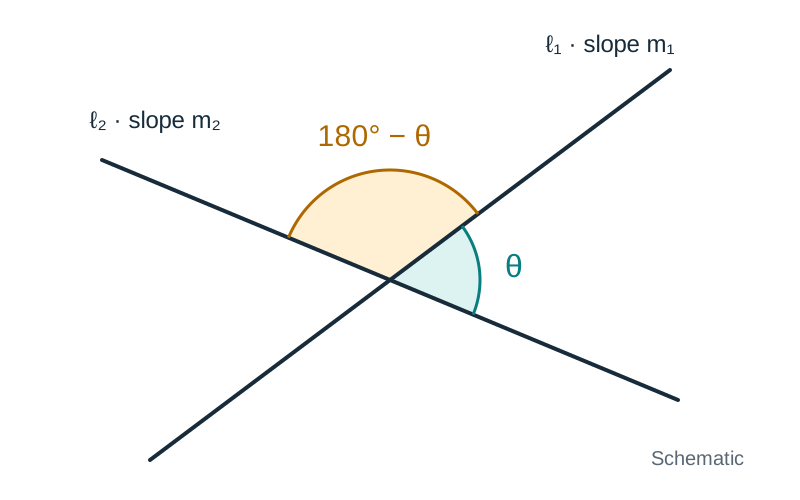
The angle θ between two lines is tan θ = |(m₁ - m₂)/(1 + m₁m₂)|. For a direct question where you know both slopes, use the modulus to find the acute angle. For a reverse question where the angle is given but a slope is unknown, use tan θ = ±(m₁ - m₂)/(1 + m₁m₂), solve both cases, and rationalise your answer. If the obtuse angle is requested, subtract the acute result from 180°.
Key terms
- General Form
- The equation ax + by + c = 0, which is necessary for the perpendicular distance formula.
- Collinear
- Points lying on the same straight line, confirmed when the area of the triangle formed by them is 0.
- Perpendicular Bisector
- A line that passes through the midpoint of a segment and is perpendicular to it. Note it is not the same as a median (vertex to the midpoint of the opposite side) or an altitude (vertex perpendicular to the opposite side).
- Internal Division
- Locating a point that splits a line segment into a specific ratio m:n using the section formula.
Check yourself
What is the perpendicular distance from (2, -3) to 3x - 4y + 1 = 0?
|3(2) - 4(-3) + 1| / √(3² + (-4)²) = |6+12+1|/5 = 3.8 units.
What is the point dividing [AB] in ratio 3:1 where A(1, 2) and B(9, 6)?
((11 + 39)/4, (12 + 36)/4) = (28/4, 20/4) = (7, 5).
True or False: If the area of a triangle formed by three points is 0, they are collinear.
True.