

Area and volume, or mensuration, is about measuring shapes: how much space a flat figure covers, how much a solid holds, and how much surface it has. Most of the formulae are short, so the marks in this topic go on three things: picking the right formula, keeping your units straight, and breaking a complicated shape into simple pieces you already know. You will often need Pythagoras or trigonometry first just to get one of the lengths the formula needs.
2D Area and Perimeter
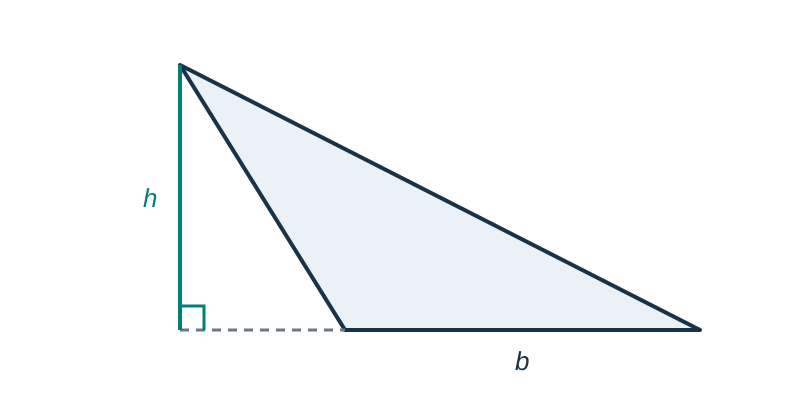
For a rectangle, Area = . For a triangle, Area = , where is the perpendicular height: the distance from the apex straight down to the base line at 90°. It is not the length of a sloping side. If you don't have the height, use the area of a triangle formula: Area = , where is the angle between sides and . For a trapezium, use Area = . For a triangle defined by coordinates, translate one vertex to the origin and use Area = .
Circles, Sectors, and Arcs
For a circle, Area = and Circumference = . When dealing with a sector, the area is and arc length is . If the angle is in radians, use the simpler versions: Area = and arc length = . Perimeter of a sector is the arc length plus two radii. Before you substitute, check if your angle is in degrees or radians.
3D Solids and Nets
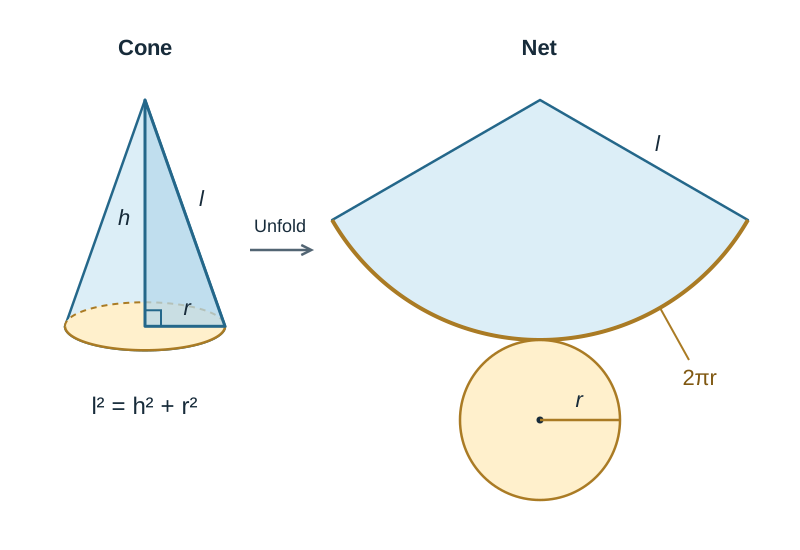
A net is the flat shape formed by unfolding a solid. It shows which faces exist. A cylinder's net is two circles plus a rectangle (). A cone's net is a circle plus a sector ( is the slant height). For any prism — a solid with the same cross-section all the way through — Volume = area of cross-section length, and Surface area = . A rectangular block has Volume = and Surface area = . A triangular prism's net is two identical triangles plus three rectangles, each as long as the prism; for right-angled, isosceles, or equilateral triangular bases, find the perpendicular height first to calculate the cross-section area. A cylinder is just a prism with a circular cross-section, which is why its volume is . Memorise these: Cylinder Volume = , CSA = . Cone Volume = , CSA = , with . Sphere Volume = , Area = . A hemisphere is half: Volume = , curved surface area = , total surface area = .
Composite Solids and Conservation of Volume
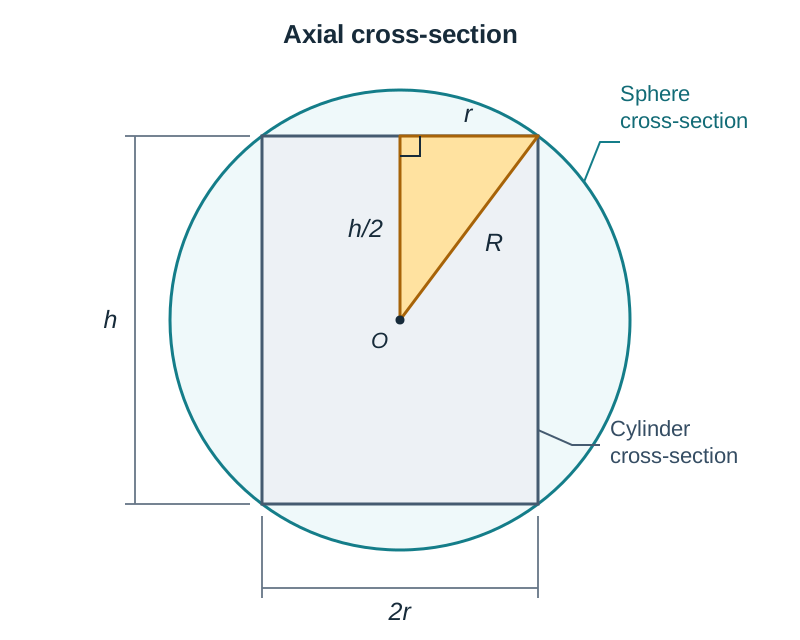
For composite solids, don't use a blanket subtraction rule. Work piece by piece and ask: is this face on the outside or is it glued to another piece? Add only the surfaces you could paint. When melting or reshaping solids, volume is conserved. Set the initial volume equal to the final volume and solve for the unknown dimension. If one solid sits inside another, draw the 2D cross-section and look for a right-angled triangle to connect the dimensions.
The Trapezoidal Rule
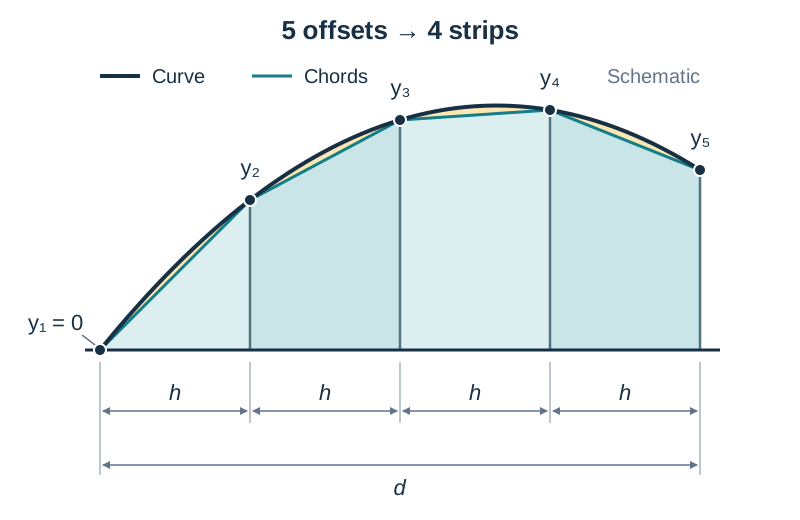
Use the trapezoidal rule to estimate the area of an irregular shape from equally spaced offsets . These give strips, each of the same width , so if the offsets span a total distance then : Area . First and last heights appear once; middle heights are doubled. An end offset of zero is still an offset; keep it as 0 in the formula. If the boundary curves out, the rule underestimates; if it curves in, it overestimates.
Area Theorems
Three theorems from the formal geometry course are used to justify area steps. Theorem 16 states that for a triangle, base height is constant regardless of base choice, explaining why works. Theorem 17 notes a diagonal bisects a parallelogram's area. Theorem 18 confirms a parallelogram's area is base perpendicular height. Quote these by name if a geometry question asks you to justify an area step.
Key terms
- Perpendicular Height
- The distance from an apex straight down to the base line at a 90° angle.
- Slant Height ()
- The distance along the sloped surface of a cone, linked to radius and height by .
- Curved Surface Area
- The surface area of a solid excluding flat bases or tops.
- Total Surface Area
- The sum of all external surfaces of a 3D solid.
- Net
- The 2D flat pattern created by unfolding a 3D solid along its edges.
- Sector
- A wedge of a circle bounded by two radii and an arc.
- Arc Length
- The length of the curved boundary of a sector.
- Trapezoidal Rule
- An approximation method for irregular area using equally spaced vertical offsets.
- Radian
- A unit of angle measure where a full rotation is 2π radians.
Check yourself
What is the volume of a sphere with radius 3 cm?
V = 4/3 π 3³ = 36π cm³.
How do you find the slant height of a cone?
Use .
If a triangle has sides 7 cm, 10 cm and angle 52° between them, what is the area?
Area = 0.5 7 10 * sin(52°) = 27.6 cm².