

This topic covers textiles as an essential resource for clothing and the home. It links consumer choices, fibre science, practical performance testing, laundering principles, and statutory fire safety standards. For examination purposes, material is divided between Core Resource Management (2.1.6) and Elective 2: Textiles, Fashion, and Design (5.2).
Textile Selection and Functions (Core 2.1.6)
Textiles perform specific practical, social, and aesthetic roles in the home and in dress.
The Four Functions of Clothing
- Protection: Protects the body from cold, heat, rain, and injury. For example, a heavy wool coat traps air to insulate in winter, while an impermeable high-visibility jacket shields outdoor workers from traffic and wet weather.
- Modesty: Conforms to accepted social, religious, and cultural standards of decency within a community.
- Identification: Communicates an individual's role, occupation, or group membership, such as Garda uniforms, medical scrubs, or school blazers.
- Adornment: Allows personal expression, decoration, and style, reflecting fashion trends and boosting personal confidence.
Functions of Household Textiles
Household textiles serve four main purposes across living spaces:
- Comfort: Soft furnishings such as cushions, wool rugs, and cotton bed sheets provide tactile softness, thermal insulation, and physical support.
- Protection: Curtains reduce draughts and protect interior surfaces from sunlight fading, while mattress protectors shield beds from stains and dust mites.
- Hygiene: Highly absorbent textiles such as bath towels, dishcloths, and bed linens help maintain cleanliness and can withstand high washing temperatures to kill bacteria.
- Aesthetic appeal: Fabrics introduce colour, pattern, and texture to create visual harmony within interior design schemes.
Consumer Selection Criteria
When choosing fabrics for clothing or household textiles, consider these factors:
- Fitness for purpose: Fabric properties must suit the intended end use. An upholstery fabric requires high tensile strength and abrasion resistance, whereas summer sportswear requires moisture-wicking and breathability.
- Cost and value for money: Balance purchase price against durability and expected lifespan, factoring in ongoing maintenance expenses such as dry-cleaning bills.
- Aesthetic appeal and personal preference: Choose colours, textures, and drape that suit individual taste and complement existing furnishings.
- Care and cleaning requirements: Check the care label to determine whether an item can be machine-washed, requires delicate handling, or needs professional dry cleaning.
- Safety and flammability: Look for flame-retardant qualities and statutory safety labels, especially when purchasing nightwear or upholstered furniture.
Safety Considerations and Fire Safety Legislation (Core 2.1.6)
Sofas, armchairs, and other soft furnishings burn quickly and give off toxic smoke, making them a major cause of death in house fires.
Safety Considerations when Selecting Household Textiles
- Flammability: Choose flame-resistant fabrics for items placed near heat sources, such as curtains near a cooker or open fire. Ensure upholstered furniture complies with fire safety laws.
- Fabric structure: Loosely woven, brushed, or raised pile fabrics (such as brushed cotton or candlewick) trap air and ignite much more readily than smooth, tightly woven textiles.
- Fibre type: Thermoplastic synthetics (such as polyester and nylon) melt and drip when burning, causing severe skin burns. In contrast, wool is naturally flame-resistant and slow to ignite.
- Slip and trip hazards: Loose rugs and mats must feature non-slip rubberised backing, and carpet edges should be securely fitted to prevent falls among older people and young children.
- Toxic fumes: Foam fillings in upholstered furniture must be fire-retardant (combustion-modified), such as CMHR foam, because untreated polyurethane foam burns quickly and gives off dense toxic smoke.
- Children's safety: Eliminate loose cords, loops, and long ties on window blinds and cot bumpers to prevent strangulation.
Fire Safety (Domestic Furniture) Order (1988)
This legislation regulates all domestic upholstered furniture sold in Ireland. Products must pass standard tests for resistance to ignition by a smouldering cigarette and a match flame. Upholstered items must carry two types of labels:
1. Display Labels (Swing Tickets)
Attached prominently to furniture in retail showrooms to inform consumers before purchase:
- Green display label: Shows a cigarette and match symbol with the word "RESISTANT". This confirms that the whole item (both cover fabric and filling) has passed the smouldering cigarette test and the match flame test.
- Red display label: Features a match flame warning. This informs the buyer that the outer cover fabric passes the cigarette test but fails the match test on its own, meaning a fire-resistant interliner has been fitted underneath to satisfy the law.
2. Permanent Labels
Securely stitched underneath the frame or beneath loose seat cushions. They provide traceability for safety inspectors, showing the manufacturer's name and address, batch or identification number, details of outer cover and filling materials (such as CMHR foam), and a formal statement confirming compliance with the Fire Safety (Domestic Furniture) Order (1988).
Short Exam Application: Interpreting Furniture Requirements
- Desirable properties for upholstery: Durable or hardwearing, resilient, stain-resistant, and comfortable.
- Meaning of the cigarette-and-match symbol with "RESISTANT": The materials meet statutory requirements for resistance to ignition from both cigarettes and matches, meaning the furniture is fire-resistant.
Fire-Retardant Finishes: Proban (Core 2.1.6)
The Proban Finish
Proban is a durable flame-retardant finish applied to cotton and other cellulosic textiles. A phosphorus-based chemical is locked inside the cotton fibres so it does not wash out during laundering.
Identification
- Items treated with this finish are identified by the trade name Proban® and the term flame-resistant on the swing ticket or sew-in care label.
- Commonly used on children's nightwear, protective industrial overalls, and cotton upholstery covers.
Effects on the Fabric
- The fabric forms an insulating char instead of bursting into flames, self-extinguishing once the ignition source is removed to allow vital escape time.
- The chemical treatment makes the handle of the fabric slightly stiffer or harsher to the touch.
- The fabric experiences a slight loss in tensile tear strength.
- The finishing process increases the retail cost of the product.
Care of Proban-Treated Fabrics
- Wash at the temperature specified on the care label.
- Never use chlorine bleach, which damages the chemical bond.
- Avoid soap in hard-water areas; soap scum coats the fibres and reduces the effectiveness of the flame-retardant finish.
Fabric Care Principles and Detergent Chemistry (Core 2.1.6)
Laundering relies on chemical action, water temperature, and mechanical movement to lift soil without damaging yarns.
Detergent Formulation and Action
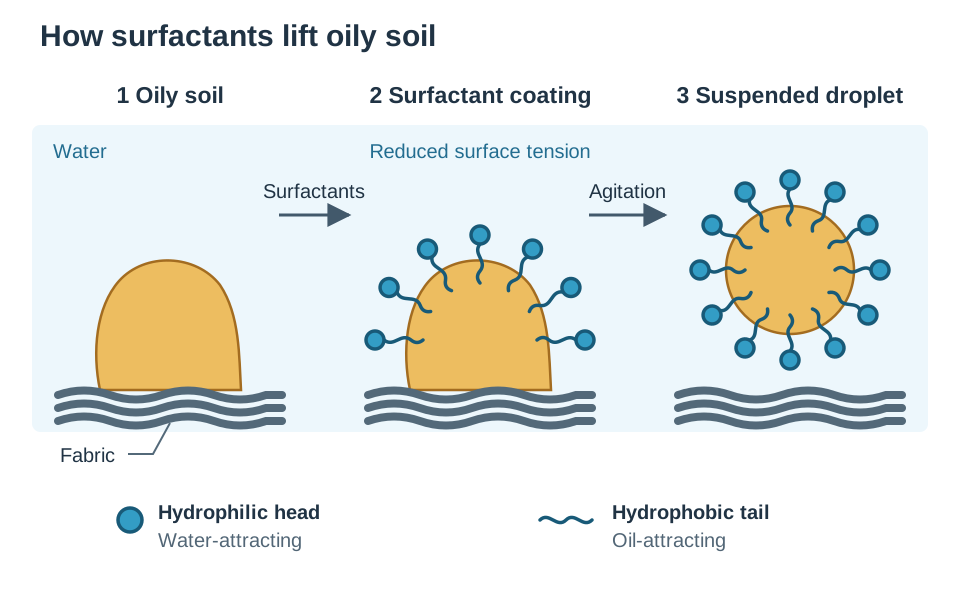
- Surfactants: Molecules with a hydrophilic head (water-attracting) and a hydrophobic tail (oil-attracting). Surfactants reduce the surface tension of water, enabling it to wet the fabric thoroughly. The hydrophobic tails embed into oily soil while the hydrophilic heads remain in water. Mechanical agitation pulls dirt droplets away, and surfactants keep soil suspended in the wash liquor so it rinses away without settling back on the fabric.
- Enzymes: Biological catalysts in washing powders that break down large, insoluble protein and food stains into smaller, soluble particles at moderate temperatures ():
- Proteases: Break down protein stains such as blood, egg, and grass into soluble amino acids.
- Lipases: Break down fats and oils into glycerol and fatty acids.
- Amylases: Break down starchy residues from gravy, rice, or pasta.
- Builders: Soften hard water by binding calcium and magnesium ions, preventing insoluble lime soap scum.
- Optical brighteners: Absorb invisible ultraviolet light and re-emit it as visible blue light, masking yellowing to make white fabrics look brighter.
- Bleaches: Oxidise coloured stains (such as tea, coffee, and fruit juice) into colourless substances.
Physical Laundering Principles
- Water temperature: Warm water melts greasy soils and activates detergents. However, protein stains (blood or egg) must be soaked in cold water first, as hot water coagulates and sets protein into fibres. Biological enzymes denature at high temperatures. Thermoplastic synthetics crease or distort if washed too hot, and wool requires low temperatures.
- Mechanical agitation: Machine drum rotation provides friction to loosen dirt. Heavy-duty cottons tolerate strong agitation, whereas wool, silk, and viscose need gentle agitation to prevent stretching, loss of shape, or fibre damage.
- Fabric softeners: Coat fibres in a lubricating layer to reduce static cling and soften handle. However, excessive use forms a waxy barrier that drastically lowers water absorbency in towels.
Care Labels
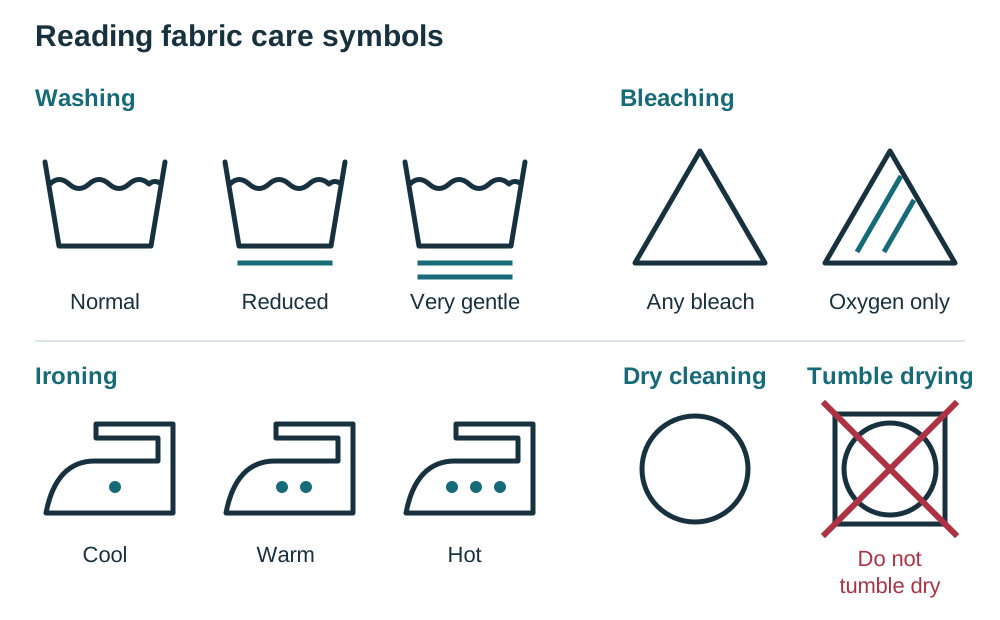
Care labels communicate scientific care instructions using five standard international symbols:
- Washtub: Washing. The number indicates maximum temperature in . A single bar underneath indicates a reduced synthetic cycle; a double bar indicates a very gentle wool cycle. A hand in the tub means hand wash only.
- Triangle: Bleaching. An empty triangle allows any bleach; diagonal stripes allow oxygen-only bleach; a crossed triangle means do not bleach.
- Iron: Ironing. One dot means cool ( for acrylic or nylon), two dots mean warm ( for wool or polyester), and three dots mean hot ( for cotton or linen).
- Circle: Dry cleaning. Letters inside specify the required cleaning solvent.
- Square with inner circle: Tumble drying. Dots indicate heat settings, while a cross indicates do not tumble dry.
Connecting symbols to fibres: Wool displays a low-temperature tub with a double bar because heat, moisture, and agitation trigger felting. Synthetics show an iron with one or two dots because they are thermoplastic and melt under hot irons.
Core Fibre Properties and Matching Care
- Cotton: Plant origin, absorbent, strong when wet, creases, can shrink. Care: hot wash tolerated, hot iron.
- Wool: Animal origin, warm, absorbent, felts with heat, moisture and agitation. Care: cool or wool cycle, gentle agitation, dry flat, warm iron.
- Viscose: Regenerated cellulose, absorbent, weak when wet. Care: gentle wash, do not wring, cool iron.
- Polyester: Synthetic, strong, crease-resistant, low absorbency, thermoplastic. Care: warm wash, cool to warm iron (one or two dots) because it is thermoplastic, quick-drying.
Practical Fabric Performance Testing (Core 2.1.6)
The syllabus suggests simple scientific tests to assess shrinkage, water-repellence, and crease recovery. Other tests, such as absorbency and abrasion, are also examined. Learn to name at least two tests and write out the procedure for one in numbered steps.
Crease Recovery Test
- Procedure:
- Cut equal-sized square samples () of test fabrics (such as cotton, linen, and polyester).
- Crumple a fabric sample tightly inside a closed fist and hold it for a set time (e.g. 60 seconds).
- Release the sample, smooth it out flat on a table, and observe the recovery.
- Score the result against a standard 1-to-5 scale (1 = heavily wrinkled; 5 = completely smooth).
- Repeat under identical conditions for the other fabrics and compare.
- Result: Polyester exhibits superior crease recovery (scoring 4–5), whereas untreated cotton and linen score low (1–2).
Water-Repellence Test
- Procedure:
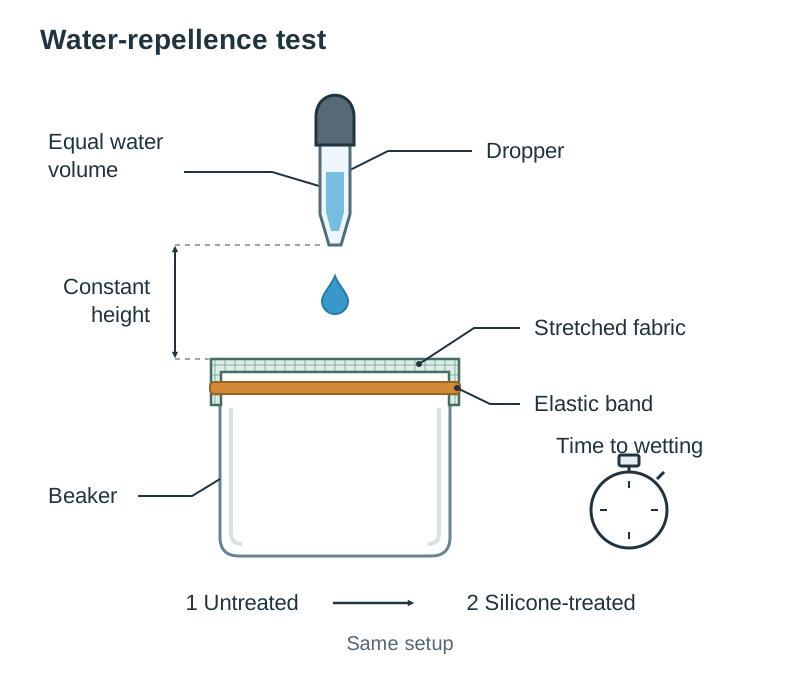
- Stretch a square sample of fabric across the mouth of a glass beaker, securing it with an elastic band.
- Using a dropper held at a constant height, apply a set volume of water (such as 5 drops) onto the fabric surface.
- Time how long the water sits on the surface before wetting the fibres, or observe if droplets run off into a collection tray when tilted.
- Repeat with a silicone-treated sample to evaluate the finish.
- Result: Untreated cotton wets through immediately, while water-repellent fabrics cause water to bead on the surface.
Absorbency Test
- Procedure:
- Cut equal-sized samples () of different fabrics (e.g. cotton, wool, polyester).
- Place each sample flat on the surface of a beaker filled with water, or place a measured volume of water onto each sample using a dropper.
- Time how many seconds each fabric takes to absorb the water or sink beneath the surface.
- Record and compare the results across the samples.
- Result: Cotton and viscose absorb water quickly, making them suitable for bath towels and summer shirts. Polyester resists water intake because it is hydrophobic.
Dimensional Shrinkage Test
- Procedure:
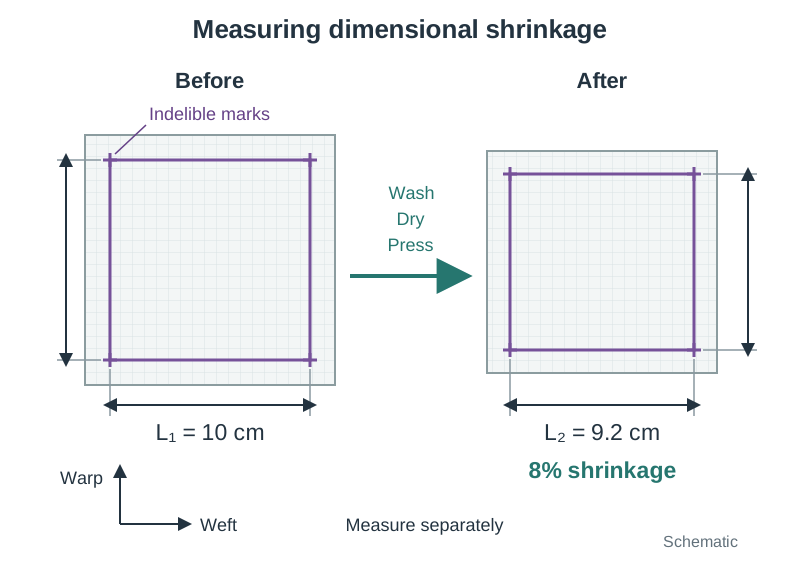
- Take an unwashed fabric sample and use indelible fabric ink to mark a square with exact side dimensions, for example ().
- Wash the fabric at on a standard cycle, dry completely, and press flat without pulling or stretching the weave.
- Measure the distance between the markings along both the warp and weft ().
- Calculate the percentage shrinkage using the formula:
- Result: An initial length of dropping to equals an 8% shrinkage, common in cotton that has not been pre-shrunk (Sanforised).
Fibre Science and Functional Finishes (Elective 2: 5.2)
Fibre Classification
- Natural fibres: Sourced directly from plants or animals without chemical transformation.
- Plant (cellulosic): Cotton, linen.
- Animal (protein): Wool, silk.
- Regenerated fibres: Created by chemically dissolving natural cellulose (such as wood pulp) and extruding the solution to form new solid filaments. Viscose and modal are prime examples.
- Synthetic fibres: Wholly man-made polymers synthesised from petrochemical sources (coal, crude oil). Examples include polyester, nylon, and acrylic.
Identifying Fibres via the Burning Test
A burning test identifies unknown textile fibres by examining three observable characteristics: reaction to flame, odour produced, and the residue or ash left behind.
| Fibre | Reaction in / near Flame | Odour Produced | Ash / Residue Remaining |
|---|---|---|---|
| Cotton (Cellulosic) | Catches flame quickly; burns rapidly with a steady yellow flame; continues burning when removed from flame | Burning paper or wood | Light, fine grey ash with soft edges |
| Wool (Protein) | Curls away from heat; burns slowly and smoulders; self-extinguishes when removed from flame | Burning hair or feathers | Black, irregular, hollow bead that crushes easily |
| Polyester (Synthetic) | Shrinks and melts before igniting; burns slowly with black smoke; drips chemical liquid | Sweet, chemical, plastic smell | Hard, round, uncrushable black bead |
Functional Finishes
Functional finishes are applied to textiles to modify their working characteristics:
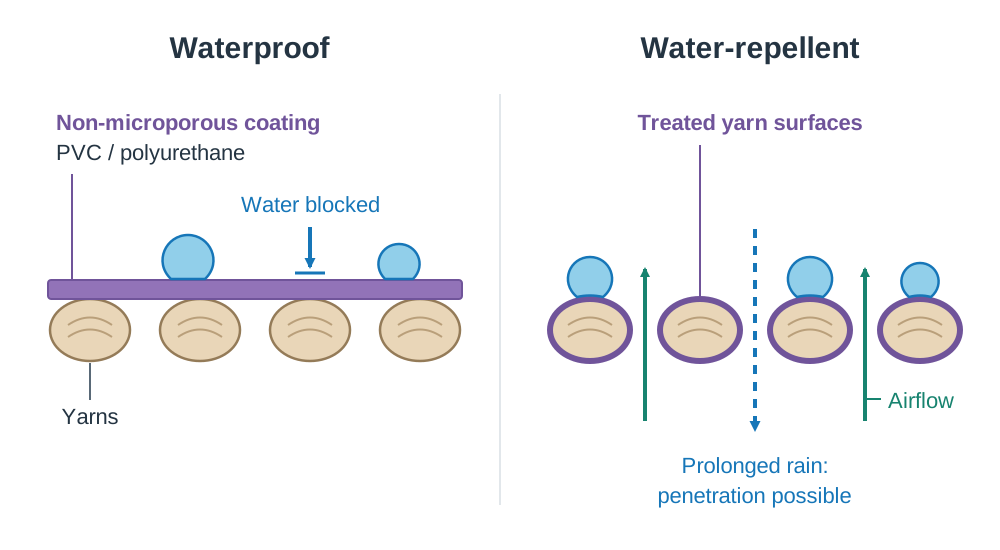
- Waterproof finish: Fabric is coated or laminated with PVC or polyurethane so that it is totally impervious to water. It prevents water penetration entirely but makes the fabric non-breathable unless engineered as a microporous membrane. Example: heavy raincoats.
- Water-repellent finish: Fibres are coated with silicone or fluorochemicals so water forms surface beads and rolls off. The weave remains open and breathable, though prolonged heavy rain will soak through. Example: showerproof jackets.
- Crease-resistant finish: Synthetic resins are applied and heat-set, helping cellulosic fabrics resist wrinkling and bounce back from folding. Example: cotton school shirts.
- Flame-resistant finish: Chemical treatments (such as Proban) ensure the fabric chars and does not support an open flame once the ignition source is removed. Example: children's nightwear.
- Stain-resistant finish: Fluorocarbon coatings (e.g. Teflon) form a barrier that stops liquids soaking into yarns, allowing spills to be blotted away before staining. Example: sofa upholstery.
- Shrink-resistant finish: Cotton is mechanically pre-shrunk (Sanforised), or wool is treated with chemicals or resin coatings (Superwash) to smooth surface scales, allowing machine laundering without shrinkage.
Key terms
- Surfactant
- A surface-active cleaning agent in detergents with a hydrophilic head and hydrophobic tail that reduces water surface tension, emulsifies grease, and keeps dirt suspended in wash water.
- Regenerated Fibre
- A manufactured textile fibre made by chemically dissolving natural plant cellulose (wood pulp) and reforming it into solid filaments, such as viscose.
- Synthetic Fibre
- A 100% man-made fibre produced through the polymerisation of petrochemical raw materials derived from coal or crude oil, such as polyester or nylon.
- CMHR Foam
- Combustion Modified High Resilience polyurethane foam treated with fire-retardant additives to delay ignition, prevent flaming drips, and create an insulating surface char.
- Proban
- A durable flame-retardant finish for cotton and cellulosic fabrics that chemically locks a phosphorus compound inside the fibres, making the fabric char rather than flame.
- Felting
- The irreversible shrinking and matting of wool caused when microscopic surface scales lock together under heat, moisture, and mechanical friction.
- Interliner
- A fire-resistant barrier fabric fitted between the exterior cover material and internal filling of upholstered furniture to prevent flame penetration.
- Fire Safety (Domestic Furniture) Order (1988)
- The statutory Irish regulations mandating that all domestic upholstered furniture withstand cigarette and match ignition tests, evidenced by permanent and display labels.
Check yourself
What three observations must be recorded when performing a burning test to identify an unknown fibre?
The fibre's reaction in or near the flame, the odour produced while burning, and the type of ash or residue left behind.
What consumer information is conveyed by a green display label on an upholstered sofa?
It informs the buyer that both the filling material and the cover fabric have passed the mandatory smouldering cigarette and match flame ignition tests.
Give two effects of the Proban flame-retardant finish on cotton fabric.
The fabric chars rather than flames, self-extinguishing when the ignition source is removed; the fabric handle becomes slightly stiffer.
A marked 20 cm line on an untreated cotton test swatch measures 18.5 cm after washing. Calculate the percentage shrinkage.
Formula: ((20 - 18.5) ÷ 20) × 100 = (1.5 ÷ 20) × 100 = 7.5% shrinkage.
Differentiate between a waterproof finish and a water-repellent finish.
A waterproof finish is a continuous surface coating (e.g. PVC) that makes the fabric completely impervious to water and non-breathable. A water-repellent finish coats individual fibres with silicone so water beads off, but leaves fabric pores open and breathable.