

Elective 1 examines how Irish households source, manage, and consume energy, alongside the environmental and health impacts of domestic emissions. For Leaving Certificate Higher Level Home Economics, students must combine practical resource management with scientific principles. This requires evaluating the sustainability of domestic fuels, explaining combustion chemistry and atmospheric pollution, calculating heat loss via U-values, analysing central heating and bimetallic thermostats, mastering electrical safety devices and electricity costing, and evaluating insulation, ventilation, and lighting methods across both existing homes and new house designs.
Domestic Energy Supplies, Sources, and Sustainability
Irish households rely on a mix of secondary energy carriers, non-renewable fossil fuels, and renewable sources for space heating, hot water, cooking, and running appliances.
Energy Supplies and Their Sources
- Electricity: Generated in power stations, wind farms, and solar arrays, transmitted at high voltage across the national grid (operated by EirGrid), stepped down at local transformers, and distributed to homes by ESB Networks through the meter and consumer unit. Irish electricity comes from a mix of natural gas, wind, solar, hydro (such as Ardnacrusha), and imported power. How clean electricity is depends directly on the generating mix at the time of use.
- Natural Gas: Piped underground directly to urban homes, supplied from domestic gas reserves such as the Corrib field and through subsea interconnectors from Britain. It consists mainly of methane (). Homes off the gas network can use liquefied petroleum gas (LPG) stored in bulk external tanks or cylinders.
- Heating Oil (Kerosene): A liquid fuel refined from imported crude oil, delivered by road tanker, and stored in an outdoor bunded tank. It is the primary heating fuel in rural Irish homes not connected to the natural gas grid.
- Solid Fuels: Wood, wood pellets, and historically coal and peat briquettes. These are purchased in bags and burned in open fires, room heaters, or closed stoves.
- Solar Energy: Free renewable energy collected on domestic roofs either as heat for water via solar thermal panels or as electricity using solar photovoltaic (PV) modules.
Sustainability and Fuel Evaluation
Sustainability means meeting current domestic energy needs without depleting natural resources or causing irreversible environmental harm for future generations.
- Natural Gas: Lower in carbon emissions and particulate matter than coal or oil, but it remains a finite fossil fuel with volatile wholesale prices.
- Heating Oil (Kerosene): Finite, price-volatile, carries risks of soil and groundwater pollution if storage tanks leak, and produces high carbon dioxide emissions.
- Solid Fossil Fuels (Peat and Coal): Non-renewable. Peat harvesting destroys peatland ecosystems that act as vital natural carbon sinks. Coal combustion releases high levels of sulphur dioxide and greenhouse gases.
- Biomass (Timber and Wood Pellets): Renewable if harvested from sustainably managed forests where felled trees are replanted. Burning wood releases carbon dioxide, but this is absorbed by new tree growth, making it largely carbon-neutral. However, wood smoke still produces fine particulates, and timber must be well seasoned to burn efficiently.
- Solar PV Evaluation: On the positive side, solar energy is renewable and free at the point of use, produces zero operational emissions, reduces utility bills, and allows homeowners to sell surplus electricity back to the grid. On the negative side, initial installation costs are high, output fluctuates with weather, season, and daylight hours (producing least in mid-winter when domestic demand peaks), and maximum benefit requires an unshaded south-facing roof.
Domestic Fuel Emissions and Environmental Impact
Combustion is the rapid chemical oxidation of a fuel that releases stored chemical energy as heat. The composition of the fuel and the volume of oxygen present dictate what emissions are released.
Principal Emissions and Atmospheric Impacts
- Carbon Dioxide (): Produced during the complete combustion of carbon-based fuels (). It is the main greenhouse gas behind global warming caused by human activity. Carbon dioxide accumulates in the atmosphere, absorbs outgoing long-wave infrared radiation emitted by the Earth, and re-radiates it downwards. This intensifies the greenhouse effect, causing rising global temperatures and disruptive weather patterns.
- Carbon Monoxide (): A colourless, odourless, and tasteless toxic gas produced by incomplete combustion when the oxygen supply to a burner or appliance is restricted. When inhaled, it binds tightly to haemoglobin in red blood cells in place of oxygen. This deprives body tissues and the brain of oxygen, leading to headaches, nausea, confusion, unconsciousness, and death.
- Sulphur Dioxide (): Formed when sulphur impurities present in solid fuels and heating oils react with oxygen during combustion. In the atmosphere, sulphur dioxide reacts with moisture and oxygen to produce dilute sulphuric acid (), resulting in acid rain. Acid rain acidifies lakes, kills freshwater organisms, damages trees, and corrodes architectural limestone and mortar.
- Nitrogen Oxides (): Formed when high combustion flame temperatures cause atmospheric nitrogen and oxygen to react. Nitrogen oxides irritate human airways, worsen asthma, contribute to acid rain, and react with sunlight to produce ground-level smog.
- Particulate Matter ( and ): Tiny airborne soot and unburnt carbon particles produced by burning solid fuels. Fine particles () penetrate deep into lung tissue and enter the bloodstream, causing serious cardiovascular and respiratory illnesses.
Clean Air Legislation in Ireland
In 1990, severe winter smog across Dublin prompted the introduction of the landmark smoky coal ban. Banning the marketing, sale, and distribution of bituminous coal produced an immediate drop in winter respiratory deaths. This ban has since been extended nationwide to include all smoky solid fuels, alongside strict limits on the moisture content of commercially sold firewood.
Identifying Domestic Inefficiencies and Designing an Energy-Efficient Home
An energy-inefficient home loses the energy it has paid for in three ways: heat escaping through the building fabric, badly maintained or outdated heating equipment, and wasteful everyday habits.
Typical Heat Losses and Remedies
- Roof (approx. 25–30% loss): Warm air rises and escapes through an uninsulated ceiling. Remedy: Fit 300 mm of mineral wool or cellulose insulation across ceiling joists.
- Walls (approx. 25–35% loss): Heat conducts through external masonry. Remedy: Pump bonded polystyrene beads into cavity walls, or fix external insulation boards to solid walls.
- Windows and Doors (approx. 10–15% loss): Heat escapes through single glazing and draughty frame gaps. Remedy: Install double or triple glazing with low-emissivity glass, fit draught-stripping, and hang heavy lined curtains.
- Ground Floors (approx. 10% loss): Heat conducts into cold subfloors. Remedy: Lay rigid insulation boards beneath concrete floor screeds, or place underlay and heavy rugs over timber boards.
- Draughts and Gaps (approx. 10–15% loss): Uncontrolled cold air infiltrates around skirting boards and service pipes. Remedy: Seal structural gaps and fit an enclosed draught lobby at entrance doors.
Equipment and Everyday Inefficiencies
- Immersion heater left on: A 3 kW immersion left switched on all day keeps reheating water that nobody is using, and heat continually escapes through the cylinder walls. Use the 'sink' setting for small quantities, the 'bath' setting only for full tanks, and fit an automated timer set to the cheaper night rate.
- Uninsulated cylinder and pipework: Hot water storage tanks without high-density factory foam or a proper lagging jacket lose useful heat into unoccupied cupboards.
- Kitchen habits: A kettle element is rated at around 3 kW. Boiling a full 1.7 litre kettle for one mug of tea keeps that element running far longer than necessary, wasting expensive kilowatt-hours. Cooking with unlidded pots lets steam escape, taking longer to cook food and wasting hob heat. Using a small saucepan on a large hob ring radiates heat directly into the kitchen air.
- Appliance standby: Leaving televisions, games consoles, and microwave displays on standby draws continuous phantom electricity.
Designing a New Home for Energy Efficiency
- Orientation and passive solar gain: Position main living rooms and large glazed elevations facing south to absorb free winter solar heat. Minimise window openings on cold north-facing elevations.
- Compact shape and layout: Build a simple, compact architectural shape. A compact form has less external wall and roof area relative to its internal volume, reducing heat-loss surfaces. Group hot water outlets near the cylinder to eliminate long pipe runs.
- Insulation beyond minimum standards: Specify insulation thicknesses that outperform standard building regulations, and eliminate cold bridges at junctions where floors meet external walls.
- Airtightness with controlled ventilation: Use an airtight membrane with taped joints to prevent uncontrolled draughts, paired with a mechanical ventilation with heat recovery (MVHR) unit to guarantee fresh indoor air.
- Efficient heating systems: Install a low-temperature air-to-water heat pump connected to underfloor heating, regulated by zoned digital thermostats.
- Building Energy Rating (BER): A BER certificate is legally required for all new dwellings, and whenever an existing home is offered for sale or rent. The BER must also be quoted in sales and letting advertisements. It rates a home on an energy scale from A1 (most efficient, consuming ) down to G (least efficient, consuming ). Target a BER of A2 or better for new builds.
Heat Transfer, U-Values, and Domestic Insulation
Heat naturally moves down a temperature gradient from warm interior rooms to colder outdoor surroundings by conduction, convection, and radiation.
- Conduction: Heat transfer through direct physical contact between particles within a solid. Vibrating atoms pass kinetic energy to neighbouring atoms (such as heat passing through brickwork or window glass).
- Convection: Heat transfer through the bulk circulation of a liquid or gas. Heated indoor air expands, becomes less dense, rises towards ceilings, and leaks out through gaps, while dense cold air moves in below to replace it.
- Radiation: Heat emitted directly across open space as electromagnetic infrared waves from warm surfaces without needing a physical contact medium.
Understanding and Calculating U-Values
A U-value measures the rate of heat loss through one square metre () of a building structure for every one kelvin (1 K) of temperature difference between the warm interior and the cold exterior. A temperature difference of 1 K is identical in size to a difference of 1 °C. Its unit is Watts per square metre kelvin ().
The U-Value Rule: The lower the U-value, the better the material insulates, because each square metre lets less heat escape per second.
Worked U-Value Calculation: A bungalow has of external cavity wall with an uninsulated U-value of . The indoor temperature is 20 °C and the outdoor temperature is 2 °C (temperature difference ).
After pumping the cavity with bonded polystyrene beads, the U-value drops to :
The insulated wall loses 1436.4 W less heat, saving the heat output of a large radiator running continuously.
Insulation Principles and Practical Methods
The underlying principle of insulation is to trap still, dry air inside porous materials. Still air is an exceptionally poor conductor of heat. By locking air into tiny cells, convection currents cannot develop, blocking both conduction and convection.
- Attic and Roof: Mineral glass-wool quilts or cellulose fibres laid 300 mm deep between and across ceiling joists. Trapped air cells drop roof U-values from down to under .
- Cavity Walls: Injecting expanded polystyrene (EPS) beads coated with adhesive into the hollow cavity between the inner block and outer leaf stops convective air looping, reducing U-values from to under .
- Solid Walls: External insulation boards fixed to the outer masonry and finished with weather-resistant render wrap the home in a continuous blanket, eliminating cold bridges.
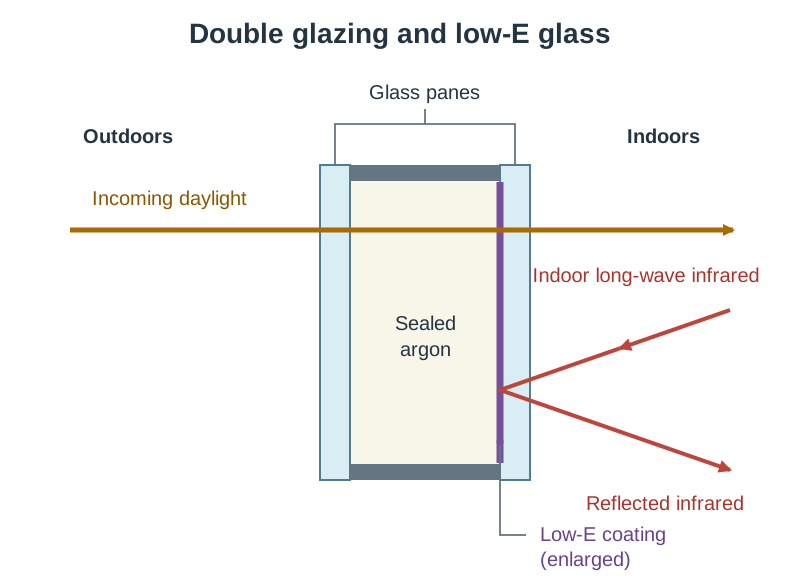
- Double and Triple Glazing: Two or three panes of glass enclosing a hermetically sealed gap filled with inert argon gas, which conducts heat more slowly than normal air. An invisible low-emissivity (low-E) metal oxide coating reflects long-wave indoor radiant heat back into the room while admitting shortwave daylight.
Thermal Comfort, Thermostats, and Heating Systems
Thermal comfort means the range of indoor conditions in which a person feels neither too hot nor too cold, comfortable without sweating or shivering. It depends on four main factors: air temperature (18–21 °C for living rooms, 16–18 °C for bedrooms), relative humidity (40–60%), air movement (gentle airflow without draughts), and the surface temperature of surrounding walls and floors.
Heating Options for the Home
- Central Heating: One central heat source heats the entire home. Options include wet radiator systems, underfloor heating (low-temperature pipe circuits embedded in floor screeds), and warm-air ducted systems. Heat sources include condensing boilers, ground-source or air-to-water heat pumps, or solid-fuel stoves with back boilers.
- Local (Individual) Heating: Heats a single room independently, such as an open fire, a closed wood stove, an electric convector heater, a radiant bar heater, or electric storage heaters running on off-peak electricity.
- Background Heating: Low-level continuous heat maintained in halls and landings to eliminate cold spots, prevent condensation, and keep walls warm.
Factors to Consider When Choosing a Heating System
- Installation cost: Upfront capital expenditure. A complete heat pump and underfloor heating system costs substantially more to install than replacing an existing gas boiler, though SEAI grants help offset this.
- Running cost and fuel price: Compare the cost per unit of delivered heat. A heat pump with a Coefficient of Performance (COP) of 3.5 delivers 3.5 kW of heat for every 1 kW of electricity consumed, offsetting higher electricity unit prices.
- Fuel availability and storage: Mains natural gas is restricted to urban areas. Rural homes must evaluate space for an outdoor kerosene tank, bulk LPG tank, or dry pellet store.
- House age and insulation level: Heat pumps run at lower flow temperatures (35–45 °C) and only function economically in well-insulated, airtight dwellings. Draughty, poorly insulated homes need retrofitting before a heat pump can work effectively.
- Controllability: Systems with multi-zone time and temperature controls, thermostatic radiator valves (TRVs), and cylinder thermostats prevent overheating unoccupied rooms.
- Maintenance requirements: Modern boilers need an annual service by a registered technician, open chimneys require regular sweeping, while heat pumps need minimal moving-part servicing.
- Environmental impact: Point-of-use emissions. Biomass and heat pumps powered by renewable electricity produce far lower lifecycle carbon emissions than kerosene or coal.
- Safety and comfort: Open solid-fuel fires carry spark and carbon monoxide risks; closed radiator systems provide even, draught-free heat with lower burn risks.
The Working Principle of a Thermostat
A mechanical thermostat regulates temperature by automatically opening and closing an electrical switch using a bimetallic strip. Set out its operation in four distinct stages:
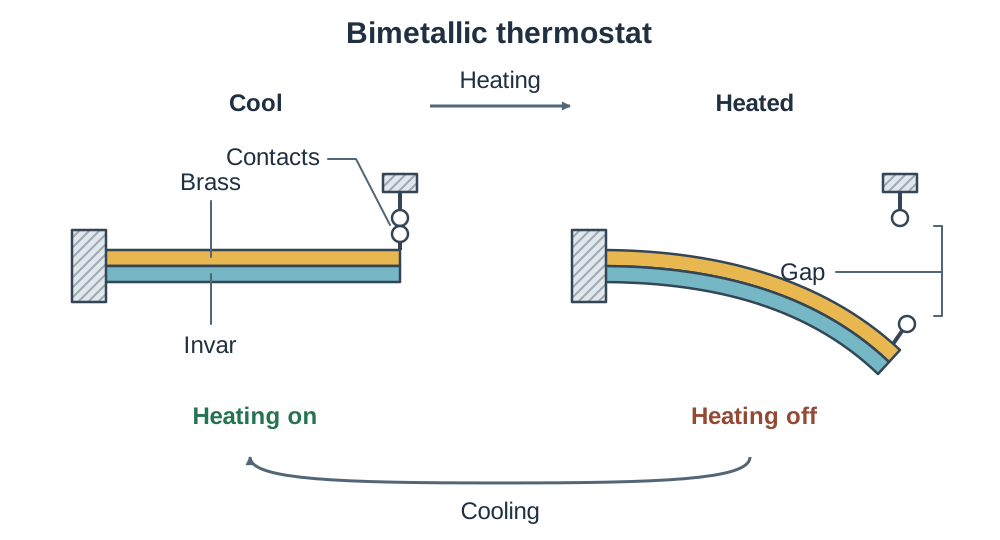
- Structure: The strip consists of two dissimilar metals bonded firmly along their length: brass (which has a high coefficient of thermal expansion) and invar (a nickel-iron alloy with very low thermal expansion).
- Unequal Expansion: As room temperature rises above the set level, heat conducts into the strip. The brass expands significantly faster and further than the invar.
- Bending and Breaking the Circuit: Because the metals are bonded, this unequal expansion forces the composite strip to curve towards the invar side. This deflection pulls contact points apart, breaking the circuit and switching off the boiler or pump.
- Cooling and Reclosing: When the room air cools below the target temperature, the brass contracts faster than the invar. The strip straightens, the contacts touch again, closing the circuit and restarting the heat supply.
- Uses in the Home: Room and cylinder thermostats and thermostatic radiator valves on a central heating system, and also domestic appliances such as the oven, the fridge and freezer, the immersion heater, and an electric iron — in each case the thermostat switches the heat source off at the set temperature and back on as it cools, saving energy and preventing overheating.
Scientific Principles of Wet Central Heating
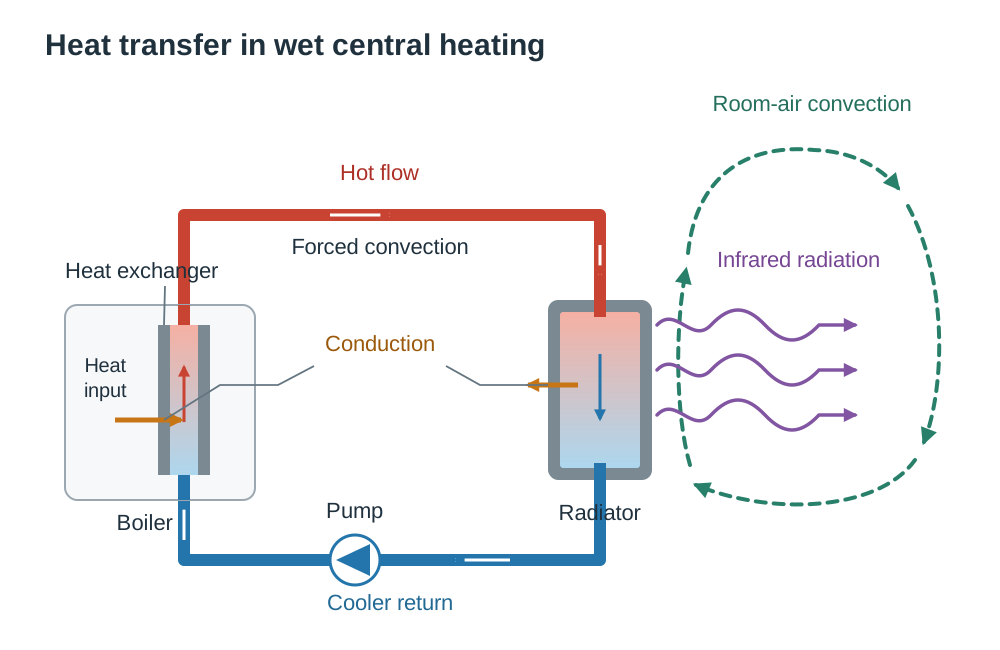
- Conduction in the Boiler: Fuel combustion heats the metal heat exchanger. Heat conducts through the steel or cast-iron casing directly into circulating system water. In a condensing boiler, an enlarged heat exchanger cools outgoing exhaust gases below 55 °C. This forces flue water vapour to condense, recovering its latent heat of vaporisation and raising seasonal fuel efficiency above 90%.
- Forced Convection in Pipework: An electric circulating pump drives hot water through insulated copper or plastic barrier pipes to radiators throughout the home.
- Convection and Radiation in Rooms: Hot water heats the pressed-steel radiator panel by conduction. Air touching the radiator warms, expands, becomes less dense, and rises. Cooler room air is pulled in underneath to take its place, setting up continuous convection currents. At the same time, the warm radiator face emits long-wave infrared radiation that directly warms occupants and furniture.
Domestic Electricity: Circuits, Safety Devices, Tariffs, and Costing
Mains electricity arrives in Irish homes as 230 V alternating current (AC) at 50 Hz. It passes through the main service fuse and utility meter into the consumer unit (fuse board).
Volts, Amps, Watts, and Kilowatt-Hours
- Voltage (volts, V): The electrical pressure that pushes current through a conductor. Irish domestic mains supply is 230 V.
- Amperage / Current (amps, A): The rate of electrical charge flow through a circuit.
- Wattage / Power (watts, W): The rate at which an appliance converts electrical energy into heat, light, or motion (). Linked by the formula:
- Kilowatt-Hour (kWh): The commercial unit of electricity billed to households, equal to 1,000 Watts of electrical power used continuously for one hour.
Structure of the Ring Main Circuit
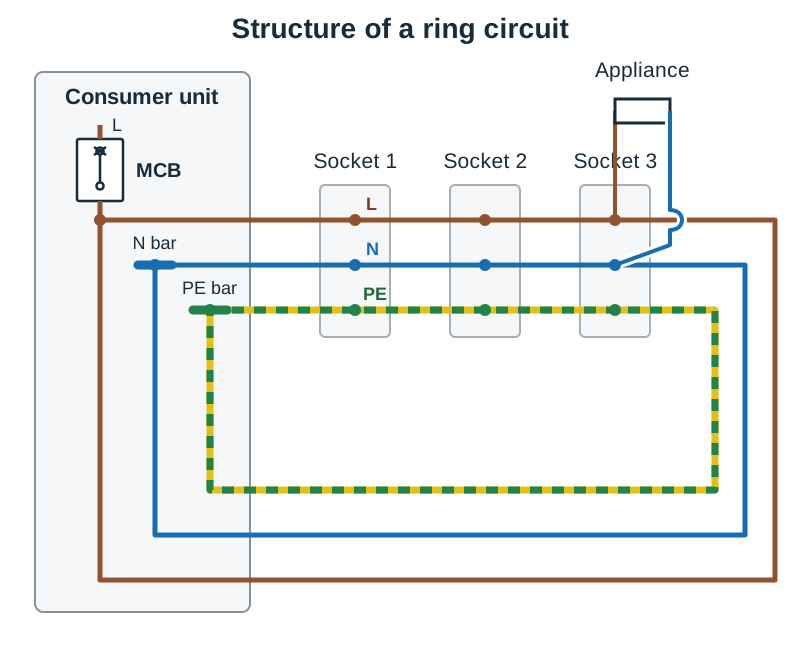
Domestic 13 A socket outlets are connected in a continuous loop called a ring main circuit. Live, neutral, and earth cables leave the consumer unit, run sequentially to each socket in a room zone, and loop back to the same terminals in the consumer unit.
- Two paths for the current: Current travels in both directions around the ring to reach any plugged-in appliance. This halves the current carried by each cable, allowing thinner copper cables without overheating.
- Supply continues if the ring is broken: If a wire comes loose at one socket, electrical current still reaches the other sockets from the opposite side of the ring.
Safety Devices: Fuses, Circuit Breakers, and Earth
- The Fuse: A deliberate weak link containing a thin wire designed to melt. If current rises above the rated limit (due to an overload or short circuit), the wire heats up and melts, breaking the circuit before appliance flexes can overheat and catch fire. A blown cartridge fuse must be replaced with one of the exact same rating—never bridged with foil or wire.
Rule of thumb for plug fuses: Appliances with a heating element (kettles, irons, toasters, fan heaters) draw high current and require a 13 A fuse. Low-power appliances (table lamps, televisions, radios) draw low current and take a 3 A fuse (or 5 A up to ~700 W).
- Miniature Circuit Breakers (MCBs): Electromagnetic switches in the consumer unit that protect building wiring against overloads and short circuits. If current exceeds rated limits (such as 16 A for an immersion circuit or 32 A for a ring main), the MCB trips open. Once the fault is fixed, it is reset using a switch.
- Residual Current Devices (RCDs): Precision life-saving devices that continuously compare the incoming current on the live wire with the outgoing current on the neutral wire. Under safe conditions, these currents balance. If an imbalance as tiny as 30 milliamperes (mA) occurs—indicating current leaking to earth through a person—the RCD cuts power in under 40 milliseconds (ms), preventing a fatal electric shock.
- Earthing: A green-and-yellow low-resistance copper wire linking the metal exterior of appliances to a copper earth electrode driven into the ground. If a loose live wire touches the metal casing, fault current safely rushes to earth rather than through an occupant, blowing the fuse or tripping the MCB immediately.
Six Electrical Safety Rules
- Never overload socket outlets with multiple adaptors.
- Keep flexes clear of heat sources, wet areas, and from under carpets.
- Repair or replace frayed flexes and cracked plugs immediately; never pull a plug out by its flex.
- Always unplug appliances before cleaning, maintaining, or repairing them.
- Use an RCD-protected socket for outdoor power tools like hedge trimmers and lawnmowers.
- Have all household wiring installed, inspected, and certified by a Registered Electrical Contractor (Safe Electric).
Tariffs and Costing
- Standard 24-Hour Tariff: Charges a uniform unit price per kWh at all times of day.
- Day/Night Tariff: Charges a cheaper rate during off-peak night hours (typically 23:00 to 08:00) and a higher day rate. Running high-consumption thermal appliances (washing machines, dryers, immersion heaters) during night hours lowers utility bills.
- Smart Tariffs: Divide the day into day, night, and evening peak (17:00 to 19:00) bands.
Ventilation and Lighting Systems in the Home
Modern airtight, well-insulated homes require controlled ventilation to remove moisture, indoor air pollutants, and cooking odours while maintaining indoor air quality.
Natural and Artificial Ventilation Methods
- Natural Ventilation: Uses natural wind pressure and the stack effect (warm interior air rises and exits through high vents, drawing cooler fresh air in through low wall inlets). Methods include openable windows, permanent wall louvres, and trickle vents built into window heads. While cost-free, natural ventilation is weather-dependent and can introduce cold winter draughts.
- Extractor Fans (Mechanical): Electric fans installed in external walls or ceilings of bathrooms, kitchens, and utility rooms. They pull moist, stale air directly outdoors. Look for fans with humidity sensors and overrun timers that run after the light is switched off.
- Cooker Hoods (Mechanical): Sited directly over cooking hobs. A ducted hood expels moisture, grease, and cooking smells outside through an external duct. A recirculating hood passes air through grease and activated charcoal filters before returning it to the kitchen; it removes odours and grease but cannot remove moisture.
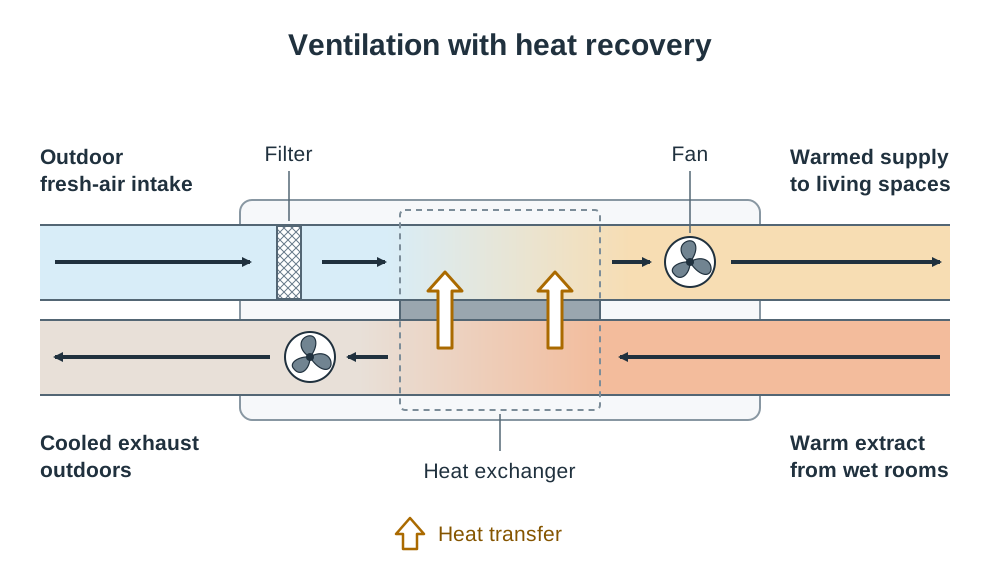
- Mechanical Ventilation with Heat Recovery (MVHR): A central whole-house system for airtight homes. An air-handling unit extracts warm, moist air from wet rooms (kitchens, bathrooms) and passes it through a heat exchanger to warm incoming, filtered fresh air before delivering it to living spaces. This recovers 85–90% of outgoing heat.
- Combustion Air Supply: Every fuel-burning appliance (stove, open fire, gas boiler) requires a permanent, unblockable fresh air vent in the room. Blocking vents starves the flame of oxygen, causing deadly carbon monoxide formation. Fit an audible carbon monoxide alarm.
- Signs of Poor Ventilation: Heavy window condensation, black mould patches in room corners and behind wardrobes, peeling wallpaper, and persistent musty smells.
Properties of Light and Domestic Applications
- Reflection: Light bounces off smooth, light surfaces. Pale walls, white ceilings, and mirrors reflect ambient light, brightening rooms and cutting artificial lighting needs. Dark surfaces absorb light.
- Diffusion: Scattering and softening light rays to prevent harsh shadows and sharp glare. Achieved using frosted glass shades, fabric lamp covers, and uplighters that bounce light off ceilings.
- Refraction: Light bends as it travels through glass or transparent lenses. Used in spotlight lenses and crystal fittings to focus or direct light beams.
- Colour and Temperature: Artificial light is measured on the Kelvin (K) colour scale. Warm white (~2700 K) creates a relaxing atmosphere for living rooms and bedrooms; cool white (4000 K and above) suits task-oriented areas like kitchens, home offices, and bathrooms.
- Glare Control: Glare is uncomfortably bright light. Prevent glare by shielding bare bulbs, using diffusers, and ensuring task lights do not reflect off glossy worktops or screens.
Planning Lighting and Contemporary Developments
- Layered Lighting: Combine general (ambient ceiling pendants), task (under-cabinet LED strips over kitchen worktops, reading lamps), and accent lighting (recessed downlighters highlighting alcoves).
- Safety and Switching: Fit two-way switching on staircases so lights can be controlled from both top and bottom. Provide well-lit hallways, landings, and external porches.
- Luminous Efficacy: Measured in lumens per Watt (lm/W). High luminous efficacy means maximum light output for minimal electrical power input. Light Emitting Diodes (LEDs) use 80–90% less electricity than traditional incandescent bulbs, reach 80–120 lm/W, switch on instantly, run cool, and last 25,000–50,000 hours.
- Contemporary Developments: Smart LED bulbs controlled by mobile apps or voice assistants, tunable white lighting that shifts from cool daylight to warm evening tones, dimmable LED drivers, low-voltage recessed plinth lighting, and solar-powered exterior security lights with integrated PIR sensors.
Syllabus Integration Note
Elective 1 directly integrates with core syllabus areas: heating and appliance costs link to household budgeting and fuel poverty in Family Resource Management; selecting A-rated appliances and using WEEE recycling points connect to Consumer Choices; while thermal performance and orientation link directly to housing design and sustainable community living.
Key terms
- U-value
- The rate of heat loss through one square metre of a building structure for every one kelvin (1 K) or degree Celsius temperature difference between inside and outside, expressed in W/m²K. A lower figure indicates superior thermal insulation.
- Thermal Comfort
- The range of indoor environmental conditions in which occupants feel neither too warm nor too cool without sweating or shivering, governed by air temperature, humidity, air movement, and surrounding surface temperatures.
- Bimetallic Strip
- A temperature-sensitive strip made from two dissimilar metals (brass and invar) bonded together that bends when heated due to unequal rates of thermal expansion, opening or closing an electrical circuit.
- Building Energy Rating (BER)
- An official energy asset rating of a building's calculated energy performance and carbon emissions on a scale from A1 (most efficient) to G (least efficient), legally required when a home is constructed, sold, or rented.
- Fuse
- A safety device containing a thin wire designed to melt and break the circuit if the electrical current exceeds a safe rating, protecting appliance flexes and circuits from overheating and fire.
- Residual Current Device (RCD)
- A sensitive safety switch that detects microscopic current imbalances (as low as 30 mA) between live and neutral conductors, cutting off electrical supply in under 40 milliseconds to protect people from fatal electric shocks.
- Ring Main Circuit
- A domestic electrical circuit wired in a continuous loop from the consumer unit, through all 13 A socket outlets in a zone, and back to the consumer unit, providing two parallel current paths to each socket.
- Kilowatt-Hour (kWh)
- The commercial billing unit of electrical energy, representing one kilowatt (1,000 Watts) of electrical power consumed continuously for one hour.
- Cold Bridge
- A localised structural area or break in insulation where heat transfers rapidly between inside and outside, causing heat loss, cold internal surfaces, and condensation.
- Luminous Efficacy
- A measure of how efficiently a light source produces visible light, calculated as visible light output in lumens divided by electrical power input in Watts (lm/W).
- Coefficient of Performance (COP)
- The ratio of useful heat energy output delivered by a heat pump relative to the electrical energy consumed by its compressor; a COP of 3.5 means 3.5 kW of heat delivered per 1 kW of electricity consumed.
- Condensing Boiler
- A high-efficiency boiler that recovers latent heat by cooling exhaust flue gases below their dew point, condensing water vapour into liquid and achieving seasonal efficiencies above 90%.
Check yourself
A 1840 W hair dryer operates on a 230 V domestic supply. Calculate the operating current and state the correct plug fuse rating.
Current = Power ÷ Voltage = 1840 ÷ 230 = 8.0 Amps. The nearest standard rating above this is a 13 A fuse.
Name the two metals bonded in a bimetallic strip thermostat and explain how they operate when ambient temperature rises.
Brass and invar. When heated, brass expands faster and further than invar, bending the strip towards the invar side to break the circuit and switch off the heat.
State the formula used to calculate conductive heat loss using a U-value.
Rate of Heat Loss (Watts) = Area (m²) × U-value (W/m²K) × Temperature Difference (K or °C).
Name three factors to consider when choosing a home heating system.
Installation cost, running cost and fuel price, and fuel availability/storage (or house insulation level, controllability, and environmental impact).
Name two properties of light and give one domestic application of each.
Reflection (using light wall paint or mirrors to brighten rooms) and Diffusion (using fabric shades or frosted glass to eliminate harsh glare).
Name one natural and one mechanical method of kitchen ventilation, and state which removes cooking moisture more effectively.
Natural: opening a window or trickle vent; Mechanical: ducted cooker hood or extractor fan. A ducted cooker hood or extractor fan is far more effective at expelling steam directly outdoors.
What is the primary atmospheric damage caused by sulphur dioxide (SO2) emissions?
It reacts with atmospheric moisture and oxygen to form dilute sulphuric acid, causing acid rain that damages lakes, forests, and stone buildings.
Why does a ring main circuit permit the use of thinner copper cables for domestic sockets?
Current travels in two parallel paths around the closed loop to reach any socket, halving the electrical current carried by each cable branch.