

This topic follows a fabric from the raw fibre to the finished cloth, and then asks whether that cloth is fit for the job it has to do. You need to be able to say where a fibre comes from, how it is turned into yarn and then fabric, what finishes and colour are added, how you would test the fabric in the lab, how it should be cared for, and what the law requires on the labels of upholstered furniture. In Leaving Certificate Home Economics, Elective 2 is worth 20% of the total marks; it is assessed through a dedicated question in Section C of the written examination alongside an assessment of practical garment coursework demonstrating prescribed construction processes.
Fibre Classification and Raw Material Origins
Textile fibres are tiny, hair-like structures that form the basic building blocks of all yarns and fabrics. In textile science, fibres are grouped into two primary classes based on where they come from: natural fibres and manufactured fibres.
Natural fibres
A natural fibre is obtained directly from animal or plant sources in nature without fundamental chemical alteration.
- Plant (cellulosic) fibres: Cotton comes from the seed hair of the cotton boll, while linen comes from the stem (bast) of the flax plant. Chemically, they consist of polymerised glucose chains. Cellulosic fibres absorb water readily, conduct heat away from the body, and are about 20% stronger when wet because the fibre swells and spreads physical loads more evenly along its fibrils. However, they lack elasticity, so they wrinkle badly and shrink during laundering unless treated.
- Animal (protein) fibres: Wool is shorn from sheep fleece, and silk is unreeled as a continuous filament from silkworm cocoons. Wool is made of the fibrous protein keratin, which has a natural waviness called crimp that traps still air and gives excellent warmth. Protein fibres dissolve in strong alkalis, scorch easily with dry heat, and are damaged by chlorine bleach and biological detergent enzymes (proteases).
Manufactured fibres
Manufactured fibres are made by industrial chemical processes and split into two distinct sub-groups:
- Regenerated fibres: Viscose and modal. Natural cellulose from wood pulp is dissolved in chemicals, forced through the fine holes of a spinneret nozzle into an acid bath, and re-solidifies as cellulose filaments. Viscose shares cotton's softness, drape, and high absorbency, but it loses substantial strength when wet and wrinkles easily. (Acetate is also derived from wood pulp, but the cellulose is chemically converted into cellulose acetate and dry spun into warm air where the solvent evaporates, leaving a fibre that is thermoplastic with low absorbency.)
- Synthetic fibres: Petrochemical derivatives synthesised through industrial polymerisation. The three main synthetics are polyester, nylon (polyamide), and acrylic. They are hydrophobic, crease-resistant, and thermoplastic, which means they soften with heat and can be heat-set into permanent pleats. Polyester and nylon are exceptionally strong and hard wearing; acrylic is weaker and prone to pilling, but it is warm, light, and soft, making it an ideal synthetic substitute for wool.
Blends and mixtures
- A blend is created when two or more different fibres are mixed together before yarn spinning, so that every single yarn in the finished fabric contains both fibres. For example, a 65% polyester / 35% cotton fabric combines polyester's strength and crease recovery with cotton's breathability and softness.
- A mixture (or union fabric) uses yarns of one fibre for the warp and yarns of an entirely different fibre for the weft, so each individual thread contains only one fibre.
Fibre Identification: Burning Tests and Microscopy
In the examination, identifying an unknown fibre by burning requires four specific observations: behaviour approaching the flame, behaviour in the flame, smell, and the nature of the residue.
| Fibre | Approach to flame | In flame | Smell | Residue / ash |
|---|---|---|---|---|
| Cotton | Does not shrink or curl away | Burns quickly with a steady yellow flame; afterglow when blown out | Burning paper | Light, feathery grey ash |
| Wool | Curls away from flame | Burns slowly with sputtering; self-extinguishes when removed from flame | Burning hair or feathers | Irregular, brittle black bead that crushes easily between fingers |
| Polyester | Shrinks and curls away from flame | Burns slowly, melts and drips; gives off black smoke | Sweetish, chemical smell | Hard, round black bead that cannot be crushed between fingers |
| Viscose | Does not shrink or curl away; does not melt | Burns rapidly with a bright yellow flame | Burning paper or wood | Small amount of light grey ash |
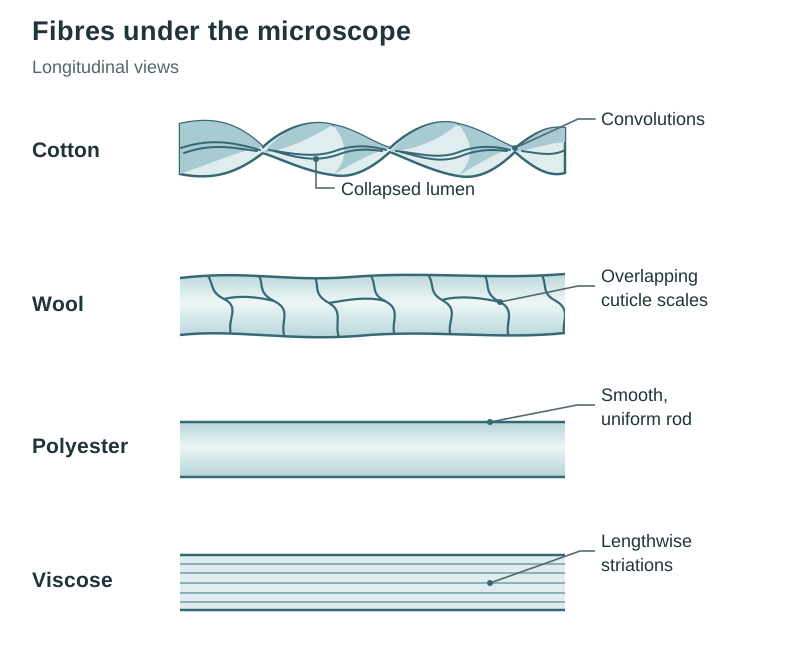
Microscopic appearance
When viewed longitudinally under a light microscope, fibres show clear distinguishing characteristics:
- Cotton: Flat, twisted ribbons with directional twists called convolutions, and a collapsed central hollow canal (lumen).
- Wool: Irregular cylindrical rods covered in overlapping surface cuticle scales that cause felting shrinkage when agitated in warm water.
- Polyester: Smooth, uniform, glass-like solid rods with an even circular cross-section, occasionally showing tiny specks of titanium dioxide delustrant.
- Viscose: Smooth, regular rods showing fine lengthwise surface lines (striations).
Fabric Profiles: Cotton, Polyester, and Polycotton
At Higher Level, you must be prepared to write a detailed profile for one natural fabric, one manufactured fabric, and one blend.
1. Natural fabric profile: Cotton
- Fibre production: Ripe cotton bolls are picked and passed through a gin to separate the raw seed hairs from seeds and field debris. The cotton is opened, cleaned, carded into a soft untwisted rope called a sliver, combed to remove short fibres, drawn out, and twisted into spun yarn.
- Properties: Highly absorbent (hydrophilic), breathable, cool next to the skin, non-static, hypoallergenic, and about 20% stronger when wet. It creases easily, has poor elasticity, and shrinks on its first wash.
- Uses: Bed sheets, towels, denim jeans, shirts, and medical gauze.
2. Manufactured synthetic profile: Polyester
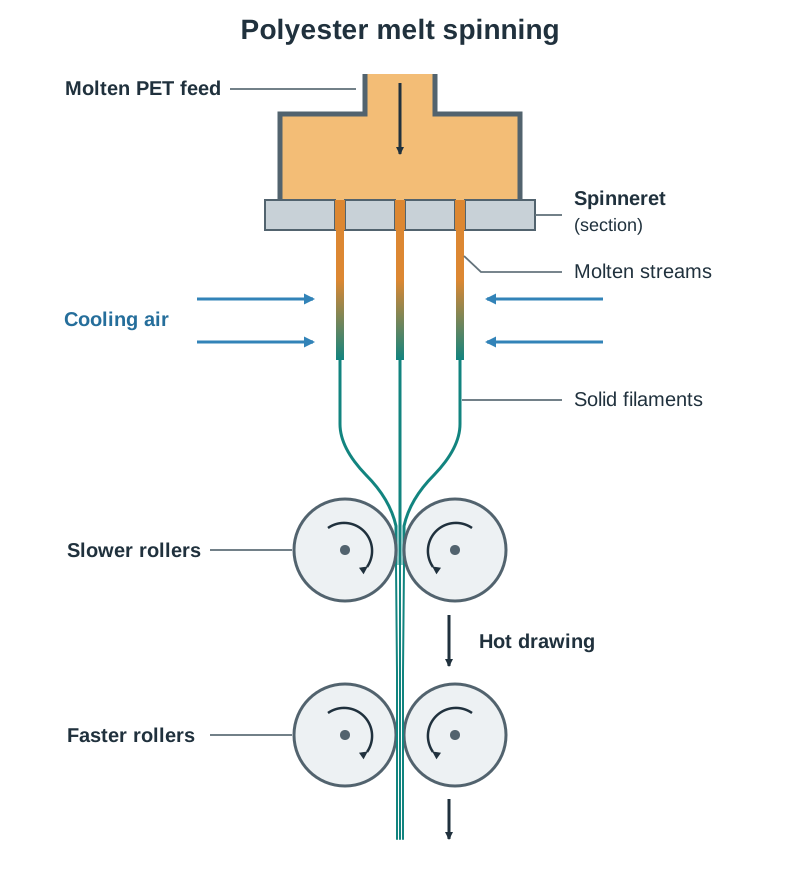
- Fibre production (melt spinning): Ethylene glycol and terephthalic acid undergo condensation polymerisation to form polyethylene terephthalate (PET) polymer chips. These chips are melted and pumped through tiny holes in a spinneret plate. The molten streams hit cool air, solidify into continuous filaments, and are hot-drawn (stretched) to pull the polymer chains into tight parallel alignment, giving the fibre high tensile strength.
- Properties: Hydrophobic (absorbs almost no moisture, with a regain of roughly 0.4%), quick drying, highly resilient against creasing, dimensionally stable, hard wearing, and thermoplastic. It attracts static electricity and readily holds oily grease stains.
- Uses: Rain jackets, sports jerseys, fleece jumpers, curtains, and polyester sewing thread.
3. Blend profile: Polycotton (65% polyester / 35% cotton)
- Fibre production: Polyester continuous filaments are crimped, heat-set, and chopped into short staple lengths matching raw cotton fibres. The two fibres are thoroughly blended together during the carding or drawing stages before being spun into a single uniform yarn.
- Performance balance: Pure cotton wrinkles badly and takes hours to dry; pure polyester feels clammy against the skin in warm weather. Blending 65% polyester with 35% cotton creates an easy-care cloth that dries rapidly, needs little or no ironing, and resists tearing, while retaining enough cotton to stay soft, breathable, and comfortable against the body.
- Uses: School shirts, everyday bed linen, and hospital uniforms.
Yarn Production, Modification, and Fabric Construction
Textile construction converts raw fibres into continuous yarns, and then interlaces or bonds those yarns into stable cloth.
Yarn types and modifications
- Staple spun yarns: Made by twisting short fibres (cotton, wool, or chopped synthetic staple). The twist locks adjacent fibres together by friction to build tensile strength. A high twist produces a crisp, smooth, strong yarn; a low twist gives a softer, bulkier, more absorbent yarn.
- Continuous filament yarns: Extruded directly from spinnerets as long, unbroken strands. They produce smooth, lustrous yarns.
- Texturising: Thermoplastic synthetic filaments are heated, mechanically crimped or coiled (for example by false-twist texturing), cooled, and permanently heat-set. Texturising inserts permanent waves and loops that trap air pockets, boosting bulk, warmth, and stretch. It also improves moisture transport (wicking), allowing perspiration to travel along the outer spaces between loops even though the fibre itself remains hydrophobic.
- Altering filament cross-sections: Modifying the spinneret hole shape changes filament properties: a trilobal (three-lobed) hole reflects light to produce a silk-like lustre, while hollow filaments trap air for lightweight warmth.
Fabric construction methods
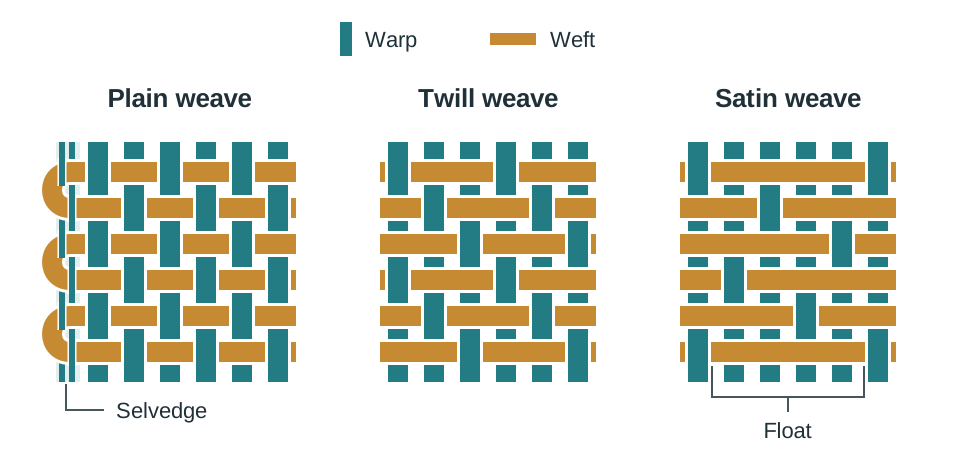
- 1. Weaving: Two sets of yarns interlace at right angles on a loom. The lengthwise yarns running under tension are the warp, the crosswise yarns interlacing back and forth are the weft, and the firmly woven edge running parallel to the warp that prevents fraying is the selvedge.
- Plain weave: Simple over-one, under-one interlacing (calico, poplin). Strong, firm, and hard wearing.
- Twill weave: The weft passes over two or more warp threads in a staggered sequence, creating visible diagonal lines across the fabric face (denim, gabardine). Extremely durable with excellent drape.
- Satin weave: Long yarn floats pass over four or more yarns before interlacing. Produces a smooth, lustrous fabric face that snags easily.
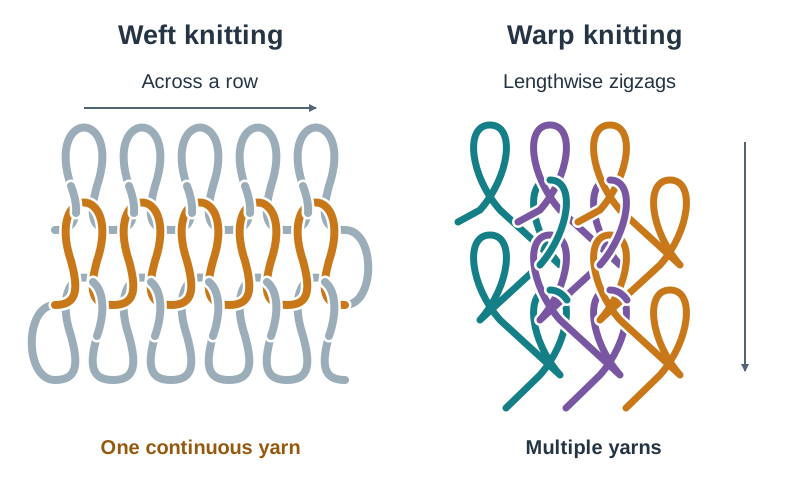
- 2. Knitting: Yarns are looped together using needles.
- Weft knitting: One yarn travels horizontally across rows of loops (single jersey, hand knitting). Stretchy and comfortable, but runs or ladders if a loop breaks.
- Warp knitting: Multiple vertical yarns interloop zigzag fashion (tricot). Ladder-resistant and structurally firm.
- 3. Non-woven direct web construction: Fabrics made directly from webs of fibres without prior spinning into yarns.
- Wool felt: Heat, moisture, and friction cause overlapping wool scales to open, interlock, and matt permanently.
- Bonded webs: Random synthetic webs are bonded using heat and heated calender rollers or chemical adhesive resins (sew-in interfacings, disposable wipes).
Finishes, Colouration, and Surface Design
Once woven or knitted, fabrics undergo finishes to improve performance, colour, or decorative appeal.
Functional finishes
- Crease-resistant finish: Synthetic resins (such as urea-formaldehyde derivatives, seen commercially in Tebilized cottons) are applied to cellulosic fabrics and baked at high heat. The resin forms chemical cross-links between neighbouring cellulose chains. These covalent bridges stop chains from sliding past each other when crushed, allowing the cloth to spring back flat.
- Flame-retardant finish (PROBAN): A specialised phosphorus-based polymer chemically bonded into cotton fibres. Under direct heat, it releases phosphoric acid, converting the cotton into an insulating char layer that smothers the flame and starves it of oxygen.
- Water-repellent versus waterproof finishes: A water-repellent finish coats individual yarns with water-repelling (hydrophobic) silicone or fluorochemicals, so water cannot wet the surface and instead beads up and rolls off, while the spaces between the yarns stay open for air and vapour breathability. A waterproof finish seals the fabric face with a continuous rubber, PVC, or polyurethane film, closing all pores and blocking both air and water completely.
Colour application (dyeing and printing)
- Solution (dope) dyeing: Pigment is blended directly into the liquid synthetic polymer before it is pumped through the spinneret holes, giving unbeatable colour-fastness.
- Piece dyeing: Complete rolls of woven or knitted cloth are immersed in a dye bath. This is economical and allows manufacturers to respond quickly to seasonal colour trends.
- Screen printing: Thick dye paste is forced through open areas of a porous mesh screen onto the cloth using a squeegee blade, using a separate screen for every colour in the pattern.
- Transfer (sublimation) printing: Designs pre-printed onto paper with disperse dyes are pressed onto synthetic fabric under heat (200 °C) and pressure. The solid dye vaporises straight into gas and fuses permanently into the polyester fibres.
Design application (surface decoration)
- Embroidery: Decorative thread patterns stitched onto fabric by hand or machine to create texture, logos, or motifs.
- Appliqué: Small fabric cut-outs laid onto a background fabric and stitched around the edges with dense satin or zigzag machine stitches.
- Batik: A wax-resist technique where hot melted paraffin or beeswax is painted onto fabric. When dipped in cold dye, waxed zones resist colour; the wax is subsequently melted and ironed out between sheets of paper.
- Tie-dye: A mechanical resist method where fabric is tightly folded, bunched, and bound with string or rubber bands before dyeing, preventing dye from reaching the folded areas.
Fabric Selection and Household Resources
Before choosing a textile for clothing or the home, consider fitness for purpose: the fabric's physical and chemical properties must match the job the item must do. In an examination answer, earn marks by stating a named factor, an explanation, and a relevant example.
Selection criteria
- Fabric properties (performance in use): Warmth, absorbency, tensile strength, crease recovery, flammability, and elasticity. Example: A bath towel must absorb moisture rapidly and tolerate frequent 60 °C washes, so 100% cotton terry towelling is selected.
- Cost: Both the retail purchase price and ongoing maintenance costs matter. Example: Polycotton shirts are chosen over pure linen for school uniforms because they are cheaper to buy and do not require expensive dry cleaning or lengthy ironing.
- Care requirements: Whether the item is machine washable, tumble-dryer safe, or requires hand washing or dry cleaning. Example: Everyday bed linen should be machine washable at 60 °C for hygiene.
- Aesthetic appeal: Colour, pattern, texture, lustre, and drape suited to the room's interior scheme or the garment's cut.
- Personal choice and comfort: Softness against the skin, weight, lifestyle, and freedom from skin irritation or allergies.
- Safety considerations: Choosing low flammability fabrics for nightwear or kitchen furnishings, and non-slip rubber backings on rugs.
Household textiles
Textiles represent a significant financial investment in the home and must deliver long-term performance:
- Curtains: Require good drape, insulation to prevent window heat loss, high light-fastness so colours do not bleach in sunlight, and low flammability near kitchens.
- Carpets and rugs: Require exceptional abrasion resistance and pile resilience. An 80% wool / 20% nylon blend is the classic flooring standard: wool provides warmth, soil resistance, and natural pile bounce-back, while nylon provides immense wear resistance against foot traffic.
- Upholstered furniture: Demands high abrasion resistance, stain resistance, and compliance with statutory fire safety standards.
- Bed linen and towels: Demand high absorbency, softness, and the ability to withstand frequent laundering at 60 °C to eliminate dust mites and bacteria.
Textile Care, Scientific Principles, and Labelling
Laundering relies on thermal, mechanical, and chemical actions working together to remove dirt without destroying fibres.
Scientific principles of laundering
- Surfactants: Cleaning molecules containing a hydrophilic (water-loving) head and a lipophilic (oil-loving) tail. They reduce the surface tension of water, allowing it to penetrate between yarns, and surround oily dirt particles to form suspended clusters called micelles that rinse away freely.
- Detergent enzymes: Biological detergents use specific enzyme catalysts to hydrolyse stubborn stains at warm temperatures (30 °C to 40 °C). Proteases break protein stains (blood, egg, sweat) into soluble peptides; lipases split fatty oils into glycerol and fatty acids; amylases break down starches. Water temperatures above 60 °C denature these enzymes, destroying their cleaning activity.
Matching fibre properties to care rules
| Fibre | Key property | Care instruction |
|---|---|---|
| Wool | Scales felt under heat/rubbing; weak when wet | Cool gentle wash, mild non-biological detergent (proteases damage protein), dry flat, warm iron |
| Cotton | Stronger when wet; not heat sensitive; creases easily | Hot machine wash (60 °C+), tumble dry safe, hot steam iron |
| Polyester | Hydrophobic; thermoplastic; melts under heat | Warm wash (40 °C), drip dry or low tumble dry, cool iron |
| Viscose | Weak when wet; loses up to 50% tensile strength | Gentle cycle or hand wash, avoid harsh wringing, warm iron |
International care symbols
A permanent care label uses five standard symbols in a set order:
- Washtub (washing): The number inside states the maximum water temperature in °C (e.g. 40). A bar underneath indicates a reduced, gentle mechanical action; a hand means hand wash only; a cross through means do not wash.
- Triangle (bleaching): An empty triangle permits chlorine bleaching; a crossed-out triangle forbids bleach.
- Iron (ironing): Dots indicate temperature: one dot = cool (acrylic, nylon); two dots = warm (polyester, wool); three dots = hot (cotton, linen). A crossed-out iron means do not iron.
- Circle (dry cleaning): Letters inside (P or F) guide the dry cleaner on solvent selection; a crossed-out circle means do not dry clean.
- Square (drying): A circle inside a square permits tumble drying (one dot = low heat, two dots = normal heat); a crossed-out square with circle means do not tumble dry.
Fabric Performance Testing Protocols
Performance tests evaluate how a fabric behaves under controlled laboratory conditions, verifying whether it suits a design brief before garment cutting.
1. Crease recovery test (fist method)
- Cut identical samples of each fabric (e.g. 10 cm by 10 cm).
- Crumple one sample tightly inside a closed fist and squeeze firmly for exactly one minute.
- Release the fabric, open the hand, and smooth the sample once gently across a flat table.
- Observe the fabric immediately and rate the remaining creases on a five-point scale (5 = no creases, excellent recovery; 1 = heavily creased, poor recovery).
(Laboratory alternative: fold a 5 cm by 2.5 cm strip along the warp, place a 1 kg weight on the fold for five minutes, suspend by one leg, and measure the recovery angle between the two halves with a protractor. An angle near 180° indicates superior recovery.) Controlled variables: Same sample size, same holding time, and equal squeezing force.
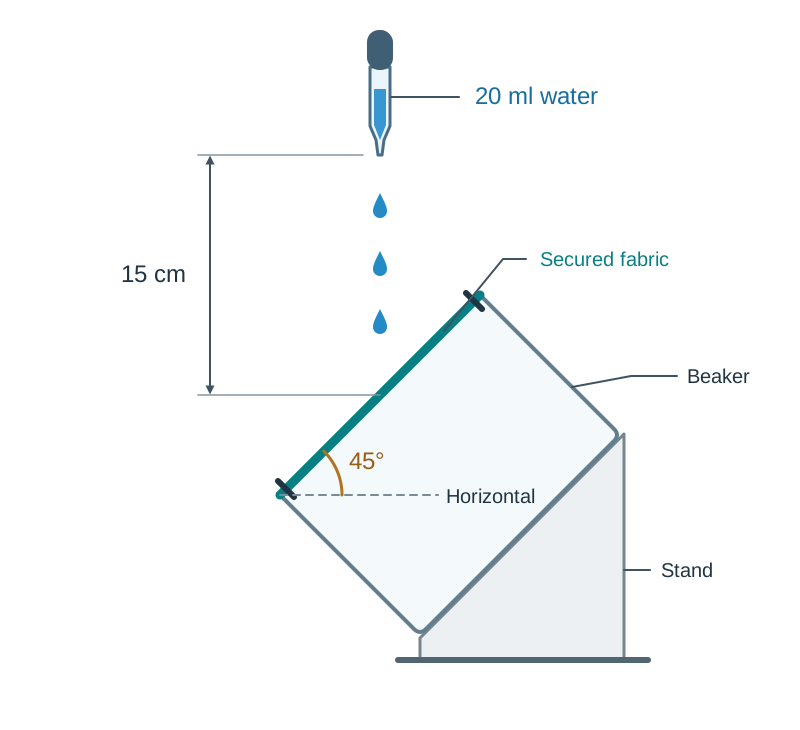
2. Water-repellence test (spray test)
- Cut equal swatches of each test fabric and pin each smoothly, without stretching, over the open mouth of a glass beaker.
- Tilt the beaker stand at a 45° angle so water can run off.
- Using a pipette or spray head held 15 cm directly above the cloth, release 20 ml of water onto the surface.
- Observe whether the droplets bead up and roll off, soak into the surface, or drip through into the beaker after five minutes.
Controlled variables: Same fabric surface area, same water volume, same drop height, and identical angle.
3. Abrasion resistance test (rub test)
- Cut equal samples of fabric and weigh each on an analytical balance to record starting mass in grams.
- Clamp the specimen into a rubbing apparatus (or secure it flat and rub with a standard abrasive pad under a fixed 500 g weight).
- Apply a set number of rubs (e.g. 100 rubs) across the grain.
- Inspect the cloth for fuzzing, thinning, or pilling, and re-weigh to determine mass lost through abrasion.
Controlled variables: Identical abrasive surface, same number of rubs, and consistent downward pressure.
4. Dimensional stability (percentage shrinkage calculation)
Mark an exact 10 cm by 10 cm square on the fabric using permanent ink. Launder and dry according to care specifications, and remeasure along both warp and weft.
Textile Fire Safety and Domestic Furniture Regulations
Upholstered furniture in the home presents severe fire risks. Untreated cotton and linen covers ignite readily, while traditional polyurethane foam padding ignites rapidly, burns with ferocious heat, and releases dense clouds of lethal carbon monoxide and hydrogen cyanide gas.
To safeguard households, domestic furniture sold in Ireland must comply with the Fire Safety (Domestic Furniture) Order (1988).
Purpose and scope of the Order
The purpose of the Order is to:
- Reduce house fires, serious burns, and deaths caused by burning furniture.
- Mandate that all upholstery fillings and fabrics meet strict ignition-resistance standards, tested against smouldering cigarettes and open match flames.
- Outlaw the sale of domestic furniture containing dangerous, untreated polyurethane foam.
- Ensure consumers receive clear safety information at the point of sale via display swing tags and permanent labels.
The Order applies to all new domestic furniture intended for indoor home use, including armchairs, sofas, sofa-beds, padded headboards, mattresses, floor cushions, and children's upholstered items.
Safety components
- CMHR foam (Combustion Modified High Resilience): Polyurethane foam manufactured with chemical fire retardants and melamine additives. Exposed to flame, it forms a dense carbonaceous char that resists open flame ignition, self-extinguishes, and sharply curtails toxic gas emissions.
- Interliners: Fire-retardant barrier fabrics stitched between the outer decorative upholstery cover and the internal foam cushion to block heat transfer.
Statutory labelling requirements
- Square display label (green border): Attached to furniture on display in the shop where the customer can see it clearly before buying. It certifies that the internal fillings comply with safety regulations and the outer cover fabric has passed both the smouldering cigarette test and the match flame ignition test.
- Triangular display label (red cautionary border): A warning swing tag indicating that while fillings pass regulations and the cover resists a cigarette, the outer cover is not match-resistant. It warns that a fire-resistant interliner must be fitted beneath the fabric.
- Permanent labels: Stitched securely into the furniture frame or under cushions. They state the manufacturer's name, batch reference number, details of internal filling materials, and whether a fire-retardant interliner is present.
Key terms
- Natural Fibre
- A textile fibre derived directly from plants or animals without chemical rebuilding, such as cotton, linen, wool, or silk.
- Regenerated Fibre
- A manufactured fibre made by chemically dissolving natural plant cellulose (wood pulp) and extruding it into solid filaments, such as viscose.
- Synthetic Fibre
- A manufactured fibre synthesised entirely from petrochemical precursors via chemical polymerisation, such as polyester, nylon, or acrylic.
- Thermoplastic
- The property of synthetic fibres to soften and melt under heat, allowing permanent pleating, texturising, and heat setting.
- Texturising
- The process of introducing permanent crimps, coils, or loops into smooth synthetic filaments with heat to improve bulk, warmth, stretch, and wicking.
- Blend
- A textile created by mixing two or more different fibres together before yarn spinning, so every single yarn contains both fibres.
- Mixture
- A fabric constructed using one fibre type for the warp yarns and a different fibre type for the weft yarns.
- Warp and Weft
- The two yarn sets in a woven cloth: warp yarns run lengthwise under tension on the loom, while weft yarns run crosswise from selvedge to selvedge.
- Selvedge
- The woven, self-finished lengthwise edge of a fabric running parallel to the warp that resists fraying.
- Felting Shrinkage
- The irreversible shrinkage of wool caused when microscopic surface cuticle scales swell and interlock tightly under heat, moisture, and agitation.
- Water-Repellent
- A finish that coats individual yarn surfaces with hydrophobic chemicals so water beads up, while leaving spaces between yarns open for breathability.
- Waterproof
- A continuous impervious coating or membrane that completely seals fabric pores, blocking the passage of all air and water.
- Flame-Retardant (PROBAN)
- A chemical finish bonded into cotton fibres that releases phosphoric acid when exposed to heat, forming an oxygen-starving char layer that stops burning.
- CMHR Foam
- Combustion Modified High Resilience foam; polyurethane foam treated with fire-retardant additives to resist ignition and toxic smoke.
- Fire Safety (Domestic Furniture) Order (1988)
- Irish legislation mandating fire-resistant fillings, cigarette and match resistance, and statutory display and permanent safety labelling on domestic furniture.
- Fitness for Purpose
- The principle that a selected fabric's physical and chemical properties must directly match the functional, aesthetic, and care needs of the finished product.
Check yourself
What is the structural cause of felting shrinkage when washing wool garments?
Wool fibres are covered in microscopic overlapping cuticle scales that swell in warm water and interlock permanently under mechanical agitation.
Distinguish between a textile blend and a textile mixture.
In a blend, two or more different fibres are combined before spinning so every yarn contains both fibres; in a mixture, warp yarns consist of one fibre and weft yarns consist of an entirely different fibre.
What does a washtub symbol containing the number 40 with a single bar underneath indicate?
Machine wash at a maximum water temperature of 40 °C using a reduced, gentler mechanical cycle.
Name four factors to consider when selecting household curtains, giving a reason for each.
Aesthetic drape (hangs nicely in room decor), light-fastness (resists fading from sun exposure), thermal insulation (reduces window heat loss), and flammability (safety near radiators or cookers).
What standard is confirmed by a square green-bordered swing tag on furniture under the Fire Safety (Domestic Furniture) Order (1988)?
It certifies that furniture fillings meet fire regulations and the outer covering fabric has passed both the smouldering cigarette test and the match flame ignition test.
Why does cotton become roughly 20% stronger when wet?
Water causes cotton fibres to swell, which improves the alignment of internal fibrils and distributes tension loads more evenly along the fibre.