

This topic covers how consumers make purchasing decisions, how retail environments influence spending, and how individuals exercise legal rights and environmental responsibilities in Ireland. It explores household budgeting and income deductions, payment methods including credit and hire purchase, essential statutory protections under the Sale of Goods and Supply of Services Act 1980 and the Consumer Rights Act 2022, complaint resolution mechanisms, and the impact of household consumption on the environment.
Consumer Choice, Retail Outlets, and Shopping Patterns
A consumer's purchasing behaviour depends on personal circumstances as well as the commercial environment. At Leaving Certificate level, you need to be able to name specific factors that shape choices and classify modern retail formats.
Factors Influencing Consumer Decision-Making
- Household Income and Socio-Economic Status: Income sets a family's purchasing power. Lower-income households direct most of their money toward essential bills and staple foods, relying heavily on supermarket own-brands and discount retailers. Households with higher incomes have more disposable income (money left after paying essential bills and taxes), which allows them to buy premium brands, convenience items, and luxury goods.
- Personal Values and Ethics: Shoppers increasingly look for organic certification, animal welfare standards, fair-trade ingredients, and recyclable packaging.
- Advertising and Marketing: Promotional campaigns generate brand awareness, remind consumers of established products, introduce new lines, and encourage impulse purchases.
- Packaging and labelling: Attractive, convenient packaging catches the eye on the shelf. Labels give information such as ingredients, nutrition, price per unit, origin and energy rating, which helps shoppers compare products and choose.
Classification of Retail Outlets
- Independent shops: Small, privately owned businesses offering personal service, such as a local butcher or corner shop. Prices are often higher due to lower purchasing volumes.
- Multiples and chain stores: Groups of stores operating under a single corporate brand with identical formats, such as Dunnes Stores or Penneys. Bulk buying allows them to keep retail prices competitive.
- Supermarkets and hypermarkets: Large self-service stores stocking groceries, household goods, and clothing with dedicated parking, such as Tesco or SuperValu.
- Discount stores: Retailers operating with low overheads and limited product ranges, focusing on own-brand goods at lower prices, such as Aldi and Lidl.
- Department stores: Large stores divided into separate departments under one roof, such as Arnotts or Brown Thomas.
- Franchises: Independently owned branches operating under a recognised brand license, adhering to strict corporate guidelines, such as McDonald's.
- Markets and farmers' markets: Stalls selling fresh, locally grown or artisan produce directly from producers to shoppers.
- Non-store retailing: Online shopping portals, mail order, and television shopping channels.
Changing Shopping Patterns
Irish shopping habits have shifted significantly. Online shopping continues to grow because of its round-the-clock convenience and easy price comparisons, though shoppers face delivery charges and cannot inspect goods before purchase. Families tend to make one large weekly supermarket shop for ambient and chilled groceries rather than daily trips to independent shops. Contactless and digital wallet payments have largely replaced cash, and busy work schedules have driven up sales of pre-prepared meals and convenience foods.
Retail Psychology, Merchandising, and Consumer Research
Retailers use calculated physical and sensory strategies to maximise shopper dwell time and increase average spend.
Retail Psychology and Merchandising Techniques
When answering exam questions on merchandising, state the technique clearly, explain how it drives spending, and give an example.
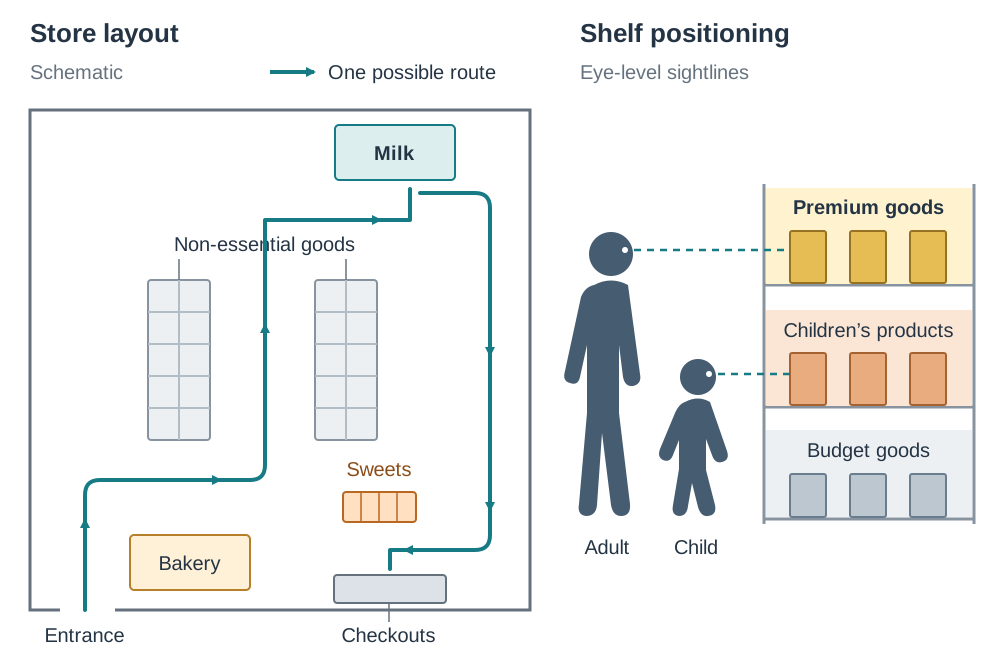
- Store layout: Essentials such as milk and bread are placed at the back of the store. This forces customers to walk through several aisles, exposing them to non-essential goods and triggering impulse buying (unplanned purchases).
- Shelf positioning: High-profit items and luxury brands sit at eye-level (the 'golden shelf' or 'buy level') where shoppers look first. Budget and own-brand items are kept on the bottom shelf, while items aimed at children, such as sugary cereals, are positioned on lower shelves within their line of sight.
- In-store stimuli: Supermarkets place the bakery near the entrance so the smell of fresh bread makes shoppers feel hungry, prompting extra food purchases. Slow-tempo background music relaxes shoppers and slows their walking pace, extending browsing time.
- Pricing strategies: Psychological pricing makes an item seem cheaper than it is, such as charging €4.99 instead of €5.00. Multi-buy promotions, like 'buy two, get one free', encourage customers to buy larger quantities. A loss leader is a staple product sold at or below cost price to draw footfall into the store in the expectation that customers will buy profitable items alongside it.
- Point-of-sale displays: Sweets, chewing gum, and magazines sit beside checkout queues to prompt last-minute purchases while customers wait in line.
- Loyalty schemes: Supermarket reward cards provide points or discount vouchers. They reward repeat visits and provide retailers with valuable data on personal shopping habits for targeted promotional mailings.
Consumer Research Methods
- Desk research (secondary research): Involves analysing existing data collected by outside bodies. Sources include Central Statistics Office (CSO) reports, trade journals, and competitor websites. It is fast and inexpensive to gather, but the data can be outdated or too general for a specific commercial need.
- Field research (primary research): Involves gathering fresh, first-hand data directly from consumers. Methods include surveys, focus groups, customer observation, and tasting panels. It provides up-to-date and tailored feedback, but is expensive and time-consuming to carry out.
Consumer Rights, Responsibilities, and Guarantees
A functional consumer market requires both legal protections and active personal diligence.
Named Consumer Rights
- The right to safety: Goods and services must not pose hazards to health or property.
- The right to information: Consumers are entitled to accurate facts about price, ingredients, and instructions for use.
- The right to choice: Shoppers should have access to competing products at fair prices.
- The right to redress: Consumers have a right to a remedy when goods or services fail legal standards.
- The right to consumer education: Access to programmes and resources that develop discerning shopping habits.
- The right to be heard: Consumer interests must be represented in government policy and regulatory decisions.
Named Consumer Responsibilities
- Be informed: Research goods and compare prices, energy ratings, and reviews before buying.
- Examine goods: Inspect products for faults or damage before paying, and check expiration dates.
- Follow instructions: Read operating manuals and care labels to ensure products are used safely and correctly.
- Keep receipts: Retain receipts, order emails, or bank statements as necessary proof of purchase.
- Complain promptly: Report defects or substandard services to the retailer calmly and without delay.
- Assess quality and value for money: Evaluate products based on durability and performance rather than selecting solely on price.
- Protect the environment: Avoid excessive packaging, reduce energy and water use, and recycle waste appropriately.
Guarantees and Warranties
A guarantee is a written statement from a manufacturer or retailer promising to repair, replace, or maintain a faulty product free of charge within a set period. Under Irish law, a guarantee must state clearly what product is covered, the duration, the guarantor's contact details, the geographic scope, and the claim procedure. A guarantee provides extra protection and cannot exclude or replace statutory consumer rights.
Statutory Consumer Protection Legislation
Candidates must know the core provisions of Irish consumer legislation and recent updates.
Sale of Goods and Supply of Services Act 1980
This Act governs the legal contract between the consumer and the seller when buying goods or services:
- Conditions applying to goods:
- Goods must be of merchantable quality (of an acceptable standard considering price, durability, and description).
- Goods must be fit for the purpose intended (suitable for normal everyday use or any specific job described to the retailer).
- Goods must be as described (matching labels, advertising, or verbal statements from staff).
- Goods must correspond to the sample (matching any cut of carpet, fabric swatch, or display model shown prior to sale).
- Conditions applying to services: The service provider must possess the necessary skill, carry out work with due care and diligence, use sound materials fit for purpose, and finish within a reasonable time.
- Forms of redress: If goods breach these conditions, the consumer is entitled to redress from the retailer: a repair, a replacement, or a refund (the '3 Rs'). If a serious fault appears shortly after purchase, the consumer is entitled to a full refund.
- Retailer responsibility: The legal contract is with the retailer, not the manufacturer. The retailer must resolve the complaint and cannot refer the customer to the manufacturer. Notices such as 'No Cash Refunds' or 'Credit Notes Only' are illegal because they attempt to limit statutory rights.
Consumer Rights Act 2022 (Updating the 1980 Act)
For consumer-to-trader contracts made from late 2022 onward, this legislation modernised statutory protections:
- Satisfactory quality: Replaced the term 'merchantable quality' for consumer contracts. Goods must meet standards of durability, functionality, and safety that a reasonable person would expect.
- Short-term right to reject: If goods develop a fault within 30 days of delivery, the consumer can reject them and obtain a full refund immediately without having to accept a repair.
- Tiered remedies: After 30 days, the trader must provide a repair or replacement within a reasonable time and without significant inconvenience. If that fails or is delayed, the consumer can claim a price reduction or use a final right to cancel the contract for a refund.
- Digital content and services: Extends statutory rights to digital purchases, such as streaming services, downloadable video games, and apps.
Consumer Information Act 1978 and Consumer Protection Act 2007
The Consumer Information Act 1978 established the office of the Director of Consumer Affairs and prohibited false trade descriptions regarding the composition, origin, or performance of goods. Most of its provisions were integrated into and expanded by the Consumer Protection Act 2007, which protects consumers against unfair, misleading, and aggressive trading practices:
- Misleading product claims: It is an offence to mislead consumers regarding product features, test results, or safety.
- Misleading pricing: Traders cannot display false previous prices. Under modern price-indication rules, any announced price cut ('was/now') must show the previous price based on the lowest price charged in the 30 days prior to the reduction.
Household Financial Management, Credit, and Appliance Selection
A household functions as an economic unit managing income, spending, and credit facilities.
Household Income and Deductions
- Gross income: Total earnings before any compulsory or voluntary deductions.
- Net income (take-home pay): The money remaining after all deductions have been subtracted from gross pay.
- Statutory deductions (compulsory by law):
- PAYE (Pay As You Earn): Income tax collected by employers on behalf of Revenue. It is calculated on gross pay and then reduced by tax credits, which directly lower the final tax liability.
- PRSI (Pay Related Social Insurance): Compulsory payments that fund State benefits, including maternity benefit, jobseeker's benefit, and the State pension.
- USC (Universal Social Charge): A tax calculated on gross income using progressive percentage bands.
- Non-statutory deductions (voluntary): Private pensions, private health insurance, and trade union subscriptions.
Household Expenditure Patterns
- Essential expenditure: Money that must be spent on basic everyday living necessities. Examples: mortgage or rent repayments, utility bills (gas, electricity), food staples, and home insurance.
- Discretionary expenditure: Spending on non-essential lifestyle choices from remaining disposable income after all essentials and savings targets are met. Examples: restaurant meals, streaming subscriptions, new clothes, and overseas holidays.
Credit Legislation and Payment Methods
- Consumer Credit Act 1995: Regulates personal loans, hire purchase, and consumer credit advertising. Credit agreements must be in writing, clearly legible, and state the cash price, credit price, instalment amounts, and the Annual Percentage Rate (APR). Lenders cannot contact borrowers at work without consent, nor can they visit or phone between 9:00 p.m. and 9:00 a.m. Monday to Saturday, or anytime on Sundays and public holidays.
- Cooling-off and withdrawal period: The 1995 Act introduced a 10-day cooling-off period. Under modern consumer credit regulations, consumers have a 14-day right of withdrawal from the date the agreement is signed to cancel without penalty.
- Hire purchase (HP) regulations: Hire purchase was first regulated by the Hire Purchase Acts 1946 and 1960. These protections were updated and now sit within the Consumer Credit Act 1995. The buyer gets possession and use of the goods, but legal ownership remains with the finance company until the final instalment is cleared. Under the one-third rule, once the consumer has paid at least one-third of the total hire purchase price, the finance company cannot repossess the goods without a court order.
Calculating the Cost of Credit
The true cost of credit is the difference between the total amount paid using credit and the original cash price.
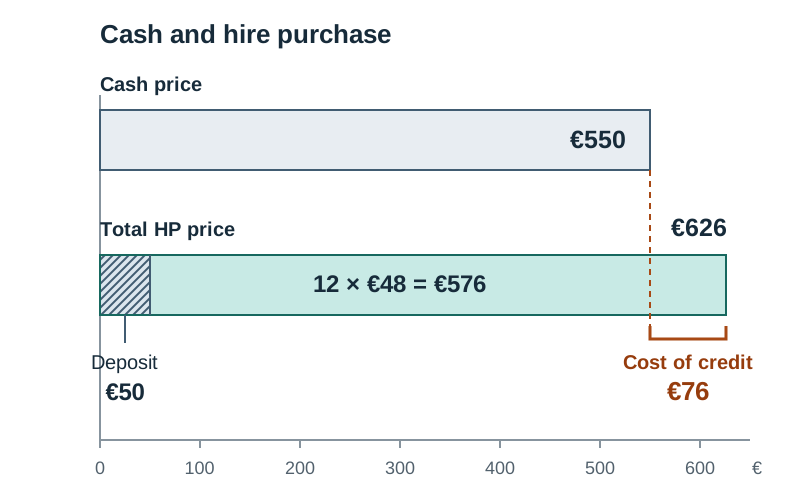
Scenario: A tumble dryer has a cash price of €550. On hire purchase, the store requires a €50 deposit followed by 12 monthly instalments of €48.
- Total hire purchase price = Deposit + (Instalments × Number of months)
- Total HP price = €50 + (€48 × 12) = €50 + €576 = €626
- Cost of credit = Total HP price − Cash price
- Cost of credit = €626 − €550 = €76
Consumer Considerations When Choosing Household Appliances
- Initial cost versus running expenses: Balance the purchase price against ongoing water and power costs.
- Energy efficiency: Check the EU Energy Label (graded A to G). An A-rated appliance uses significantly less electricity over its lifespan.
- Capacity and size: Ensure the appliance matches household needs (such as an 8 kg drum for a large family) and fits physical kitchen dimensions and door clearances.
- Safety marks and quality: Look for the CE mark, which confirms the manufacturer declares the product meets EU safety and health requirements (note: it is a declaration of conformity, not an independent quality seal). Check the terms of the manufacturer's guarantee and the availability of spare parts.
Complaint Procedures, Small Claims, and Consumer Agencies
Step-by-Step Complaint Procedure
- Stop using the item and retain proof: Cease using the product immediately to prevent further damage. Gather the till receipt, order confirmation, or bank statement.
- Contact the retailer: Return to the shop or contact the customer service department. Speak calmly to a manager, explain the fault, reference the Sale of Goods and Supply of Services Act 1980 (or Consumer Rights Act 2022), and state the preferred redress (repair, replacement, or refund).
- Formal written complaint: If verbal discussion fails, send a registered letter or email to head office outlining the purchase date, item details, fault, history of contact, and a clear deadline for resolution (usually 10 to 14 days).
- Use the Small Claims Procedure: If the trader refuses to cooperate, bring a claim through the local District Court.
The Small Claims Procedure
A fast, inexpensive legal avenue operating through the District Court to resolve consumer disputes without a solicitor:
- Financial limit: Claims up to a maximum value of €2,000.
- Application and fee: The consumer submits a claim online via courts.ie for an administrative fee of €25.
- Operation: The Small Claims Registrar contacts the trader and attempts to broker an agreed settlement. If the business disputes or ignores the claim, the matter is referred to a District Court judge for an enforceable ruling.
- Exclusions: It cannot be used for personal injury claims, debts, or disputes arising from tenancy agreements.
Statutory and Voluntary Consumer Protection Bodies
| Agency | Status | Core Functions and Powers |
|---|---|---|
| Competition and Consumer Protection Commission (CCPC) | Statutory | Enforces Irish and EU consumer legislation, investigates anti-competitive practices, issues product recalls, handles trader investigations, and provides educational resources. |
| Food Safety Authority of Ireland (FSAI) | Statutory | Coordinates food safety regulation enforcement across Ireland, ensures accurate food labelling, inspects food businesses via environmental health officers, and has the legal power to issue closure orders against premises that breach food hygiene regulations. |
| National Standards Authority of Ireland (NSAI) | Statutory | Develops national industrial and commercial safety standards, testing and certifying products with the Irish Standard Mark. |
| Financial Services and Pensions Ombudsman (FSPO) | Statutory | Resolves consumer complaints against regulated financial service providers, including banks, insurance firms, and credit unions. |
| Commission for Regulation of Utilities (CRU) / ComReg | Statutory | Oversees energy, water, and telecommunications markets, handling unresolved billing or service disputes. |
| Consumers' Association of Ireland (CAI) | Voluntary | Independent, non-profit organisation that advocates for consumer interests, lobbies legislators, and publishes comparative product testing in Consumer Choice magazine. |
| Advertising Standards Authority for Ireland (ASAI) | Voluntary | Industry-funded self-regulatory body that investigates consumer complaints to ensure marketing materials are legal, decent, honest, and truthful. |
Environmental Responsibilities, Resources, and Green Symbols
Everyday domestic choices directly influence resource consumption, climate change, and pollution.
Energy Resources and Conservation
- Non-renewable resources: Finite natural reserves that cannot be replenished once consumed, such as coal, oil, peat, and natural gas. Their combustion releases greenhouse gases like carbon dioxide, driving global warming.
- Renewable resources: Naturally replenishing energy sources that do not deplete finite reserves, including solar, wind, wave, hydroelectric, and geothermal energy.
- Household conservation strategies: Insulating attics and cavity walls, installing heat pumps or solar PV panels, switching to LED lighting, and programming smart thermostats.
Forms of Pollution and Consumer Action
- Air pollution: Caused by burning fossil fuels for home heating and transport. Consumer action: use public transport, choose electric vehicles or active travel, and install renewable heating systems.
- Water pollution: Caused by untreated sewage, fertiliser runoff, and domestic cleaning chemicals entering water tables. Consumer action: use phosphate-free detergents and avoid pouring cooking fats or chemicals down drains.
- Noise pollution: Caused by traffic, aircraft, and heavy machinery. Consumer action: install double-glazed windows and plant perimeter hedges to absorb sound.
- Land pollution: Caused by landfill disposal and litter. Consumer action: follow the waste hierarchy (prevention, minimisation, reuse, recycling, energy recovery, disposal).
Electrical Recycling and Green Packaging Symbols
- WEEE Scheme (Waste Electrical and Electronic Equipment): Retailers must take back old household electrical appliances free of charge on a one-for-one basis when an equivalent new appliance is bought. This ensures old appliances are recycled safely, so harmful substances such as lead and mercury do not end up in landfill.
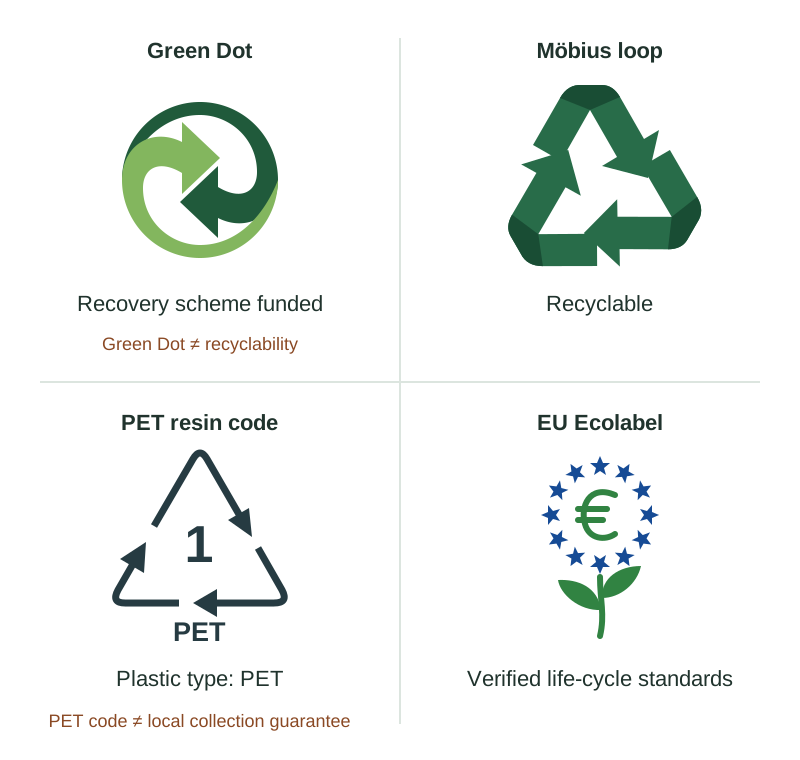
- The Green Dot: A European registered trademark showing that the packaging manufacturer has paid a financial levy to a national packaging recovery organisation (such as Repak in Ireland). It does not mean the packaging is made from recycled materials or is locally recyclable.
- Mobius Loop and Plastic Resin Codes (e.g. PET 1): The chasing-arrows Mobius Loop indicates that an item can be recycled. When accompanied by the number 1 and the letters PET, it identifies Polyethylene Terephthalate, a widely collected, easily recyclable rigid plastic used for drinks bottles.
- EU Ecolabel: A voluntary flower logo awarded to goods and services that meet verified, high environmental standards across their full life cycle.
Key terms
- Merchantable Quality
- The statutory standard under the Sale of Goods and Supply of Services Act 1980 requiring goods to be of an acceptable standard and durability, taking into account price and description.
- Satisfactory Quality
- The updated standard under the Consumer Rights Act 2022 requiring goods sold by a trader to meet the durability, functionality, and safety standards that a reasonable consumer would expect.
- Right to Redress
- The consumer's legal entitlement to a remedy from the retailer when goods or services fail statutory standards, comprising a repair, replacement, or refund.
- Small Claims Procedure
- A low-cost, informal dispute resolution process in the District Court dealing with consumer claims up to €2,000 for a fee of €25 without requiring a solicitor.
- Annual Percentage Rate (APR)
- The total annual cost of credit expressed as a percentage of the amount borrowed, including interest and all mandatory borrowing charges.
- One-Third Rule
- A legal protection under hire purchase legislation preventing a finance company from repossessing goods without a court order once the consumer has paid one-third of the hire purchase price.
- Loss Leader
- A retail pricing strategy where a popular staple product is sold at or below cost price to draw shoppers into a store so they purchase higher-margin items.
- Tax Credit
- A statutory allowance that directly reduces the gross amount of income tax an employee must pay to Revenue.
- Green Dot
- A trademark logo confirming that the packaging producer has contributed financially toward a national packaging recovery and recycling scheme, such as Repak.
- Discretionary Expenditure
- Household spending on non-essential lifestyle wants and leisure activities, paid for out of disposable income once essential living costs have been covered.
Check yourself
What are the four implied conditions regarding goods under the Sale of Goods and Supply of Services Act 1980?
Goods must be of merchantable quality, fit for the purpose intended, as described, and correspond to any sample or model shown.
What is the short-term right to reject under the Consumer Rights Act 2022?
If consumer goods develop a fault within 30 days of delivery, the consumer can reject them and claim a full refund immediately without having to accept a repair.
A television has a cash price of €800. On hire purchase, it requires a €100 deposit and 18 monthly payments of €45. Calculate the cost of credit.
Total HP price = €100 + (18 × €45) = €100 + €810 = €910. Cost of credit = €910 − €800 = €110.
What protection does the one-third rule provide to consumers using hire purchase?
Once the consumer has paid at least one-third of the total hire purchase price, the finance company cannot repossess the goods without a court order.
Distinguish between a statutory deduction and a non-statutory deduction from household income, giving one example of each.
A statutory deduction is compulsory by law (such as PAYE, PRSI, or USC), whereas a non-statutory deduction is voluntary and chosen by the employee (such as a private pension, private health insurance, or trade union dues).
What does the PET 1 resin symbol convey to the consumer?
It shows that the packaging is made from Polyethylene Terephthalate, a widely recyclable plastic, and the number helps waste facilities sort it into the correct recycling stream.