

Carbohydrates are essential macronutrients formed in green plants during photosynthesis. Composed of carbon, hydrogen, and oxygen, they provide the body's main and most readily available source of heat and energy, providing 4 kcal (17 kJ) per gram. In this topic you need to know four things well: what carbohydrates are made of, how they behave in cooking, how they are digested and used in the body, and why fibre matters for health.
Photosynthesis and Chemical Structure
Green plants manufacture carbohydrates through photosynthesis. Chlorophyll in leaves traps sunlight to combine atmospheric carbon dioxide with water from the soil, forming glucose and releasing oxygen:
Carbohydrates contain carbon (C), hydrogen (H), and oxygen (O). Hydrogen and oxygen always occur in a 2:1 ratio, exactly as in water, giving the general formula .
Molecular Units
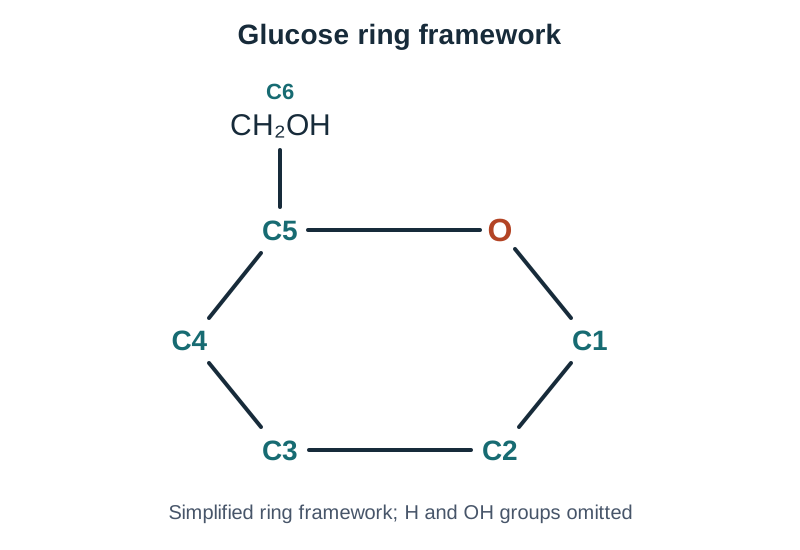
- Monosaccharides (): The basic unit of all carbohydrates. Glucose, fructose, and galactose are hexose sugars containing six carbon atoms. In solution and food, glucose forms a six-sided pyranose ring (five carbons and one oxygen atom inside the ring, with the sixth carbon located outside the ring in a group). Fructose forms a five-sided furanose ring containing four carbon atoms and one oxygen atom.
- Disaccharides (): Formed when two monosaccharide units join in a condensation reaction. A hydroxyl group () from one unit and a hydrogen atom () from the other combine to eliminate one molecule of water (), forming a strong glycosidic bond:
- Polysaccharides (): Formed when many monosaccharide units join through repeated condensation reactions, losing a water molecule at each glycosidic bond. The number of units () can range from several dozen to many thousands.
- Hydrolysis: The chemical breakdown of a compound due to reaction with water. During digestion or cooking with acid, glycosidic bonds split, returning polysaccharides and disaccharides to free monosaccharides.
Classification and Dietary Sources
Carbohydrates are divided into three classes based on the number of sugar units in the molecule:
| Class | Chemical Formula | Composition & Forms | Food Sources |
|---|---|---|---|
| Monosaccharides | Single sugar units: <br>• Glucose <br>• Fructose <br>• Galactose | • Fruit, onions, sweetcorn, honey <br>• Ripe fruits (apples, pears, grapes), berries, honey <br>• Not found free in food; released when lactose in milk is digested | |
| Disaccharides | Double sugars: <br>• Sucrose (Glucose + Fructose) <br>• Lactose (Glucose + Galactose) <br>• Maltose (Glucose + Glucose) | • Table sugar, sugar beet, sugar cane, jam <br>• Cow's milk, yoghurt, cheese <br>• Germinating barley, malted breakfast cereals | |
| Polysaccharides | Many sugar units: <br>• Starch <br>• Glycogen <br>• Cellulose <br>• Pectin | • Potatoes, flour, bread, pasta, rice, pulses <br>• Stored in animal liver and muscle tissue <br>• Wholemeal flour, wholegrain cereals, skins of vegetables <br>• Cooking apples, blackcurrants, plums, citrus rinds |
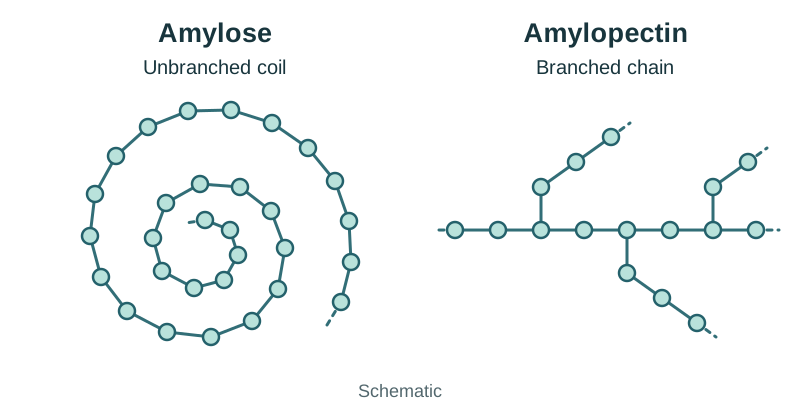
Starch consists of two molecules: amylose (long, unbranched chains coiled into a spiral) and amylopectin (shorter, branched chains). Cellulose and pectin belong to the group known as non-starch polysaccharides (NSP), which form the indigestible structural framework of plant cell walls.
Culinary Properties of Carbohydrates
In food science and cookery questions, marking schemes award marks when you structure your answer in three steps: name the property → say what happens with the temperature → name an example dish.
Example: Caramelisation: when dry sugar is heated it melts at about 160°C and browns between 160°C and 180°C, forming brown caramel with a distinctive flavour – used in crème caramel.
Properties of Sugars
- Sweetness: All sugars taste sweet, but their sweetening power varies. Fructose is the sweetest, followed by sucrose, glucose, maltose, and lastly lactose.
- Solubility: Sugars are white crystalline solids that dissolve in water. Solubility increases with heat, allowing thick sugar syrups to form for glazes, poaching syrups, and preserves.
- Caramelisation: Heating dry sugar without water causes it to melt at approximately 160°C. Between 160°C and 180°C, it undergoes thermal decomposition, developing a golden brown colour and rich aroma. Heating above 180°C burns the sugar to black, bitter carbon.
- Crystallisation: When a saturated sugar solution cools, the liquid cannot hold all the dissolved sugar, and solid sugar crystals precipitate out. In confectionery, boiling syrup progresses through recognisable temperature stages: thread stage at about 104°C (jam setting), soft ball at about 116°C (fudge), hard ball at about 121°C (toffee), and caramel at about 160°C to 180°C. Rapid cooling and beating produce tiny crystals for smooth fudge; unprompted crystallisation produces grainy jam.
- Inversion: Boiling sucrose with an acid (such as lemon juice) hydrolyses the disaccharide bond, producing invert sugar (an equal mixture of glucose and fructose). Invert sugar is sweeter than sucrose and inhibits large crystals from developing, keeping confectionery, icings, and jams smooth.
Properties of Starch and Pectin
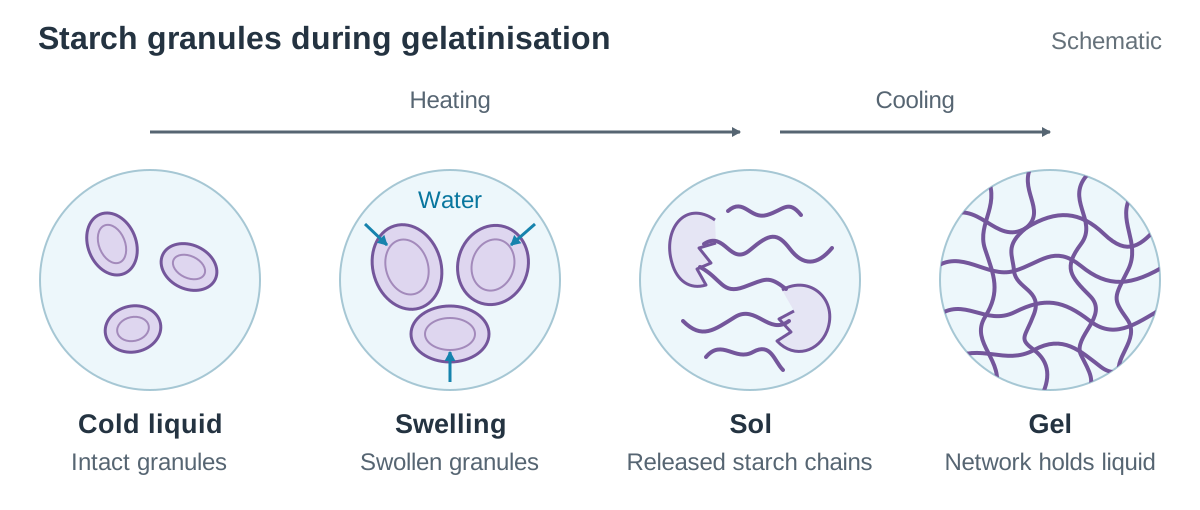
- Gelatinisation: Starch does not dissolve in cold water; it forms a temporary suspension. When heated in liquid to 60°C, starch granules begin to absorb liquid and swell. Between 80°C and 85°C, the swollen granules burst, releasing amylose and amylopectin to create a viscous sol. At 100°C, gelatinisation completes. On cooling below 40°C, the mixture solidifies into a stable gel (seen in roux sauces, custard, and lemon curd).
- Dextrinisation: Exposing starchy food to dry heat causes long starch polymers to split into shorter-chain polysaccharides called dextrins. Dextrins produce a toasted aroma, golden colour, and sweeter taste on toast and bread crusts. Because the starch chains are shortened, toasted flour has less thickening power than raw flour.
- Pectin extraction and gel formation: Pectin is a structural gelling carbohydrate found in plant cell walls. In under-ripe fruit, it exists as insoluble protopectin; as the fruit ripens, enzymes convert it into soluble pectin; in over-ripe fruit, it breaks down into pectic acid, which cannot form a gel. Simmering ripe fruit with water and acid extracts pectin. Combined with 60% to 65% sugar at pH 2.8 to 3.4 and boiled to 104°C–105°C, pectin sets into a firm gel.
Investigating Carbohydrate Properties in the Kitchen
Practical activities demonstrate how starch behaves under moist and dry heat:
Demonstration 1: Gelatinisation of Starch
- Method: Blend 20 g of cornflour with 50 ml of cold milk in a saucepan. Add 200 ml of milk and heat gently over low heat, stirring continuously with a wooden spoon. Record the temperature and texture changes at regular intervals.
- Result: At room temperature, the starch forms a milky suspension. At 60°C, the mixture thickens slightly as granules absorb liquid. Between 80°C and 85°C, the mixture thickens rapidly as granules burst. Boiling for 1 to 2 minutes fully cooks the starch sol. Upon pouring into a bowl and cooling below 40°C, it sets to a firm, smooth gel.
- Conclusion: Starch requires moist heat and agitation to gelatinise successfully. Constant stirring prevents granules from sinking to the bottom, clumping into lumps, or scorching.
Demonstration 2: Dextrinisation of Starch
- Method: Place two equal spoonfuls (25 g each) of plain white flour into separate dry pans. Leave the first pan unheated. Heat the second pan over medium dry heat, stirring continuously until the flour turns an even golden brown. Allow to cool. Compare the appearance, aroma, and taste of both flours. Then prepare a basic sauce with each flour using equal amounts of butter and milk.
- Result: The dry-heated flour turns golden brown, smells nutty, and tastes slightly sweeter. The sauce made from the toasted flour is darker in colour and noticeably thinner than the sauce made from the raw flour.
- Conclusion: Dry heat breaks down long starch chains into shorter dextrins. Dextrins brown and sweeten the food, but their shorter molecular length reduces their ability to absorb liquid and thicken sauces.
Effects of Moist and Dry Heat
Cooking transforms carbohydrates depending on whether moisture is present:
| Carbohydrate | Moist Heat (Boiling, Steaming, Stewing) | Dry Heat (Baking, Grilling, Toasting) |
|---|---|---|
| Sugar | Dissolves readily to form syrup. Boiling with acid causes inversion, yielding glucose and fructose. | Melts at ~160°C and caramelises between 160°C and 180°C to form brown pigments. Chars to carbon if overheated. |
| Starch | Granules absorb liquid and swell at 60°C, burst at 80°C–85°C, and fully gelatinise at 100°C, cooling into a firm gel. | Long starch chains break down into shorter dextrins (dextrinisation) at high surface temperatures, causing browning and crisping. |
| Cellulose (NSP) | Absorbs moisture and softens, tenderising plant walls and improving digestibility in cooked vegetables. | Loses moisture, dries out, crisps, and eventually scorches and chars. |
| Pectin (NSP) | Simmering fruit with acid extracts soluble pectin into cooking liquor, allowing gel formation with sugar. | Not relevant: with dry heat the fruit simply dries out and the pectin is destroyed, so no gel can form. |
Biological and Culinary Functions
Carbohydrates perform distinct roles in the human body and in recipe formulation:
Biological Functions
- Carbohydrates are the body's main source of heat and energy, providing 4 kcal (17 kJ) per gram. Blood glucose is oxidised during respiration to supply fuel for muscular activity and maintain core body temperature at 37°C:
- Carbohydrate has an essential protein-sparing action. When sufficient carbohydrate is consumed to satisfy energy needs, dietary protein is spared from being burned for fuel, leaving it free for cellular growth and tissue repair.
- Excess absorbed glucose is converted into glycogen by the hormone insulin and stored in the liver and skeletal muscles as a short- to medium-term energy store. Once these limited glycogen reserves are fully saturated, any remaining surplus glucose is converted into fatty acids and glycerol, built up into triglycerides (fat) and stored in adipose tissue under the skin and around internal organs as a long-term energy reserve and for insulation.
- Non-starch polysaccharides (dietary fibre) promote digestive health. Insoluble fibre absorbs water and adds bulk to waste, stimulating peristalsis to speed transit through the colon.
Culinary Functions
- Sweetening: adds flavour and sweetness to baked goods, desserts, and beverages.
- Preservation: high concentrations of sugar (60% or higher) preserve foods such as jams and candied fruits by exerting osmotic pressure, drawing water out of microbial cells so bacteria and moulds cannot grow.
- Thickening: starch granules absorb hot liquid and swell, thickening soups, sauces, and gravies through gelatinisation.
- Gel formation: extracted fruit pectin forms a stable structural network with sugar and acid to set jams and jellies.
- Aeration: beating caster sugar with fat traps air bubbles into an emulsion to give sponges and Madeira cakes a light, open crumb.
- Fermentation: sugar provides food for yeast cells in breadmaking, producing carbon dioxide gas to raise dough.
Digestion, Absorption, and Utilisation of Glucose
Carbohydrate digestion is a sequential process of hydrolysis carried out by digestive enzymes that cleave polysaccharides and disaccharides into absorbable monosaccharides:
| Organ | Secretion | Enzyme | Substrate | End Product |
|---|---|---|---|---|
| Mouth | Saliva | Salivary amylase (ptyalin) | Cooked starch | Maltose |
| Stomach | Gastric juice | None (acid halts amylase) | Cooked starch | Hydrochloric acid denatures salivary amylase; no carbohydrate enzymes present |
| Duodenum | Pancreatic juice | Pancreatic amylase | Remaining starch and dextrins | Maltose |
| Ileum | Intestinal juice | Maltase<br>Sucrase<br>Lactase | Maltose<br>Sucrose<br>Lactose | Glucose + Glucose<br>Glucose + Fructose<br>Glucose + Galactose |
Cellulose and other structural NSPs pass into the large intestine unhydrolysed because humans do not produce the enzyme cellulase.
[Mouth: Salivary Amylase] Cooked Starch -> Maltose
   |
[Stomach: Acid Chyme] (Amylase denatures; mechanical churning continues)
   |
[Duodenum: Pancreatic Amylase] Remaining Starch & Dextrins -> Maltose
   |
[Ileum Brush Border]
   +-- Maltase: Maltose -> Glucose + Glucose
   +-- Sucrase: Sucrose -> Glucose + Fructose
   +-- Lactase: Lactose -> Glucose + Galactose
Absorption and Transport
Monosaccharides pass across the villi of the small intestine into capillary blood vessels. They travel through the hepatic portal vein directly to the liver.
Utilisation of Glucose
- Interconversion: In the liver, fructose and galactose are converted into glucose.
- Respiration: Glucose travels in the blood to the body cells, where it is oxidised (combined with oxygen) during respiration to release energy, carbon dioxide, and water.
- Glycogenesis: Insulin causes the liver and muscles to join surplus glucose molecules together to form glycogen (short- to medium-term store).
- Lipogenesis: When glycogen stores are full, excess carbohydrate is converted into fatty acids and glycerol, built up into triglycerides (fat) and stored in adipose tissue under the skin and around the organs.
Key terms
- Monosaccharide
- A single sugar unit with the chemical formula C6H12O6 that cannot be hydrolysed into a simpler carbohydrate; examples are glucose, fructose, and galactose.
- Disaccharide
- A double sugar with the chemical formula C12H22O11 formed when two monosaccharides combine in a condensation reaction, eliminating one molecule of water.
- Polysaccharide
- A complex carbohydrate with the formula (C6H10O5)n composed of many monosaccharide units joined by glycosidic bonds.
- Condensation Reaction
- A chemical reaction in which two molecules combine to form a larger molecule with the elimination of a simple molecule such as water.
- Hydrolysis
- The chemical breakdown of a compound caused by reaction with water, catalysed in the body by digestive enzymes or acids.
- Glycosidic Bond
- The covalent bond that links two monosaccharide units together following a condensation reaction.
- Gelatinisation
- The process where starch granules absorb moist heat and swell at 60°C, burst between 80°C and 85°C to form a sol, and cool into a semi-solid gel.
- Caramelisation
- A form of non-enzymatic browning that occurs when dry sugar is heated between 160°C and 180°C, producing caramel pigments and aromas.
- Dextrinisation
- The breakdown of long starch chains into shorter polysaccharides called dextrins when exposed to dry radiant heat, resulting in browning and sweetening.
- Invert Sugar
- An equal mixture of glucose and fructose produced by the hydrolysis of sucrose using acid and heat or the enzyme invertase; sweeter and more resistant to crystallisation than sucrose.
- Non-Starch Polysaccharides (NSP)
- Structural plant cell wall materials, including cellulose and pectin, that resist digestion by human enzymes; commonly referred to as dietary fibre.
- Glycaemic Index (GI)
- A ranking of carbohydrate foods based on how quickly they raise blood glucose levels compared to pure glucose.
- Protein-Sparing Action
- The biological process where consuming sufficient carbohydrate allows protein to be used for growth and repair rather than being burned for energy.
- Glycogen
- A branched polysaccharide stored in the liver and skeletal muscle that acts as the body's short- to medium-term glucose reserve.
Check yourself
Write the balanced chemical equation for the formation of glucose during plant photosynthesis.
6CO2 + 6H2O -> C6H12O6 + 6O2 (in the presence of light and chlorophyll).
What is the chemical formula of a disaccharide, and what specific reaction joins its monosaccharide units?
C12H22O11. Disaccharides are formed by a condensation reaction that joins two monosaccharides and eliminates one molecule of water (H2O), creating a glycosidic bond.
Outline the physical changes that occur to starch granules during gelatinisation between 60°C and 100°C.
At 60°C, starch granules absorb water and swell. Between 80°C and 85°C, the swollen granules burst, releasing amylose and amylopectin to create a thick sol. At 100°C, gelatinisation completes, setting into a semi-solid gel upon cooling.
Explain what invert sugar is and why it is beneficial in jam-making.
Invert sugar is an equal mixture of glucose and fructose formed by hydrolysing sucrose with acid and heat. It is sweeter than sucrose and resists crystallisation, keeping jam smooth on storage.
Name three culinary functions of sugar and give one example dish for each.
Sweetening (shortbread biscuits), preservation by osmosis at 60%+ concentration (strawberry jam), and aeration when creamed with fat (sponge cake).
State the daily adult dietary target for fibre (NSP) in Ireland and identify two chronic conditions reduced by meeting it.
25 g to 30 g daily. Meeting this target helps prevent constipation and haemorrhoids and reduces the risk of diverticular disease and colorectal cancer.
Name the three brush border enzymes that complete carbohydrate digestion in the ileum, and identify their substrates and products.
Maltase hydrolyses maltose to glucose + glucose; sucrase hydrolyses sucrose to glucose + fructose; lactase hydrolyses lactose to glucose + galactose.