

Household appliances are fundamental to family resource management. They cut down physical labour, free up time, maintain food hygiene, and help manage energy costs. For Leaving Certificate Home Economics Higher Level, you need competence in two distinct areas: first, as an informed consumer who evaluates selection criteria, independent information sources, energy efficiency ratings, running costs, and statutory consumer protection rights; second, as a home scientist who can explain the underlying working principles, key components, safety mechanisms, and guidelines for use across four mandatory categories: motor-driven appliances, heating-element appliances, refrigeration appliances, and the microwave oven.
1. Technology and Household Resource Management
Household technology encompasses electrical appliances and automated systems that assist with domestic chores and improve the family living environment. Introducing technology into the home alters how a household manages its finite resources:
- Time and labour: Automated appliances complete repetitive, heavy chores rapidly. A modern washing machine replaces six to eight hours of arduous manual soaking, scrubbing, and wringing with roughly thirty minutes of active loading and folding.
- Physical energy and accessibility: Ergonomic design features, such as eye-level controls, lightweight materials, and simple push-button programmes, allow older people and individuals with physical disabilities to manage their homes independently.
- Financial resources: Highly rated appliances lower electricity and water bills over their lifespan, though households must budget for initial capital outlay and eventual servicing.
- Food safety and hygiene: Domestic refrigeration keeps perishable commodities chilled between 0 °C and 5 °C (outside the microbial danger zone of 5 °C to 63 °C), slowing down bacterial multiplication and food spoilage.
- Smart home technology: Appliances connected via Wi-Fi allow householders to schedule cycles remotely or run appliances during off-peak electricity hours, cutting running costs.
2. Appliance Selection Criteria: Cost, Design, and Ease of Cleaning
When answering exam questions on choosing large or small appliances, state the factor, explain it, and provide a concrete example.
- Initial cost versus running cost: The total cost includes the retail purchase price and the running costs over its lifetime. A cheap, poorly rated tumble dryer may cost €300 to buy but will run up steep electricity bills compared to an energy-efficient heat-pump model.
- Household needs and capacity: Drum size or storage capacity must match family requirements. A family of five needs a 9 kg to 10 kg washing machine drum to handle bulky school uniforms and sports gear efficiently, whereas a single person in an apartment needs only a 5 kg or 6 kg drum.
- Design and ergonomics: The appliance must fit comfortably into the kitchen layout and be safe to use. Controls should sit at a clear, accessible height with large, easy-to-read dials. A tall, narrow fridge-freezer suits a galley kitchen with limited floor area.
- Ease of cleaning: Smooth, wipeable surfaces, removable shelves, concealed heating elements, and self-cleaning or catalytic oven linings save domestic labour and maintain food hygiene standards.
- Safety features: Look for child locks, cool-touch outer walls, automatic shut-off mechanisms, and recognised safety approval marks such as the CE mark or the NSAI Irish Standard Mark.
- Guarantee and after-sales service: A comprehensive two-year manufacturer guarantee backed by accessible local service engineers and available replacement parts protects the buyer against premature breakdown.
Transferring Knowledge Between Appliances
The syllabus requires you to understand principles across four broad categories. You can transfer core principles across similar appliances:
- Motor-driven: Food processor, food mixer, blender, vacuum cleaner, washing machine.
- Heating-element: Electric kettle, toaster, iron, cooker hob/oven, immersion heater.
- Refrigeration: Larder fridge, upright freezer, chest freezer, fridge-freezer combination.
- Microwave: Solo microwave, grill microwave, combination microwave oven.
3. Consumer Information, Energy Labelling, and Running Costs
Discerning consumers consult multiple independent sources before buying major household technology:
| Information Source | How it helps the consumer | Drawback / bias to watch for |
|---|---|---|
| Independent consumer reports (e.g. Consumer Choice published by the Consumers' Association of Ireland) | Provides objective, laboratory-tested comparisons of reliability, performance, and running costs. | Tests only selected popular models; may not cover every brand in Irish shops. |
| EU Energy Label | Offers standardised, verified data on energy efficiency, water use, and noise levels. | Figures are measured under strict laboratory test conditions, which may vary from heavy family use. |
| Manufacturer websites and manuals | Gives exact product dimensions, electrical requirements, and specialised features. | Promotional in nature; highlights strengths and omits design flaws. |
| Retail sales staff | Demonstrates the controls, door openings, and interior fittings in the showroom. | Sales staff may receive commission or push specific brands to clear slow-moving floor stock. |
The EU Energy Label
Major appliances display the standardised EU Energy Label. The label uses an alphabetical scale from A (dark green, most efficient) to G (red, least efficient). It also includes a QR code linking directly to the European Product Registry for Energy Labelling (EPREL), acoustic noise levels in decibels alongside a noise class from A to D, and operational metrics such as annual kWh consumption, water volume per cycle, or storage volume in litres.
Important syllabus caution: The rescaled A to G label applies to refrigerators, freezers, washing machines, dishwashers, and televisions. However, appliances like tumble dryers and ovens may still display the older to D scale until their European regulations are fully phased over.
Contrasting Consumer Ratings
Do not confuse the different rating systems found on appliances:
- EU Energy Label (A to G): Measures energy efficiency and resource consumption.
- Freezer Star Rating (★ to ★★★★): Measures minimum storage temperature and preservation time.
- Noise Rating (A to D / decibels): Measures acoustic sound emissions during operation.
Calculating Running Costs
Electricity is billed per kilowatt-hour (kWh). You can calculate running costs using two standard formulas:
Worked Example: A 3 kW kettle runs for 4 minutes (0.067 hours). If electricity costs €0.35 per kWh:
Boiling this kettle five times a day costs roughly €127.75 every year, showing why boiling only the water you need saves money.
Now you try: A 2 kW immersion heater runs for 1.5 hours. If electricity costs €0.35 per kWh, how much does this cost? (Answer: ; ).
4. Domestic Electrical Safety and Usage Guidelines
Electricity is a clean, versatile domestic energy source, but faulty wiring or careless handling creates severe shock and fire risks. Safety relies on built-in protective devices and sensible habits.
Protective Safety Devices
- Miniature Circuit Breaker (MCB): Located in the main consumer unit (fuse board). An electromagnetic switch that automatically trips and cuts the electrical supply when it senses an overload or a short circuit. Once the fault is fixed, you can reset the switch by hand.
- Residual Current Device (RCD): A fast-acting safety switch that monitors the balance between incoming live and outgoing neutral currents. If it detects a minute current leakage to ground (as little as 30 mA, such as current passing through a person's body), it cuts the circuit within milliseconds, preventing fatal electrocution.
- Earth wire: A protective safety conductor covered in green-and-yellow striped insulation. It connects the exposed metal casing of an appliance to the earth pin of the plug. If a loose live wire touches the metal casing, the earth wire channels the large fault current safely down into the ground, causing the fuse to blow or the MCB to trip instantly instead of shocking the user.
- Three-pin plug wiring: The Live (L) wire is brown and connects to the right pin through the cartridge fuse. The Neutral (N) wire is blue and connects to the left pin. The Earth (E) wire is green/yellow striped and connects to the top pin.
Guidelines for the Safe Use of Electricity
- Buy only appliances bearing a recognised safety approval mark such as the CE mark or the NSAI mark.
- Have fixed household wiring, socket additions, and fuse board upgrades installed by a registered electrical contractor (Safe Electric Ireland).
- Check flexes and plugs regularly for fraying, cracking, or scorch marks; replace damaged flexes immediately and never run cords under carpets.
- Avoid overloading wall sockets with multi-way cube adaptors or coiled extension reels, as resistance generates extreme heat and causes electrical fires.
- Never operate switches, plugs, or electrical appliances with wet hands, and keep portable appliances well away from kitchen sinks.
- Always switch off at the socket and unplug appliances before cleaning, dismantling, or servicing them, pulling by the plug head rather than the flex.
- Use ceiling pull-cord switches in bathrooms; wall-mounted sockets (other than low-voltage safety shaver sockets) are strictly prohibited in wet areas.
- Never drape damp clothes over electric heaters or block the ventilation grilles of heat-producing appliances.
- Unplug small appliances when not in use, especially before going to bed or leaving the house on holiday.
- Always follow the manufacturer instruction manual for recommended loading and maintenance schedules.
5. Motor-Driven Appliances: Food Processor and Automatic Washing Machine
An electric motor converts electrical energy into mechanical kinetic energy. An electric current passes through a coil (armature) positioned within a magnetic field, forcing the coil and its central drive shaft to rotate.
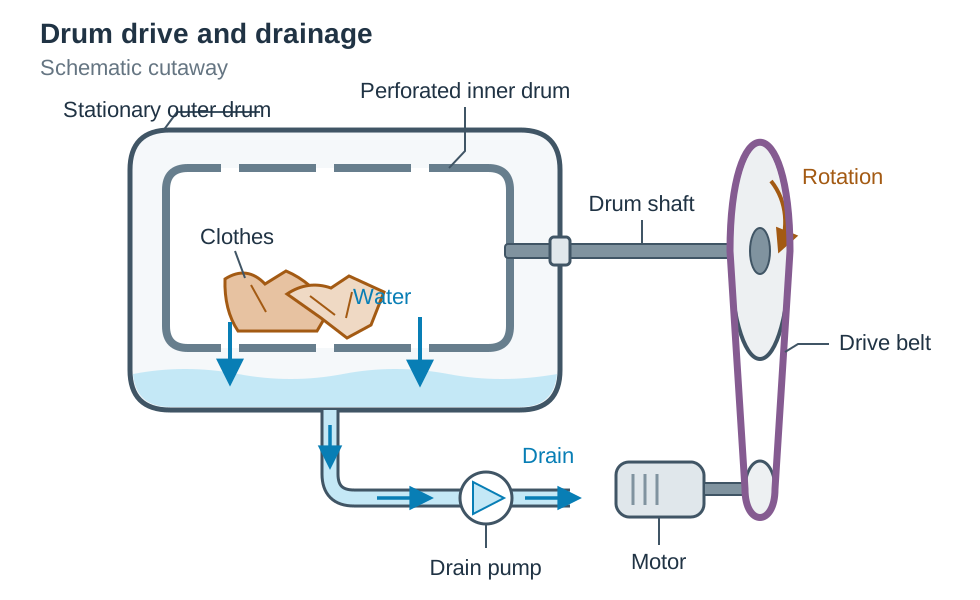
Food Processor
- Construction: Heavy motor base with rubber suction feet for counter stability, a vertical drive spindle, a shatterproof polycarbonate bowl and lid with a feed chute, and stainless steel blades or slicing discs.
- Safety mechanism: A safety interlock switch ensures the electrical circuit stays broken until both the processing bowl and its lid are correctly locked into position, preventing hands from contacting spinning blades.
- Working principle: Mains current enters the electric motor, spinning the central drive shaft at high speed. The shaft rotates the cutting blade or disc, applying mechanical shear forces that chop, slice, grate, or blend food. The pulse button allows short, controlled bursts of power, giving precise control over texture so ingredients are evenly cut rather than turned to purée.
- Guidelines for use:
- Always use the plastic food pusher to guide food down the feed chute; never insert fingers or cutlery, to avoid severe lacerations.
- Never exceed the marked liquid fill line, preventing liquids from seeping down the drive spindle into the motor casing.
Automatic Washing Machine
The washing machine combines an electric motor and a heating element, removing dirt through detergent action, heat, and mechanical action:
- Programme selection: The user selects a wash programme via the electronic controls, setting the wash temperature, drum action, and spin speed.
- Water intake: Solenoid valves open, allowing mains water to flow through the detergent dispenser drawer, flushing detergent into the outer drum.
- Heating: An electric heating element situated in the base of the outer drum warms the water to the chosen temperature, regulated by an internal thermostat.
- Mechanical washing action: An electric motor rotates the inner perforated drum back and forth via a drive belt. Internal paddles (baffles) lift garments and drop them through the soapy water, providing the mechanical friction needed to dislodge soil.
- Pumping and rinsing: The drain pump removes dirty wash water through a filter. Fresh cold water enters repeatedly to rinse out detergent residues.
- Centrifugal spin: The drum spins at high speeds (up to 1,400 rpm). Centrifugal force throws water outward through the perforations into the outer casing, where it is pumped away.
- Safety controls: An electro-mechanical door interlock prevents the door from opening while the drum rotates or contains hot water. An out-of-balance sensor slows down the spin cycle if laundry clumps unevenly.
6. Heating-Element Appliances: Electric Kettle and the Thermostat Principle
Heating appliances convert electrical energy into thermal heat energy through electrical resistance.
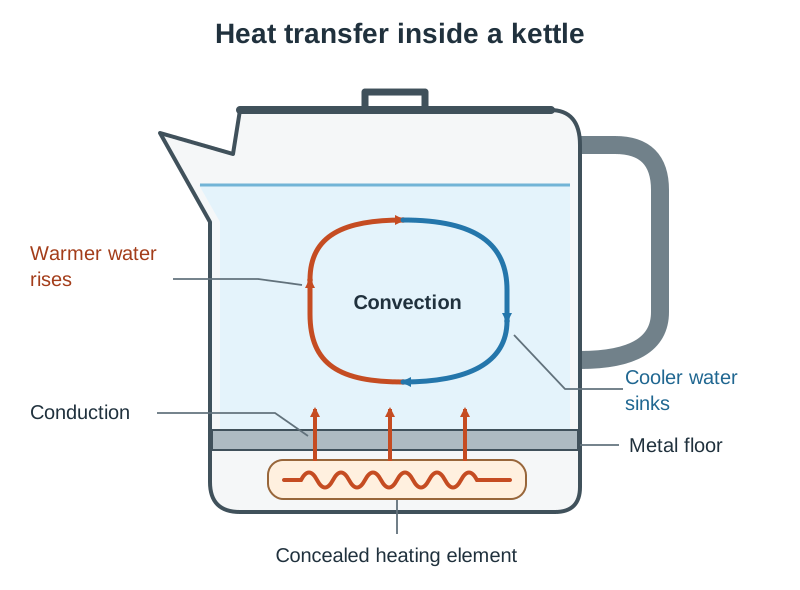
Electric Kettle
- Construction: Body made from stainless steel, heat-resistant glass, or BPA-free plastic; heat-resistant handle; water-level window; concealed base heating element; fine mesh spout filter to catch scale particles; automatic thermostatic switch; and a secondary thermal boil-dry cut-out.
- Working principle:
- Electrical resistance: Mains current passes through a coiled nickel-chromium (nichrome) wire sealed inside the base plate. The metal's high resistance opposes the electron flow, transforming electrical energy directly into heat energy.
- Heat transfer: Heat conducts directly through the metal floor into the water touching it. This heated water expands, becomes less dense, and rises. Denser, cooler water sinks to replace it, establishing continuous convection currents that heat the entire body of water to 100 °C.
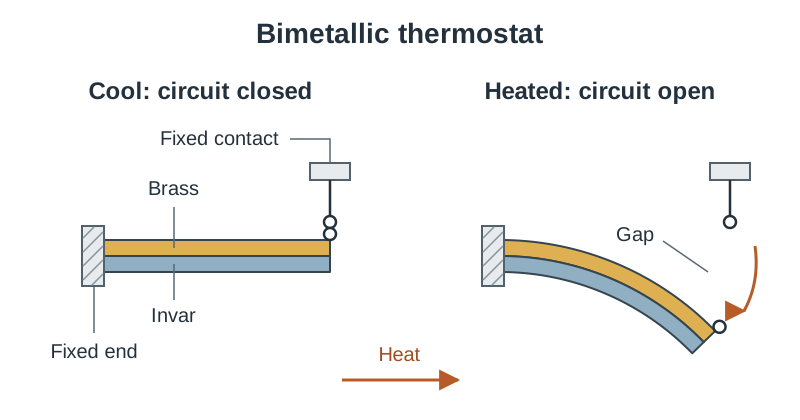
- Automatic cut-off: Boiling generates steam that travels down an internal conduit pipe directly onto a bimetallic strip thermostat. Unequal expansion bends the strip, which mechanically opens the contact points and cuts the power.
- Boil-dry protection: If turned on empty, the element heats up rapidly. A secondary thermal cut-out switch senses this excessive dry heat and cuts the electrical supply, preventing element burnout.
- Guidelines for use:
- Boil only the volume of water needed for immediate use, reducing waiting time and saving electricity.
- Descale the interior regularly in hard-water areas using a dilute citric acid or vinegar solution; limescale () forms an insulating blanket over the element, slowing heat transfer and wasting energy.
The Thermostat Principle and Domestic Uses
A thermostat is an automatic temperature-regulating device that switches an appliance on and off to maintain a preset temperature.
- Underlying principle (bimetallic strip): Two dissimilar metals with different rates of thermal expansion (such as brass and invar) are welded together. When heated, the brass expands more rapidly than the invar, forcing the composite strip to bend. This physical bending opens the electrical contacts, breaking the circuit and cutting power to the heating element (or compressor). When the appliance cools down, the strip straightens, the contacts touch again, and the circuit remakes. A control knob alters the distance between the contacts, setting the target temperature.
- Uses in the home:
- Electric ovens, grills, and hobs (regulates cooking temperature).
- Electric kettles and steam irons (shuts off power when target heat is reached).
- Domestic refrigerators and freezers (switches the compressor on and off).
- Domestic immersion heaters, central heating boilers, and thermostatic radiator valves.
7. Refrigeration Appliances: The Domestic Fridge-Freezer
A domestic refrigerator preserves food by maintaining its cabinet temperature between 0 °C and 5 °C (ideally 4 °C or below). Freezers run at −18 °C or colder. These cold temperatures slow down microbial multiplication, halt toxin production, and reduce enzymatic decay.
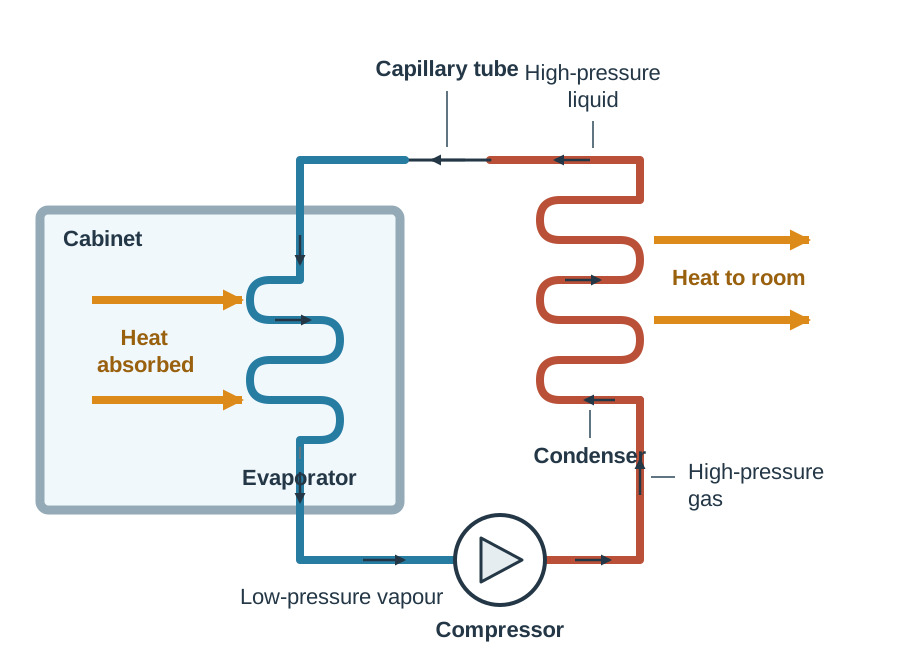
Construction and Key Components
- Insulated cabinet: Formed by an outer steel shell, a moulded plastic inner lining, and a thick core of rigid polyurethane foam to minimise heat entering from the room.
- Magnetic door gasket: A flexible synthetic seal fitted with a magnetic strip to keep the door airtight.
- Refrigerant: A non-toxic chemical compound with an extremely low boiling point (such as isobutane, R600a) circulating through sealed pipework.
- Compressor: A motor-driven pump at the rear base that pressurises the refrigerant vapour.
- Condenser coils: A network of metal pipes on the exterior rear fitted with cooling fins.
- Expansion valve (capillary tube): A narrow pipe constriction that drops refrigerant pressure suddenly.
- Evaporator coils: Tubing built into the inside walls of the food compartment.
- Thermostat: Regulates internal temperature by switching the compressor motor on and off.
Vapour-Compression Cycle
The system operates on a fundamental scientific law: when a liquid evaporates into a gas, it absorbs latent heat from its surroundings.
- Compression: The compressor pumps low-pressure refrigerant gas into high pressure and high temperature, forcing it into the condenser.
- Condensation: As hot, high-pressure gas moves through the external condenser coils, heat radiates out into the kitchen. The gas cools and condenses into a high-pressure liquid.
- Expansion: The liquid passes through the narrow capillary tube into wider piping. This abrupt pressure drop lowers the refrigerant's boiling point.
- Evaporation: The cold, low-pressure liquid enters the evaporator coils inside the cabinet. It absorbs latent heat from the food and surrounding air, boiling back into a low-pressure gas and chilling the cabinet.
- Return: The low-pressure vapour returns to the compressor to begin the cycle again.
Freezer Star Ratings
- ★ (−6 °C): Stores pre-frozen food up to 1 week; cannot freeze fresh food.
- ★★ (−12 °C): Stores pre-frozen food up to 1 month; cannot freeze fresh food.
- ★★★ (−18 °C): Stores pre-frozen food up to 3 months; cannot freeze fresh food.
- ★★★★ (−18 °C or colder): Stores frozen food 3 to 12 months; can safely freeze fresh food.
8. The Microwave Oven: Principle, Advantages, and Disadvantages
A microwave oven uses high-frequency electromagnetic radiation to heat food rapidly from within, making it exceptionally energy-efficient for defrosting, reheating, and small-portion cooking.
Construction and Working Principle
- Transformer: Increases household mains voltage (230 V) to approximately 2,000 V to 4,000 V to power the magnetron.
- Magnetron: A specialised vacuum tube that converts high-voltage electrical energy into high-frequency electromagnetic waves at 2,450 MHz (2.45 GHz).
- Waveguide and stirrer fan / turntable: The metal waveguide directs waves into the cavity, while a revolving wave stirrer or glass turntable distributes them evenly to reduce cold spots.
- Door safety interlocks: Dual electro-mechanical switches instantly kill power to the magnetron if the door opens, preventing microwave leakage.
- Interaction with materials: Metals reflect microwaves (causing arcing and fire risks); glass, ceramics, and microwave-safe plastics transmit them; water, fats, and sugars absorb them.
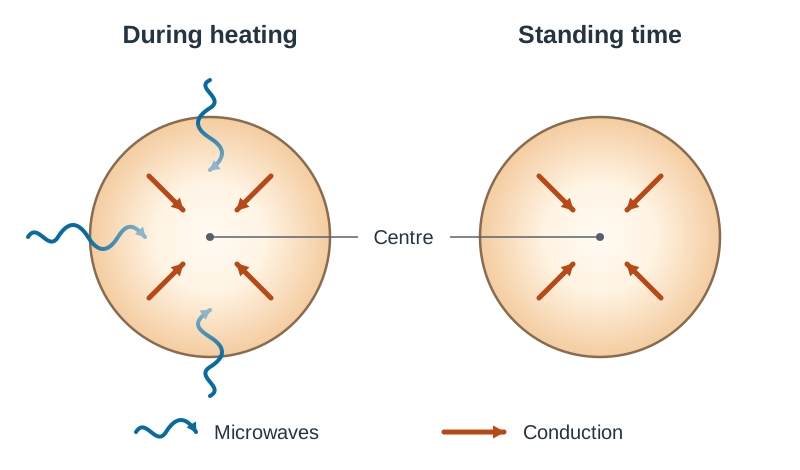
- Heating mechanism: Microwaves penetrate roughly 2 cm to 4 cm into food. Water molecules are electrical dipoles (possessing positive and negative poles). The alternating electric field forces these polar molecules to rotate back and forth 2,450 million times per second (dipole rotation). The resulting molecular friction generates heat, which conducts inwards to the centre of the food.
- Standing time: Heat continues conducting inward after the magnetron switches off. Standing time allows temperatures to balance throughout the food, eliminating cold spots and killing harmful bacteria.
Advantages and Disadvantages
- Advantages:
- Speed: Reheats and cooks small portions in a fraction of the time needed by a conventional oven.
- Energy efficiency: No preheating required; energy heats only the food rather than the whole oven or kitchen.
- Nutrient retention: Short cooking times and minimal cooking water preserve water-soluble vitamins (B group and vitamin C).
- Convenience and safety: Food can be defrosted, cooked, and served in the same dish; cool cavity walls lower burn risks.
- Disadvantages:
- No browning or crisping: Without dry radiant heat, baked goods, pastry, and meats do not crisp or brown unless using a combination grill model.
- Uneven heating: Microwaves penetrate only 2 cm to 4 cm; dense foods may retain cold spots, posing food-poisoning risks if not stirred.
- Capacity limits: Unsuitable for batch baking, whole poultry, or large family roasts.
- Container restrictions: Cannot use metal containers, metal foil, or gold-rimmed crockery.
9. Consumer Protection, Redress Procedures, and Environmental Care
Purchasing and operating domestic technology involves legal rights and environmental duties.
Statutory Consumer Protection Legislation
- Sale of Goods and Supply of Services Act 1980 / Consumer Rights Act 2022: Goods sold by a trader must be of merchantable quality (durable, free from defects), fit for the purpose intended, and as described. If an appliance is faulty upon purchase, the consumer is legally entitled to redress (a repair, replacement, or refund) directly from the retailer who sold it, not the manufacturer.
- Consumer Information Act 1978 / Consumer Protection Act 2007: Makes it an offence for a trader or advertiser to make false or misleading claims regarding the description, performance, or price of goods. An appliance advertised as 'stainless steel' must not be plastic with a metallic finish, and 'was €600, now €400' is lawful only if the appliance was on sale at €600 for a reasonable continuous period beforehand. Enforced by the Competition and Consumer Protection Commission (CCPC).
- Status of guarantees: A manufacturer guarantee is an extra, voluntary benefit. It operates in addition to, and does not replace, your statutory legal rights. You can still seek redress from the retailer after a guarantee expires if the item was not of merchantable quality.
Steps to Take When an Appliance Develops a Fault
- Stop using the appliance immediately so the fault is not worsened, which could compromise your claim.
- Locate your proof of purchase (till receipt, credit card statement, or digital invoice).
- Return to the retailer who sold the item; state the fault clearly and request your statutory remedy (repair, replacement, or refund).
- Keep a written record of all dates, names of staff spoken to, and agreed actions; confirm telephone calls by email.
- If the retailer refuses redress, write a formal complaint letter to head office, seek advice from the CCPC helpline, or contact the Advertising Standards Authority for Ireland (ASAI) if the product was falsely advertised.
- Small Claims Procedure: If the dispute remains unresolved, lodge an application online or at the local District Court office for a non-refundable fee of €25 (claims up to €2,000). The Small Claims Registrar attempts an informal settlement; if contested, a District Court judge hears the case without requiring a solicitor.
Environmental Responsibility: Choosing and Using Appliances
- When buying:
- Choose the highest energy class possible (A on the rescaled label) to lower domestic carbon emissions.
- Buy the correct capacity for your household to avoid wasting power on empty space.
- Select models built for repairability with readily available spare parts to combat electronic waste.
- Use the WEEE (Waste Electrical and Electronic Equipment) scheme: retailers must take back old appliances free of charge on a one-for-one, like-for-like basis, funded by the visible Environmental Management Cost (EMC).
- When using:
- Run washing machines and dishwashers with full loads, using eco modes and 30 °C cycles where practical.
- Defrost freezers when ice buildup reaches 5 mm; heavy frost acts as an insulator, making the compressor work harder.
- Clean condenser coils annually to ensure heat dissipates efficiently into the surrounding air.
Key terms
- CE Mark
- A mandatory European conformity mark indicating that an electrical product meets EU health, safety, and environmental protection standards.
- EU Energy Label
- A standardised European grading system rating appliances from A (most efficient) to G (least efficient), stating annual kWh consumption and operational performance metrics.
- WEEE Directive
- Waste Electrical and Electronic Equipment Directive; legislation obliging retailers to take back obsolete electrical appliances for recycling free of charge upon purchase of a replacement.
- Safety Interlock
- An electromechanical switch that breaks an appliance's electrical circuit, cutting power to moving blades or microwave radiation sources whenever a lid or door is open.
- Bimetallic Strip
- A temperature-sensing strip composed of two metals (e.g. brass and invar) welded together that expand at different rates when heated, bending to break an electrical circuit.
- Boil-Dry Protector
- A safety thermal cut-out in an electric kettle that automatically disconnects power if the heating element is switched on without water, preventing element burnout.
- Refrigerant
- A circulating chemical fluid with an exceptionally low boiling point (such as isobutane R600a) that absorbs and transfers heat out of an insulated cabinet.
- Evaporator
- Coiled tubing inside a refrigerator cabinet where cold liquid refrigerant absorbs latent heat from the food compartment and vaporises into gas.
- Condenser
- Exterior metal tubing fitted with fins at the rear or base of a refrigerator where hot compressed gas radiates heat into the room and condenses into a liquid.
- Magnetron
- A high-voltage thermionic vacuum tube in a microwave oven that converts electrical energy into electromagnetic waves at a frequency of 2,450 MHz.
- Dipole Rotation
- The rapid oscillating movement of polar water molecules in food aligning with the alternating electric field of microwaves, generating heat through molecular friction.
- Standing Time
- The resting period required after microwave cooking during which heat conducts inwards to finish cooking the centre and destroy pathogens.
- Miniature Circuit Breaker (MCB)
- An automatic electromagnetic safety switch in the domestic consumer unit that trips to break the circuit when it senses an electrical overload or short circuit.
- Residual Current Device (RCD)
- A sensitive circuit breaker that disconnects mains electricity within milliseconds when it detects current leaking to earth, preventing fatal electric shocks.
- Earth Wire
- A safety conductor covered in green-and-yellow striped insulation that channels fault currents from a metal appliance casing into the ground, tripping the MCB or fuse.
- Small Claims Procedure
- An informal, low-cost legal mechanism operated through the District Court allowing consumers to resolve disputes over faulty goods or services up to €2,000 for a fee of €25.
Check yourself
What energy transformation occurs in an electric motor?
Electrical energy is converted into mechanical kinetic energy as an electric current causes an armature to rotate inside a magnetic field.
Why is nichrome wire used in the heating elements of electric kettles?
Nichrome has high electrical resistance, opposing electron flow and transforming electrical energy efficiently into thermal heat energy without melting.
Explain how a bimetallic strip thermostat breaks an electrical circuit when water boils.
It is made of two metals (such as brass and invar) bonded together. Heat from steam causes the brass to expand faster than the invar, bending the strip to open contacts and cut the circuit.
What state change takes place in the evaporator coils of a refrigerator, and what thermal effect does it produce?
The low-pressure liquid refrigerant evaporates into a gas, absorbing latent heat from the cabinet interior and chilling the food compartment.
What temperature must a domestic freezer maintain to earn a four-star (★★★★) rating?
It must maintain −18 °C or colder, allowing it to freeze fresh produce safely and store frozen food for 3 to 12 months.
Why is standing time essential after cooking food in a microwave oven?
Microwaves only penetrate 2 cm to 4 cm; standing time allows heat to conduct inwards to the centre, eliminating cold spots and killing harmful bacteria.
Differentiate between the functions of an MCB and an RCD on a domestic fuse board.
An MCB trips when an overload or short circuit creates excessive current, whereas an RCD detects minute current leakages to earth (e.g. through a person) to prevent electrocution.
What are the three statutory conditions goods must satisfy under the Sale of Goods Act / Consumer Rights Act?
Goods must be of merchantable quality, fit for the purpose intended, and as described.